Visualizzazione post con etichetta Americas. Mostra tutti i post

lunedì 6 luglio 2015

L'immutabile percorso della mente del ciarlatano

A qualunque latitudine ed in qualsiasi lingua, la mente del ciarlatano segue sempre il medesimo percorso: costruisce secondo i medesimi canoni le proprie meravigliose farneticazioni. In questo caso, che mi pregio di presentare oggi, siamo fortunatamente ben lontani dalla Sardegna e dagli Shardana: ci troviamo, infatti, in Arizona, USA.
Ma i numerosi punti di contatto sono almeno tanto curiosamente numerosi da non potere NON essere portati all'attenzione.

- Si tratta di "petroglifi".
- Come è noto, i petroglifi non sono databili
- Sono presenti in una zona remota, ove non si reca mai nessuno, essendo tra l'altro proprietà privata.
- Essendo una zona mai frequentata, nessuno può dire: "il mese scorso non c'erano!".
- Sono "nascosti in piena vista" (un'espressione molto cara ai fantarcheologi, che riescono sempre a vedere ciò che persino gli studiosi del campo non hanno mai trovato).
- La scoperta è di quelle che permetteranno di "riscrivere la Storia".
- Tutte le elucubrazioni e ricerche sono partite da un appassionato che è (John A. Ruskamp, vedi il fondo dell'articolo riportato) un "educatore in pensione, uno statistico, un analista chimico" e che si è interessato della cosa solo per hobby.
- Ha recentemente pubblicato un articolo, sì è trovato sostenitori di nicchia David Keightley, massimo epigrafista di ossa oracolari cinesi) e si sta promuovendo in tutti i modi.
- Ha già trovato, in giro per gli States, circa 82 petroglifi (New Mexico, Arizona, Utah, Nevada, California, Oklahoma, e persino Ontario). 

Unica differenza: trattandosi degli USA, in cui la democrazia e la verità sono un'ossessione popolare diffusa, l'articolo di Ruskamp sarà sottoposto a "Peer Review": pertanto, sarà espressa una precisa sentenza scientifica su di lui e sul suo operato.


Researcher claims 


ancient Chinese explorers 


landed in America 

Americas, ArchaeoHeritage, Archaeology, Breakingnews, China, North America, USA 

John A. Ruskamp Jr., Ed.D., reports that he has identified an outstanding, history-changing treasure hidden in plain sight. 
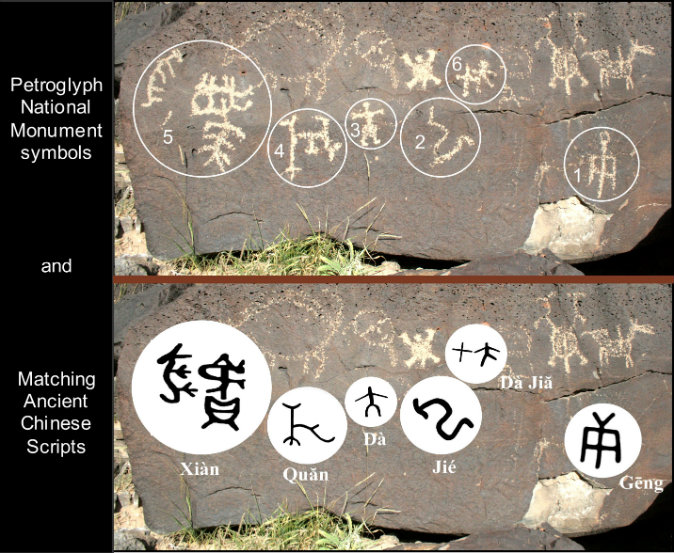
High above a walking path in Albuquerque’s Petroglyph National Monument, Ruskamp spotted petroglyphs that struck him as unusual. After consulting with experts on Native American rock writing and ancient Chinese scripts to corroborate his analysis, he has concluded that the readable message preserved by these petroglyphs was likely inscribed by a group of Chinese explorers thousands of years ago. 


Petroglyphs found in Arizona that are said to show an ancient Chinese script 
 [Credit: John Ruskamp] 

On the fringe of archaeology have long been claims that the Chinese reached North America 
long before Europeans. 
With some renowned experts taking interest in Ruskamp’s discovery, those claims may be working their way from the fringe to the core. 
It doesn’t mean our history textbooks will change tomorrow. 
Anything short of discovering an undisturbed early Asiatic relic or village in the Americas may fail to convince those archaeologists who have dogmatically rejected evidence of an ancient Chinese presence in the New World, said Ruskamp. 


Cartouche 1, which reads "Set apart (for) 10 years together"
 [Credit: John Ruskamp] 


But, the disparate and widespread symbols he has found show many indications of authenticity. 
They have the potential to inspire a more serious investigation into early trans-Pacific interaction. 
To date, Ruskamp has identified over 82 petroglyphs matching unique ancient Chinese scripts not only at multiple sites in Albuquerque, New Mexico, but also nearby in Arizona, as well as in Utah, Nevada, California, Oklahoma, and Ontario. 
Collectively, he believes that most of these artifacts were created by an early Chinese exploratory expedition, although some appear to be reproductions made by Native people for their own purposes. 
One of Ruskamp’s staunchest supporters has been David N. Keightley, Ph.D., a MacArthur Foundation Genius Award recipient who is considered by many to be the leading analyst in America of early Chinese oracle-bone writings. 
Keightley has helped Ruskamp decipher the scripts he has identified. 
One ancient message, preserved by three Arizona cartouche petroglyphs, translates as: “Set apart (for) 10 years together; declaring (to) return, (the) journey completed, (to the) house of the Sun; (the) journey completed together.” 
At the end of this text is an unidentified character that may be the author’s signature.


 Cartouche 2, which reads, “Declaring (to) return, (the) journey completed,  (to the) house of the Sun” 
[Credit: John Ruskamp] 


The oracle-bone style of writing employed for creating a number of these ancient petroglyph scripts disappeared by royal decree from mankind’s memory around 1046 B.C., following the fall of the Shang Dynasty. It remained an unknown and totally forgotten form of writing until it was rediscovered in A.D. 1899 at Anyang, China. 
Ruskamp thus concluded that the mixed styles of Chinese scripts found in these Arizona petroglyphs indicates that they were made during a transitional period of writing in China, not long after 1046 B.C. 
Ruskamp gives the following translation for the Albuquerque petroglyphs: “Geng (a date; the seventh Chinese Heavenly Stem); Jie (to kneel down in reverence); Da (great—referring to a superior); Quan (dog—the sacrificial animal); Xian (offering worship to  deceased ancestors); and Da Jia (the name of the third king of the Shang dynasty).” 


Cartouche 3, which reads, "(The) journey completed together" 
[Credit: John Ruskamp] 


The Albuquerque petroglyphs use both Seal era and Bronze era Chinese scripts, suggesting they were also written during a transitional period in Chinese calligraphy, likely between 1046 B.C. and 475 B.C. The use of the title “Da” before the name “Jia,” suggests a date close to the end of the Shang Dynasty in 1046 B.C., as this appellation emerged during that time period and was replaced shortly thereafter. 
Michael F. Medrano, Ph.D., chief of the Division of Resource Management for Petroglyph National Monument, studied the petroglyphs at that location upon Ruskamp’s request. He said that, based on his more than 25 years of experience with local Native cultures, “These images do not readily appear to be associated with local tribal entities,” and “based on repatination appear to have antiquity to them.” 


Arizona cartouche petroglyphs  
[Credit: John Ruskamp] 


It is difficult to physically date petroglyphs with absolute certainty, notes Ruskamp. Yet the syntax and mix of Chinese scripts found at these two locations correspond to what experts would expect explorers from China to use some 2,500 years ago. For example, the Arizona ranch petroglyphs are divided into three sections each enclosed in a square known as a cartouche. Two of the cartouches are numbered; one with the Chinese script for “one” placed beneath it and in a similar manner the second cartouche has the ancient Chinese script meaning “second” inscribed beneath it. Together these numeric figures indicate the order in which these images should be read. Importantly, the cartouches are thus shown to be read in the traditional Chinese manner, from right to left. 


Evolution of Chinese symbols
  [Credit: John Ruskamp] 


The first two cartouches are rotated 90 degrees to the left of vertical and the third is rotated 90 degrees to the right. “The deliberate rotation of these writings, both to the left and right of vertical by an equal number of degrees, endorses their authenticity, for the rotation of individual scripts by Chinese calligraphers is well-documented,” wrote Ruskamp. 
Some of the symbols found in the petroglyphs are common to both Chinese script and ancient Native American writing. 
For instance, “The Chinese petroglyph figure of Jiu conveys the idea of “togetherness,” in much the same manner as the Nakwach symbol is now, and has been in the past, understood by the Hopi,” wrote Ruskamp. 
   Another similarity is the use of a rectilinear spiral to convey the concept of a “round-trip journey.” Though these similarities could be conceived as supporting a Native American origin for Ruskamp’s petroglyphs, Ruskamp stated: “The extensive Chinese vocabulary evidenced at each location advocates against the authorship of the figures evaluated in this study being credited to Native Americans. None of the more complex Chinese figures identified in this report are known to have any Native tribal affiliation.” 


The Arizona glyph site on what has always been, and still is, very private ranch property  located miles from any public access or road [Credit: John Ruskamp] 


The conclusion of his paper titled 'Ancient Chinese Rock Writings Confirm Early Trans-Pacific Interaction,' reads: “In contrast to any previous historical uncertainty, the comparative evidence presented in this report, which is supported by both analytical evaluation and expert opinion, documenting the presence of readable sequences of old Chinese scripts located upon the rocks of North America, establishes that prior to the extinction of oracle-bone script from human memory, approximately 2,500 years ago, trans-Pacific exchanges of epigraphic intellectual property took place between Chinese and North American populations.” 

He published the paper on his website, Asiaticechoes.org, in April and it is currently under peer review.
 Last October, he began presenting his findings in speaking engagements, including most recently to the Association of American Geographers in Chicago. 
He will next present at a meeting of the Little Colorado River Chapter of the Arizona Archaeology Society in Springerville, Arizona, on May 18. 
The editors of the journal Pre-Columbiana have confirmed they will soon publish Ruskamp’s article.
The journal is edited by Professor Emeritus Stephen C. Jett, Ph.D., University of California–Davis, with the assistance of an editorial board of distinguished professional 
scholars, and is dedicated to exploring Pre-Columbian transoceanic contact. 

A retired educator, statistician, and analytical chemist, Ruskamp pursued his study of petroglyphs as a hobby—little expecting to find what may lead to a great shift in how we view both American and Chinese history. 


Author: Tara MacIsaac | Source: Epoch Times [June 30, 2015]

sabato 31 gennaio 2015

Uso del Propulsore.

Conoscerlo è un conto (il propulsore era noto dal 18.000 a.C.) usarlo è un altro (mi sono sempre chiesto se i Protosardi ne avessero bisogno: non credo). 
Dimostrare che fosse usato  da una popolazione richiede ricerca. Per i Paleo indiani nord americani, eccola:


First Americans used spear-throwers to hunt large animals 


Despite a lack of archaeological evidence, the first North Americans have often been depicted hunting with spear-throwers, which are tools that can launch deadly spear points at high speeds. 
But now, a new analysis of microscopic fractures on Paleo-Indian spear points provides the first empirical evidence that America's first hunters really did use these weapons to tackle mammoths and other big game.


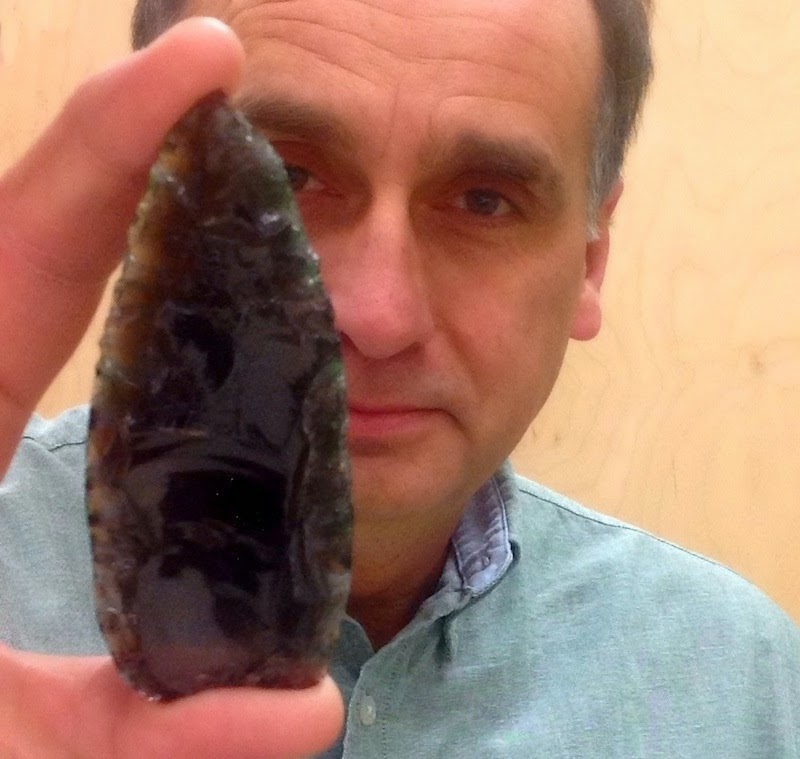
A nearly complete Clovis projectile point of dendritic chert, a mid-interval biface  of translucent quartz, displaying relatively heavy red ochre residue and an  "end-beveled" osseous rod, also exhibiting red ochre residue  [Credit: Sarah L. Anzick] 

The new study has implications for scientists' understanding of the way Paleo-Indians lived, researchers say. 
To understand the inner workings of extinct hunter-gatherer societies, it's important to first learn how the ancient peoples got the food they ate, because their lives were closely tied to their subsistence activities. 
Current models of Paleo-Indian society are based on the assumption that hunters sometimes used spear-throwers, or atlatls, said study author Karl Hutchings, an archaeologist at Thompson Rivers University in Canada. "We can now be assured that those assumptions were right," Hutchings told Live Science. Ancient hunting tools Similar to bows, atlatls can propel flexible, pointed shafts — called darts, rather than arrows — at high speeds across long distances. 
Essentially, they were sticklike tools that contained a hook or spur at one end to hold a dart. By swinging the spear-thrower overhead and forward, hunters could launch their darts with greater force than if they were to throw them like javelins. 
Archaeological evidence indicates that hunter-gathers in the Old World used atlatls beginning at least 18,000 years ago. 
Researchers have long thought that Paleo-Indians — including the people of the Clovis culture, who lived around 13,000 years ago and are considered one of the first American peoples — also hunted with spear-throwers. 
Researchers reasoned that "if the spear-thrower originated in the Old World, then it only made sense that it must have shown up with early [North American] colonists," Hutchings said. Additionally, Paleo-Indians were thought to have hunted big animals, such as mammoths and ground sloths, which would have required powerful, long-distance weapons to take the animals down safely. "People started wondering just how crazy you would have to be to run up to these things with just a sharp, broken rock tied to a stick." 


Karl Hutchings, an archaeologist at Thompson Rivers University in Canada,  holds a Clovis spear point [Credit: Karl Hutchings] 


But archaeological evidence of Paleo-Indian atlatls and darts is lacking because these tools were often made of wood, which doesn't preserve well — the only part of the weapons left in the archaeological record are the stone points, which could have also been used in other types of weapons, such as spears, Hutchings said. In comparison, ancient spear-throwers from Europe were often made of ivory or bone. 
The earliest known evidence of Paleo-Indian spear-throwers comes from 11,000-year-old "bannerstones," which are stone objects that may have functioned as atlatl weights, though the true function of bannerstones is debated, Hutchings said.
 The earliest solid evidence of atlatls in the New World, then, are 9,000- to 10,000-year-old spear-thrower hooks from Warm Mineral Springs, a sinkhole in Florida. However, these tools date back to the Early Archaic subperiod, which came after the Paleo-Indian period. 
Telltale fractures To see if the earliest North Americans — including people from the Clovis culture, Folsom culture (10,000 to 11,000 years ago) and other Paleo-Indians — used atlatls, Hutchings analyzed the fractures present in hundreds of spear points. He looked for clues that the weapon tips experienced high-velocity, mechanically propelled impacts. 
If a spear point hits a target hard enough, the energy of the impact will cause the tip to break. "When it breaks, it sends a shock wave through the stone that produces fractures, which are related to the amount and kind of force involved," Hutchings said. 
By measuring topographic features on the fracture surface, you can calculate the "fracture velocity" of the impact, or how quickly the fractures spread through the material, Hutchings explained. Because different weapons — spears, javelins, atlatls or bows — produce specific fracture velocities and related forces, you can work backward from a fracture to determine what caused it. Using this method, which he developed in the late 1990s, Hutchings determined the fracture velocities for 55 out of 668 Paleo-Indian artifacts that he examined. 
Of these points, about half of them exhibited fracture velocities that can only be achieved using an atlatl and dart or a bow and arrow.
 Because Paleo-Indians aren't thought to have had bows and arrows or other propulsive weapons, the findings suggest that they most likely used atlatls to launch their spear points, Hutchings said. Importantly, the method may also help scientists better understand ancient projectile technologies, by allowing them to trace the origin of the technologies and how they were used across societies and continents. 
"We can get a better resolution of when these technologies occurred, how they spread and why they spread," Hutchings said. Hutchings detailed his findings in the March issue of the Journal of Archaeological Science. 

Author: Joseph Castro | Source: LiveScience [January 28, 2015]

Read more at: http://archaeologynewsnetwork.blogspot.it/2015/01/first-americans-used-spear-throwers-to.html?utm_source=feedburner&utm_medium=feed&utm_campaign=Feed:+TheArchaeologyNewsNetwork+(The+Archaeology+News+Network)
Follow us: @ArchaeoNewsNet on Twitter | groups/thearchaeologynewsnetwork/ on Facebook

domenica 2 marzo 2014

Beringia

Il 'ponte' della Beringia, che un tempo univa l'attuale Siberia all'Alaska non era solo ghiaccio: era anche terra solida, bassa e cespugliosa, sulla quale si soffermarono - per un lungo periodo, forse anche 10.000 anni - alcune popolazioni. Non esistono prove archeologiche perché la Beringia si trova ora tutta sotto il livello del mare. Ma anche in assenza di queste, gli scienziati si basano su prove genetico-ambientali per le loro affermazioni (carotaggi marini ed in Alaska, con ritrovamenti di pollini, resti di insetti e piante). Tra i discendenti di queste popolazioni sarebbero gli attuali Inuit.
Insomma: sbiadisce l'immagine della Beringia-tundra erbosa e inizia ad affermarsi l'immagine di una Beringia verde, con cespugli e persino alberi e presenza di numerosi 'refugia' per gli esseri viventi.

10,000 years on the Bering Land Bridge 


Genetic and environmental evidence indicates that after the ancestors of Native Americans left Asia, they spent 10,000 years in shrubby lowlands on a broad land bridge that once linked Siberia and Alaska. Archaeological evidence is lacking because it drowned beneath the Bering Sea when sea levels rose. 


Canadian Inuit dogs pull a sled using traditional harnesses in February 2010 in Iqaluit, Canada.
 Inuit people are among the many descendants of the people now believed to have lingered for 10,000 years in the Bering land bridge, or Beringia [Credit: AP/Rob Gillies] 


University of Utah anthropologist Dennis O'Rourke and two colleagues make that argument in the Friday, Feb. 28, issue of the journal Science. They seek to reconcile existing genetic and paleoenvironmental evidence for human habitation on the Bering land bridge -- also called Beringia -- with an absence of archaeological evidence. 
O'Rourke says cumulative evidence indicates the ancestors of Native Americans lived on the Bering land bridge "in the neighborhood of 10,000 years," from roughly 25,000 years ago until they began moving into the Americas about 15,000 years ago once glacial ice sheets melted and opened migration routes. O'Rourke co-authored the Science Perspective column -- titled "Out of Beringia?" -- with archaeologist John Hoffecker of the University of Colorado at Boulder, and Scott Elias, a paleoecologist at the University of London. Perspective columns in Science don't feature research by the authors, but instead are meant to highlight and provide context for exciting new research in a field or across fields. "Nobody disputes that the ancestors of Native American peoples came from Asia over the coast and interior of the land bridge" during an ice age called the "last glacial maximum," which lasted from 28,000 to at least 18,000 years ago, O'Rourke says, The ice sheets extended south into the Pacific Northwest, Wyoming, Wisconsin and Ohio. Large expanses of Siberia and Beringia were cold but lacked glaciers. The absence of archaeological sites and the inhospitable nature of open, treeless landscape known as tundra steppe mean that "archaeologists have not given much credence to the idea there was a population that lived on the Bering land bridge for thousands of years," he adds. O'Rourke and colleagues say that in recent years, paleoecologists -- scientists who study ancient environments -- drilled sediment cores from the Bering Sea and Alaskan bogs. Those sediments contain pollen, plant and insect fossils, suggesting the Bering land bridge wasn't just barren, grassy tundra steppe but was dotted by "refugia" or refuges where there were brushy shrubs and even trees such as spruce, birch, willow and alder. "We're putting it together with the archaeology and genetics that speak to American origins and saying, look, there was an environment with trees and shrubs that was very different than the open, grassy steppe. It was an area where people could have had resources, lived and persisted through the last glacial maximum in Beringia," O'Rourke says. "That may have been critical for the people to subsist because they would have had wood for construction and for fires. Otherwise, they would have had to use bone, which is difficult to burn." A Frozen, Isolated Dawn for the Earliest Americans During the last glacial maximum, thick glacial ice sheets extended south into what now is the northern United States, sea levels dropped some 400 feet, O'Rourke says. As the glaciers melted, sea levels began to rise, reaching current levels 6,000 years ago. During the long glacial period, Siberia and Alaska were linked by the Bering land bridge, which contrary to the name's implication, really was a huge swath of land north, between and south of Siberia and Alaska, at the present sites of the Chukchi Sea, the Bering Strait and the Bering Sea, respectively. 


This map shows the outlines of modern Siberia (left) and Alaska (right) with dashed lines. The broader area in darker green (now covered by ocean) represents the Bering land bridge near the end of the last glacial maximum, a period that lasted from 28,000 to 18,000 years ago when sea levels were low and ice sheets extended south into what is now the northern part of the lower 48 states. University of Utah anthropologist Dennis O'Rourke argues in the Feb. 28 issue of the journal Science that the ancestors of Native Americans migrated from Asia onto the Bering land bridge or "Beringia" some 25,000 years ago and spent 10,000 years there until they began moving into the Americas 15,000 years ago as the ice sheets melted [Credit: Wlliam Manley, Institute of Arctic and Alpine Research, University of Colorado] 


At its largest extent, Beringia measured as much as 1,000 miles from north to south and as much as 3,000 miles from Siberia's Verkoyansk Range east to the Mackenzie River in in Canada. The theory that humans inhabited the Bering land bridge for some 10,000 years "helps explain how a Native American genome (genetic blueprint) became separate from its Asian ancestor," O'Rourke says. "At some point, the genetic blueprint that defines Native American populations had to become distinct from that Asian ancestry," he explains. "The only way to do that was for the population to be isolated. Most of us don't believe that isolation took place in Siberia because we don't see a place where a population could be sufficiently isolated. It would always have been in contact with other Asian groups on its periphery." "But if there were these shrub-tundra refugia in central Beringia, that provided a place where isolation could occur" due to distance from Siberia, O'Rourke says. Genetic and Paleoenvironmental Evidence O'Rourke and colleagues point to a study of mitochondrial DNA -- genetic information passed by mothers -- sampled from Native Americans throughout the Americas. The study found that the unique genome or genetic blueprint of Native Americans arose sometime before 25,000 years ago but didn't spread through the Americas until about 15,000 years ago. "This result indicated that a substantial population existed somewhere, in isolation from the rest of Asia, while its genome differentiated from the parental Asian genome," O'Rourke says. "The researchers suggested Beringia as the location for this isolated population, and suggested it existed there for several thousand years before members of the population migrated southward into the rest of North and, ultimately, South America as retreating glaciers provided routes for southern migration." "Several other genetic-genomic analyses of Native American populations have resulted in similar conclusions," he adds. "For a long time, many of us thought the land bridge was a uniform tundra-steppe environment" -- a broad windswept grassland devoid of shrubs and trees, O'Rourke says. But in recent years, sediment cores drilled in the Bering Sea and along the Alaskan coast -- the now-submerged lowlands of Beringia -- found pollens of trees and shrubs. That "suggests Beringia was not a uniform tundra-steppe environment, but a patchwork of environments, including substantial areas of lowland shrub tundra," O'Rourke says. "These shrub-tundra areas were likely refugia for a population that would be invisible archaeologically, since the former Beringian lowlands are now submerged." "Large herd animals like bison or mammoths likely lived on the highland steppe tundra because they graze. Many smaller animals, birds, elk and moose (which browse shrubs instead of grazing on grass) would have been in the shrub tundra," he adds. Other research indicates "that much of Beringia -- particularly the lowlands -- appears to have had average summer temperatures nearly identical (or only slightly cooler in some regions) to those in the region today," O'Rourke says. "The local environments likely were not as daunting as many have assumed for years. They probably hunkered down pretty good in the winter though. It would have been cold." The idea that rising sea levels covered evidence of human migration to the Americas has long been cited by researchers studying how early Native Americans moved south along the Pacific coast as the glaciers receded and sea levels rose. O'Rourke says the idea hasn't been used before to explain the scarcity of archaeological sites in Alaska and Siberia, which were highlands when the land bridge was exposed. But O'Rourke and his colleagues say archaeological sites must be found in Beringia if the long human layover there is to be confirmed. Although most such sites are underwater, some evidence of human habitation in shrub tundra might remain above sea level in low-lying portions of Alaska and eastern Chukotka (in Russia)." 


Source: University of Utah [February 27, 2014] 

Read more at: http://archaeologynewsnetwork.blogspot.it/2014/02/10000-years-on-bering-land-bridge.html?utm_source=feedburner&utm_medium=feed&utm_campaign=Feed:+TheArchaeologyNewsNetwork+(The+Archaeology+News+Network)#.UxNvd4uLdCB
Follow us: @ArchaeoNewsNet on Twitter | groups/thearchaeologynewsnetwork/ on Facebook

giovedì 27 febbraio 2014

Mummia Incaica di donna

Un forte trauma cranico contusivo - su una mummia recante segni di malattia di Chagas (una parassitosi tropicale)  - suggerisce l'omicidio come causa di morte, non diversamente dai riscontri su altre mummie  sud americane. La mummia (ospitata da circa un secolo nella collezione di in un museo archeologico bavarese) è stata studiata con metodiche forensi della moderna medicina legale. Essa risale al 1450/1640 dopo Cristo. Il grave trauma cranio facciale che la mummia presenta potrebbe proprio essere quello che ha ucciso la giovane donna, all'età di circa 20/25 anni. La giovane donna aveva le trecce legate con fibre di lama o di alpaca: l'esame dei capelli svela che la sua dieta era  a base di frutti di mare e di mais, per cui si ritiene vivesse sulla costa (Cile o Perù). La parassitosi intestinale era probabilmente presente dell'età infantile.

Impact on Incan mummy skull suggests murder


 Blunt force trauma to the skull of a mummy with signs of Chagas disease may support homicide as cause of death, which is similar to previously described South American mummies, according to a study published February 26, 2014 in PLOS ONE by Stephanie Panzer from Trauma Center Murau, Germany, and colleagues, a study that has been directed by the paleopathologist Andreas Nerlich from Munich University. 


This is a frontal view of the mummy which reveals typical squatting position (although  the legs are broken off below both knees) 
[Credit: Andreas Nerlich] 


For over a hundred years, the unidentified mummy has been housed in the Bavarian State Archeological Collection in Germany. To better understand its origin and life history, scientists examined the skeleton, organs, and ancient DNA using a myriad of techniques: anthropological investigation, a complete body CT scan, isotope analysis, tissue histology, molecular identification of ancient parasitic DNA, and forensic injury reconstruction. 


External appearance of the hair plaits which are fixed at their ends by tiny ropes of foreign material. 
[Credit: Andreas Nerlich] 


Radiocarbon dated to around 1450 -- 1640 AD, skeletal examination indicated that the mummy was likely 20-25 years old at the time of her death, and her skull exhibits typical Incan-type skull formations. Fiber from her hair bands appear to originate from South American llama or alpaca. Isotope analysis of nitrogen and carbon in her hair reveal a diet likely comprising maize and seafood, which, along with other evidence suggest South American origin and a life spent in coastal Peru or Chile. Detailed view of the mummy's face. Note the transverse defect above the left eye.  Both eyes are closed and covered by skin. 


The mouth is ovally opened, the frontal teeth are missing 
[Credit: Andreas Nerlich] 


The mummy also showed significant thickening of the heart, intestines, and the rectum, features typically associated with chronic Chagas disease, a tropical parasitic infection. DNA analysis of parasites found in rectum tissue samples also support chronic Chagas disease, a condition she probably had since early infancy. The skull structure where a massive skull and face trauma occurred, suggests the trauma was acquired prior to death, and indicates massive central blunt force. The young Incan may have been victim of a ritual homicide, as has been observed in other South American mummies. 


Source: PLOS [February 26, 2014] 
Read more at: http://archaeologynewsnetwork.blogspot.it/2014/02/impact-on-incan-mummy-skull-suggests.html?utm_source=feedburner&utm_medium=feed&utm_campaign=Feed:+TheArchaeologyNewsNetwork+(The+Archaeology+News+Network)#.Uw9kXovomuD
Follow us: @ArchaeoNewsNet on Twitter | groups/thearchaeologynewsnetwork/ on Facebook

domenica 19 gennaio 2014

Aztechi e Antropofagia

Un articolo sul Cannibalismo (in questo caso rituale) di cui ho già pubblicato, in passato. In questa ricerca esso è interpretato (per me, con troppa sicurezza) come un mezzo 'per assorbire la potenza divina attraverso l'ingestione dei corpi delle vittime, considerate l'incarnazione degli dei".
Io penso che gli eventi si siano susseguiti in modo diverso: credo che la dieta degli Aztechi (insufficiente, perché scarsissima in proteine, salvo che nelle più fortunate zone costiere) li avesse costretti all'antropofagia (praticata sugli sconfitti). L'assorbimento di proteine altamente nutrienti, poi, aveva un effetto benefico che poteva essere ben riconosciuto e che poteva certamente considerarsi anche 'divino'.


Analysis of human bones 

shows Aztecs practiced 

ritual cannibalism 

Fragments of human bones that show cuts and prolonged exposure to fire, have allowed investigators to conclude that during the Post Classic period (900 through 1521 AD) rulers, priests and some high ranking warriors practiced cannibalism as a religious rite. 


Fragments of human bones have cut marks and prolonged exposure to fire [Credit: INAH] 

The findings are a result of recent investigations by archaeologist Gabino Lopez Arenas on craniums, tibia, humerus and jaws located among the offerings of the Great Temple and in the surroundings of the historical center. 
Lopez Arenas explained that the osteological evidence found in the Sacred Grounds of Tenochtitlan, allows the conclusion that individuals were decapitated and dismembered, the majority of which still possessed bland tissue. 


Cannibalism''was intended to absorb the divine force that held the body of the sacrificed' [Credit: INAH] 

“We observed that immediately after the victims were immolated their flesh was removed, this is confirmed because a great quantity of bones had cuts and alterations that were done while the bone was fresh and recently exposed to fire”, he assured. The specialist added that the practice of cannibalism had the purpose of “absorbing the divine strength that remained in the victim’s bodies: To Mexicas, the human victims were the incarnation of the gods they represented, and by eating their flesh they could share their divinity”. 


To the Aztecs, the victims were the incarnation of the gods [Credit: INAH] 

The archaeologist pointed out that the flesh of those sacrificed was ingested in specific ceremonies by individuals of a high social status, but it wasn’t a common meal in their diet. Lopez Arenas quoted the famous Spanish writer Francisco Cervantes Salazar, whom added that the arms and legs in the cannibalistic ritual were the most appreciated parts and the most frequently eaten, but the hands and the feet exclusively belonged to the priests and rulers. “To give someone these parts was a distinction, since these were considered the most delicious. The blood was never consumed because it was exclusively for the gods”. 


Eating human flesh represented a kind of communion with divinity [Credit: INAH] 

The investigator also added a quote from Diego Duran to his investigation; he wrote that within the Mexica militia one of the privileges of warriors who attained the rank of tequihua was to eat human meat in certain ceremonies. Lopez Arenas mentioned that these rituals were made in certain dates. For example, during the parties made celebrating the first month of the Mexica calendar (atlacahualo), several children were sacrificed to honor the gods of water or rain, and after they were killed they were cooked and eaten. 


Human offerings were given to the priests and eaten in certain ceremonies [Credit: INAH] 

Meanwhile, during the tlacaxipehualizli month, those sacrificed in the temple of the god Huitzilopochtli were devoured in the house of the warrior that captured them. 


Source: INAH via Art Daily [January 17, 2014]

Read more at: http://archaeologynewsnetwork.blogspot.it/2014/01/analysis-of-human-bones-shows-aztecs.html?utm_source=feedburner&utm_medium=feed&utm_campaign=Feed:+TheArchaeologyNewsNetwork+(The+Archaeology+News+Network)#.UtumMovX__Q
Follow us: @ArchaeoNewsNet on Twitter | groups/thearchaeologynewsnetwork/ on Facebook

martedì 31 dicembre 2013

Elmo di guerra

Rare 

Tlingit war helmet 

discovered at museum


 The mystery began to unfold when Museum staffers began to select objects from the over 200,000 items in the Museum’s collections for a new display titled “People of the Northwest Coast.” Dr. Ellen Savulis, the Science Museum’s Curator of Anthropology, was intrigued by one of the items described in collections records as simply an “Aleutian hat.” 
Stored on a shelf for over 100 hundred years, a rare anthropological treasure was recently discovered in the Springfield Science Museum’s permanent collections. Museum Director David Stier, who has worked in museums collections for almost 30 years, describes the discovery as nothing less than “the find of a lifetime” [Credit: Springfield Museum] The object was relatively large, ornately carved, and made from a single piece of dense wood. Although Dr. Savulis’ main area of expertise is Northeastern United States archaeology, she had the foresight to question whether hats made by the Unangax, the inhabitants of the Aleutian Islands, were typically made from such dense wood. Upon further investigation, Dr. Savulis found that the only type of wooden hat made in the treeless Aleutians is the hunting hat or visor, made from a thin plank of driftwood bent into a lopsided cone. None of this information matched the object she had in front of her. Dr. Savulis suspected that she had a helmet of some kind, and enlisted the help of Steve Henrikson, Curator of Collections at the Alaska State Museum in Juneau.  After hearing the description and an extensive viewing of artifact images, Mr. Henrikson responded enthusiastically, “This is a Tlingit war helmet, absolutely, no question!”  He went on to say that “it’s very rare - there are less than 100 Tlingit war helmets in existence that we know of. I’ve been studying them for over 20 years and I’m sure I’ve seen most of them.” Museum records show that the artifact was accepted into collections sometime after 1899, the year that the Springfield Science Museum (formerly the Museum of Natural History) moved into its own building at the Quadrangle.  The source of the artifact was not known, and it carried the simple label “Aleutian hat.” Having limited experience with cultural materials, museum specialist Albertus Lovejoy Dakin accepted the accuracy of the object’s label and entered it as such in the collection records. Some 40 years later the artifact received a permanent museum collection number from museum director Leo D. Otis, who still had no reason to dispute the “Aleutian hat” claim. There the artifact remained in its spot in the permanent collections, carefully preserved and unheralded, waiting to be found. According to Mr. Henrikson, we now know that the object is indeed a war helmet from the Tlingit people of southeast Alaska.  The style of the carving and decoration on the helmet (probably the emblem of a clan) dates it to the mid-19th century or earlier. With the mass importation of firearms to the region in the mid-1800’s, this sort of body armor became relegated to ceremonial uses. Today, a few helmets are still brought out at ceremonial gatherings, such as potlatches, to commemorate prominent events and honor past clan elders.  Because they are associated with combat, the helmets are not actually worn on the head during such peaceful gatherings, but are instead held in hand or perhaps held over the head of someone needing spiritual support. Henrikson estimates that there are approximately 95 war helmets in existence today, mostly in large museum collections. Many of these were collected by Russian explorers on the battlefield following clashes with the Tlingit. The largest collection of Tlingit armor is at the Peter the Great Museum of Anthropology in St. Petersburg. Beginning as protection for Tlingit warriors in battle, war helmets today serve the Tlingit as healing reminders of their rich and ancient history.  A glimpse of this rich history can be seen starting Thursday, December 26, when the helmet will be placed on display for the first time since arriving in Springfield over a century ago. Source: Springfield Museum [December 18, 2013]

Read more at: http://archaeologynewsnetwork.blogspot.it/2013/12/rare-tlingit-war-helmet-discovered-at.html?utm_source=feedburner&utm_medium=email&utm_campaign=Feed:+TheArchaeologyNewsNetwork+(The+Archaeology+News+Network)#.UsLVG9LuKSo
Read more at: http://archaeologynewsnetwork.blogspot.com/