Visualizzazione post con etichetta USA. Mostra tutti i post

lunedì 6 luglio 2015

L'immutabile percorso della mente del ciarlatano

A qualunque latitudine ed in qualsiasi lingua, la mente del ciarlatano segue sempre il medesimo percorso: costruisce secondo i medesimi canoni le proprie meravigliose farneticazioni. In questo caso, che mi pregio di presentare oggi, siamo fortunatamente ben lontani dalla Sardegna e dagli Shardana: ci troviamo, infatti, in Arizona, USA.
Ma i numerosi punti di contatto sono almeno tanto curiosamente numerosi da non potere NON essere portati all'attenzione.

- Si tratta di "petroglifi".
- Come è noto, i petroglifi non sono databili
- Sono presenti in una zona remota, ove non si reca mai nessuno, essendo tra l'altro proprietà privata.
- Essendo una zona mai frequentata, nessuno può dire: "il mese scorso non c'erano!".
- Sono "nascosti in piena vista" (un'espressione molto cara ai fantarcheologi, che riescono sempre a vedere ciò che persino gli studiosi del campo non hanno mai trovato).
- La scoperta è di quelle che permetteranno di "riscrivere la Storia".
- Tutte le elucubrazioni e ricerche sono partite da un appassionato che è (John A. Ruskamp, vedi il fondo dell'articolo riportato) un "educatore in pensione, uno statistico, un analista chimico" e che si è interessato della cosa solo per hobby.
- Ha recentemente pubblicato un articolo, sì è trovato sostenitori di nicchia David Keightley, massimo epigrafista di ossa oracolari cinesi) e si sta promuovendo in tutti i modi.
- Ha già trovato, in giro per gli States, circa 82 petroglifi (New Mexico, Arizona, Utah, Nevada, California, Oklahoma, e persino Ontario). 

Unica differenza: trattandosi degli USA, in cui la democrazia e la verità sono un'ossessione popolare diffusa, l'articolo di Ruskamp sarà sottoposto a "Peer Review": pertanto, sarà espressa una precisa sentenza scientifica su di lui e sul suo operato.


Researcher claims 


ancient Chinese explorers 


landed in America 

Americas, ArchaeoHeritage, Archaeology, Breakingnews, China, North America, USA 

John A. Ruskamp Jr., Ed.D., reports that he has identified an outstanding, history-changing treasure hidden in plain sight. 
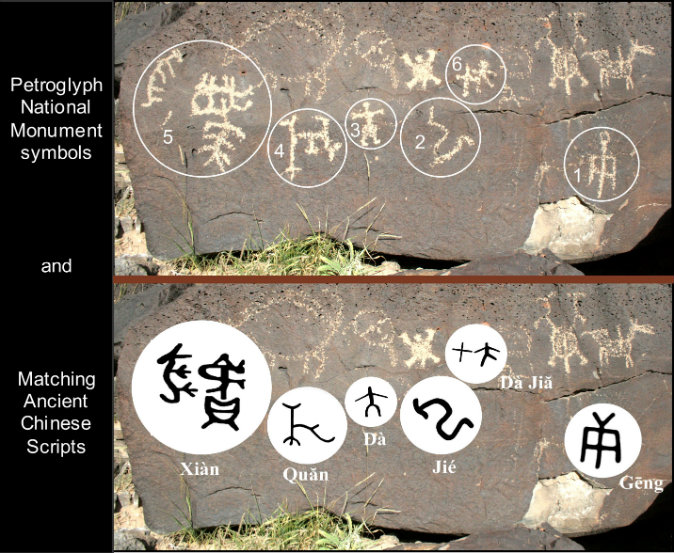
High above a walking path in Albuquerque’s Petroglyph National Monument, Ruskamp spotted petroglyphs that struck him as unusual. After consulting with experts on Native American rock writing and ancient Chinese scripts to corroborate his analysis, he has concluded that the readable message preserved by these petroglyphs was likely inscribed by a group of Chinese explorers thousands of years ago. 


Petroglyphs found in Arizona that are said to show an ancient Chinese script 
 [Credit: John Ruskamp] 

On the fringe of archaeology have long been claims that the Chinese reached North America 
long before Europeans. 
With some renowned experts taking interest in Ruskamp’s discovery, those claims may be working their way from the fringe to the core. 
It doesn’t mean our history textbooks will change tomorrow. 
Anything short of discovering an undisturbed early Asiatic relic or village in the Americas may fail to convince those archaeologists who have dogmatically rejected evidence of an ancient Chinese presence in the New World, said Ruskamp. 


Cartouche 1, which reads "Set apart (for) 10 years together"
 [Credit: John Ruskamp] 


But, the disparate and widespread symbols he has found show many indications of authenticity. 
They have the potential to inspire a more serious investigation into early trans-Pacific interaction. 
To date, Ruskamp has identified over 82 petroglyphs matching unique ancient Chinese scripts not only at multiple sites in Albuquerque, New Mexico, but also nearby in Arizona, as well as in Utah, Nevada, California, Oklahoma, and Ontario. 
Collectively, he believes that most of these artifacts were created by an early Chinese exploratory expedition, although some appear to be reproductions made by Native people for their own purposes. 
One of Ruskamp’s staunchest supporters has been David N. Keightley, Ph.D., a MacArthur Foundation Genius Award recipient who is considered by many to be the leading analyst in America of early Chinese oracle-bone writings. 
Keightley has helped Ruskamp decipher the scripts he has identified. 
One ancient message, preserved by three Arizona cartouche petroglyphs, translates as: “Set apart (for) 10 years together; declaring (to) return, (the) journey completed, (to the) house of the Sun; (the) journey completed together.” 
At the end of this text is an unidentified character that may be the author’s signature.


 Cartouche 2, which reads, “Declaring (to) return, (the) journey completed,  (to the) house of the Sun” 
[Credit: John Ruskamp] 


The oracle-bone style of writing employed for creating a number of these ancient petroglyph scripts disappeared by royal decree from mankind’s memory around 1046 B.C., following the fall of the Shang Dynasty. It remained an unknown and totally forgotten form of writing until it was rediscovered in A.D. 1899 at Anyang, China. 
Ruskamp thus concluded that the mixed styles of Chinese scripts found in these Arizona petroglyphs indicates that they were made during a transitional period of writing in China, not long after 1046 B.C. 
Ruskamp gives the following translation for the Albuquerque petroglyphs: “Geng (a date; the seventh Chinese Heavenly Stem); Jie (to kneel down in reverence); Da (great—referring to a superior); Quan (dog—the sacrificial animal); Xian (offering worship to  deceased ancestors); and Da Jia (the name of the third king of the Shang dynasty).” 


Cartouche 3, which reads, "(The) journey completed together" 
[Credit: John Ruskamp] 


The Albuquerque petroglyphs use both Seal era and Bronze era Chinese scripts, suggesting they were also written during a transitional period in Chinese calligraphy, likely between 1046 B.C. and 475 B.C. The use of the title “Da” before the name “Jia,” suggests a date close to the end of the Shang Dynasty in 1046 B.C., as this appellation emerged during that time period and was replaced shortly thereafter. 
Michael F. Medrano, Ph.D., chief of the Division of Resource Management for Petroglyph National Monument, studied the petroglyphs at that location upon Ruskamp’s request. He said that, based on his more than 25 years of experience with local Native cultures, “These images do not readily appear to be associated with local tribal entities,” and “based on repatination appear to have antiquity to them.” 


Arizona cartouche petroglyphs  
[Credit: John Ruskamp] 


It is difficult to physically date petroglyphs with absolute certainty, notes Ruskamp. Yet the syntax and mix of Chinese scripts found at these two locations correspond to what experts would expect explorers from China to use some 2,500 years ago. For example, the Arizona ranch petroglyphs are divided into three sections each enclosed in a square known as a cartouche. Two of the cartouches are numbered; one with the Chinese script for “one” placed beneath it and in a similar manner the second cartouche has the ancient Chinese script meaning “second” inscribed beneath it. Together these numeric figures indicate the order in which these images should be read. Importantly, the cartouches are thus shown to be read in the traditional Chinese manner, from right to left. 


Evolution of Chinese symbols
  [Credit: John Ruskamp] 


The first two cartouches are rotated 90 degrees to the left of vertical and the third is rotated 90 degrees to the right. “The deliberate rotation of these writings, both to the left and right of vertical by an equal number of degrees, endorses their authenticity, for the rotation of individual scripts by Chinese calligraphers is well-documented,” wrote Ruskamp. 
Some of the symbols found in the petroglyphs are common to both Chinese script and ancient Native American writing. 
For instance, “The Chinese petroglyph figure of Jiu conveys the idea of “togetherness,” in much the same manner as the Nakwach symbol is now, and has been in the past, understood by the Hopi,” wrote Ruskamp. 
   Another similarity is the use of a rectilinear spiral to convey the concept of a “round-trip journey.” Though these similarities could be conceived as supporting a Native American origin for Ruskamp’s petroglyphs, Ruskamp stated: “The extensive Chinese vocabulary evidenced at each location advocates against the authorship of the figures evaluated in this study being credited to Native Americans. None of the more complex Chinese figures identified in this report are known to have any Native tribal affiliation.” 


The Arizona glyph site on what has always been, and still is, very private ranch property  located miles from any public access or road [Credit: John Ruskamp] 


The conclusion of his paper titled 'Ancient Chinese Rock Writings Confirm Early Trans-Pacific Interaction,' reads: “In contrast to any previous historical uncertainty, the comparative evidence presented in this report, which is supported by both analytical evaluation and expert opinion, documenting the presence of readable sequences of old Chinese scripts located upon the rocks of North America, establishes that prior to the extinction of oracle-bone script from human memory, approximately 2,500 years ago, trans-Pacific exchanges of epigraphic intellectual property took place between Chinese and North American populations.” 

He published the paper on his website, Asiaticechoes.org, in April and it is currently under peer review.
 Last October, he began presenting his findings in speaking engagements, including most recently to the Association of American Geographers in Chicago. 
He will next present at a meeting of the Little Colorado River Chapter of the Arizona Archaeology Society in Springerville, Arizona, on May 18. 
The editors of the journal Pre-Columbiana have confirmed they will soon publish Ruskamp’s article.
The journal is edited by Professor Emeritus Stephen C. Jett, Ph.D., University of California–Davis, with the assistance of an editorial board of distinguished professional 
scholars, and is dedicated to exploring Pre-Columbian transoceanic contact. 

A retired educator, statistician, and analytical chemist, Ruskamp pursued his study of petroglyphs as a hobby—little expecting to find what may lead to a great shift in how we view both American and Chinese history. 


Author: Tara MacIsaac | Source: Epoch Times [June 30, 2015]

sabato 31 gennaio 2015

Uso del Propulsore.

Conoscerlo è un conto (il propulsore era noto dal 18.000 a.C.) usarlo è un altro (mi sono sempre chiesto se i Protosardi ne avessero bisogno: non credo). 
Dimostrare che fosse usato  da una popolazione richiede ricerca. Per i Paleo indiani nord americani, eccola:


First Americans used spear-throwers to hunt large animals 


Despite a lack of archaeological evidence, the first North Americans have often been depicted hunting with spear-throwers, which are tools that can launch deadly spear points at high speeds. 
But now, a new analysis of microscopic fractures on Paleo-Indian spear points provides the first empirical evidence that America's first hunters really did use these weapons to tackle mammoths and other big game.


A nearly complete Clovis projectile point of dendritic chert, a mid-interval biface  of translucent quartz, displaying relatively heavy red ochre residue and an  "end-beveled" osseous rod, also exhibiting red ochre residue  [Credit: Sarah L. Anzick] 

The new study has implications for scientists' understanding of the way Paleo-Indians lived, researchers say. 
To understand the inner workings of extinct hunter-gatherer societies, it's important to first learn how the ancient peoples got the food they ate, because their lives were closely tied to their subsistence activities. 
Current models of Paleo-Indian society are based on the assumption that hunters sometimes used spear-throwers, or atlatls, said study author Karl Hutchings, an archaeologist at Thompson Rivers University in Canada. "We can now be assured that those assumptions were right," Hutchings told Live Science. Ancient hunting tools Similar to bows, atlatls can propel flexible, pointed shafts — called darts, rather than arrows — at high speeds across long distances. 
Essentially, they were sticklike tools that contained a hook or spur at one end to hold a dart. By swinging the spear-thrower overhead and forward, hunters could launch their darts with greater force than if they were to throw them like javelins. 
Archaeological evidence indicates that hunter-gathers in the Old World used atlatls beginning at least 18,000 years ago. 
Researchers have long thought that Paleo-Indians — including the people of the Clovis culture, who lived around 13,000 years ago and are considered one of the first American peoples — also hunted with spear-throwers. 
Researchers reasoned that "if the spear-thrower originated in the Old World, then it only made sense that it must have shown up with early [North American] colonists," Hutchings said. Additionally, Paleo-Indians were thought to have hunted big animals, such as mammoths and ground sloths, which would have required powerful, long-distance weapons to take the animals down safely. "People started wondering just how crazy you would have to be to run up to these things with just a sharp, broken rock tied to a stick." 


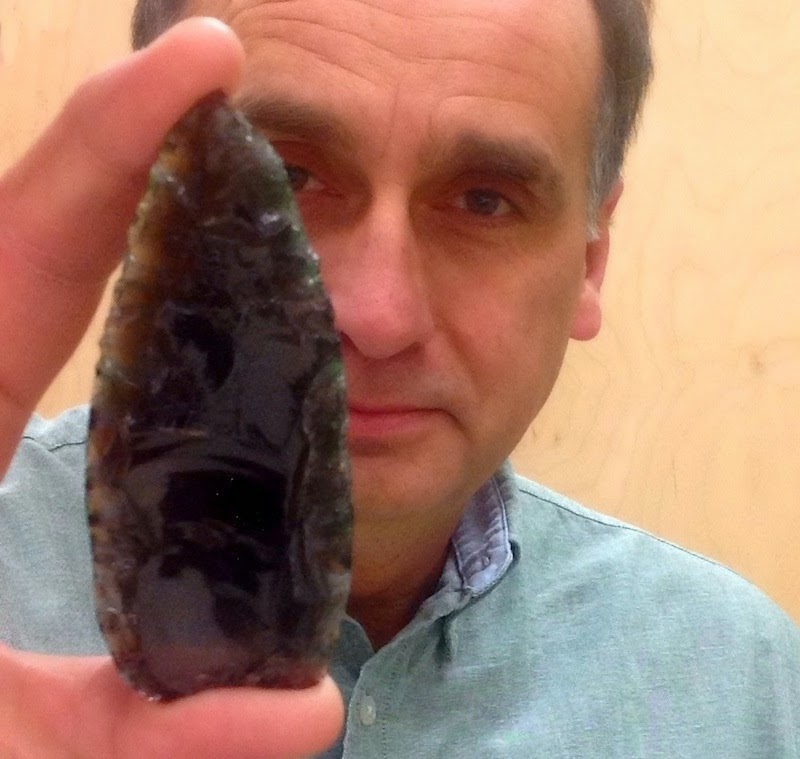
Karl Hutchings, an archaeologist at Thompson Rivers University in Canada,  holds a Clovis spear point [Credit: Karl Hutchings] 


But archaeological evidence of Paleo-Indian atlatls and darts is lacking because these tools were often made of wood, which doesn't preserve well — the only part of the weapons left in the archaeological record are the stone points, which could have also been used in other types of weapons, such as spears, Hutchings said. In comparison, ancient spear-throwers from Europe were often made of ivory or bone. 
The earliest known evidence of Paleo-Indian spear-throwers comes from 11,000-year-old "bannerstones," which are stone objects that may have functioned as atlatl weights, though the true function of bannerstones is debated, Hutchings said.
 The earliest solid evidence of atlatls in the New World, then, are 9,000- to 10,000-year-old spear-thrower hooks from Warm Mineral Springs, a sinkhole in Florida. However, these tools date back to the Early Archaic subperiod, which came after the Paleo-Indian period. 
Telltale fractures To see if the earliest North Americans — including people from the Clovis culture, Folsom culture (10,000 to 11,000 years ago) and other Paleo-Indians — used atlatls, Hutchings analyzed the fractures present in hundreds of spear points. He looked for clues that the weapon tips experienced high-velocity, mechanically propelled impacts. 
If a spear point hits a target hard enough, the energy of the impact will cause the tip to break. "When it breaks, it sends a shock wave through the stone that produces fractures, which are related to the amount and kind of force involved," Hutchings said. 
By measuring topographic features on the fracture surface, you can calculate the "fracture velocity" of the impact, or how quickly the fractures spread through the material, Hutchings explained. Because different weapons — spears, javelins, atlatls or bows — produce specific fracture velocities and related forces, you can work backward from a fracture to determine what caused it. Using this method, which he developed in the late 1990s, Hutchings determined the fracture velocities for 55 out of 668 Paleo-Indian artifacts that he examined. 
Of these points, about half of them exhibited fracture velocities that can only be achieved using an atlatl and dart or a bow and arrow.
 Because Paleo-Indians aren't thought to have had bows and arrows or other propulsive weapons, the findings suggest that they most likely used atlatls to launch their spear points, Hutchings said. Importantly, the method may also help scientists better understand ancient projectile technologies, by allowing them to trace the origin of the technologies and how they were used across societies and continents. 
"We can get a better resolution of when these technologies occurred, how they spread and why they spread," Hutchings said. Hutchings detailed his findings in the March issue of the Journal of Archaeological Science. 

Author: Joseph Castro | Source: LiveScience [January 28, 2015]

Read more at: http://archaeologynewsnetwork.blogspot.it/2015/01/first-americans-used-spear-throwers-to.html?utm_source=feedburner&utm_medium=feed&utm_campaign=Feed:+TheArchaeologyNewsNetwork+(The+Archaeology+News+Network)
Follow us: @ArchaeoNewsNet on Twitter | groups/thearchaeologynewsnetwork/ on Facebook

sabato 3 maggio 2014

Dendro il Clima

Tree rings reveal nightmare droughts in western USA 


If you think the 1930s drought that caused The Dust Bowl was rough, new research looking at tree rings in the Rocky Mountains has news for you: Things can get much worse in the West. 


Scientists extended Utah's climate record back to 1429 using tree rings. They  found Utah's climate has seen extreme droughts, including one that lasted 16 years  [Credit: Brigham Young University] 


In fact the worst drought of this century barely makes the top 10 of a study that extended Utah's climate record back to the year 1429. With sandpaper and microscopes, Brigham Young University professor Matthew Bekker analyzed rings from drought-sensitive tree species. He found several types of scenarios that could make life uncomfortable in what is now the nation's third-fastest-growing state: Long droughts: The year 1703 kicked off 16 years in a row with below average stream flow. Intense droughts: The Weber River flowed at just 13 percent of normal in 1580 and dropped below 20 percent in three other periods. Consecutive worst-case scenarios: The most severe drought in the record began in 1492, and four of the five worst droughts all happened during Christopher Columbus' lifetime. 


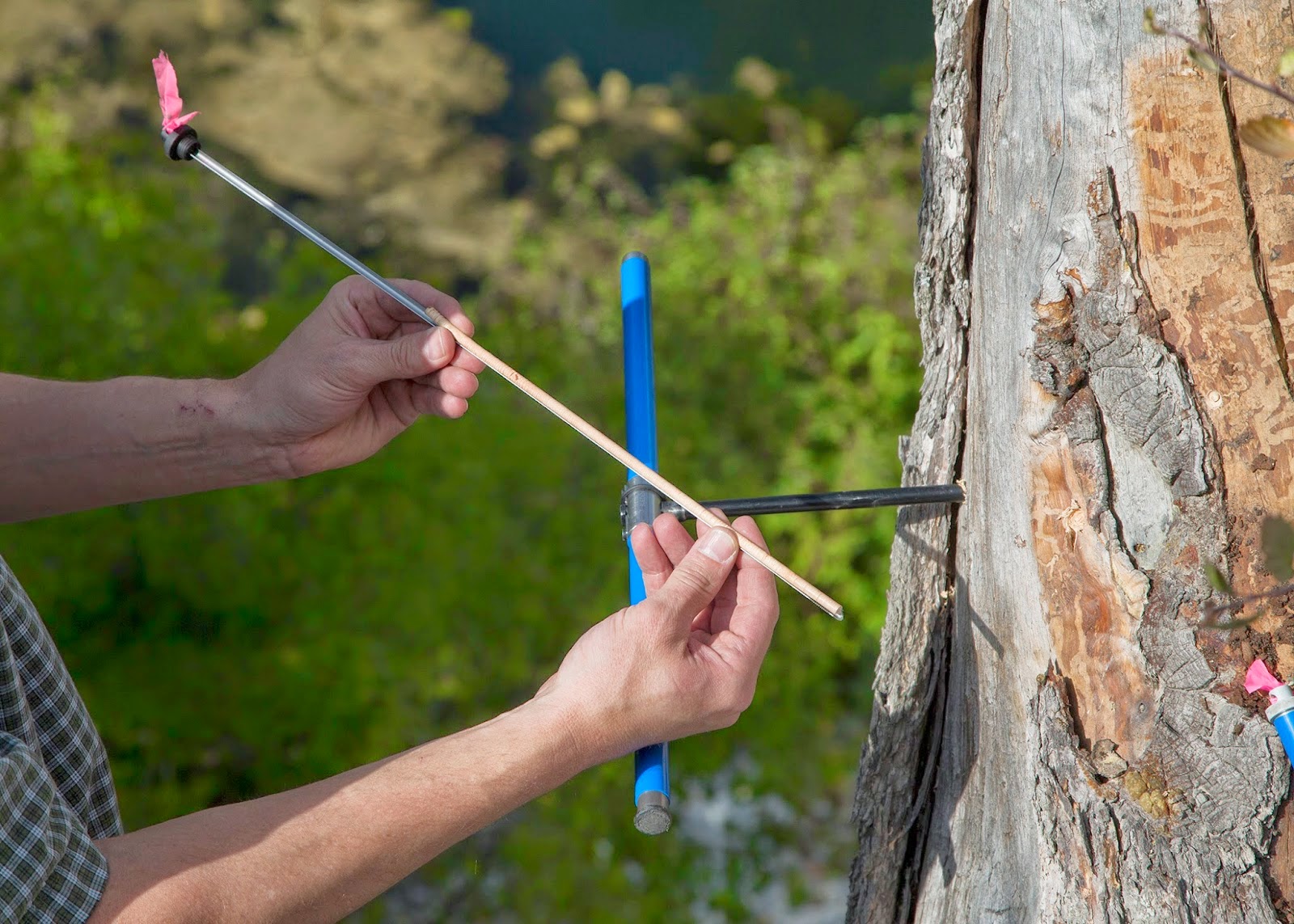
Professor Bekker extracts a core sample from a dead tree in Provo canyon  [Credit: Brigham Young University] 


"We're conservatively estimating the severity of these droughts that hit before the modern record, and we still see some that are kind of scary if they were to happen again," said Bekker, a geography professor at BYU. "We would really have to change the way we do things here." Modern climate and stream flow records only go back about 100 years in this part of the country, so scientists like Bekker turn to Mother Nature's own record-keeping to see the bigger picture. For this study, the BYU geographer took sample cores from Douglas fir and pinyon pine trees. The thickness of annual growth rings for these species is especially sensitive to water supply. 
Using samples from both living and dead trees in the Weber River basin, the researchers built a tree-ring chronology that extends back 585 years into Utah's natural history. Modern stream flow measurements helped them calibrate the correlation between ring thickness and drought severity. As Bekker and his co-authors report in the Journal of the American Water Resources Association, the west's climate usually fluctuates far more than 
it did in the 1900s.


 The five previous centuries each saw more years of extremely dry and extremely wet climate conditions. "We're trying to work with water managers to show the different flavors of droughts this region has had," said Bekker. "These are scenarios you need to build into your models to know how to plan for the future." 
Bekker collaborated with researchers from the U.S. Forest Service, Columbia University and Utah State University. 
The team is currently working on a climate reconstruction based on tree rings that date back more than 1,000 years. 


Source: Brigham Young University [May 01, 2014]

Read more at: http://archaeologynewsnetwork.blogspot.it/2014/05/tree-rings-reveal-nightmare-droughts-in.html?utm_source=feedburner&utm_medium=email&utm_campaign=Feed:+TheArchaeologyNewsNetwork+(The+Archaeology+News+Network)#.U2SW-ih7DfU
Follow us: @ArchaeoNewsNet on Twitter | groups/thearchaeologynewsnetwork/ on Facebook

venerdì 4 aprile 2014

Africa? Nel Nord America

Magnetic anomaly deep within Earth's crust reveals Africa in North America 


  The repeated cycles of plate tectonics that have led to collision and assembly of large supercontinents and their breakup and formation of new ocean basins have produced continents that are collages of bits and pieces of other continents. 


Antonio Snider-Pellegrini's Illustration of the closed and opened  Atlantic Ocean (1858) [Credit: eurasiareview] 


Figuring out the origin and make-up of continental crust formed and modified by these tectonic events is a vital to understanding Earth's geology and is important for many applied fields, such as oil, gas, and gold exploration.

 In many cases, the rocks involved in these collision and pull-apart episodes are still buried deep beneath Earth's surface, so geologists must use geophysical measurements to study these features. 

This new study by Elias Parker Jr. of the University of Georgia examines a prominent swath of lower-than-normal magnetism -- known as the Brunswick Magnetic Anomaly -- that stretches from Alabama through Georgia and off shore to the North Carolina coast. 

The cause of this magnetic anomaly has been under some debate. 

Many geologists attribute the Brunswick Magnetic Anomaly to a belt of 200 million year old volcanic rocks that intruded around the time the Atlantic Ocean. 
In this case, the location of this magnetic anomaly would then mark the initial location where North America split from the rest of Pangea as that ancient supercontinent broke apart. 
Parker proposes a different source for this anomalous magnetic zone. 
Drawing upon other studies that have demonstrated deeply buried metamorphic rocks can also have a coherent magnetic signal, Parker has analyzed the detailed characteristics of the magnetic anomalies from data collected across zones in Georgia and concludes that the Brunswick Magnetic Anomaly has a similar, deeply buried source. 
The anomalous magnetic signal is consistent with an older tectonic event -- the Alleghanian orogeny that formed the Alleghany-Appalachian Mountains when the supercontinent of Pangea was assembled. 
Parker's main conclusion is that the rocks responsible for the Brunswick Magnetic Anomaly mark a major fault-zone that formed as portions of Africa and North America were sheared together roughly 300 million years ago -- and that more extensive evidence for this collision are preserved along this zone. 
One interesting implication is that perhaps a larger portion of what is now Africa was left behind in the American southeast when Pangea later broke up. 


Source: Geological Society of America  [April 02, 2014]

Read more at: http://archaeologynewsnetwork.blogspot.it/2014/04/magnetic-anomaly-deep-within-earths.html?utm_source=feedburner&utm_medium=feed&utm_campaign=Feed:+TheArchaeologyNewsNetwork+(The+Archaeology+News+Network)#.Uz5dnCh7DfU
Follow us: @ArchaeoNewsNet on Twitter | groups/thearchaeologynewsnetwork/ on Facebook

giovedì 20 marzo 2014

POLLO ALLA DIAVOLA

No, non è una ricetta. 
E' l'ultimo trovatello dei dinosauri: Anzu wyliei, un ornitiforme teropode nordamericano, di 66 milioni d'anni fa, del quale sono stati trovati ben 3 esemplari e che è subito stato chiamato il 'Pollo dall'Inferno' semplicemente perché rinvenuto in una zona - ricca di fossili - che si chiama Hell Creek Formation (per intenderci: la stessa zona in cui sono stati reperiti vari esemplari di Triceratops e di t. Rex). 
Dato che i resti rinvenuti permettono una ricostruzione quasi totale di questo cenagnatide (http://it.inforapid.org/index.php?search=Saurischia), i  disegnatori si sono subito sbizzarriti in una serie di possibili interpretazioni grafiche. 
In parte simile ad un casuario o uno struzzo, ma molto più grande (3.3 mt), era un uccello che non volava. Anche se non ci sono notizie sulla sua dieta (si presume fosse onnivoro, come l'uomo), non era un uccello che un essere umano vorrebbe incontrare mai: aveva 'ali' che terminavano con molti artigli su dita lunghe e articolate e zampe potenti con unghioni poco raccomandabili.
Alcuni esemplari mostrano la presenza di lesioni anche ossee, rimarginate (non sappiamo se provocate da predatori oppure da lotte con altri esemplari della stessa specie). 
E' anche chiamato 'oviraptor' perché uno dei primi esemplari simili, rinvenuto in Asia era stato rinvenuto morto su alcune uova e si pensava che fosse stato ucciso nell'atto di razziare un nido. Invece, si è poi scoperto (1990) che le uova contenevano piccoli di oviraptor: si trattava quindi di un genitore morto nell'etto di difendere le proprie uova. Ma il nome è rimasto, triste soma derivata da un errore.
E oggi vi si è aggiunta questa provenienza infernale...


Bizarre, bird-like dinosaur discovered 


 A team of researchers has announced the discovery of a bizarre, bird-like dinosaur, named Anzu wyliei, that provides paleontologists with their first good look at a dinosaur group that has been shrouded in mystery for almost a century. Anzu wyliei - a bird-like dinosaur nicknamed the "chicken from hell" that roamed the Dakotas 66 million years ago -- appears in its natural environment in this artist's depiction. 


Discovery and description of the new dinosaur was announced by the University of Utah, Carnegie Museum of Natural History and Smithsonian Institution's National Museum of Natural History [Credit: Mark Klingler, Carnegie Museum of Natural History] 

Anzu was described from three specimens that collectively preserve almost the entire skeleton, giving scientists a remarkable opportunity to study the anatomy and evolutionary relationships of Caenagnathidae -- the long-mysterious group of theropod dinosaurs to which Anzu belongs. 
The three described fossil skeletons of Anzu were unearthed in North and South Dakota, from roughly 66 million-year-old rocks of the Hell Creek Formation, a rock unit celebrated for its abundant fossils of famous dinosaurs such as Tyrannosaurus rex and Triceratops. 
The team of scientists who studied Anzu was led by Dr. Matthew Lamanna of Carnegie Museum of Natural History in Pittsburgh. Dr. Lamanna's collaborators include Dr. Hans-Dieter Sues and Dr. Tyler Lyson of the Smithsonian Institution's National Museum of Natural History in Washington, DC, and Dr. Emma Schachner of the University of Utah in Salt Lake City. 
According to Dr. Lamanna, "Anzu is far and away the most complete caenagnathid that has ever been discovered. After nearly a century of searching, we paleontologists finally have the fossils to show what these creatures looked like from virtually head to toe. And in almost every way, they're even weirder than we imagined." 

Hell's Chicken 

At roughly 11 feet long and five feet tall at the hip, Anzu would have resembled a gigantic flightless bird, more than a 'typical' theropod dinosaur such as T. rex. Its jaws were tipped with a toothless beak, and its head sported a tall, rounded crest similar to that of a cassowary (a large ground bird native to Australia and New Guinea). 


This is the skeleton and selected bones of the new oviraptorosaurian dinosaur species Anzu wyliei as presented in the paper by Matthew Lamanna and colleagues published in the scientific journal PLOS ONE [Credit: The skeleton illustration was done by Scott Hartman [skeletaldrawing.com] and the individual bones by Mark A. Klingler/Carnegie Museum of Natural History] 


The neck and hind legs were long and slender, also comparable to a cassowary or ostrich. Although the Anzu specimens preserve only bones, close relatives of this dinosaur have been found with fossilized feathers, strongly suggesting that the new creature was feathered too. 
The resemblance to birds ends there, however: the forelimbs of Anzu were tipped with large, sharp claws, and the tail was long and robust. 

Says Dr. Lamanna, "We jokingly call this thing the 'Chicken from Hell,' and I think that's pretty appropriate. So we named it after Anzu, a bird-like demon in ancient mythology." 
The species is named for a Carnegie Museums of Pittsburgh Trustee's grandson, Wylie. Not only do the fossils of Anzu wyliei paint a picture of this particular species, they shed light on an entire group of dinosaurs, the first evidence of which was discovered almost 100 years ago. 

In 1924, paleontologist Charles Whitney Gilmore described the species Chirostenotes pergracilis from a pair of fossil hands found a decade earlier in ~74 million-year-old rocks in Alberta, Canada. Later, in 1940, Caenagnathus collinsi was named, based on a peculiar lower jaw from the same beds. More recently, after studies of these and other fragmentary fossils, Hans Sues and other paleontologists determined that Chirostenotes and Caenagnathus belonged to the same dinosaur group, Caenagnathidae, and that these animals were close cousins of Asian oviraptorid theropods such as Oviraptor. 

Asian relations 

Oviraptor ('egg thief') is widely known because the first fossil skeleton of this animal, described in 1924, was found atop a nest of dinosaur eggs, suggesting that the creature had died in the act of raiding the nest. 


With its head crest and presumably feathered forelegs, the newly discovered and described dinosaur Anzu wyliei was nicknamed the "chicken from hell" by its discoverers at the Carnegie Museum of Natural History, Smithsonian Institution's National Museum of Natural History and University of Utah [Credit: Bob Walters] 

This thinking prevailed until the 1990s, when the same type of egg was found with a baby oviraptorid inside, demonstrating that, rather than a nest plunderer, Oviraptor was a caring parent that perished while protecting its eggs. More than a dozen oviraptorid species have been discovered, all in Mongolia and China, and many are known from beautifully-preserved, complete or nearly complete skeletons. Additionally, beginning in the 1990s, several small, primitive relatives of oviraptorids were unearthed in much older, ~125 million-year-old rocks in northeastern China. 
Many of these are also represented by complete skulls or skeletons, some of which preserve fossilized feathers. Researchers have established that caenagnathids, oviraptorids, and these more archaic Chinese species are closely related to one another, and have united them as the theropod group Oviraptorosauria. 
The occurrence of oviraptorosaurs in both Asia and North America was not a surprise to paleontologists, because these continents were frequently connected during the Mesozoic Era (the 'Age of Dinosaurs'), allowing dinosaurs and other land animals to roam between them. 
However, because their fossils were so incomplete, caenagnathids remained the most poorly known members of Oviraptorosauria, and indeed, one of the least understood of all major dinosaur groups. 
"For many years, caenagnathids were known only from a few bits of the skeleton, and their appearance remained a big mystery," says Dr. Sues. 

More fossils, more knowledge 

The nearly completely represented skeleton of Anzu opens a window into the anatomy of this and other caenagnathid species. 


This is a mounted replica skeleton of the new oviraptorosaurian dinosaur species Anzu wyliei on display in the Dinosaurs in Their Time exhibition at Carnegie Museum of Natural History, Pittsburgh, Pa., USA [Credit: Carnegie Museum of Natural History] 


Armed with this wealth of new information, Dr. Lamanna and his team were able to reconstruct the evolution of these extraordinary animals in more detail than ever before. 
Analysis of the relationships of Anzu reaffirmed that caenagnathids form a natural grouping within Oviraptorosauria: Anzu, Caenagnathus, Chirostenotes, and other North American oviraptorosaurs are more closely related to each other than they are to most of their Asian cousins -- a finding that had been disputed in recent years. Furthermore, the team's analysis confirmed the recent hypothesis that the enormous (and aptly-named) Gigantoraptor -- at a weight of at least 1.5 tons, the largest oviraptorosaur known to science -- is an unusual member of Caenagnathidae as well, instead of an oviraptorid as had initially been proposed. 
"We're finding that caenagnathids were an amazingly diverse bunch of dinosaurs," says Dr. Lamanna. "Whereas some were turkey-sized, others -- like Anzu and Gigantoraptor -- were the kind of thing you definitely wouldn't want to meet in a dark alley. 
Apparently these oviraptorosaurs occupied a much wider range of body sizes and ecologies than we previously thought." The anatomy and ancient environment of Anzu provide insight into the diet and habitat preferences of caenagnathids as well. 
Although the preferred food of these oviraptorosaurs remains something of a puzzle, Dr. Lamanna and collaborators think that caenagnathids were probably omnivores -- like humans, animals that could eat either meat or plants. 
Moreover, studies of the rocks in which several of the most complete caenagnathid skeletons have been found show that these strata were laid down in humid floodplain environments, suggesting that these dinosaurs favored such habitats. 
In this way, caenagnathids appear to have differed greatly from their oviraptorid cousins, all of which have been found in rocks that were deposited under arid to semi-arid conditions . 
"Over the years, we've noticed that Anzu and some other Hell Creek Formation dinosaurs, such as Triceratops, are often found in mudstone rock that was deposited on ancient floodplains. Other dinosaurs, like duckbills, are found in sandstone deposited in or next to rivers," says Dr. Lyson, who found his first Hell Creek fossil on his family's ranch in North Dakota when he was only six years old. 
Anzu led a life that was fraught with danger. 
In addition to sharing its Cretaceous world with the most notorious carnivore of all time -- T. rex -- this oviraptorosaur seems to have gotten hurt a lot as well. Two of the three specimens show clear evidence of injuries: one has a broken and healed rib, while the other has an arthritic toe bone that may have been caused by an avulsion fracture (where a tendon ripped a piece off the bone to which it was attached). Says Dr. Schachner, "These animals were clearly able to survive quite a bit of trauma, as two of the specimens show signs of semi-healed damage. Whether these injuries were the result of combat between two individuals or an attack by a larger predator remains a mystery." As much insight as the Anzu skeletons provide, paleontologists still have much to learn about North American oviraptorosaurs. 
Ongoing studies of these and other important fossils promise to remove more of the mystery surrounding these remarkable bird-like creatures. "For nearly a hundred years, we paleontologists knew almost nothing about these dinosaurs," concludes Dr. Lamanna. "Now, thanks to Anzu, we're finally starting to figure them out." 
A fully-articulated cast of Anzu wyliei is on public view in Carnegie Museum of Natural History's Dinosaurs in Their Time exhibition. The scientific paper describing the discovery appears today in the freely-accessible journal PLOS ONE. 

Source: Carnegie Museum of Natural History [March 19, 2014]

Read more at: http://archaeologynewsnetwork.blogspot.it/2014/03/bizarre-bird-like-dinosaur-discovered.html?utm_source=feedburner&utm_medium=feed&utm_campaign=Feed:+TheArchaeologyNewsNetwork+(The+Archaeology+News+Network)#.UyshtSjvjfU
Follow us: @ArchaeoNewsNet on Twitter | groups/thearchaeologynewsnetwork/ on Facebook


domenica 16 febbraio 2014

La più antica corona di Rame

Sarà in mostra a Manhattan la più antica corona esistente - per ora - al mondo (6.000 anni fa). E' di rame dipinto di nero, ha la forma di un anello ed è ornata con avvoltoi e porte, che sporgono dal profilo superiore della stessa. Secondo gli archeologi, potrebbe essere una rappresentazione di una delle strutture ("Torri del silenzio" - ndt) in cui i corpi dei defunti erano esposti alla decomposizione naturale, prima della sepoltura.


Copper Age crown, 

the world's oldest, 

to go on display in Manhattan


 The world’s oldest crown will be taking on Manhattan when it goes on display at a new exhibit on the city's Upper East Side.

 This Crown from the Copper Age is believed to be the oldest in existence. 


The artifact will be on display at The Institute for the Study of the Ancient World in Manhattan until June [Credit: Ardon Bar Hama, Collection of Israel Antiquities Authority©/The Israel Museum] 

The crown is a relic of the Copper Age, dating back some 6,000 years, and will be on display with 150 other artifacts from the era as part of the “Masters of Fire: Copper Age Art from Israel” exhibit opening this week at Institute for the Study of the Ancient World at New York University. “To the modern eye, it is stunning to see how these groups of people, already mastering so many new social systems and technologies, still had the ability to create objects of enduring artistic interest,” said Jennifer Y. Chi, ISAW Exhibitions Director and Chief Curator in a statement. 
The Copper Age was when people discovered how to make implements and ritual objects out of copper and organize and glean products like milk and wool. The show is considered to be the most comprehensive collection of artifacts from the era to be seen outside of Israel, according to local news site DNA info New York. 
The black-colored crown is shaped like a thick ring and adorned with vultures and doors protruding from the top. It is believed to have played a part in burial ceremonies and its adornments are believed a model of a structure where bodies were allowed to decompose before burial. Many of the objects are part of the Nahal Mishmar Hoard, which is a collection of over 400 objects that were found in a remote cave near the Dead Sea in 1961. 
The pieces include two clay statues of the Lady of Gilat and The Ram of Gilat and a full array of Copper Age figurines made from stone, ivory, bone, and clay as well as a scepter decorated with horned animals, a copper container designed to look like a woven basket, and clay goblets and bowls. “The fascinating thing about this period is that a burst of innovation defined the technologies of the ancient world for thousands of years,” Daniel M. Master, Professor of Archaeology at Wheaton College and a member of the curatorial team, said in a statement. “People experimented with new ways to use not just copper, but also leather, ceramics, and textiles—sometimes successfully, sometimes not.”

Source: FoxNews [February 13, 2014]

Read more at: http://archaeologynewsnetwork.blogspot.it/2014/02/copper-age-crown-worlds-oldest-to-go-on.html?utm_source=feedburner&utm_medium=feed&utm_campaign=Feed:+TheArchaeologyNewsNetwork+(The+Archaeology+News+Network)#.UwCoUIu4ZZ8
Follow us: @ArchaeoNewsNet on Twitter | groups/thearchaeologynewsnetwork/ on Facebook