Visualizzazione post con etichetta Fossils. Mostra tutti i post

mercoledì 14 ottobre 2015

Clonabile il Mammut lanoso?

Arctic expedition finds 

woolly mammoth remains 

ripe for cloning 

Breakingnews, Early Mammals, Fossils, Genetics, Palaeontology, Russia 


Russian scientists undertaking an exploratory expedition on the Lyakhovsky Islands have discovered woolly mammoth remains including skin and tusk, which they believe suitable for obtaining the DNA necessary to clone the animal. 


The mammoth expedition led by scientists from Russia's North-Eastern Federal  University in Yakutsk, and funded by the Russian Geographical Society  
[Credit: ©: gazetayakutia.ru] 


An international expedition to the Lyakhovsky Islands led by scientists from Russia's North-Eastern Federal University in Yakutsk has discovered six specimens of woolly 
mammoth fossils suitable for extracting DNA.

"The Lyakhovsky Islands are considered the mammoth continent," explained Semyon Grigorev, leader of the expedition to the islands and director of the Mammoth Museum at Russia's North-Eastern Federal University in Yakutsk. "The largest concentration of remains in the world is here, so that's why we chose this area to carry out our studies," Grigorev told a press conference on Wednesday.
 "To start with, together with archeologists we carried out a dig at the most northern site where ancient man lived, not far from the village of Kazachye where we found an enormous amount of mammoth bones, and also ancient tools," said Grigorev of the expedition, which took place over two stages from August 11 to September 29. 


The discovery is seen as highly significant by Russian and South Korean experts  working to bring the mammoths back to life through cloning 
[Credit: NVK]


"Then, after waiting a long time for the right weather conditions, we continued to the main target of our expedition, Great Lyakhovsky Island, where we found a great amount of unique remains," which includes ancient mammoth skin and teeth. 
"Take, for example, the tusk of a pygmy mammoth that we found. We calculate that the animal was no more than two meters tall, so now we have to work out what this was – a micropopulation, or the peculiarity of this single individual." 
"Skin is the most interesting for us, for our project 'The Mammoth Rebirth' because our Korean colleagues consider skin to be the best material for an attempt at cloning via the extraction of viable cells."
 The 'Northern Ecumene' expedition of 16 researchers from six different countries was made possible thanks to a grant of two million rubles provided by the Russian Geographical Society. 
"We consider the expedition a success; after all, out of what seems to be these kinds of small expeditions, great scientific discoveries can be made," said Grigorev, whose team is now joining forces with Korean researchers to analyze the mammoth remains for cells viable for cloning. 

Source: Sputnik News [October 09, 2015]

lunedì 25 maggio 2015

Il Primo Amico dell'Uomo


Our bond with dogs 

may go back more than 27,000 years 

Dogs' special relationship to humans may go back 27,000 to 40,000 years, according to genomic analysis of an ancient Taimyr wolf bone reported in the Cell Press journal Current Biology on May 21. 
Earlier genome-based estimates have suggested that the ancestors of modern-day dogs diverged from wolves no more than 16,000 years ago, after the last Ice Age. 


Ancient Taimyr Wolf bone from the lower jaw. The animal lived approximately  27,000 to 40,000 years ago
 [Credit: Love Dalén] 


The genome from this ancient specimen, which has been radiocarbon dated to 35,000 years ago, reveals that the Taimyr wolf represents the most recent common ancestor of modern wolves and dogs. 
"Dogs may have been domesticated much earlier than is generally believed," says Love Dalén of the Swedish Museum of Natural History. 
"The only other explanation is that there was a major divergence between two wolf populations at that time, and one of these populations subsequently gave rise to all modern wolves." 
Dalén considers this second explanation less likely, since it would require that the second wolf population subsequently became extinct in the wild. 
"It is [still] possible that a population of wolves remained relatively untamed but tracked human groups to a large degree, for a long time," adds first author of the study Pontus Skoglund of Harvard Medical School and the Broad Institute. 


DNA from this small piece of a rib bone from an ancient Taimyr wolf suggests that  dogs may have been domesticated 27,000 years ago 
[Credit: Love Dalén] 


The researchers made these discoveries based on a small piece of bone picked up during an expedition to the Taimyr Peninsula in Siberia. 
Initially, they didn't realize the bone fragment came from a wolf at all; this was only determined using a genetic test back in the laboratory. 
But wolves are common on the Taimyr Peninsula, and the bone could have easily belonged to a modern-day wolf. 
On a hunch, the researchers decided to radiocarbon date the bone anyway. 
It was only then that they realized what they had: a 35,000-year-old bone from an ancient Taimyr wolf. 
The DNA evidence also shows that modern-day Siberian Huskies and Greenland sled dogs share an unusually large number of genes with the ancient Taimyr wolf. 
"The power of DNA can provide direct evidence that a Siberian Husky you see walking down the street shares ancestry with a wolf that roamed Northern Siberia 35,000 years ago," Skoglund says. 
To put that in perspective, "this wolf lived just a few thousand years after Neandertals disappeared from Europe and modern humans started populating Europe and Asia." 

Source: Cell Press [May 21, 2015]

domenica 19 aprile 2015

Perfidi Archeologi Colpiscono ancora

Baboon bone found in famous Lucy skeleton 


 Lucy, arguably the world's most famous early human fossil, is not quite all she seems. 
A careful look at the ancient hominin's skeleton suggests one bone may actually belong to a baboon. 


Lucy 
[Credit: Dave Einsel/Getty] 


In November 1974, palaeoanthropologists Donald Johanson and Tom Gray made the discovery of a lifetime near the village of Hadar in Ethiopia: dozens of fossil fragments belonging to a single hominin skeleton dating back 3.2 million years. 

Once the fragments had been pieced together, the skeleton was declared to be of the species Australopithecus afarensis. But the skeleton became known as Lucy, inspired by a Beatles song that blasted out of a cassette player as the researchers celebrated their discovery that evening. 
Forty years later, thanks to its age and completeness, Lucy remains an important specimen. It shows, for instance, that our distant ancestors began to walk upright on two legs long before they developed big brains. It's no surprise, then, that replicas of the skeleton are on display at museums across the world. 

But when Gary Sawyer and Mike Smith at the American Museum of Natural History in New York recently began work on a new reconstruction of Lucy's skeleton, with help from Scott Williams at New York University, they noticed something odd. 
"Mike pointed out that one of the [vertebra] fragments, which no one, including me, had really paid close attention to, looked fairly small to fit with the rest of Lucy's vertebral column," says Williams. 
Williams had been working with Marc Meyer at Chaffey College in Rancho Cucamonga, California, on the spinal column of another early hominin, Australopithecus sediba, and so the two researchers decided to study the fragment. They soon concluded that it didn't belong to Lucy. "It was just too small," says Williams. 
One possible explanation was that the vertebra fragment came from a second, juvenile member of Lucy's species. So Williams and Meyer did a comparative study that included vertebrae from other Australopithecus fossils. 
To satisfy a personal hunch, Williams also added vertebrae from other animals known to have lived in the Hadar region 3.2 million years ago, such as porcupines and pigs. 
The results showed, surprisingly, that the fragment may not have belonged to Australopithecus at all. 
"Baboons were a close match, both in shape and size," says Williams. "So we think we've solved this mystery. 
It seems that a fossil gelada baboon thoracic vertebra washed or was otherwise transported in the mix of Lucy's remains." He stresses, though, that the analysis, which he will present at a meeting of the Paleoanthropology Society in San Francisco next week, also confirms that the other 88 fossil fragments belonging to Lucy's skeleton are correctly identified. 
And the mislabelled baboon bone fragment doesn't undermine Lucy's important position in the evolution of our lineage. 
There may be a simple reason why no one noticed that Lucy's remains included a baboon bone fragment. Although many scientists have examined Lucy's skeleton, most experts have not worked as extensively on bones of the back relative to the limbs, says Dan Gebo at the Northern Illinois University in DeKalb. "Given that broken bones are always a problem and most of us are not vertebral specialists, it would not be unusual to make a small mistake." Also, there was no sign of a baboon skeleton at the site where Lucy was discovered in 1974, says William Sanders at the University of Michigan in Ann Arbor. 
"So there was no reason to assume intermingling of elements between two different animals," he says. Even so, Sanders wants to see the analysis in detail before he accepts that the vertebra fragment really does belong to a baboon. "Offhand, I don't see any morphological features in this element that cry out for recognition as a baboon," he says. If the fragment really does prove to belong to a baboon, he says, "we can cut Don Johanson and his colleagues some slack".

Author: Colin Barras | Source: New Scientist [April 13, 2015]

sabato 21 febbraio 2015

I primi mammiferi


Earliest-known 

arboreal and subterranean 

ancestral mammals discovered 

  The fossils of two interrelated ancestral mammals, newly discovered in China, suggest that the wide-ranging ecological diversity of modern mammals had a precedent more than 160 million years ago. 


On the left are photos of the type specimen of Docofossor brachydactylus.  Docofossor was found in lake sediments of the Jurassic Ganggou fossil site  in Hebei Province of China. The fossil of Docofossor is preserved with dense  and carbonized furs around its skeleton. On the right is the fossil of  Agilodocodon scansorius. Found in lake sediments of the 165 million  years old Daohugou Fossil Site of Inner Mongolia of China, Agilodocodon  scansorius is preserved with a halo of dense, carbonized furs and hair  impressions. The horny claws on hands and feet are also preserved  [Credit: Zhe-Xi Luo, the University of Chicago] 


With claws for climbing and teeth adapted for a tree sap diet, Agilodocodon scansorius is the earliest-known tree-dwelling mammaliaform (long-extinct relatives of modern mammals). The other fossil, Docofossor brachydactylus, is the earliest-known subterranean mammaliaform, possessing multiple adaptations similar to African golden moles such as shovel-like paws. Docofossor also has distinct skeletal features that resemble patterns shaped by genes identified in living mammals, suggesting these genetic mechanisms operated long before the rise of modern mammals. These discoveries are reported by international teams of scientists from the University of Chicago and Beijing Museum of Natural History in two separate papers published Feb. 13 in Science (the papers can be found here and here). 
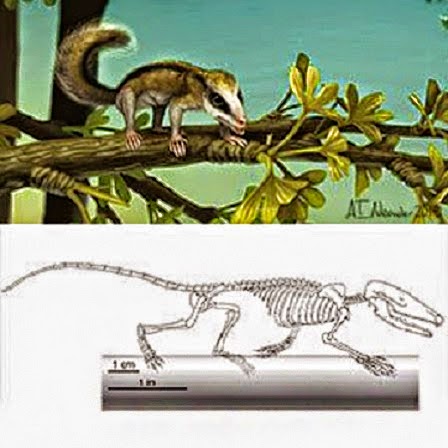


Skeletal and life style reconstructions of Agilodocodon scansorius, a docodont mammaliaform.  The skeletal features suggest that it was an agile and active animal living on trees.  Its incisors were specialized to feed on tree sap (exudate feeding), and its molars  suggest omnivorous feeding 
[Credit: April I. Neander/University of Chicago] 


"We consistently find with every new fossil that the earliest mammals were just as diverse in both feeding and locomotor adaptations as modern mammals," said Zhe-Xi Luo, PhD, professor of organismal biology and anatomy at the University of Chicago and an author on both papers. "The groundwork for mammalian success today appears to have been laid long ago." Agilodocodon and Docofossor provide strong evidence that arboreal and subterranean lifestyles evolved early in mammalian evolution, convergent to those of true mammals. These two shrew-sized creatures -- members of the mammaliaform order Docodonta -- have unique adaptations tailored for their respective ecological habitats.
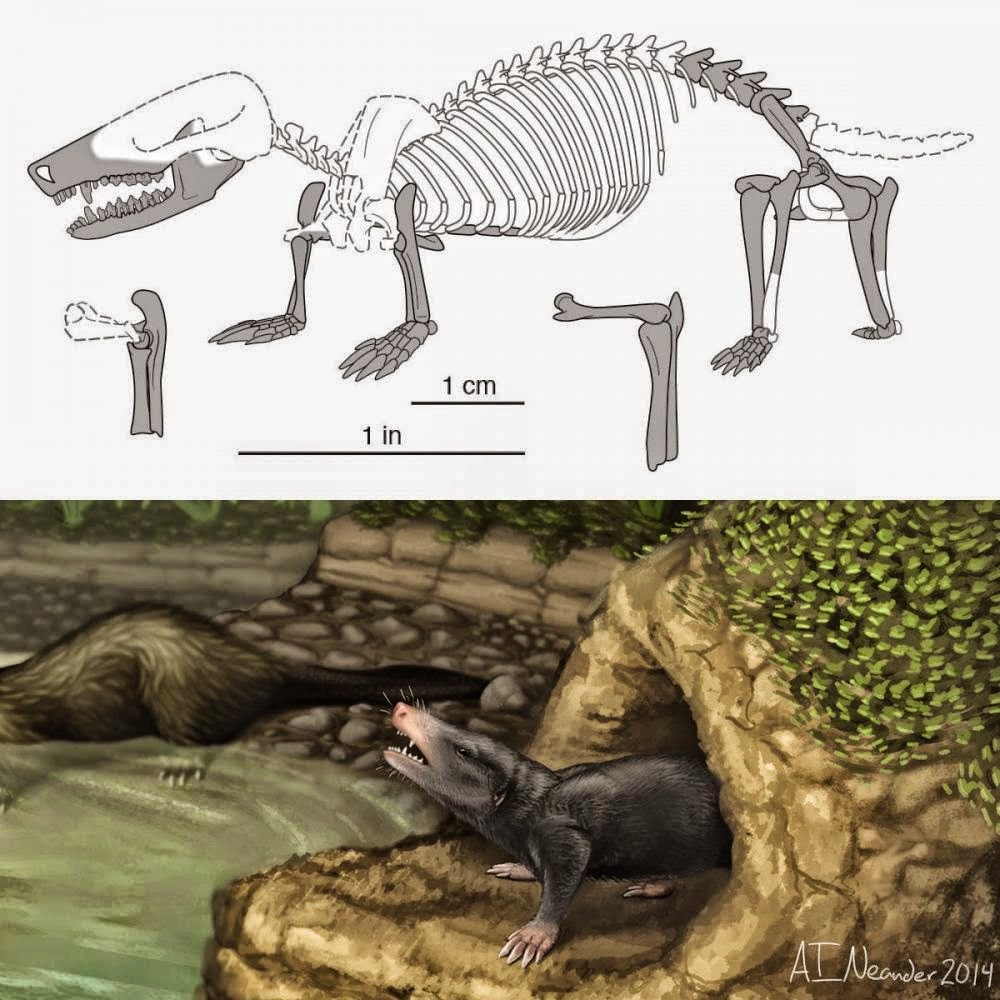


 Skeletal and life style reconstructions of Docofossor brachydactylus. Docofossor lived  in burrows on the lakeshore and fed on the worms and insects in the soil. Docofossor  is also unique in that it has one segment fewer of finger bone segments than most  other mammals, suggesting that it had a unique embryonic development  of its hands and feet [Credit: April I. Neander/University of Chicago] 


Agilodocodon, which lived roughly 165 million years ago, had hands and feet with curved horny claws and limb proportions that are typical for mammals that live in trees or bushes. It is adapted for feeding on the gum or sap of trees, with spade-like front teeth to gnaw into bark. This adaptation is similar to the teeth of some modern New World monkeys, and is the earliest-known evidence of gumnivorous feeding in mammaliaforms. Agilodocodon also had well-developed, flexible elbows and wrist and ankle joints that allowed for much greater mobility, all characteristics of climbing mammals. "The finger and limb bone dimensions of Agilodocodon match up with those of modern tree-dwellers, and its incisors are evidence it fed on plant sap," said study co-author David Grossnickle, graduate student at the University of Chicago. "It's amazing that these arboreal adaptions occurred so early in the history of mammals and shows that at least some extinct mammalian relatives exploited evolutionarily significant herbivorous niches, long before true mammals." 


An illustration of Agilodocodon and Docofossor. The skeletal features  of Agilodocodon (top left) suggeset it was an agile and active  arboreal animal. The skeletal features of Docofossor (bottom right)  suggest it lived in burrows and fed on worms and insects  [Credit: April I. Neander/University of Chicago] 


Docofossor, which lived around 160 million years ago, had a skeletal structure and body proportions strikingly similar to the modern day African golden mole. It had shovel-like fingers for digging, short and wide upper molars typical of mammals that forage underground, and a sprawling posture indicative of subterranean movement. Docofossor had reduced bone segments in its fingers, leading to shortened but wide digits. African golden moles possess almost the exact same adaptation, which provides an evolutionary advantage for digging mammals. This characteristic is due to the fusion of bone joints during development -- a process influenced by the genes BMP and GDF-5. Because of the many anatomical similarities, the researchers hypothesize that this genetic mechanism may have played a comparable role in early mammal evolution, as in the case of Docofossor. The spines and ribs of both Agilodocodon and Docofossor also show evidence for the influence of genes seen in modern mammals. Agilodocodon has a sharp boundary between the thoracic ribcage to lumbar vertebrae that have no ribs. However, Docofossor shows a gradual thoracic to lumber transition. These shifting patterns of thoracic-lumbar transition have been seen in modern mammals and are known to be regulated by the genes Hox 9-10 and Myf 5-6. That these ancient mammaliaforms had similar developmental patterns is an evidence that these gene networks could have functioned in a similar way long before true mammals evolved. "We believe the shortened digits of Docofossor, which is a dead ringer for modern golden moles, could very well have been caused by BMP and GDF," Luo said. "We can now provide fossil evidence that gene patterning that causes variation in modern mammalian skeletal development also operated in basal mammals all the way back in the Jurassic." 


Stem mammaliaforms—also known as stem mammals—are long-extinct relatives to   the extant mammals (crown Mammalia). Docodonts are a lineage of stem mammaliaforms.  Their morphologies provide evidence for the ancestral mammalian condition.  Their functional adaptations provide new insight on the ecological diversification  of the earliest mammals 
[Credit: April I. Neander/University of Chicago]


 Early mammals were once thought to have limited ecological opportunities to diversify during the dinosaur-dominated Mesozoic era. However, Agilodocodon, Docofossor and numerous other fossils -- including Castorocauda, a swimming, fish-eating mammaliaform described by Luo and colleagues in 2006 -- provide strong evidence that ancestral mammals adapted to wide-ranging environments despite competition from dinosaurs. "We know that modern mammals are spectacularly diverse, but it was unknown whether early mammals managed to diversify in the same way," Luo said. "These new fossils help demonstrate that early mammals did indeed have a wide range of ecological diversity. It appears dinosaurs did not dominate the Mesozoic landscape as much as previously thought." 

Author: Kevin Jiang 

Source: University of Chicago [February 14, 2015]

venerdì 21 novembre 2014

DI CAVALLI, RINOCERONTI E TAPIRI

I Perissodattili (ungulati dispari, relativamente alle zampe posteriori) hanno una comune origine? Sì, e si sapeva già. 

Ma che avessero avuto una comune origine nel sub-Continente Indiano quando questo era ancora un'isola che viaggiava sicura verso l'ineluttabile scontro con il Continente Asiatico (per dare origine alla più alta catena mondiale di montagne), questo è una novità, offerta dalla Johns Hopkins University.


Vi esisteva uno strano animale, il Cambaytherium thewissi  (la cui ricostruzione sembra il disegno di un bambino), che - a quanto sembra - è il più antico progenitore mai scoperto  del gruppo dei perissodattili: la data dei fossili è 54,5 milioni di anni fa.
La scoperta è stata fatta per caso, nel corso di lavori di scavo ai margini di una miniera di carbone, presso Mumbay, in India. I lavori sono stati finanziati dalla National Geographic Society.


Horses and rhinos originated on Asian subcontinent while it was still an island 


Working at the edge of a coal mine in India, a team of Johns Hopkins researchers and colleagues have filled in a major gap in science's understanding of the evolution of a group of animals that includes horses and rhinos.

That group likely originated on the subcontinent when it was still an island headed swiftly for collision with Asia, the researchers report Nov. 20 in the online journal Nature Communications. 


An artist’s depiction of Cambaytherium thewissi  
[Credit: Elaine Kasmer]


Modern horses, rhinos and tapirs belong to a biological group, or order, called Perissodactyla. 
Also known as "odd-toed ungulates," animals in the order have, as their name implies, an uneven number of toes on their hind feet and a distinctive digestive system. Though paleontologists had found remains of Perissodactyla from as far back as the beginnings of the Eocene epoch, about 56 million years ago, their earlier evolution remained a mystery, says Ken Rose, Ph.D., a professor of functional anatomy and evolution at the Johns Hopkins University School of Medicine. 
Rose and his research team have for years been excavating mammal fossils in the Bighorn Basin of Wyoming, but in 2001 he and Indian colleagues began exploring Eocene sediments in Western India because it had been proposed that perissodactyls and some other mammal groups might have originated there. 
In an open-pit coal mine northeast of Mumbai, they uncovered a rich vein of ancient bones. Rose says he and his collaborators obtained funding from the National Geographic Society to send a research team to the mine site at Gujarat in the far Western part of India for two weeks at a time once every year or two over the last decade. 
The mine yielded what Rose says was a treasure trove of teeth and bones for the researchers to comb through back in their home laboratories. 
Of these, more than 200 fossils turned out to belong to an animal dubbed Cambaytherium thewissi, about which little had been known. 
The researchers dated the fossils to about 54.5 million years old, making them slightly younger than the oldest known Perissodactyla remains, but, Rose says, it provides a window into what a common ancestor of all Perissodactyla would have looked like. 
"Many of Cambaytherium's features, like the teeth, the number of sacral vertebrae, and the bones of the hands and feet, are intermediate between Perissodactyla and more primitive animals," Rose says. 
"This is the closest thing we've found to a common ancestor of the Perissodactyla order." Cambaytherium and other finds from the Gujarat coal mine also provide tantalizing clues about India's separation from Madagascar, lonely migration, and eventual collision with the continent of Asia as Earth's plates shifted, Rose says. In 1990, two researchers, David Krause and Mary Maas of Stony Brook University, published a paper suggesting that several groups of mammals that appear at the beginning of the Eocene, including primates and odd- and even-toed ungulates, might have evolved in India while it was isolated. Cambaytherium is the first concrete evidence to support that idea, Rose says. 
But, he adds, "It's not a simple story."
 "Around Cambaytherium's time, we think India was an island, but it also had primates and a rodent similar to those living in Europe at the time," he says. 
"One possible explanation is that India passed close by the Arabian Peninsula or the Horn of Africa, and there was a land bridge that allowed the animals to migrate. 
But Cambaytherium is unique and suggests that India was indeed isolated for a while." Rose said his team was "very fortunate that we discovered the site and that the mining company allowed us to work there," although he added, "it was frustrating to knowing that countless fossils were being chewed up by heavy mining equipment." 
When coal extraction was finished, the miners covered the site, he says. His team has now found other mines in the area to continue digging.


Source: Johns Hopkins Medicine 

[November 20, 2014]


mercoledì 29 ottobre 2014

L'ANTICHITA' di Ebola


Uno studio genetico dimostra - contrariamente a quello che si potrebbe pensare, che il VirusEbola è antico. Si pensava che risalisse alla nascita dell'Agricoltura (circa 10.000 anni fa, più o meno). 
Invece è molto più antico.
Risalirebbe addirittura al periodo Miocenico, cioé a diversi milioni d'anni fa...
La fonte è la rivista PeerJ e le ricerche sono di tipo genetico: il virus sarebbe stato rinvenuto - esattamente nel medesimo posto del genoma -  in quattro specie differenti di roditori. Dato l'estrema esiguità che la cosa sia avvenuta in tempi differenti, si pensa che l'introduzione del materiale virale nel genoma sia avvenuta in un unico progenitore, è cioé proprio nel Miocene.


Ebola's evolutionary roots are more ancient than previously thought 


 A new study is helping to rewrite Ebola's family history. The research shows that filoviruses—a family to which Ebola and its similarly lethal relative, Marburg, belong—are at least 16-23 million years old. 


A colorized transmission electron micrograph (TEM) of the Ebola virus  
[Credit: Frederick A. Murphy, via the Centers for Disease Control and Prevention] 


Filoviruses likely existed in the Miocene Epoch, and at that time, the evolutionary lines leading to Ebola and Marburg had already diverged, the study concludes. 
The research was published in the journal PeerJ in September. 
It adds to scientists' developing knowledge about known filoviruses, which experts once believed came into being some 10,000 years ago, coinciding with the rise of agriculture. 
The new study pushes back the family's age to the time when great apes arose. 
"Filoviruses are far more ancient than previously thought," says lead researcher Derek Taylor, PhD, a University at Buffalo professor of biological sciences. 
"These things have been interacting with mammals for a long time, several million years." According to the PeerJ article, knowing more about Ebola and Marburg's comparative evolution could "affect design of vaccines and programs that identify emerging pathogens." 
The research does not address the age of the modern-day Ebolavirus. 
Instead, it shows that Ebola and Marburg are each members of ancient evolutionary lines, and that these two viruses last shared a common ancestor sometime prior to 16-23 million years ago. 
Clues in 'fossil genes' Taylor and co-author Jeremy Bruenn, PhD, UB professor of biological sciences, research viral "fossil genes"—chunks of genetic material that animals and other organisms acquire from viruses during infection.

In the new study, the authors report finding remnants of filovirus-like genes in various rodents. 

One fossil gene, called VP35, appeared in the same spot in the genomes of four different rodent species: two hamsters and two voles. 
This meant the material was likely acquired in or before the Miocene Epoch, prior to when these rodents evolved into distinct species some 16-23 million years ago. 

In other words: It appears that the known filovirus family is at least as old as the common ancestor of hamsters and voles. "These rodents have billions of base pairs in their genomes, so the odds of a viral gene inserting itself at the same position in different species at different times are very small," Taylor says. "It's likely that the insertion was present in the common ancestor of these rodents." 
The genetic material in the VP35 fossil was more closely related to Ebola than to Marburg, indicating that the lines leading to these viruses had already begun diverging from each other in the Miocene. 
The new study builds on Taylor's previous work with Bruenn and other biologists, which used viral fossil genes to estimate that the entire family of filoviruses was more than 10 million years old. However, those studies used fossil genes only distantly related to Ebola and Marburg, which prevented the researchers from drawing conclusions about the age of these two viral lines. 
The current PeerJ publication fills this viral "fossil gap," enabling the scientists to explore Ebola's historical relationship with Marburg. Possible relevance to disease prevention The first Ebola outbreak in humans occurred in 1976, and scientists still know little about the virus' history. 
The same dearth of information applies to Marburg, which was recognized in humans in 1967 and implicated in the death of a Ugandan health worker this month. 
Understanding the virus' ancient past could aid in disease prevention, Taylor says. He notes that if a researcher were trying to create a single vaccine effective against both Ebola and Marburg, it could be helpful to know that their evolutionary lineages diverged so long ago. 

Knowing more about filoviruses in general could provide insight into which host species might serve as "reservoirs" that harbor undiscovered pathogens related to Ebola and Marburg, Taylor says. "When they first started looking for reservoirs for Ebola, they were crashing through the rainforest, looking at everything—mammals, insects, other organisms," Taylor says. "The more we know about the evolution of filovirus-host interactions, the more we can learn about who the players might be in the system." 


Author: Charlotte Hsu | Source: University at Buffalo [October 24, 2014]


sabato 16 agosto 2014

'Nuovi' rettili volanti.

Bones from nearly 50 ancient flying reptiles 

discovered

   Scientists discovered the bones of nearly 50 winged reptiles from a new species, Caiuajara dobruskii, that lived during the Cretaceous in southern Brazil, according to a study published August 13, 2014 in the open-access journal PLOS ONE by Paulo Manzig from Universidade do Contestado, Brazil, and colleagues. 


This is a reconstruction of three ontogenetic (growth) stages of the new pterosaur  Caiuajara dobruskii 
[Credit: Maurilio Oliveira/Museu Nacional-UFRJ] 


The authors discovered the bones in a pterosaur bone bed in rocks from the Cretaceous period. They belonged to individuals ranging from young to adult, with wing spans ranging from 0.65-2.35m, allowing scientists to analyze how the bones fit into their clade, but also how the species developed as it matured. 
After the initial analysis, scientists determined that the bones represent a new pterosaur, Caiuajara dobruskii, which is the southernmost known occurrence of this particular clade. Several features of the Caiuajara dobruskii head differ from all other members of this clade, including the presence of a bony expansion projecting inside the large opening in the skull in front of the eyes, and the rounded depressions in the outer surface of the jaw. Younger and older reptiles mainly varied in the size and angle of the bony crest on the top of the head. The crest appeared to change from small and inclined in juveniles, to large and steep in adults. According to the authors, the bone analysis suggests this species was gregarious, lived in colonies and may have been able to fly at a very young age.

Source: PLOS [August 13, 2014]

venerdì 1 agosto 2014

Entomologia nell'Ambra preistorica

Decades-old amber collection offers new views of a 


lost world 


Scientists are searching through a massive collection of 20-million-year-old amber found in the Dominican Republic more than 50 years ago, and the effort is yielding fresh insights into ancient tropical insects and the world they inhabited. 


Sir David Attenborough narrates and appears in a video about the digital curation of a  20-million-year-old amber collection at the Illinois Natural History Survey at Illinois 
[Credit: Kaitlin and Kevin Southworth] 


When the collection is fully curated, a task that will take many years, it will be the largest unbiased Dominican amber collection in the world, the researchers report. 
Perhaps the most striking discovery thus far is that of a pygmy locust, a tiny grasshopper the size of a rose thorn that lived 18- to 20-million years ago and fed on moss, algae and fungi. 
The specimen is remarkable because it represents an intermediate stage of evolution in the life of its subfamily of locusts (known as the Cladonotinae). 
The most ancient representatives of this group had wings, while modern counterparts do not. 
The newly discovered locust has what appear to be vestigial wings — remnant structures that had already lost their primary function. "Grasshoppers are very rare in amber and this specimen is extraordinarily well-preserved," said Sam Heads, a paleontologist at the Illinois Natural History Survey, a division of the Prairie Research Institute at the University of Illinois. 


Scientists have found a fossilized pygmy locust that represents an intermediate stage  in the evolution of this group of insects [Credit: Sam Heads] 


Heads, laboratory technician Jared Thomas and study co-author Yinan Wang found the new specimen a few months after the start of their project to screen more than 160 pounds of Dominican amber collected in the late 1950s by former INHS entomologist Milton Sanderson. 
Sanderson described several specimens from the collection in a paper in Science in 1960, a report that inspired a generation of scientists to seek out and study Dominican amber, Heads said. 
The bulk of the Sanderson amber collection remained in storage, however, until Heads uncovered it in 2010. Heads has named the new pygmy locust Electrotettix attenboroughi, the genus name a combination of electrum (Latin from Greek, meaning "amber") and tettix (Greek, meaning "grasshopper"). 
The species is named for Sir David Attenborough, a British naturalist and filmmaker (not to be confused with Richard Attenborough, David's actor brother who appeared in the movie "Jurassic Park"). 
"Sir David has a personal interest in amber, and also he was one of my childhood heroes and still is one of my heroes and so I decided to name the species in his honor -- with his permission of course," Heads said. (Attenborough narrates and appears in a new video about the Sanderson collection and the specimen that bears his name.) 

The process of screening the amber is slow and painstaking. Much of the amber is clouded with oxidation, and the researchers must carefully cut and polish "windows" in it to get a good look at what's inside. 

In addition to the pygmy locust, Heads and his colleagues have found mating flies, stingless bees, gall midges, Azteca ants, wasps, bark beetles, mites, spiders, plant parts and even a mammal hair. 
The pygmy locust was found in a fragment that also contained wasps, ants, midges, plant remnants and fungi. 
Such associations are rich in information, Heads said, offering clues about the creatures' physiological needs and the nature of their habitat. 
"Fossil insects can provide lots of insight into the evolution of specific traits and behaviors, and they also tell us about the history of the time period," Heads said. "They're a tremendous resource for understanding the ancient world, ancient ecosystems and the ancient climate - better even, perhaps, than dinosaur bones." The discovery is reported in the journal ZooKeys. 

Source: University of Illinois at Urbana-Champaign [July 30, 2014]

Read more at: http://archaeologynewsnetwork.blogspot.it/2014/07/decades-old-amber-collection-offers-new.html?utm_source=feedburner&utm_medium=feed&utm_campaign=Feed:+TheArchaeologyNewsNetwork+(The+Archaeology+News+Network)#.U9tnWCh7DfW
Follow us: @ArchaeoNewsNet on Twitter | groups/thearchaeologynewsnetwork/ on Facebook

sabato 26 luglio 2014

T-Rex


Sono giunti tardi, alla fine del Giurassico, dopo i piccoli Ceratosauri ed i mastodontici Allosauri, ma certamente sono quelli che hanno maggiormente stuzzicato la fantasia di tutti: i Tirannosauri. 
Su di essi si è molto favoleggiato e molto studiato. Ad un certo punto si è perfino sostenuto che fossero 'scavengers', cioé che si nutrissero di animali già morti, uccisi da altri predatori più veloci.

Oggi, da una squadra di ricercatori canadesi che hanno scavato in una località rigorosamente tenuta segreta della British Columbia, giunge la notizia che il Tirannosauro era un cacciatore di prede viventi e che cacciava in branco, più o meno come oggi fanno i lupi ed i leoni.
La squadra ha rilevato 30/40 impronte chiare e inconfondibili, oggi stampate sulla roccia (un tempo il fondo doveva essere fangoso: sono visibili persino le scaglie dei grandi rettili) a dimostrare il lavoro del branco contro una preda mobile (probabilmente un Adrosauro, un dinosauro erbivoro con un buffo muso d'anatra).
A conti fatti, doveva trattarsi di tre animali pesanti circa tre tonnellate ciascuno, alti all'incirca 2,5 metri e dell'età di meno di trent'anni, capaci di muoversi a 8.5 km/ora, camminando normalmente.
Sono stati fatti stampi delle impronte e la località è stata secretata e ricoperta di terra.
Il Canada non possiede leggi che proteggono la zona dai ricercatori non autorizzati e non ci sono i fondi per proseguire gli scavi, né per staccare le zone delle impronte dal sito e portarle via in elicottero.
L'unica cosa sicura per il momento è seppellirle e proteggerle dall'uomo e dal clima.
Forse dovremmo fare la stessa cosa con Pompei....


Fossil footprints suggest 

tyrannosaurs hunted in packs 


They were the king of the carnivores that ruled the Earth 70 million years ago but maybe tyrannosaurs were friendlier than their reputations have allowed. 


A team of paleontologists in British Columbia uncovered the preserved footprints  of three tyrannosaurs, suggesting they might have hunted in packs 
 [Credit: The Canadian Press/Richard McCrea] 


A trio of fossilized footprint tracks discovered near Tumbler Ridge, in northeastern British Columbia, offer compelling evidence that the beasts were not solitary but travelled in packs. The footprints were found by a local guide outfitter in October 2011. "I was hunting with a client and we were just walking along, and I didn't want to cross the river again for the millionth time," said Aaron Fredlund. 
As he made his way across a ledge along the river, he stumbled across two unmistakable footprints etched into the rock. "These tracks are really distinct. There was no doubt what we found," he said. That was almost the end of it. 
Fredlund began to leave, thought better of it, and went back for photos. A few days later he showed his wife the photos and she urged him to report his discovery. Those photos set Richard McCrea's heart racing half a world away. McCrea, curator of the Peace Region Palaeontology Research Centre in Tumbler Ridge, was in Australia at the time. The picture showed Fredlund's own foot beside the half-metre dinosaur fossil.


The dinosaur footprints preserved in the rock near Tumbler Ridge provide a glimpse  at the beasts that roamed the region 70 million years ago 
[Credit: The Canadian Press/ HO-Peace Region Palaeontology Research Centre] 


By the end of the month, McCrea and his colleagues were at the site themselves. 
Over the next year, they found five more prints belonging to three tyrannosaurs. 
In total, the site has 30 to 40 dinosaur footprints, including hadrosaurs, or duck-billed dinosaurs, and a smaller dinosaur called Szurexallopus cordata. And the fossils are close to perfect, McCrea said. The surface the animals trod was "pretty much the consistency of Play-Doh," he said, with a very high clay content. 
That was then covered by a thick layer of volcanic ash. Conditions were so ideal that impressions of the dinosaurs' rough skin are clearly visible.
 "This is the most ideal situation you could almost ask for," he said. Once believed to be solitary creatures, evidence has grown that tyrannosaurs were more "gregarious" than thought, according to McCrea's study published in the scientific journal PLOS One. 
Many solitary tyrannosaur tracks have been unearthed but these are the first trackways with multiple prints that show several travelling in close proximity. 
"We have extremely compelling evidence that tyrannosaurs travelled in groups. This was suspected and this is probably the most definitive evidence to come out to date on that topic," McCrea said. 

Tyrannosaur footprints are outlined at Tumbler Ridge, B.C. following the discovery  that the meat-eating dinosaur might have hunted in packs 
 [Credit: The Canadian Press/Richard McCrea] 


The trackways also provide the first record of tyrannosaur's walking gait, which the team calculated to be about 8.5 kilometres an hour.
 Paleontologists estimate the three were 25, 26 and 29 years old and stood about 2.35 metres high at the hip. They would have weighed about three tonnes each. 
At the time the footprints were made in the Cretaceous period, the area was about 1,100 kilometres further north than it is now but the temperature much milder. 
It was also closer to sea level than it is now. McCrea believes the discovery was serendipitous. 
The tracks survived millennia because they were covered by earth and they may not have made it through a freezing northern British Columbia winter exposed to the elements, he said. 
The team made castings of the footprints but the centre, which is locally funded, cannot afford to excavate the site.
 The team covered the tracks to protect them from treasure hunters and the weather and McCrea is searching for grants to retrieve and permanently preserve them. That would involve cutting the rock and flying the fossils out via helicopter. 
The location is a well-guarded secret. Unfortunately, despite numerous fossil beds throughout the province, British Columbia does not have a management plan for paleontological sites. The area is not protected under the law. 


Author: Dene Moore | Source: 

The Canadian Press

 [July 23, 2014]
Read more at: http://archaeologynewsnetwork.blogspot.it/2014/07/fossil-footprints-suggest-tyrannosaurs.html?utm_source=feedburner&utm_medium=feed&utm_campaign=Feed:+TheArchaeologyNewsNetwork+(The+Archaeology+News+Network)#.U9PW9-N_uSo
Follow us: @ArchaeoNewsNet on Twitter | groups/thearchaeologynewsnetwork/ on Facebook