The
Beringer Hoax
Extraordinary fossils and
inscriptions:
Works of Nature or God?
Or made by jealous colleagues?
 |
| Title page |
In the early 18th century, Johann
Bartholomew Adam Beringer--chair of natural history at the University of Würzburg and chief
physician to the Prince Bishop of Würzburg--took part enthusiastically in the
debate about the origins of fossils. Were they traces of real plants and
animals, indicating that the earth was of great age, some other natural
phenomena, or part of the biblical creation? Single-minded and with a high
opinion of his scholarly abilities, Beringer was wide open for a simple, but
devastating hoax.
Many accounts, as in The
Scientific Monthly
for May 1925, say Beringer often took students out to dig for fossils.
On one mountain they planted
carvings of bizarre lizards and salamanders, mating frogs, spiders with webs,
birds walking and flying, and even slugs and butterflies.
Beringer thought these were real,
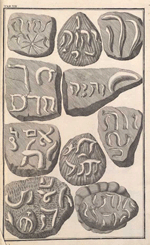
and, inspired by their success, the pranksters made ones with Syrian, Hebrew, and
Babylonian inscriptions, even one with the name Jehovah on it. Beringer "wholly, publicly
committed himself to the belief that fossils were merely the capricious
fabrications of God, hidden in the earth by Him for some inscrutable purpose;
possibly, thought Beringer, merely for His own pleasure; possibly as a test for
human faith" and proceeded to write a book on them. Alarmed, the
perpetrators told all--but he rejected their confession, claiming they were
trying to stop the publication of his proof of the stones' godly origins.
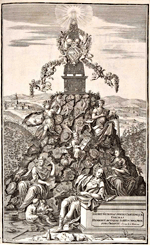
Beringer's masterpiece, Lithographiae Wirceburgensis, was printed in 1726. Soon
after, the doctor uncovered another "fossil." It had his name on it. Beringer's bubble of illusions
burst. Devastated, he tried to buy up all of the copies of his book, dying
penniless and heartbroken. The story, in this version, was "a memorial at
once of an almost incredible hoax, a colossal farce and a pitiful story of
broken ambition and humbled pride."
|
| Frontispiece |
But historians Melvin E. Jahn and
Daniel J. Woolf, who in 1963 produced the first English translation of
Beringer's book, showed the truth behind the tale lies not in farcical student
antics but in a slanderous plot by Beringer's jealous colleagues. Far from
dying as a result of his shame, Beringer initiated legal proceedings. The
stones were proved to be fake and the perpetrators revealed: J. Ignatz
Roderick, professor of geography, algebra, and analysis at the university, and
Georg von Eckhart, privy councillor and librarian to the bishop's court and
university. Eckhart
and Roderick were disgraced, but Beringer kept his job, lived another 14 years,
and published several more books.
Roderick and Eckhart had hired
17-year-old Christian Zanger to assist them. Roderick carved the stones, which
Zanger polished. In court, Zanger said Roderick devised the scheme
"because Beringer was so arrogant and despised them all." Zanger and
two other boys, Niklaus and Valentin Hehn, who were not in on the hoax, were
then hired by Beringer to excavate and collect the stones. Some were planted,
to be found by Zanger or the Hehns, others Zanger sold directly to Beringer.
 |
| Animal Fossils |
When Beringer announced his
intention to publish, Roderick and Eckhart spread rumors about the fossils'
authenticity. But Beringer thought they were trying to rob him of his great
discovery. "Our idiomorphic stones are not the handwrought products of
recent artistry," he wrote, "as some persons have shamelessly
pretended, and attempted to peddle to the public by widespread rumor and gossip."
Beringer was also aware that
Roderick had carved a few stones, planting some on the mountain and giving
others to "a stonecutter's helper" [Zanger] hired "to sell them
to me." In court, Zanger said this was "to see if [Beringer] could be
tricked into buying the false stones." When he "returned to the
residence of the privy councillor, they all had a big laugh that Dr. Beringer
was deceived by the stones." But the doctor refused to accept the
implications of this incident, asking "Does this mean that every iconolith
I have uncovered during the past six months smacks of imposture?" He
answered himself with a firm "no."
Beringer was taken in because he was
obstinate and because the stones fit the early 18th-century debate about the
origins of fossils (Gould 1998). He compared his stones against various
theories: relics of the Flood, the vagaries of Nature, created by a
"marvelous force of petrifying moisture and salts of the earth" or
some subterranean "generative vapor." But the 100 or so with
inscriptions, unlike anything found before, baffled him. "For whatever
power has fashioned [them] the agent...has surpassed his limits by employing
the art of writing, and has traced the characters of several languages, but
especially those of the sacred tongue, so exactly in accordance with the rules
of Hebrew orthography that they were adjudged in the opinion of experts to
extol in eloquent titles the most holy name, power, and wisdom of God, and thus
perhaps manifest the one and only author of these wondrous stones."
 |
| Inscriptions |
As Beringer describes the stones and
weighs the interpretations in his book, he passes by one telltale clue after
another: "The figures...are so exactly fitted to the dimensions of the
stones, that one would swear that they are the work of a very meticulous
sculptor." The fossils have a "smoothness suggesting the polished
effect of applied pumice, though the lower side retains its natural soiled
roughness." "One would swear that he discerned on many of them the
strokes of a knife gone awry...."
Beringer's experience shows how
hoaxers can exploit a single-minded belief that can blind those unwilling to
question their own initial conclusions despite mountains of evidence to the
contrary.
Trapped by their own hoax, Roderick
and Eckhart tried to shift the blame. Roderick threatened the Hehns with irons
and fetters if they did not admit to having carved and hidden the stones. They
promised Zanger "much money and many favors if he would state that the
Hehn brothers made the stones." To his credit, Zanger refused and the
hoaxers were disgraced. (He did, however, ask "the commission for help in
obtaining the wages owed to him by Roderick for eight days of stone polishing
for which he had received no compensation.")

© 2009 by the Archaeological Institute of America
archive.archaeology.org/online/features/hoaxes/beringer.html