Visualizzazione post con etichetta cina. Mostra tutti i post

sabato 21 febbraio 2015

I primi mammiferi


Earliest-known 

arboreal and subterranean 

ancestral mammals discovered 

  The fossils of two interrelated ancestral mammals, newly discovered in China, suggest that the wide-ranging ecological diversity of modern mammals had a precedent more than 160 million years ago. 


On the left are photos of the type specimen of Docofossor brachydactylus.  Docofossor was found in lake sediments of the Jurassic Ganggou fossil site  in Hebei Province of China. The fossil of Docofossor is preserved with dense  and carbonized furs around its skeleton. On the right is the fossil of  Agilodocodon scansorius. Found in lake sediments of the 165 million  years old Daohugou Fossil Site of Inner Mongolia of China, Agilodocodon  scansorius is preserved with a halo of dense, carbonized furs and hair  impressions. The horny claws on hands and feet are also preserved  [Credit: Zhe-Xi Luo, the University of Chicago] 


With claws for climbing and teeth adapted for a tree sap diet, Agilodocodon scansorius is the earliest-known tree-dwelling mammaliaform (long-extinct relatives of modern mammals). The other fossil, Docofossor brachydactylus, is the earliest-known subterranean mammaliaform, possessing multiple adaptations similar to African golden moles such as shovel-like paws. Docofossor also has distinct skeletal features that resemble patterns shaped by genes identified in living mammals, suggesting these genetic mechanisms operated long before the rise of modern mammals. These discoveries are reported by international teams of scientists from the University of Chicago and Beijing Museum of Natural History in two separate papers published Feb. 13 in Science (the papers can be found here and here). 
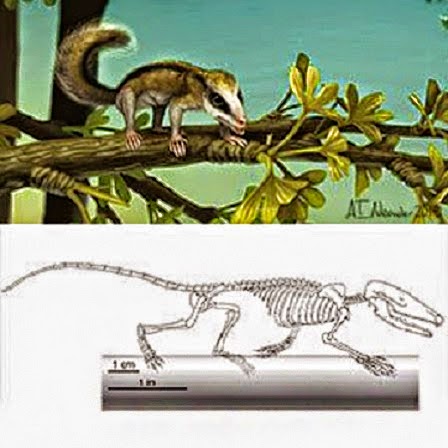


Skeletal and life style reconstructions of Agilodocodon scansorius, a docodont mammaliaform.  The skeletal features suggest that it was an agile and active animal living on trees.  Its incisors were specialized to feed on tree sap (exudate feeding), and its molars  suggest omnivorous feeding 
[Credit: April I. Neander/University of Chicago] 


"We consistently find with every new fossil that the earliest mammals were just as diverse in both feeding and locomotor adaptations as modern mammals," said Zhe-Xi Luo, PhD, professor of organismal biology and anatomy at the University of Chicago and an author on both papers. "The groundwork for mammalian success today appears to have been laid long ago." Agilodocodon and Docofossor provide strong evidence that arboreal and subterranean lifestyles evolved early in mammalian evolution, convergent to those of true mammals. These two shrew-sized creatures -- members of the mammaliaform order Docodonta -- have unique adaptations tailored for their respective ecological habitats.
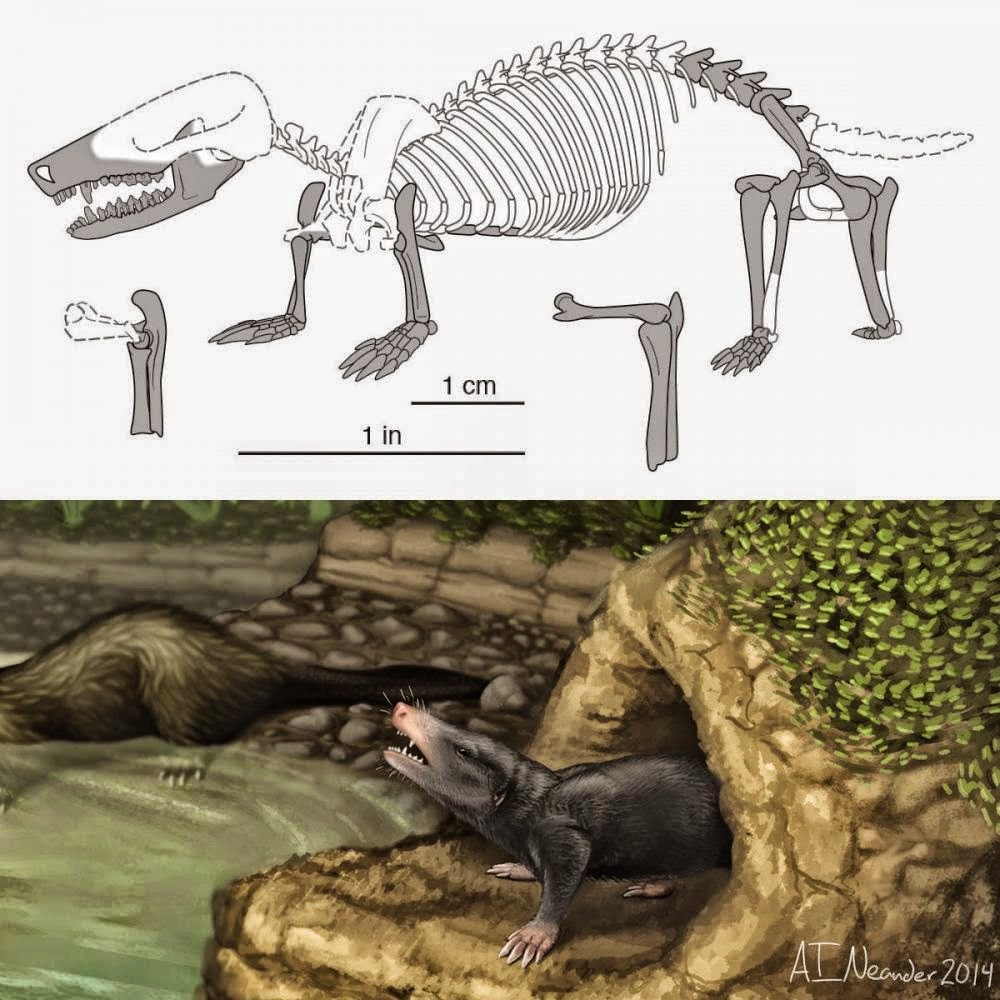


 Skeletal and life style reconstructions of Docofossor brachydactylus. Docofossor lived  in burrows on the lakeshore and fed on the worms and insects in the soil. Docofossor  is also unique in that it has one segment fewer of finger bone segments than most  other mammals, suggesting that it had a unique embryonic development  of its hands and feet [Credit: April I. Neander/University of Chicago] 


Agilodocodon, which lived roughly 165 million years ago, had hands and feet with curved horny claws and limb proportions that are typical for mammals that live in trees or bushes. It is adapted for feeding on the gum or sap of trees, with spade-like front teeth to gnaw into bark. This adaptation is similar to the teeth of some modern New World monkeys, and is the earliest-known evidence of gumnivorous feeding in mammaliaforms. Agilodocodon also had well-developed, flexible elbows and wrist and ankle joints that allowed for much greater mobility, all characteristics of climbing mammals. "The finger and limb bone dimensions of Agilodocodon match up with those of modern tree-dwellers, and its incisors are evidence it fed on plant sap," said study co-author David Grossnickle, graduate student at the University of Chicago. "It's amazing that these arboreal adaptions occurred so early in the history of mammals and shows that at least some extinct mammalian relatives exploited evolutionarily significant herbivorous niches, long before true mammals." 


An illustration of Agilodocodon and Docofossor. The skeletal features  of Agilodocodon (top left) suggeset it was an agile and active  arboreal animal. The skeletal features of Docofossor (bottom right)  suggest it lived in burrows and fed on worms and insects  [Credit: April I. Neander/University of Chicago] 


Docofossor, which lived around 160 million years ago, had a skeletal structure and body proportions strikingly similar to the modern day African golden mole. It had shovel-like fingers for digging, short and wide upper molars typical of mammals that forage underground, and a sprawling posture indicative of subterranean movement. Docofossor had reduced bone segments in its fingers, leading to shortened but wide digits. African golden moles possess almost the exact same adaptation, which provides an evolutionary advantage for digging mammals. This characteristic is due to the fusion of bone joints during development -- a process influenced by the genes BMP and GDF-5. Because of the many anatomical similarities, the researchers hypothesize that this genetic mechanism may have played a comparable role in early mammal evolution, as in the case of Docofossor. The spines and ribs of both Agilodocodon and Docofossor also show evidence for the influence of genes seen in modern mammals. Agilodocodon has a sharp boundary between the thoracic ribcage to lumbar vertebrae that have no ribs. However, Docofossor shows a gradual thoracic to lumber transition. These shifting patterns of thoracic-lumbar transition have been seen in modern mammals and are known to be regulated by the genes Hox 9-10 and Myf 5-6. That these ancient mammaliaforms had similar developmental patterns is an evidence that these gene networks could have functioned in a similar way long before true mammals evolved. "We believe the shortened digits of Docofossor, which is a dead ringer for modern golden moles, could very well have been caused by BMP and GDF," Luo said. "We can now provide fossil evidence that gene patterning that causes variation in modern mammalian skeletal development also operated in basal mammals all the way back in the Jurassic." 


Stem mammaliaforms—also known as stem mammals—are long-extinct relatives to   the extant mammals (crown Mammalia). Docodonts are a lineage of stem mammaliaforms.  Their morphologies provide evidence for the ancestral mammalian condition.  Their functional adaptations provide new insight on the ecological diversification  of the earliest mammals 
[Credit: April I. Neander/University of Chicago]


 Early mammals were once thought to have limited ecological opportunities to diversify during the dinosaur-dominated Mesozoic era. However, Agilodocodon, Docofossor and numerous other fossils -- including Castorocauda, a swimming, fish-eating mammaliaform described by Luo and colleagues in 2006 -- provide strong evidence that ancestral mammals adapted to wide-ranging environments despite competition from dinosaurs. "We know that modern mammals are spectacularly diverse, but it was unknown whether early mammals managed to diversify in the same way," Luo said. "These new fossils help demonstrate that early mammals did indeed have a wide range of ecological diversity. It appears dinosaurs did not dominate the Mesozoic landscape as much as previously thought." 

Author: Kevin Jiang 

Source: University of Chicago [February 14, 2015]

sabato 29 novembre 2014

Il pollo? Fu addomesticato in Cina.

Oldest example of chicken domestication found in China

 An international research team including a University of York biologist has found the earliest evidence for chicken domestication to date. 


Beijing Fatty Chicken, a local Chinese breed  [Credit: Huagui Liu] 


Michi Hofreiter, of the University of Potsdam in Germany and an Honorary Professor in York’s Department of Biology, led the research with Professor Xingbo Zhao from China Agricultural University in Beijing. 

The researchers obtained mitochondrial DNA sequences from up to 10,000 year old chicken fossils originating from northern China. 

At this age, the sequences are several thousands of years older than any other chicken ancient DNA sequences reported previously. 
Moreover, despite their age, the northern Chinese chicken sequences already represent the three major groups of mitochondrial DNA sequences present in the modern chicken gene pool, suggesting genetic continuity between these oldest chicken bones known worldwide and modern chicken populations. 

The research is reported in PNAS. 
Based on modern DNA sequences scientists had already suggested that chickens had been domesticated in different places in south and south-east Asia, but previously northern China had never been suggested as a location for chicken domestication. 

Professor Xingbo Zhao said: “People argued that northern China did not provide suitable habitat for red jungle fowl, the wild ancestor of domestic chickens but they do not take into account that climate and vegetation were very different 10,000 years ago.” 

The results not only suggest northern China as one of the earliest places for chicken domestication but also that the domestication of chicken, today the most important poultry species in the world, started as early as those of the other four agriculturally important animal species, cattle, pigs, goat and sheep. 

Moreover, the results provide further evidence for an early agricultural complex in northern China. 
Professor Hofreiter, who is also an associate member of the University of York’s Palaeo research centre, added: “These are really exciting results as they suggest that societies with mixed agriculture developed in northern China around the same time they did so in the Near East”. 

Source: University of York [November 24, 2014]

martedì 13 maggio 2014

La Teoria del grano e del riso.

 Una curiosità interessante: le differenze aggregative sociali tra Nord e Sud della Cina riproducono quelle più grandi esistenti fra Cina e Mondo Occidentale. 
Sembra che ciò dipenda - secondo questo studio psicologico antropologico - da differenti arttitudini indotte dal coltivare grano (nord della Cina) e coltivare riso (coltura tradizionale del sud della Cina).
Il primo tipo di coltura renderebbe gli uomini più orientato verso l'aggregazione in comunità, mentre il secondo tipo condurrebbe a maggiore individualismo.

"Rice theory" in China.

A new cultural psychology study has found that psychological differences between the people of northern and southern China mirror the differences between community-oriented East Asia and the more individualistic Western world -- and the differences seem to have come about because southern China has grown rice for thousands of years, whereas the north has grown wheat. 'Rice theory' explains north-south China cultural differences 


A new cultural psychology study has found that psychological differences between the people of northern and southern China mirror the differences between community-oriented East Asia and the more individualistic Western world -- and the differences seem to have come about because southern China has grown rice for thousands of years, whereas the north has grown wheat [Credit: Handout/Getty Images]


 "It's easy to think of China as a single culture, but we found that China has very distinct northern and southern psychological cultures and that southern China's history of rice farming can explain why people in southern China are more interdependent than people in the wheat-growing north," said Thomas Talhelm, a University of Virginia Ph.D. student in cultural psychology and the study's lead author. He calls it the "rice theory." The findings appear in the May 9 issue of the journal Science. Talhelm and his co-authors at universities in China and Michigan propose that the methods of cooperative rice farming -- common to southern China for generations -- make the culture in that region interdependent, while people in the wheat-growing north are more individualistic, a reflection of the independent form of farming practiced there over hundreds of years. "The data suggests that legacies of farming are continuing to affect people in the modern world," Talhelm said. "It has resulted in two distinct cultural psychologies that mirror the differences between East Asia and the West." According to Talhelm, Chinese people have long been aware of cultural differences between the north region and the southern, which are divided by the Yangtze River -- the largest river in China, flowing west to east across the vast country. People in the north are thought to be more aggressive and independent, while people to the south are considered more cooperative and interdependent. "This has sometimes been attributed to different climates -- warmer in the south, colder in the north -- which certainly affects agriculture, but it appears to be more related to what Chinese people have been growing for thousands of years," Talhelm said. He notes that rice farming is extremely labor-intensive, requiring about twice the number of hours from planting to harvest as does wheat. And because most rice is grown on irrigated land, requiring the sharing of water and the building of dikes and canals that constantly require maintenance, rice farmers must work together to develop and maintain an infrastructure upon which all depend. This, Talhelm argues, has led to the interdependent culture in the southern region. Wheat, on the other hand, is grown on dry land, relying on rain for moisture. Farmers are able to depend more on themselves, leading to more of an independent mindset that permeates northern Chinese culture. Talhelm developed his rice theory after living in China for four years. He first went to the country in 2007 as a high school English teacher in Guangzhou, in the rice-growing south. A year later, he moved to Beijing, in the north. On his first trip there, he noticed that people were more outgoing and individualistic than in the south. "I noticed it first when a museum curator told me my Chinese was clearly better than my roommate's," Talhelm said. "The curator was being direct and a little less concerned about how her statement might make us feel." After three years in China, including time as a journalist, he later went back as a U.Va. doctoral student on a Fulbright scholarship. "I was pretty sure the differences I was seeing were real, but I had no idea why northern and southern China were so different -- where did these differences come from?" Talhelm asked. He soon found that the Yangtze was an important cultural divider in China. "I found out that the Yangtze River helped divide dialects in China, and I soon learned that the Yangtze also roughly divides rice farming and wheat farming," he said. He dug into anthropologists' accounts of pre-modern rice and wheat villages and realized that they might account for the different mindsets, carried forward from an agrarian past into modernity. "The idea is that rice provides economic incentives to cooperate, and over many generations, those cultures become more interdependent, whereas societies that do not have to depend on each other as much have the freedom of individualism," Talhelm said. He went about investigating this with his Chinese colleagues by conducting psychological studies of the thought styles of 1,162 Han Chinese college students in the north and south and in counties at the borders of the rice-wheat divide. They found through a series of tests that northern Chinese were indeed more individualistic and analytic-thinking -- more similar to Westerners -- while southerners were interdependent, holistic-thinking and fiercely loyal to friends, as psychological testing has shown is common in other rice-growing East Asian nations, such as Japan and Korea. The study was conducted in six Chinese cities: Beijing in the north; Fujian in the southeast; Guangdong in the south; Yunnan in the southwest; Sichuan in the west central; and Liaoning in the northeast. Talhelm said that one of the most striking findings was that counties on the north-south border -- just across the Yangtze River from each other -- exhibited the same north/south psychological characteristics as areas much more distantly separated north and south. "I think the rice theory provides some insight to why the rice-growing regions of East Asia are less individualistic than the Western world or northern China, even with their wealth and modernization," Talhelm said. He expects to complete his Ph.D. next year, and this year received an Arts, Humanities and Social Sciences Research Fellowship from U.Va.'s Office of the Vice President for Research and the Graduate School of Arts & Sciences for an in-depth study of people from the rice-wheat border in China's Anhui province. 

 Source: University of Virginia [May 08, 2014]

Read more at: http://archaeologynewsnetwork.blogspot.it/2014/05/rice-theory-explains-north-south-china.html?utm_source=feedburner&utm_medium=feed&utm_campaign=Feed:+TheArchaeologyNewsNetwork+(The+Archaeology+News+Network)#.U3Ge0nYarpc
Follow us: @ArchaeoNewsNet on Twitter | groups/thearchaeologynewsnetwork/ on Facebook

martedì 6 agosto 2013

Le più antiche scritte cinesi


INCISIONI DI 5.000 ANNI FA, CONSIDERATE IL PRIMO CINESE SCRITTO.


5,000-year-old carvings believed to be first-written Chinese.


GLI ARCHEOLOGI RITENGONO DI AVERE SCOPERTO UNO DEGLI SCRITTI PRIMITIVI PIU' ANTICHI, RISALENTI A CIRCA 5.000 ANNI FA, NELL'EST DELLA CINA: ALCUNI DEI GRAFFITI RINVENUTI SU UN'ASCIA SPEZZATA ASSOMIGLIANO A MODERNI CARATTERI CINESI.

Archaeologists say they have discovered some of the world’s oldest known primitive writing, dating about 5,000 years ago, in eastern China, and some of the markings etched on broken axes resemble a modern Chinese character.

5,000-year-old carvings believed to be first-written Chinese
I DUE FRAMMENTI D'ASCIA GRAFFITI RINVENUTI A PINGHU, NELLA CINA ORIENTALE, NELLA PROVINCIA DI ZHEJIANG
The two inscribed stone axes were found in Pinghu, in eastern China's Zhejiang province [Credit: AP]
LE ISCRIZIONI SUI REPERTI DEL SITO A SUD DI SHANGHAI SONO CIRCA 1400 ANNI PIù ANTICHI DEL PIU' ANTICO CINESE SCRITTO FINORA RINVENUTO. GLI STUDIOSI SONO DIVISI CIRCA LA POSSIBILITA' CHE SI TRATTI DI SIMBOLI O FRASI COMPIUTE MA CONVENGONO SUL FATTO CHE QUESTE INCISIONI SERVIRANNO A GETTARE LUCE SULLE ORIGINI DEL LINGUAGGIO E DELLA CULTURA CINESI.

The inscriptions on artefacts found at a relic site south of Shanghai are about 1,400 years older than the oldest written Chinese language. Chinese scholars are divided over whether the markings are words or something simpler, but they say the finding will shed light on the origins of Chinese language and culture.

IL PIU' ANTICO LINGUAGGIO SCRITTO E' OGGI RITENUTO QUELLO ATTESTATO IN MESOPOTAMIA E RISALENTE A POCO PIU' DI 5.000 ANNI FA. QUESTI CARATTERI CINESI SONO RITENUTI ESSERE UNO SVILUPPO DEL TUTTO INDIPENDENTE.

The oldest writing in the world is believed to be from Mesopotamia, dating slightly more than 5,000 years ago. Chinese characters are believed to have been developed independently.

SONO STATE RINVENUTE SU PIU' DI 200 PEZZI, SCAVATI DAL SITO NEOLITICO DI LIANGZHU. I PEZZI SI TROVAVANO TRA MIGLIAIA DI FRAMMENTI CERAMICI, LAPIDEI, DI GIADA, LIGNEI, EBURNEI ED OSSEI, RESTITUITI DAL SITO TRA IL 2003 ED IL 2006, COME HA DICHIARATO IL  CAPO ARCHEOLOGO XU XINMIN.

Inscriptions were found on more than 200 pieces dug out from the Neolithic-era Liangzhu relic site. The pieces are among thousands of fragments of ceramic, stone, jade, wood, ivory and bone excavated from the site between 2003 and 2006, lead archaeologist Xu Xinmin said.

LE ISCRIZIONI NON SONO STATE ESAMINATE DA ESPERTI FUORI DELLA CINA, MA UN GRUPPO DI ARCHEOLOGI ED EPIGRAFISTI  CINESI SI SONO RADUNATI ALL'INIZIO DI  LUGLIO PER DISCUTERE L'ARGOMENTO.

The inscriptions have not been reviewed by experts outside the country, but a group of Chinese scholars on archaeology and ancient writing met last weekend in Zhejiang province to discuss the finding.

HANNO CONVENUTO CHE GLI SCRITTI NON SONO SUFFICIENTI PER DEDURNE L'ESISTENZA DI UN SISTEMA SCRITTORIO SVILUPPATO, MA XU SOSTIENE CHE ESSI INCLUDANO L'EVIDENZA DI PAROLE, SULLA SUPERFICIE DEI FRAMMENTI DI ASCE.

They agreed that the inscriptions are not enough to indicate a developed writing system, but Xu said they include evidence of words on two broken stone-ax pieces.

UNO DEI PEZZI INFATTI RIPORTA UNA SERIE DI SEI SEGNI SIMILI A PAROLE, ASSEMBLATI IN MODO DA SUGGERIRE UNA FRASE.

One of the pieces has six word-like shapes strung together to resemble a short sentence.

SONO DIFFERENTI DAI SIMBOLI VISTI IN PRECEDENTI REPERTI: LA SEQUENZA E' SIMILE A QUELLA DI UNA FRASE, COME SE CERCASSE DI ESPRIMERE QUALCHE PRECISO SIGNIFICATO.

“They are different from the symbols we have seen in the past on artefacts,” Xu said. “The shapes and the fact that they are in a sentence-like pattern indicate they are expressions of some meaning.”

5,000-year-old carvings believed to be first-written Chinese
DETTAGLIO DEI GRAFFITI DELLE PIETRE RINVENUTE A PINGHU
Detail of the carvings a a stone axe found in Pinghu, Zhejiang province [Credit: Xinhua]

I SEI CARATTERI SONO ALLINEATI IN UNA RIGA, E TRE DI ESSI ASSOMIGLIANO AL MODERNO CINESE USATO PER INDICARE GLI ESSERI UMANI. CIASCUN CARATTERE POSSIEDE DA DUE A CINQUE TRATTI.

The six characters are arranged in a line, and three of them resemble the modern Chinese character for human beings. Each shape has two to five strokes.

SE CINQUE O SEI CARATTERI SONO INTERCONNESSI COME IN UNA FRASE, NON SI TRATTEREBBE PIU' DI SIMBOLI, BENSI' DI PAROLE - SECONDO CAO JINYANG EPIGRAFISTA DI LINGUE ANTICHE DELLA SEDE DI HANGZOU DELL'UNIVERSITA' DI ZHEJIANG . I SEGNI, SECONDO LUI, DOVREBBERO ESSERE CONSIDERATI GEROGLIFICI.

“If five to six of them are strung together like a sentence, they are no longer symbols but words,” said Cao Jinyan, a scholar on ancient writing at Hangzhou-based Zhejiang University. He said the markings should be considered hieroglyphics.

ASSERISCE CHE ESISTONO INCISIONI ISOLATE COMPOSTE DA PIU' SEGNI CHE, SE SI CONSIDERA LA COMPOSIZIONE, DEVONO ESSERE PIU' CHE SEMPLICI SIMBOLI.

He said there are also stand-alone shapes with more strokes. “If you look at the composition, you will see they are more than symbols,” Cao said.

LIU ZHAO, ARCHEOLOGO DELL'UNIVERSITà FUDAN DI SHANGAI AMMONISCE CHE IL MATERIALE NON E' PURTROPPO ANCORA SUFFICIENTE PER TRARNE CONCLUSIONI.

But archaeologist Liu Zhao from Shanghai-based Fudan University warned that there was not sufficient material for any conclusion.

“I don’t think they should be considered writing by the strictest definition,” Liu said. “We do not have enough material to pin down the stage of those markings in the history of ancient writings.”

PER IL MOMENTO, IL CONSENSO PROVVISORIO CONSIDERA LE ISCRIZIONI DI LIANGZHU COME QUALCHE COSA DI INTERMEDIO TRA I SIMBOLI E LE PAROLE, CIOE' UNA FORMA PRIMITIVA DI SCRITTURA.

For now, the Chinese scholars have agreed to call it primitive writing, a vague term that suggests the Liangzhu markings are somewhere between symbols and words.

LA PIU' ANTICA FORMA DI LINGUAGGIO CINESE SCRITTO ATTESTATO ED ACCETTATO RESTA PERTANTO QUELLA RINVENUTA SU OSSA ANIMALI - CONOSCIUTE COME OSSA ORACOLARI - E RISALENTI A3.600 ANNI FA, AL PERIODO DELLA DINASTIA SHANG.

The oldest known Chinese writing has been found on animal bones – known as oracle bones – dating to 3,600 years ago during the Shang dynasty.

Source: Associated Press [July 11, 2013]