Visualizzazione post con etichetta Spain. Mostra tutti i post

domenica 10 maggio 2015

Fiori per la Signora in Rosso.

La sensibilità umana non è certamente di recente origine. Si tratta di una serie di comportamenti che attribuiamo a sentimenti 'superiori' che però - qualche volta - ci sembra di riscontrare persino negli animali. Cerchiamo allora di giustificarli in vario modo ('istinto', riflessi condizionati, etc), a seconda della nostra cultura di provenienza e della relativa preparazione e 
anche degli eventuali sensi religiosi di ciascuno di noi.

Di fatto, nella regione basca (grotta di El Miron, in Cantabria, scoperta già nel 1903, ma sotto studio ancora oggi per le grande ricchezza e varietà di reperti che offre, essendo stata in uso dal Paleolitico al Bronzo) è stata recentemente trovata una deposizione che data indietro fino al Paleolitico Superiore (16.000 anni fa) e che riguarda una donna dell'apparente età di 35/40 anni, con ossa tinte di rosso, accompagnata dalla deposizione di fiori interi appartenente al genere Chenopodium.

Sono state prese in esame tutte le possibilità, circa la presenza dei fiori interi nel sito.
Dopo l'accurata considerazione del clima (che era piuttosto freddo, allora), della flora di quell'area e degli usi ipotizzabili anche per scopi decorativi, o alimentari, o depurativi dell'aria, l'unica conclusione possibile sembra proprio essere quella di un omaggio floreale alla defunta.

Ed è proprio quella che ci piace di più.


Traces of flowers placed on Palaeolithic grave found 

The burial of the so-called Red Lady, dating back to the Upper Palaeolithic, was discovered in El Mirón cave (Cantabria) in 2010. 
The Journal of Archaeological Science has devoted a special edition to all the studies conducted at this unique burial site, because there are hardly any Palaeolithic tombs like this one which is intact and which has not been contaminated. One study is the research led by the UPV/EHU's Ikerbasque lecturer Mª José Iriarte, who analysed the remains of fossilised pollen dating back more than 16,000 years ago and which appeared on the tomb. 
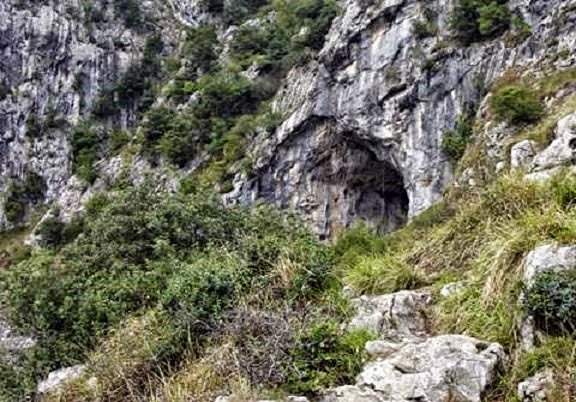


El Mirón cave, Ramales de la Victoria, Kantabria  
[Credit: UPV/EHU] 


"They put whole flowers on the tomb, but it has not been possible to say whether the aim of placing plants was to do with a ritual offering for the dead person, or whether it was for a simpler purpose like, for example, to ward off the bad smells associated with the burial," explained Iriarte. 

El Mirón cave (Ramales de la Victoria, Cantabria, Spain) was inhabited between the Middle Palaeolithic and the Bronze Age and therefore contains a significant archaeological deposit. 
It had been known since 1903, but systematic archaeological investigations did not begin until 1996 (led by L. G. Straus and M. González-Morales) and it was not until the 2010 campaign that a human burial site was found in the levels corresponding to the Cantabrian Lower Magdalenian. 

The grave containing the osseous remains of a woman aged between 35 and 40 is located at the back of the cave in a small space between the wall and a block that has come away from the roof. What is more, there are various engravings on this block that could belong to the same period as the burial. 
The reddish colour of the bones and the sediment in which they lie point to the use of ochre as part of the interment. 
Hence the name ‘Red Lady' given to the remains. 


This is fossilised pollen of Chenopodiaceae which was  found on the grave 
[Credit: UPV/EHU] 


In this context, the researchers in the UPV/EHU's Prehistory Group, the Ikerbasque Lecturer Mª José Iriarte and the lecturer Alvaro Arrizabalaga, together with the University of Zaragoza lecturer Gloria Cuenca, have studied the environmental conditions under which the burial took place and have analysed the pollen and spores preserved in the sediment together with the microfauna remains recovered. 

During the Lower Magdalenian age in which the burial took place the environmental conditions around El Mirón cave were, as in the rest of the Cantabrian region, very cold and fairly dry. 
This influenced the plant landscape, characterised by the sparse tree cover comprising pines and birches. 
Nevertheless, at the end of this period in the Magdalenian, there was an improvement in the climate which signified a slight increase in the tree-covered areas and the record of the hazelnut tree among its components. 
At the sepulchral level in the cave and there only, the UPV/EHU researchers found a high concentration of pollen of plants of a single family, the so-called Chenopodiaceae. 

The appearance of part of this pollen grouped together with the absence of this taxon in other records of the same archaeological level from other parts of the cave suggest that they did not appear naturally reflecting the plant landscape around the cavity. 

Having ruled out other possibilities for various reasons, like the fact that these plants may have been used for food or therapeutic purposes, "the most plausible hypothesis is that complete flowers were placed on the tomb," explained Uriarte. 
"It has not been possible to say whether the aim of placing these plants was to give the dead woman a ritual offering, or whether they fulfilled a more simple purpose linked, for example, to hygiene or cleansing," she added.  
"With their small, generally white or yellowish flowers we would not regard them as colourful plants today," explained Iriarte, "although we cannot apply the Principle of Actualism to human conduct in these merely aesthetic matters.

" Source: University of the Basque Country [May 07, 2015]

domenica 3 maggio 2015

NON (sempre) UNA CULTURA EGALITARIA

I ricercatori di buon senso sanno che devono avere uno schema di riferimento, per non perdersi nel corso di ricerche talvolta totalizzanti. Ma sanno anche che detti schemi non possono e non devono essere mai considerati assoluti in modo rigido: si corre il rischio di avere una visione troppo cristallizzata degli ambienti umani che - lo si sa anche troppo bene - sono sempre in continua evoluzione. Secondo una ricercatrice spagnola (forse lei preferirebbe la definizione "basca"), è questo anche il caso della presunta 'uguaglianza assoluta' durante il neolitico. Dallo studio di alcuni resti umani (148 individui in totale) reperiti in strutture dolmeniche comunitarie (sette deposizioni megalitiche in totale), ha formulato l'ipotesi che tombe di così grande impegno fossero riservate solamente ad alcuni e con certezza non a tutti (sono esclusi bimbi al di sotto dei 5 anni, anziani e donne). E' ancora sotto indagine il criterio di esclusione. Si pensa che lo studio in corso (presso l'Oxford University) degli isotopi stabili dei resti potrà fornire ulteriori indizi.


Research challenges view that Neolithic societies 

were egalitarian 


The data obtained by Teresa Fernández-Crespo in seven megalithic graves in La Rioja and Araba-Álava suggest that certain individuals were excluded from burial on the basis of age and sex.


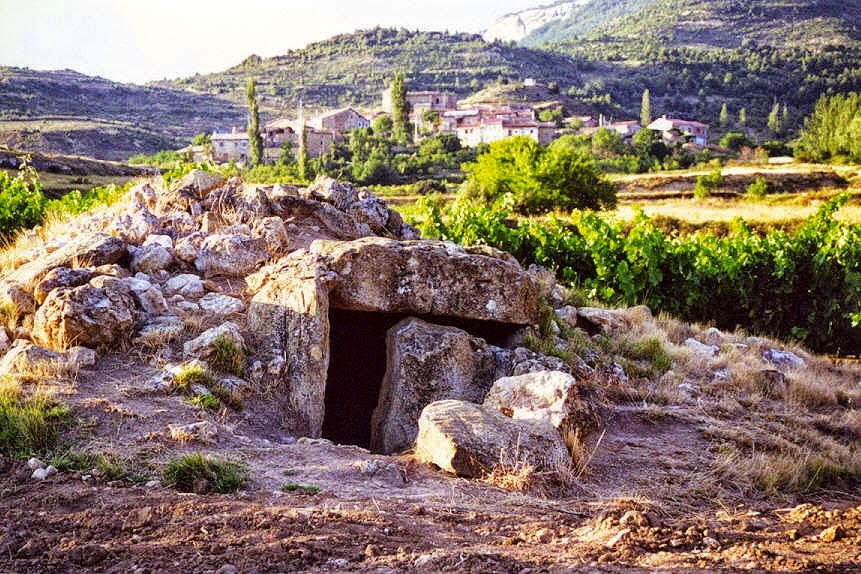
 A megalithic grave in La Cascaja (Rioja, Spain)


 [Credit: Vallenajerilla.com] 


The research Demographic evidence of selective burial in megalithic graves of northern Spain by Teresa Fernández-Crespo and Concepción de la Rúa of the Department of Genetics, Physical Anthropology and Animal Physiology of the UPV/EHU-University of the Basque Country challenges the widely-held view that societies were egalitarian during the late Neolithic and Chalcolithic ages.

This work, published in the leading Journal of Archaeological Science, comes from Fernández-Crespo's PhD thesis entitled Antropología y prácticas funerarias en las poblaciones neolíticas finales y calcolíticas de la región natural de La Rioja (Anthropology and funeral practices in late Neolithic and Chalcolithic populations in the natural region of La Rioja). 

The data obtained by Teresa Fernández-Crespo in seven megalithic graves in La Rioja and Araba-Álava suggest that certain individuals were excluded from burial on the basis of "criteria relating to age and possibly sex." 

So the existence of a funerary recruitment system that marginalised a considerable proportion of the population, according to the UPV/EHU researcher, could be pointing to the fact that the collective use of a shared burial area, which has often been understood as an egalitarian sign of megalithic societies, could in actual fact be masking the privileges of communities that were starting to become hierarchized. 

"In the article we propose that the people buried were intentionally selected. 

We do so by basing ourselves on the fact that the demographic composition of the megaliths displays significant anomalies with respect to a natural population of an ancient type. 
The bias identified, which almost systematically affects children under five, but certain adults as well, above all female ones, could be indicating that access to graves was restricted to those people who enjoyed certain rights and privileges only, against what is usually maintained in the traditional archaeological literature," says Teresa Fernandez-Crespo. 

The work signed by Teresa Fernández-Crespo and Concepción de la Rúa has studied seven dolmens: two of them located in a municipality of the current province of Araba-Álava (Alto de la Huesera and San Martín, both in Laguardia) and five in localities in the Autonomous Community (region) of La Rioja (La Cascaja in Peciña, Collado del Mallo in Trevijano, Peña Guerra II in Nalda, Collado Palomero I in Viguera and Fuente Morena in Montalvo de Cameros). 

The number of individuals found in these seven megalithic graves varies and ranges between less than ten (in the case of Fuente Morena, for example) and over a hundred subjects (in the case of Alto de la Huesera), making a total of 248.

 Isotope analysis  

With respect to the idea that the monuments were burial spaces reserved for a specific group of the population, one possible explanation, although not the only one, concludes Fernández-Crespo, could be related to the existence of different statuses within the population.

 "If we accept this hypothesis, it would be plausible that the remains of those who had a lower social position (and for that reason may not have met the access requirements to be included in the dolmens) were laid to rest in other burial structures the building and maintenance of which would require less effort, like, for example, natural caves, sheltered spaces under rock or pits. 

However, the current state of the research does not allow the refutation that other causes relating to the population or culture could account for this selection of those buried. In this respect, it is possible that the analysis of stable isotopes that we are currently carrying out at Oxford University on the skeletal remains from some of these graves could shed some light on the matter." 

Source: University of the Basque Country

 [April 30, 2015]

domenica 19 aprile 2015

Il Clima e l' Uomo.

Esiste una correlazione diretta tra la geografia e l'Uomo, si sa. E questa correlazione - che vale per tutte le creature viventi - è mediata dal Clima, una variabile che ha sempre influenzato gli spostamenti, la quantità e la qualità di vita di tutti i viventi.


Earliest humans migrated to Europe 

1.4 million years ago 

thanks to rising temperatures 


 A warming climate may have enabled the earliest humans to venture into Western Europe 1.4 million years ago, a new study suggests. 

The Acheulean tool technology period - between 700,000 an 300,000 years ago - followed  the more primitive Oldowan period. 


Tools at the time included large stone hand-axes  made from flint and quartzite, used to scavenge from carcasses  
[Credit: Nico Tondini/Robert Harding World Imagery/Corbis]


 Researchers believe that the spread of our distant human ancestors, the hominins, had been halted by colder and drier temperatures. 
But as conditions warmed, they were able to branch out from Africa into Spain, and ultimately spread across Europe. The research was led by Dr Jordi Agusti from the Catalan Institution for Research and Advanced Studies (ICREA). 

Published in the Journal of Human Evolution, the paper suggests climate change affected the amount of resources available.

The theory is based on analysis of the Barranco León site in the Guadix-Baza Basin in southeast Spain. 
Here, simple Oldowan tools have previously been found, linked to the earliest known hominins 1.4 million years ago.
 But they were not able to migrate to this region until conditions improved.

 The researchers said that the early Pleistocene era (the era lasted from 2.59 million to 11,700 years ago) was characterised by colder and drier weather. 
This ‘possibly impeded the settlement of this region by the early hominin population from the southern Caucasus,’ the researchers wrote. 

But shortly afterwards, ‘when the climatic conditions were again favourable, a hominin presence is suddenly evidenced.’ 
It should be noted that the warming climate referred to here is on a vastly longer time scale than modern climate change. 
At the time 1.4 million years ago, though, temperatures warmed above 13°C (55°F) and humidity increased, allowing hominins to inhabit the region - scavenging carcasses in the region with the help of tools. 
‘The data reported here clearly support the idea that the early hominin occupation of Europe was strongly constrained by climatic and environmental conditions, rather than by physiography or cultural factors,’ the researchers wrote. 

Author: Jonathan O'Callaghan | Source: Daily Mail Online [April 14, 2015]

mercoledì 23 luglio 2014

Selce e territorio

Selce e territorio dei gruppi Paleolitici.

Oggi è il petrolio: nel paleolitico, i gruppi di cacciatori raccoglitori gravettiani competevano per la selce, che era la loro principale 'ricchezza'.
Emerge da uno studio spagnolo, pubblicato sul Journal of Anthropological Research.


Flint sources determined the economic territory of Upper Palaeolithic groups 


 Never before had the mobility patterns and management of lithic resources in the Upper Palaeolithic been determined so precisely. 

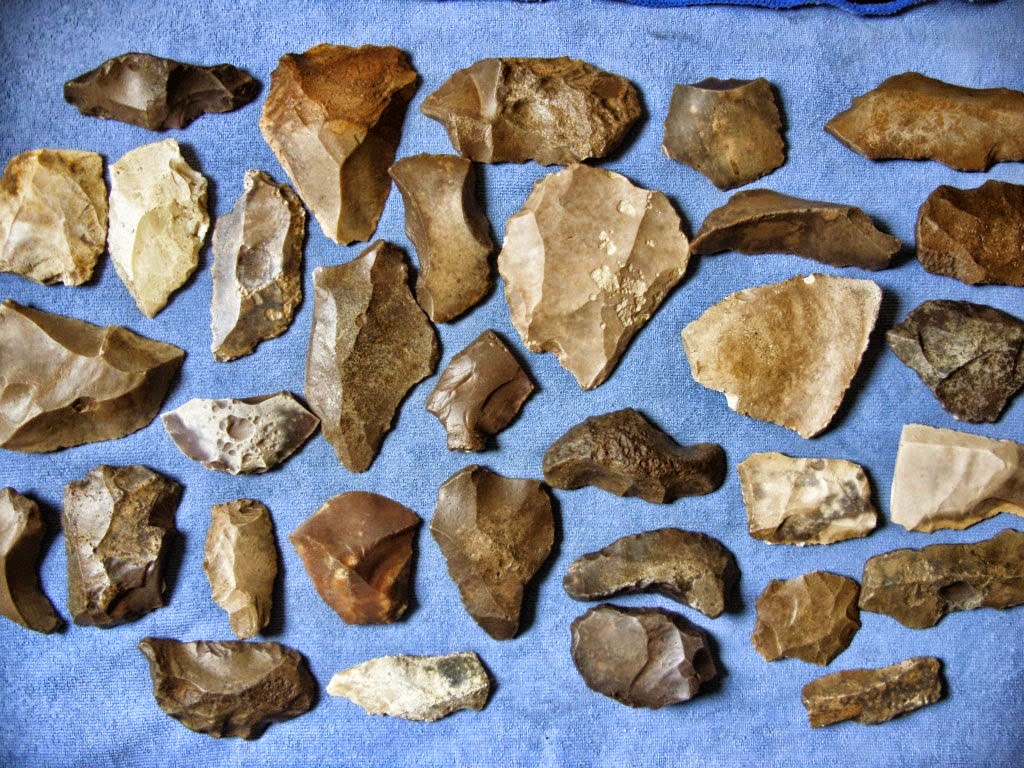
The study of flint remains found in the open-air Ametzagaina site in Donostia-San Sebastian has determined the economic territory of the human groups that lived there for about 2,000 years. 

The paper, Where to and What for? Mobility Patterns and the Management of Lithic Resources by Gravettian Hunter-Gatherers in the Western Pyrenees, has been published in the Journal of Anthropological Research. 


The study of flint remains found in the open-air Ametzagaina site in Donostia-San Sebastian  has determined the economic territory of the human groups that lived there for about  2,000 years [Credit: Archaiologia Online] 


The first inhabitants of Donostia-San Sebastian lived about 25,000 years ago in the spot known today as the Ametzagaina park. 
Cro-Magnons of the Upper Palaeolithic set up their camps there for a couple of millennia, as shown by the remains in the open-air site. Sites of this type are much more difficult to locate than those found in caves and, what is more, "in theory they are not a good basis for drawing conclusions as they tend to provide little more than the remains of lithic industry," explained Álvaro Arrizabalaga. 
On this site, the oldest in the Donostia-San Sebastian area, however, a significant set of flint items were found. 
Despite the fact that the area has changed a lot, this find was made possible by the fact that the lines of attack and defence of Donostia-San Sebastian during the Carlist Wars [1833-1876] were located in this area, and there were parts of the site that had been buried and protected under the earth banks beside the trenches. 
Numerous flint tools were found while taking samples under these banks. 
The rock is endowed with excellent properties for carving, an art mastered by those human groups. 
In fact, in the Gravettian culture to which the Cro-Magnons of Ametzagaina belonged, clear technological progression took place in this sphere. 


Map showing areas where flint was obtained for Ametzagaina site during  the Gravettian period [Credit: UPV/EHU] 


These groups were nomads: they had no permanent settlements, but temporary camps instead and basically moved around a territory indefinitely.  
"Determining where they obtained the flint makes it possible to establish their economic territory. 
The cultural territory, that of art, is much broader, it would cover the whole of Western Europe," explained the Arts Faculty lecturer. 
"Flint was their steel, but it was not abundant, they had to know the locations where there were seams, they made their way there, they rough-hewed it on the spot and returned to their camps just with whatever they could make use of," he added. 
The researchers also compared the remains in this site with those in other nearby sites; they found that outcrops of peninsular flint were worked in 90% of the sites in the Peninsular Basque Country, and that outcrops of the Continental Basque Country were worked in 90% of the sites in the Northern Basque Country. 
In other words, the exploitation area tended to be radial and cover about 100 km2. But this is not the case in Ametzagaina. 
"They exploited the outcrops on both sides of the Pyrenees, their territory was shaped like a sandglass because it gets thinner across the Bidasoa pass," pointed out the researcher. In fact, flint from Chalosse, in the south of Les Landes, was found on the site; it was used to make arrowheads and spears, because the mineral obtained there was of exceptional quality and large format; and they also found flint from Kurtzia on the Biscay coast to the north of Bilbao, and from the Urbasa ridge, in the northwest of Navarre, in addition to what they obtained at the nearby Donostia-San Sebastian site of Gaintxurizketa. But, as Arrizabalaga pointed out, "it was more than their flint territory, it was the area where they hunted, gathered and fished. 
It was their economic territory." 


Source: University of the Basque Country 


[July 21, 2014]

Read more at: http://archaeologynewsnetwork.blogspot.it/2014/07/flint-sources-determined-economic.html?utm_source=feedburner&utm_medium=feed&utm_campaign=Feed:+TheArchaeologyNewsNetwork+(The+Archaeology+News+Network)#.U8-PyeN_uSo
Follow us: @ArchaeoNewsNet on Twitter | groups/thearchaeologynewsnetwork/ on Facebook

lunedì 14 luglio 2014

Datazione dei metalli: ora è possibile.

Ebbene, sì: ora è possibile datare i metalli, con la voltammetria. Una datazione incrociata di vari oggetti ne ha dimostrato l'effidabilità (vedi: http://it.wikipedia.org/wiki/Voltammetria).

Spero quindi che smetterete - una volta e per tutte - di scassarci metodicamente i cabbasisi con la datazione inventata delle tavolette di 
Tzricottu (*).


(*) Ne esiste una solamente, è in metallo: è stato dimostrato che 'le altre' sono solamente calchi in gesso malamente falsificati dall'unico esemplare realmente esistente (perché sono troppo simili alla prima ed unica 'tavoletta': più esatto sarebbe chiamarla 'matrice'). Inoltre, non si tratta affatto di scrittura, bensì di una decorazione (simmetrica! mai nessuna scrittura al mondo è stata simmetrica), da trasferire su cuoio. 
La fattura farebbe infatti propendere per uno stampo medioevale. 
Da notare che dette tavolette sono visibili solamente in fotografia. Viene proprio da pensare che le somiglianze con il fatto dell'uomo di Piltdown siano davvero troppe! 
E che basarsi 'scientificamente' su tale materiale sia più adatto ad un ciarlatano...

New method for dating copper and bronze artefacts 

 How can the age of archeological objects be determined if the well-established carbon dating method does not apply, for example for metal objects? 

Spanish and Portuguese scientists have now introduced a technique for dating artifacts made of copper and bronze. Presented in the journal Angewandte Chemie, their electroanalytical method is based on the voltammetry of microparticles. It compares various corrosion products that form over long periods of time and works with only a few nanograms of material so it causes almost no damage. 


Voltammetry of microparticles used to date archeological artefacts  made of copper and bronze [Credit: © Wiley-VCH] 


Voltammetric experiments produce current–voltage curves that have characteristic shapes for many compounds. In order to date copper-containing, archaeological finds, a team led by Antonio Doménech-Carbó at the University of Valencia examined the ratios of two different copper oxides, tenorite and cuprite, that can be differentiated and quantified based on their voltammetric curves. When they are exposed to air, copper surfaces become covered by a natural layer of cuprite (Cu2O). Over time, this layer is slowly converted to other products of corrosion. As copper-containing objects age in a slightly corrosive environment, without contact with soils or sea air, a layer of tenorite (CuO) continuously forms over the primary cuprite patina. 
This occurs because cuprite reacts with oxygen from the air to preferentially form tenorite in an atmosphere containing CO2 or in the presence of calcareous materials. Examination of copper coins by scanning electron microscopy coupled with X-ray spectroscopy confirmed the presence of cuprite and tenorite.
 To carry out the electroanalytical experiments, the researchers impregnate a graphite bar electrode with paraffin and dab the surface of the artifact with it. A few nanograms of the sample surface stick to the electrode, which is then dipped into an aqueous electrolyte. 
This causes almost no damage to the object. Copper oxide microparticles result in very characteristic peaks in the resulting current–voltage curves. Of particular interest to the researchers is the ratio of the current peaks for tenorite and cuprite. It shows a steady increase with increasing corrosion time, as demonstrated with a series of antique coins from various collections, including the Prehistory Museums of València and Xàtiva (Spain), as well as the artificial ageing of Euro cent coins made of copper. 
The researchers were able to use the coins to establish a calibration curve that can be used to date objects of unknown age. The voltammetric dating of a water pitcher from the Caliphal period and a Montefortino helmet from the Roman age gave ages of 1050±80 and 2150±150 years, respectively, which agree well with dates previously established from the archaeological context. 

Source: Angewandte Chemie [July 11, 2014] 

sabato 28 giugno 2014

Neanderthal: anche vegetali nella dieta

E' forse solo una curiosità per il vasto pubblico, ma questo studio per la prima volta dimostra che i Neanderthal mangiavano anche vegetali. E' sempre stato descritto come un mangiatore specialista (solo carne da grandi mammiferi), pertanto costretto ad inseguire nelle migrazioni il proprio cibo e per questo condannato infine all'estinzione.
Questo studio (PLoS ONE) è stato eseguito da scienziati del MIT, in Spagna.
Dimostra inequivocabilmente - per la prima volta - che Neanderthal era onnivoro.
Si tratta di un altro tassello di Verità che s'aggiunge ai precedenti, nel ridare finalmente al Neanderthal una figura più verosimile e vicina alla realtà.
Study provides first direct evidence of plants in

 Neanderthal diet

 The popular conception of the Neanderthal as a club-wielding carnivore is, well, rather primitive, according to a new study conducted at MIT. Instead, our prehistoric cousin may have had a more varied diet that, while heavy on meat, also included plant tissues, such as 
tubers and nuts. 

The popular conception of the Neanderthal as a club-wielding carnivore is, well,  rather primitive, according to a new study conducted at MIT. Instead, our prehistoric cousin  may have had a more varied diet that, while heavy on meat, also included plant tissues,  such as tubers and nuts [Credit: Christine Daniloff/MIT] 


Scientists from MIT and the University of La Laguna in Spain have identified human fecal remains from El Salt, a known site of Neanderthal occupation in southern Spain that dates back 50,000 years. The researchers analyzed each sample for metabolized versions of animal-derived cholesterol, as well as phytosterol, a cholesterol-like compound found in plants. While all samples contained signs of meat consumption, two samples showed traces of plants -- the first direct evidence that Neanderthals may have enjoyed an omnivorous diet. "We have passed through different phases in our interpretation of Neanderthals," says Ainara Sistiaga, a graduate student at the University of La Laguna who led the analysis as a visiting student at MIT. She and her colleagues have published their study in the journal PLoS ONE. 
"It's important to understand all aspects of why humanity has come to dominate the planet the way it does," adds co-author Roger Summons, a professor of geobiology in MIT's Department of Earth, Atmospheric and Planetary Sciences. "A lot of that has to do with improved nutrition over time." Unearthing a prehistoric meal While scientists have attempted to reconstruct the Neanderthal diet, much of the evidence has been inconclusive. For example, researchers have analyzed bone fragments for carbon and nitrogen isotopes -- signs that Neanderthals may have consumed certain prey, such as pigs versus cows. But such isotopic data only differentiate between protein sources -- underestimating plant intake, and thereby depicting the Neanderthal as exclusively carnivorous. 


The top panels show the coprolite, while the bottom panels show phosphate fluorescing  under blue light [Credit: PLOS ONE] 


Other researchers recently identified plant microfossils trapped in Neanderthal teeth -- a finding that suggests the species may have led a more complex lifestyle, harvesting and cooking a variety of plants in addition to hunting prey. But Sistiaga says it is also possible that Neanderthals didn't eat plants directly, but consumed them through the stomach contents of their prey, leaving traces of plants in their teeth. Equally likely, she says, is another scenario: "Sometimes in prehistoric societies, they used their teeth as tools, biting plants, among other things. We can't assume they were actually eating the plants based on finding microfossils in their teeth." Signs in the soil For a more direct approach, Sistiaga looked for fecal remains in El Salt, an excavation site in Alicante, Spain, where remnants of multiple Neanderthal occupations have been unearthed. Sistiaga and her colleagues dug out small samples of soil from different layers, and then worked with Summons to analyze the samples at MIT. 


A view of El Salt archeological site [Credit: Ainara Sistiaga] 


In the lab, Sistiaga ground the soil into a powder, then used multiple solvents to extract any organic matter from the sediment. Next, she looked for certain biomarkers in the organic residue that would signal whether the fecal remains were of human origin. Specifically, Sistiaga looked for signs of coprostanol, a lipid formed when the gut metabolizes cholesterol. As humans are able to break down more cholesterol than any other mammal, Sistiaga looked for a certain peak level of coprostanol that would indicate the sample came from a human. She and Summons then used the same geochemical techniques to determine the proportions of coprostanol -- an animal-derived compound -- to 5B-stigmastanol, a substance derived from the breakdown of phytosterol derived from plants. Each sample contained mostly coprostanol -- evidence of a largely meat-based diet. However, two samples also held biomarkers of plants, which Sistiaga says may indicate a rather significant plant intake. As she explains it, gram for gram, there is more cholesterol in meat than there is phytosterol in plants -- so it would take a significant plant intake to produce even a small amount of metabolized phytosterol. In other words, while Neanderthals had a mostly meat-based diet, they may have also consumed a fairly regular portion of plants, such as tubers, berries, and nuts. "We believe Neanderthals probably ate what was available in different situations, seasons, and climates," Sistiaga says. Sistiaga, Summons, and their colleagues plan to use similar geochemical biomarker techniques, coupled with micromorphological analysis, to analyze soil samples in Olduvai Gorge, Tanzania -- a 1.8-million-year-old site where some of the earliest evidence of human ancestry have been discovered. "We're working in a micro context," Sistiaga says. "Until now, people have carried out residue analysis on pots, tools, and other objects, but 90 percent of archaeology is sediment. We're opening a new window to the information that is enclosed in Paleolithic soil and sediment." 


Author: Jennifer Chu | 

Source: Massachusetts Institute of Technology [June 25, 2014]

Read more at: http://archaeologynewsnetwork.blogspot.it/2014/06/study-provides-first-direct-evidence-of.html?utm_source=feedburner&utm_medium=feed&utm_campaign=Feed:+TheArchaeologyNewsNetwork+(The+Archaeology+News+Network)#.U65poih7DfU
Follow us: @ArchaeoNewsNet on Twitter | groups/thearchaeologynewsnetwork/ on Facebook

martedì 6 maggio 2014

Il Neanderthal bolliva il cibo.

Si credeva che neanderthal fosse inferiore a Uomo moderno e che per questo si fosse estinto. Uno dei (numerosissimi) motivi addotti era la sua presunta ignoranza dei metodi di cottura dei cibi. 
Ebbene: si sono trovate prove evidenti di 'cucina Neanderthaliana'.
Pertanto, il motivo dell'estinzione resta difficile da stabilire con certezza.
Le ultime osservazioni lasciano pensare che Neanderthal bollisse il proprio cibo. Si sa che Neanderthal era bravo con il fuoco, perché:

1) Sono stati ritrovati numerosi forni Neanderthal, risalenti a 300.000 anni fa.

2) Fino da 200.000 anni fa, Neanderthal usava la pece estratta dalla corteccia delle betulle per fissare le punte delle proprie lance. Si tratta di una tecnica molto difficile da attuare, perché deve avvenire in ambiente privo di aria (altrimenti la pece esplode), per cui si deve avere molta dimestichezza ed esperienza con il fuoco.


3) Alcuni semi - rinvenuti tra i denti di un Neanderthal della grotta di Shanidar in Irak - sono cotti.


4) Il 98% delle ossa animali rinvenute nei siti Neanderthal non presenta segni di animali spazzini (scavengers). Questo può solamente significate che il grasso del midollo era stato estratto da esse a mezzo cottura.

5) Unico fattore negativo: la mancanza di recipienti per la cottura. Il Neanderthal si estinse circa 26.000 anni fa: troppo presto per la prima comparsa dei recipienti di argilla, che è di 20.000 anni fa. Ma l'acqua ha la proprietà fisica di permettere di mantenere qualsiasi recipiente al di sotto della temperatura di combustione (purché la si tolga dal fuoco rapidamente, all'ebollizione). L'ipotesi - piuttosto probabile - è che Neanderthal usasse recipienti di pelle animale, oppure di corteccia (che sapeva lavorare benissimo).

6) Non provata è l'ipotesi "speculativa" che Neaderthal bollisse i cibi nell'acqua per i propri figli. Si basa sul fatto che i figli Neanderthal erano svezzati ad un'età molto più precoce di quelli umani moderni e che potesse quindi essere ritenuto necessario rendere più tenero il cibo per loro.

 
Evidence suggests Neanderthals boiled food


Neanderthal cooking likely wouldn't have won any prizes on Top Chef, but a paleontologist suggests that our ancient cousins knew how to cook a mean stew, without even a stone pot to their name. 


This female Neanderthal, found in a cave in Gibraltar, may have enjoyed foods heated in birch bark trays 
[Credit: Kenneth Garrett, National Geographic] 


"I think it's pretty likely the Neanderthals boiled," said University of Michigan paleontologist John Speth at a recent meeting of the Society for American Archaeology in Austin, Texas.
 "They were around for a long time, and they were very clever with fire." 

Neanderthals were a species of early humans who lived in Europe and the Near East until about 30,000 years ago. 
Conventional wisdom holds that boiling to soften food or render fat from bones may have been one of the advantages that allowed Homo sapiens to thrive, while Neanderthals died out. 
But based on evidence from ancient bones, spears, and porridge, Speth believes our Stone Age cousins likely boiled their food. 
He suggests that Neanderthals boiled using only a skin bag or a birch bark tray by relying on a trick of chemistry: Water will boil at a temperature below the ignition point of almost any container, even flammable bark or hides. 

"You can boil in just about anything as long as you take it off the flame pretty quickly," Speth says. 
His presentation included video of water boiling in a paper cup (the water keeps the paper from reaching its ignition temperature) and mention of scenes in Jean Auel's 1980 novel, Clan of the Cave Bear (later a movie), in which Neanderthals boiled stews in hide pouches. "This wasn't an invention of some brainy modern people," Speth says. 

Quest for Fire 

While conceding that Neanderthals were handy with wood and fire, paleontologists such as Mary Stiner of the University of Arizona in Tucson want to let Speth's idea simmer for a while before they swallow it. 
"Whether they went as far as boiling stuff in birch bark containers or in hides is harder to evaluate," Stiner says. "I am not convinced." 
The use of fire by humans goes back more than 300,000 years in Europe, where evidence is seen in Neanderthal hearths.

But most research has supported the idea that Stone Age boiling, which relied on heating stones in fire pits and dropping them into water, arrived on the scene too late for Neanderthals.

Evidence of cracked "boiling stones" in caves used by early modern humans, for example, goes back only about 26,000 years, too recent for Neanderthals. 
And pottery for more conventional boiling appears to be only about 20,000 years old.

 Birch Bubbling 

But who needs boiling stones or pots? Speth suggests that Neanderthals boiled foods in birch bark twisted into trays, a technology that prehistoric people used to boil maple syrup from tree sap. 
Archaeologists have demonstrated that Neanderthals relied on birch tar as an adhesive for hafting spear points as long as 200,000 years ago. 
Making birch tar requires clever cooking in an oxygen-free container, says paleontologist Michael Bisson of Canada's McGill University. "I've burned myself trying to do it," Bisson says, adding that Neanderthals were plenty clever when it came to manipulating birch. 
They likely ignited rolled-up birch bark "cigars" and plunged them into holes to cook the tar in an oxygen-free environment. 

If the tar is exposed to oxygen in the air as it cooks, "it explodes," Bisson adds. 
Supporting the boiling idea, Speth said that animal bones found in Neanderthal settings are 98 percent free of scavenger's gnawing marks, which he says suggests the fat had been cooked off. 
And some grains found in the teeth of a Neanderthal buried in Iraq's Shanidar Cave site appear to have been cooked, according to a 2011 Proceedings of the National Academies of Science report. "It is speculative, but I think it is pretty likely that they knew how to boil," Speth says.
 In a separate talk at the meeting, University of Michigan paleontologist Andrew White noted recent evidence that Neanderthal mothers weaned their children at an earlier age than human mothers typically do. He said the early transition from milk to food supports the theory that Neanderthals boiled their youngsters' food to make it 
more digestible.

The idea that Neanderthals could probably boil their food first came to Speth as he watched an episode of the TV show Survivorman. Stuck in East Africa with only dirty water to drink, host Les Stroud sterilized the muddy liquid by boiling it in a plastic bag. "Who says you can't learn anything from TV?" says Speth. "I figured if we could boil water in a plastic bag, then Neanderthals could do it in a birch tray." 

Author: Dan Vergano 

| Source: National Geographic 

[April 30, 2014]