Visualizzazione post con etichetta Forensics. Mostra tutti i post

domenica 19 luglio 2015

Protesi ortopedica egizia, 3000 anni fa!

Prosthetic pin 

discovered in ancient 

Egyptian mummy 


ArchaeoHeritage, Archaeology, Breakingnews, Egypt, Forensics, Greater Middle East, Near East 


Researchers during a routine DNA test on a male Egyptian have made an astonishing discovery after finding a 23 cm iron orthopaedic screw inside his knee. 


The mummy is believed to date to between the 16th and 11th centuries BC  
[Credit: Beyond Belief Archive] 


The mummy is thought to have died between the 16th and 11 century BC and the pin is held in place by organic resin, similar to modern bone cement. 
Medical experts were so amazed by this discovery they drilled through the bone to allow access for an arthroscopic camera to take a closer look. 

This confirmed what they believed was impossible – that this operation was performed over 3,000 years ago. 

Not only were the researchers astonished that the pin is ancient, but the highly advanced design had the visiting surgeons in awe. 


The 23cm long nail found inside the mummy's knee  
[Credit: Beyond Belief Archive] 


"The pin is made with some of the same designs we use today to get good stabilisation of the bone," said Dr. Richard Jackson, an orthopeadic surgeon from Brigham Young University. 
Apparently, the ancient Egyptian doctors knew how to use the flanges on a screw to stabilise the rotation of the leg.
 To date, no other mummy has ever been found with evidence of a similar surgery. "I have to give the ancients a lot of credit for what they have done," added Dr. Wilfred Griggs, who led the team of scientists conducting DNA research on the mummy when they made this incredible find. 


Author: Jenny Paschall | Source: Express [July 12, 2015]

sabato 4 luglio 2015

Una punta di freccia nella vertebra

Iron Age warrior lived with arrowhead in spine 

ArchaeoHeritage, Archaeology, Asia, Breakingnews, Central Asia, Forensics, Kazakhstan 


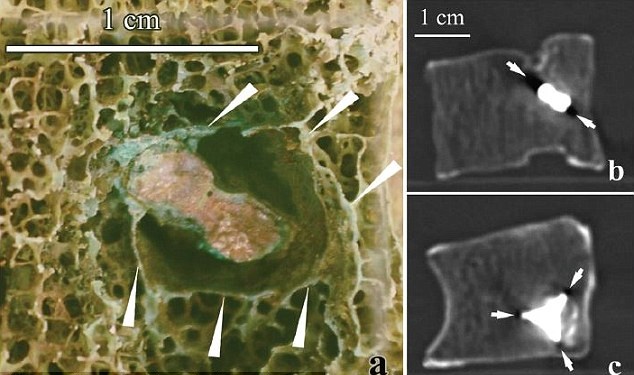
 A horrific spinal injury caused by a bronze arrowhead didn't immediately kill an Iron Age warrior, who survived long enough for his bone to heal around the metal point, a new study of his burial in central Kazakhstan finds. 


The two-inch long arrowhead was lodged in one of the vertebrae of the early Iron Age  warrior, as shown in the x-ray images above [Credit: S. Tur et al.,  International Journal of Osteoarchaeology] 


"This found individual was extremely lucky to survive," said study researcher Svetlana Svyatko, a research fellow in the school of geography, archaeology and paleoecology at Queen's University Belfast in Northern Ireland. 

"It's hard to get a vertebral wound without damaging the main blood vessels, which would have resulted in an immediate death." 

The male warrior was likely between 25 and 45 years old, and stood 5 foot 7 inches (174 centimeters) in height, which was tall considering that his people stood an average of 5 foot 4 inches (165 cm) in height, the researchers said. 

They found his grave, an elaborate burial mound called a "kurgan," after getting a tip from local people who live in the area. The researchers have studied the area in central Kazakhstan for more than 20 years. 
Their work has shed light on the area's culture and the emergence of the powerful Scythians (also known as the Saka), a population of fierce nomads who lived on the central Eurasian steppes from about the eighth century B.C. to about the second century A.D., said study researcher Arman Beisenov, the head of prehistoric archaeology at the Institute of Archaeology in Kazakhstan. 


The CT images above show the cavity left in the bone by the arrow  and the healing and hardening of the bone tissue around it, as  shown by the white arrows on the left [Credit: S. Tur et al.,  International Journal of Osteoarchaeology] 


During an excavation of a famous Saka cemetery in 2009 (a dig that yielded 200 jewellery pieces and more than 30,000 smaller ornaments, such as beads), locals told the researchers about a nearby kurgan that had been shamefully neglected and heavily devastated, Beisenov said. "What local people often want is attention and respect to their history and customs, which is the foundation of their present life and the key to the future," he told Live Science.
 "Although the schedule of our excavations was extremely tight and prohibitive for any extension, we anyway decided to follow the tip and take a look at the remains of the kurgan." 
The kurgan was so magnificent that the researchers opened a new investigation, excavating the kurgan in 2010 and 2011. It was likely no more than 6.5 feet (2 meters) high and about 74 feet (22.5 m) in diameter when built, Beisenov said. 
However, evidence suggests that robbers plundered the site in ancient times, and that local people reused much of its soil and stones for housing in the 1960s and 1970s, he said. 


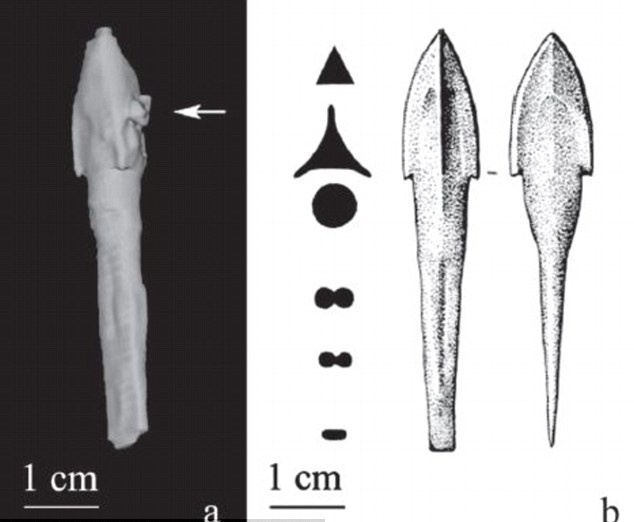
The researchers used CT scans to reconstruct how the arrowhead looks and  found it appears to have been made with a pure form of copper and tin. They say  it appears to have been a military grade arrow rather than one used for hunting   [Credit: S. Tur et al., International Journal of Osteoarchaeology] 


The grandiose grave suggests the individual belonged to the early Saka nomadic aristocracy, the researchers said. But the plundered kurgan held only a few scattered bones, including ribs, fibulae (lower-leg bones) and a vertebra. 
Radiocarbon dating suggests the individual lived sometime between the eighth and sixth centuries B.C., during the early Iron Age, according to the study. 
A close look at the man's bones revealed a bronze arrowhead — made of copper, tin, and traces of lead and iron — lodged in one of his vertebras. 

The researchers also found a rib with a healed fracture, but it's unclear whether the man received these injuries at the same time as the arrow wound, the researchers said. 
It's also unclear how long he survived following his injuries, they said. 
Computed tomography (CT) scans showed that the arrowhead, measuring 2.2 inches (5.6 cm) long, caused more than just a flesh wound. 
In fact, it "teaches us is the power of the human body to heal," said Aleksey Shitvov, a research team assistant at Queen's University Belfast who works with the group, but wasn't among the study's authors. 
The scientists also looked at the chemical composition of the man's bones, and found he likely ate more millet (a type of grain) than did many of his Saka peers, Svyatko said. "We can only speculate now what was the status of millet as a food for this society," Svyatko told Live Science. "Perhaps it was specifically accessible to high-ranked people or military elite, though this needs further investigation." 
The study was published online June 22 in the International Journal of Osteoarchaeology. 

Author: Laura Geggel | Source: LiveScience [June 29, 2015]

sabato 16 maggio 2015

Il sangue umano più antico.


- Due ferite: una di freccia e l'altra un taglio sulla mano destra.  Sono state esaminate con una sonda nanotecnologica avanzatissima, che ha identificato con laser-scanner la tipica forma a concavità doppia dei globuli rossi...

- Il sangue umano in oggetto è il più antico mai trovato (5.300 anni fa circa) con certezza (altri reperti dell'età della pietra, su strumenti ed altro, non sono certi, in quanto varie altre entità possiedono forme analoghe al globulo rosso: grani di polline, batteri etc e con esso potrebbero essere state confuse). 

- La certezza. In questo caso, la rifrazione della luce del laser ha permesso di identificare con precisione una proteina tipica ed esclusiva del globulo rosso (emoglobina) ed una sostanza coagulante (fibrina.)

- Si tratta di un omicidio di 5.000 anni fa, per cause sconosciute: un uomo fu ucciso da una freccia scagliata con l'arco. Il caso di Iceman Otzi è un vero 'cold case' e s'indaga ancora... 

- La sua morte fu rapida dopo neanche qualche minuto; se fu dolorosa, ebbene: non soffrì a lungo. Questo si può affermare proprio per via della presenza della fibrina: quest'ultima si forma immediatamente, subito dopo la lesione. In un corpo vivo, però, scompare e viene riassorbita dopo pochi minuti.

- L'articolo dell'avanzatissima indagine è comparso sulla rivista Interface, autore Albert Zink, capo dell'Istituto per le mummie e per l'Icemen, di Bolzano, Italia. 


World's oldest blood found 

in famed

 "Iceman" mummy 


The world's oldest known blood cells have been found on Ötzi the Iceman, according to the latest research on the 5,300-year-old mummy. 
What's more, the discovery proves that the Stone Age homicide victim had a quick, if not painless, death. 


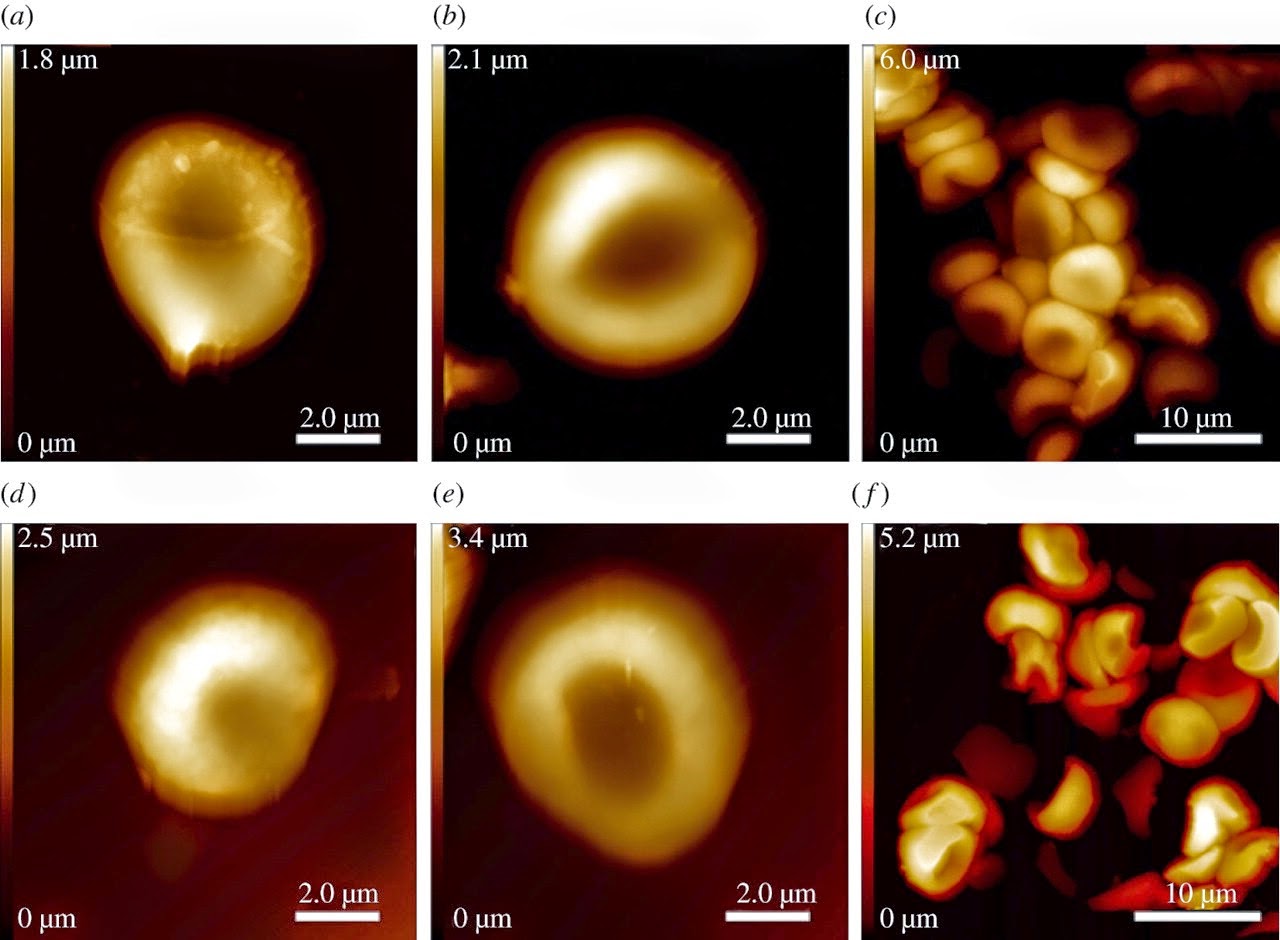
AFM images of red blood cells (RBCs). 
(a,b) Single RBCs from recent human tissue. (c) An assembly of RBCs. (d,e) Single corpuscles found in Iceman sample A and  sample B are shown. An assembly of several randomly distributed corpuscles,  similar to those found within the recent sample (c), are displayed in image (f). The imaged corpuscles (d–f) feature the characteristic discoid and concave  surface of RBCs 
[Credit: Journal of the Royal Society Interface] 


Ötzi has been the subject of extensive postmortem investigations ever since his corpse was discovered in an Alpine glacier on the Austrian-Italian border in 1991. 

No blood residue had previously been detected, however, despite various studies detailing his violent death due to an arrow shot and other injuries. 

"There were no [blood] traces found, even when they opened some arteries, so it was thought maybe the blood had not preserved and had completely degraded, or that he lost too much blood because of the arrow injury" on his back, said team member Albert Zink, head of the Institute for Mummies and the Iceman in Bolzano, Italy. 

For the new investigation, scientists traced Ötzi's wound areas—the arrow injury and a cut on his right hand—with a pioneering nano-size probe. 
Each minute movement of the probe was recorded with a laser, "so you get a three-dimensional image of the sample in a very tiny scale," Zink explained. The scans revealed classic "doughnut shape" red blood cells, the team reported Wednesday in the journal Interface.

While past studies have suggested evidence for prehistoric blood on Stone Age tools and other artifacts, "you can never really be sure, because you can see structures which are quite similar to red blood cells" such as pollen grains or bacteria, Zink commented. 


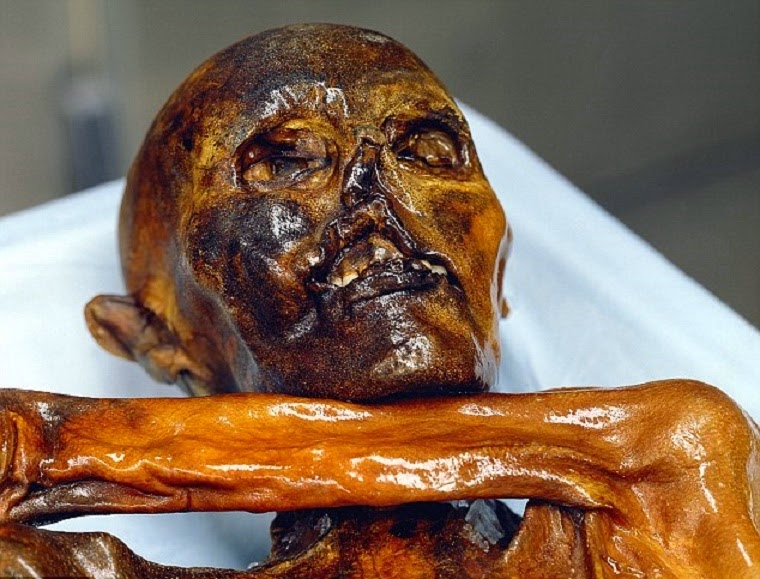
Ötzi the Iceman's mummified remains (shown above) were found on a glacier  on the Italian and Austrian border in 1991. Researchers have now discovered traces  of a molecule involved in blood clotting on the body, suggesting he bled rapidly  to death from an arrow wound to his shoulder 
[Credit: Reuters] 


To confirm they were indeed dealing with human blood cells, the researchers illuminated the wounds with a laser. The wavelengths of the scattered light revealed the substances' molecular makeup. 
"We got very typical samples for blood, like for the [blood protein] hemoglobin," he said. The new finding "really is the oldest clear evidence for red blood cells.

" The new nanotechnology, allied with an atomic force microscope, also uncovered traces of fibrin, a blood-clotting agent—evidence that the Iceman suffered a mercifully quick demise. 

"Fibrin is formed immediately when you get a wound, within a few minutes, but then it disappears"—in a living, functioning body, anyway, Zink said. 

"Finding fibrin in the arrow wound is confirmation that Ötzi actually died very quickly after the arrowshot."

"There were still some people arguing that he survived the arrow maybe a few hours or a few days, but this was definitely not true," he added. 

The relatively new techniques used in the study may in the future assist in the investigation of modern-day homicides. Since old blood cells are more elastic than fresh samples, the same blood-analysis techniques could become useful at crime scenes, Zink said. "If the blood is dry, forensic science really has no good method for determining the age of blood spots ... They cannot say if it is a day, a week, or a month old," he said. "If you can record with this technology little differences in the elasticity of the structure, then you can maybe determine the age of the blood spot." 

Author: James Owen | Source: National Geographic News 

[May 08, 2015]

domenica 3 maggio 2015

NON (sempre) UNA CULTURA EGALITARIA

I ricercatori di buon senso sanno che devono avere uno schema di riferimento, per non perdersi nel corso di ricerche talvolta totalizzanti. Ma sanno anche che detti schemi non possono e non devono essere mai considerati assoluti in modo rigido: si corre il rischio di avere una visione troppo cristallizzata degli ambienti umani che - lo si sa anche troppo bene - sono sempre in continua evoluzione. Secondo una ricercatrice spagnola (forse lei preferirebbe la definizione "basca"), è questo anche il caso della presunta 'uguaglianza assoluta' durante il neolitico. Dallo studio di alcuni resti umani (148 individui in totale) reperiti in strutture dolmeniche comunitarie (sette deposizioni megalitiche in totale), ha formulato l'ipotesi che tombe di così grande impegno fossero riservate solamente ad alcuni e con certezza non a tutti (sono esclusi bimbi al di sotto dei 5 anni, anziani e donne). E' ancora sotto indagine il criterio di esclusione. Si pensa che lo studio in corso (presso l'Oxford University) degli isotopi stabili dei resti potrà fornire ulteriori indizi.


Research challenges view that Neolithic societies 

were egalitarian 


The data obtained by Teresa Fernández-Crespo in seven megalithic graves in La Rioja and Araba-Álava suggest that certain individuals were excluded from burial on the basis of age and sex.


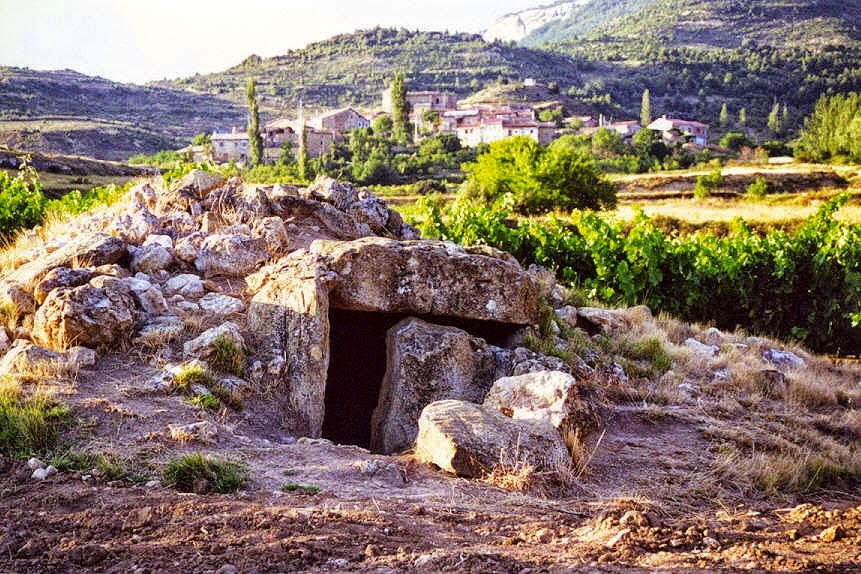
 A megalithic grave in La Cascaja (Rioja, Spain)


 [Credit: Vallenajerilla.com] 


The research Demographic evidence of selective burial in megalithic graves of northern Spain by Teresa Fernández-Crespo and Concepción de la Rúa of the Department of Genetics, Physical Anthropology and Animal Physiology of the UPV/EHU-University of the Basque Country challenges the widely-held view that societies were egalitarian during the late Neolithic and Chalcolithic ages.

This work, published in the leading Journal of Archaeological Science, comes from Fernández-Crespo's PhD thesis entitled Antropología y prácticas funerarias en las poblaciones neolíticas finales y calcolíticas de la región natural de La Rioja (Anthropology and funeral practices in late Neolithic and Chalcolithic populations in the natural region of La Rioja). 

The data obtained by Teresa Fernández-Crespo in seven megalithic graves in La Rioja and Araba-Álava suggest that certain individuals were excluded from burial on the basis of "criteria relating to age and possibly sex." 

So the existence of a funerary recruitment system that marginalised a considerable proportion of the population, according to the UPV/EHU researcher, could be pointing to the fact that the collective use of a shared burial area, which has often been understood as an egalitarian sign of megalithic societies, could in actual fact be masking the privileges of communities that were starting to become hierarchized. 

"In the article we propose that the people buried were intentionally selected. 

We do so by basing ourselves on the fact that the demographic composition of the megaliths displays significant anomalies with respect to a natural population of an ancient type. 
The bias identified, which almost systematically affects children under five, but certain adults as well, above all female ones, could be indicating that access to graves was restricted to those people who enjoyed certain rights and privileges only, against what is usually maintained in the traditional archaeological literature," says Teresa Fernandez-Crespo. 

The work signed by Teresa Fernández-Crespo and Concepción de la Rúa has studied seven dolmens: two of them located in a municipality of the current province of Araba-Álava (Alto de la Huesera and San Martín, both in Laguardia) and five in localities in the Autonomous Community (region) of La Rioja (La Cascaja in Peciña, Collado del Mallo in Trevijano, Peña Guerra II in Nalda, Collado Palomero I in Viguera and Fuente Morena in Montalvo de Cameros). 

The number of individuals found in these seven megalithic graves varies and ranges between less than ten (in the case of Fuente Morena, for example) and over a hundred subjects (in the case of Alto de la Huesera), making a total of 248.

 Isotope analysis  

With respect to the idea that the monuments were burial spaces reserved for a specific group of the population, one possible explanation, although not the only one, concludes Fernández-Crespo, could be related to the existence of different statuses within the population.

 "If we accept this hypothesis, it would be plausible that the remains of those who had a lower social position (and for that reason may not have met the access requirements to be included in the dolmens) were laid to rest in other burial structures the building and maintenance of which would require less effort, like, for example, natural caves, sheltered spaces under rock or pits. 

However, the current state of the research does not allow the refutation that other causes relating to the population or culture could account for this selection of those buried. In this respect, it is possible that the analysis of stable isotopes that we are currently carrying out at Oxford University on the skeletal remains from some of these graves could shed some light on the matter." 

Source: University of the Basque Country

 [April 30, 2015]

giovedì 29 gennaio 2015

OTZI, ancora.

Nuovi tatuaggi antichi.


Sono stati rinvenuti 'nuovi' tatuaggi su Otzi (l'Uomo 'di 

ghiaccio' di Similaun che fu rinvenuto nel ghiacciaio della 

Val Venosta).   La notizia è interessante, anche se - 

apparentemente - sembrerebbe impresa davvero dappoco il 

rinvenimento di un tatuaggio. La realtà dei fatti è diversa: la 

cute di Otzi (ben lontana dall'essere cute 'normale', ormai) si 

è molto scurita nel tempo e questo rende necessario l'uso di 

una tecnica fotografica non invasiva particolare, che 

permette di identificare tatuaggi anche solo presenti nello 

strato profondo dell'epidermide... E ciò è proprio quello che 

hanno fatto i ricercatori del EURAC, scoprendo una nuova 

serie di piccole linee nella zona costale anteriore inferiore 

destra di Otzi...


Illustrazione dei nuovi tatuaggi di Otzi (da Samadelli 2009:52).  La colorazione scura dei segni - si ritiene - fu ottenuta con ripetute epplicazioni nel tempo, in ciascuna sede, del pigmento (probabilmente, polvere di carbone di legno) 
[Credit: © Lars Krutak]

Già gli scopritori del corpo di Otzi avevano notato, fin dal 

giorno della scoperta, il 19 settembre 1991, la presenza dei 

suoi tatuaggi. Da allora, sono stati effettuati numerosi studi 

su entità, modalità e classificazione dei segni tatuati.

Ma ora, utilizzando una nuova metodica che egli stesso ha 

messo a punto, Marco Samadelli (scienziato dell'EURAC - 

Istituto per Le Mummie e per l'Uomo di Ghiaccio) ha potuto 

effettuare una completa mappatura di tutti i tatuaggi di Otzi, 

che sono - si deve ricordare - tra i più antichi tatuaggi mai 

rinvenuti nel mondo...


Visione d'insieme dei tatuaggi.
 [Credit: © Marco Samadelli

Samadelli ha fotografato il corpo della mummia da angoli differenti, adottando una procedura multi-spettro, che copre l'intera gamma delle lunghezze d'onde luminose, dall'infrarosso all'ultravioletto. Ciò ha permesso a quei tatuaggi che oggi non sono più visibili ad occhio nudo di apparire, con grande nitidezza.
I 61 segni marchiati sul corpo di Otzi consistono in linee, della lunghezza variabile da 0.7 a 4 centimetri, più spesso disposte in gruppi di due, tre o quattro linee parallele; sono inoltre presenti due croci. 


La Tabella mostra posizione e forma dei gruppi di tatuaggi. Variano in dimensioni da  1 mm (0.03 inches) e 3 mm (0.1 inches) ed in spessore da 7 mm (0.2 inches) a 40 mm (1.5 inches). La maggior parte consiste di  linee parllele tra loro: ma in due sedi è stata tracciata una croce (cavilgia e ginocchio sinistro) 
[Credit: Samadelli M, SLaschitz Gr/ Eurac-Archaeological Museum Bolzano] 


I nuovi segni scoperti nella parte anteriore-inferiore della 

gabbia toracica di Otzi sono rilevanti perché la maggior parte 

degli altri segni è localizzata nella parte inferiore del dorso, 

negli arti inferiori (tra ginocchia e piede). A proposito delle 

varie differenti sedi, è opinione di alcuni ricercatori che i 

segni fossero parte di un procedimento magico-terapeutico, 

una specie di 'agopuntura' antelitteram per alleviare il dolore 

delle giunture. I segni appena scoperti sulla gabbi toracica 

hanno riaperto il dibattito circa il ruolo del tatuaggio in tempi 

preistorici. Le posizioni si distinguono, comprensibilmente, 

tra sostenitori di una funzione terapeutica, un'altra magico- 

simbolica ed infine una religiosa. 


I tatuaggi di Otzi (sopra) si trovano prevalentemente in zone sottoposte a logoramento da trauma o da usura, indirizzando il giudizio degli archeologi verso la pratica dell'agopuntura, un'antichissima pratica contro il fastidio articolare. Le radiografie eseguite in corrispondenza delle zone tatuate hanno rivelato la presenza di aree degenerative che potevano creare dolore.
 [Credit: Samadelli M, SLaschitz Gr/Eurac-Archaeological Museum Bolzano] 


Le fotografie dell'articolo sono state scattate nella cella 

refigerata  destinata alla mummia e sita nel Museo di 

Archeologia del Sud Tirolo. Ciascuna immagine è stata 

scattata sette volte, ogni volta utilizzando una differente 

lunghezza d'onda. Questo ha permesso di raggiungere ogni 

volta uno strato cutaneo di profondità differente, in 

ognuno dei quali poteva essere presente una certa quantità 

di polvere di carbone usata come pigmento per il tatuaggio. 

Le onde ultraviolette si sono dimostrate utili per gli strati 

cutanei superficiali, mentre le infrarosse più adatte agli 

strati profondi.

I risultati completi sono stati pubblicati sul "Journal of 

Cultural Heritage"

Fonte: 
European Academy of Bozen/Bolzano 
[January 27, 2015]


New tattoos discovered on iceman 

Oetzi 


 With the aid of a non-invasive photographic technique, researchers at the EURAC-Institute for Mummies and the Iceman have been able to show up all the tattoos on the man who was found preserved in a glacier, and in the process have stumbled upon a previously unknown tattoo on his ribcage. This tattoo is very difficult to make out with the naked eye because his skin has darkened so much over time. The latest sophisticated photographic technology has now enabled tattoos in deeper skin layers to be identified as well. 


Illustration of Ötzi’s new tattoos (after Samadelli 2009:52).  The dark coloration  of the body markings is probably related to multiple applications  at the same loci over time 
[Credit: © Lars Krutak] 


Oetzi's discoverers had already noticed his tattoos on the very day they found him, 19th September 1991. Various studies since then have investigated and itemised these skin marks. But now, using a technique which he developed himself, Marco Samadelli, a scientist at the EURAC-Institute for Mummies and the Iceman, has carried out a complete mapping of all the tattoos on the man from the glacier. They are amongst the oldest documented tattoos in the world.


Overview tattoos of the Iceman
 [Credit: © Marco Samadelli]


Samadelli photographed the mummy's body from different angles using a multi-spectral procedure which covered the whole range of wavelengths from infrared to ultraviolet. This allowed tattoos deep in the skin layers and which are no longer recognisable to the human eye to be shown up with great precision. The 61 discovered skin markings on Oetzi's body consist of lines from 0.7 to 4 centimetres in length, mostly arranged in groups of two, three or four parallel lines, and also include two crosses. 


This table shows the location and shape of the tattoo groups. They range from  1mm (0.03 inches) and 3mm (0.1 inches) thick and 7mm (0.2 inches) and  40mm (1.5 inches) long. The majority consist of lines running parallel to  each other, but in two locations, including the right knee and left ankle,  these lines form a cross
[Credit: Samadelli M, SLaschitz Gr/ Eurac-Archaeological Museum Bolzano]


The newly discovered tattoos on the lower right-hand side of the ribcage are striking, because the other markings are mostly found on his lower back and the legs between the knee and the foot. On account of the various locations of the tattoos, some researchers suspected that the marks were part of some therapeutic medical treatment, a kind of acupuncture to relieve pain in the joints. The newly discovered tattoos on the ribcage have now reopened the debate about the role of tattoos in prehistoric times. This investigation has given researchers a new piece to add to the jigsaw puzzle when trying to tease out whether prehistoric tattoos had a therapeutic, symbolic or religious significance. 

 
The ice man's tattoos (pictured) are largely seen on parts of the body that endured  wear-and-tear, causing archaeologists to liken the practice to acupuncture - an  ancient treatment for joint distress. Radiological images of the tattooed areas  also show degenerative areas under the tattoos that could have caused pain 
 [Credit: Samadelli M, SLaschitz Gr/Eurac-Archaeological Museum Bolzano]


The multi-spectral photographs were shot in the mummy's specially refrigerated 'cell' in the South Tyrol Museum of Archaeology. "Each shot was taken seven times, using a different wavelength each time. This enabled us to cover the different depths at which the carbon powder used for the tattoos had been deposited. The ultraviolet waves were adequate for the upper skin layers, whilst we resorted to infrared light for the lower layers," explains Marco Samadelli. 
The findings are published in the Journal of Cultural Heritage. 

Source: 
European Academy of Bozen/Bolzano 
[January 27, 2015]