Visualizzazione post con etichetta Human Evolution. Mostra tutti i post

martedì 27 ottobre 2015

Geni Mobili ed Evoluzione.

Scientists discover protein factories 

hidden in 

human jumping genes 


Breakingnews, Evolution, Genetics, Human Evolution 

Scientists have discovered a previously unknown wellspring of genetic diversity in humans, chimps and most other primates. 
This diversity arises from a new component of itinerant sections of genetic code known as jumping genes.


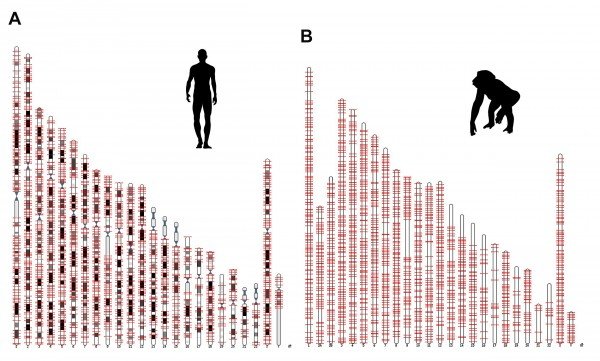
Salk researchers discovered a new genetic component, called ORF0, spread  throughout the DNA of humans, chimps and most other primates. This image  shows the locations of the ORFO on human and chimp chromosomes 
 [Credit: Salk Institute] 


In a paper published October 22, 2015 in Cell, Salk scientists report finding human and chimp DNA peppered with sequences of genetic code they've dubbed ORF0, which spreads throughout the genome on jumping genes. 
The ORF0 sequences may produce hundreds or even thousands of previously unknown proteins. 
The abundance of ORF0 instances in the human genome suggests that it played--and still plays--an important role in evolutionary diversity and flexibility by serving as a mechanism for generating novel proteins. The discovery of these mobile protein factories may also shine light on the origins of genetic mutations responsible for cancer, mental disorders and other diseases. 
"This discovery shows that jumping genes are an even more important source of variation in the primate genome than we thought, whether you're looking at the level of different species, different people or even the different cells within an individual's body," says Rusty Gage, senior author of the paper and a professor in Salk's Laboratory of Genetics. 
With the sequencing of the human genome, it became clear that jumping genes--mobile genetic elements first discovered in maize by Barbara McClintock in the early 1950s--were also present and highly active during human evolution. 
About half of the human genome resulted from sequences of genetic code that moved or insert extra copies of themselves throughout the genome. 
The evolutionary importance of jumping genes was highlighted by the results of another recent study by Gage and collaborators at Stanford. The research used stem cell technologies developed in Gage's lab to explore how differences in gene expression contribute to human and chimp facial structure. 
The findings, also reported in Cell, suggested that jumping genes played a role in the evolutionary split between humans and other primates. 
In the more recent study that uncovered ORF0, Gage and his colleagues focused on a class of jumping genes known as LINE-1 elements, which make up about 17 percent of the human genome. 
These elements contain all the necessary genetic machinery for moving themselves and other classes of jumping genes, unaided, to elsewhere in the genome. 
Previously, it was thought that LINE-1 elements contain just two sequences that coded for proteins, the ultimate product of genes that serve a wide range of roles in our cells and organs. 
These sequences are known as open reading frames (ORF), and the two previously known sequences, ORF1 and ORF2, are thought to be involved in producing proteins that are important for allowing LINE-1 elements to move around in the genome. In their new study, Gage and his colleagues discovered a third open reading frame. They named it ORF0 based on its location in the LINE-1 element next to ORF1. The scientists found ORF0 in about 3,500 locations in the DNA of humans and about 3,000 locations in the chimp and most other primate genomes. 
The structure of LINE-1 elements is such that when an element moves to another site there is a possibility that the ORF0 sequence can blend with genetic sequences in new location in DNA. The result of the new gene sequences can be a new protein. Evolutionarily speaking, this represents a way to generate entirely new molecules that could be beneficial to a species. On the other hand, the reshuffling of an existing ORF0 sequence during a jump could result in a disease-causing mutation. 
"This discovery redraws the blueprint of an important piece of genetic machinery in primates, adding a completely new gear," says Ahmet Denli, a staff scientist in Gage's lab and the first author on the paper reporting the findings. 
"Jumping genes with ORF0 are basically protein factories with wheels, and over the eons evolution has been driving the bus." 
Now that they have identified ORF0 in the primate genome, Denli says they plan to determine how many of the instances of ORF0 actually code for proteins and to investigate what function those proteins serve. The researchers also plan to investigate the behavior of ORF0 in different cell types and diseases. They are particularly interested in exploring its role in cancers and in neurological disorders such as schizophrenia, where previous studies have suggested jumping genes may be involved. 

Source: Salk Institute [October 22,2015]


domenica 9 agosto 2015

L'aiuto della Genetica


Using modern human genetics to study ancient phenomena 


Anthropology, Breakingnews, Genetics, Human Evolution 


We humans are obsessed with determining our origins, hoping to reveal a little of  “who we are” in the process. 

It is relatively simple to trace one’s genealogy back a few generations, and there are many companies and products offering such services. 

But what if we wanted to trace our origins further on an evolutionary timescale and study human evolution itself? In this case, there are no written records and censuses. Instead, the study of human evolution has so far relied heavily on fossil specimens and archaeological finds. 
Now, genetic tools and approaches are frequently used to answer evolutionary questions and reveal patterns of divergence that reflect different selective pressures and geographical movement. 
This is particularly true for studies of human migrations out of Africa, global population divergence, and its consequences for human health. 


Figure 1. Diagrammatic representation of the serial founder effect model  
[Credit: Emma Whittington] 


Humans Originated in Africa

The current best hypothesis suggests anatomically modern humans (AMH) arose in East Africa approximately 200,000 YBP (Years Before Present). 
AMH migrated from Africa around 100,000-60,000 years ago in a series of dispersals that expanded into Europe and Asia between 60,000 and 40,000 YBP. 
It has been scientifically proven that East Africa is the origin of humans, and supported by both archaeological and genetic data. 
Genetic diversity is greatest in East Africa and decreases in a step-wise fashion from the equator in a pattern reflecting sequential founder populations and bottlenecks. 


Figure 1 shows three populations with decreasing genetic diversity (represented by the colored circles) from left to right. The first population, with the greatest genetic diversity, represents Africa. A second population is shown migrating away from ‘Africa’ taking with it a sample of the existing genetic diversity. This forms the founding population for the next series of migrations. Each time a population migrates it represents only a sample of genetic variation existing in its founding population, and in doing so, sequential migration (such as those in Figure 1) leads to a reduction in genetic diversity with increasing distance from the first population. 

Leaving Africa – Where do we go from here? 

Although the location of human origin is generally accepted, there is a lack of consensus around the migration routes by which AMH left Africa and expanded globally. 
There are many studies using genetic tools to identify likely migration routes, one of which is a recent PLOS One article by Veerappa et al (2015). 
In this study, researchers characterized the global distribution of copy number variation, which is the variation in the number of copies of a particular gene, by high resolution genotyping of 1,115 individuals from 12 geographic populations, identifying 44,109 copy number variants (CNVs). 
The CNVs carried by an individual determined their CNV genotype and by comparing CNV genotypes between all individuals from all populations, the authors determined similarity and genetic distance between populations. 

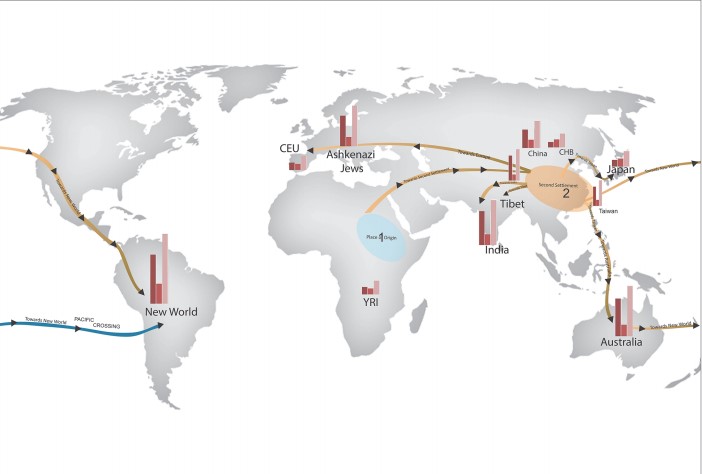
The phylogenetic relationship between populations proposed a global migration map (Figure 2), in which an initial migration from the place of origin, Africa, formed a second settlement in East Asia, which is similar to a founding population seen in Figure 1. 

At least five further branching events took place in the second settlement, forming populations globally. The migration routes identified in this paper largely support those already proposed, but of particular interest this paper also proposes a novel migration route from Australia, across the Pacific, and towards the New World (shown in blue in Figure 2).

Figure 2. A global map showing CNV counts and possible migration routes  
[Credit: Veerappa et al (2015)] 


Global Migration Leads to Global Variation As AMH spread across the globe, populations diverged and encountered novel selective pressures to which they had to adapt. This is reflected in the phenotypic (or observable) variation seen between geographically distant populations. 
At the genotype level, a number of these traits show evidence of positive selection, meaning they likely conferred some advantage in particular environments and were consequently favored by natural selection and increased in frequency. 
A well cited example of this is global variation in skin color, which is thought to reflect a balance between vitamin D synthesis and photoprotection (Figure 3). 

Vitamin D synthesis requires UV radiation, and a deficiency in vitamin D can result in rickets, osteoporosis, pelvic abnormalities, and a higher incidence of other diseases. 

At higher latitudes, where UV radiation is low or seasonal, experiencing enough UV radiation for sufficient vitamin D synthesis is a major concern. 
Presumably, as AMHs migrated from Africa, they experienced reduced levels of UV radiation, insufficient vitamin D synthesis, and severe health problems; resulting in selection for increased vitamin D synthesis and lighter skin pigmentation. 
Consistent with this, a number of pigmentation genes underlying variation in skin color show evidence of positive selection  in European and Asian populations, relative to Africa. 

On the flip side, populations near the equator experience no shortage of UV radiation and thus synthesize sufficient vitamin D; however the risk of UV damage is much greater. Melanin, the molecule determining skin pigmentation, acts as a photoprotective filter, reducing light penetration and damage caused by UV radiation, resulting in greater photoprotection in darkly pigmented skin. 
Selective pressure to maintain dark pigmentation in regions with high UV radiation is evident by the lack of genetic variation in pigment genes in areas such as Africa. 
This suggests selection has acted to remove mutation and maintain the function of these genes.


Figure 3. A map showing predominant skin pigmentation globally  
[Credit: Barsch (2003)]


 Can genetics and human evolution have a practical use in human health? 
Beyond phenotypic consequences, genetic variation between populations has a profound impact on human health. 
It has a direct influence on an individual’s predisposition for certain conditions or diseases. For example, Type 2 diabetes is more prevalent in African Americans than Americans of European descent. 
Genome wide association studies (GWAS) analyze common genetic variants in different individuals and assess whether particular variants are more often associated with certain traits or diseases. 
Comparing the distribution and number of disease-associated variants between populations can assess if genetic risk factors underlie disparities in disease susceptibility. In the case of Type 2 diabetes, African Americans carry a greater number of risk variants than Americans of European descent at genetic locations (loci) associated with Type 2 diabetes. 
It is clear that an individual’s ethnicity affects their susceptibility and likely reaction to disease, and as such should be considered in human health policy. 
Understanding the genetic risk factors linking populations and disease can identify groups of individual at greater risk of developing certain diseases for the sake of prioritizing treatment and prevention. 
Applying modern human genetics to human evolution has opened a door to studying ancient evolutionary phenomena and patterns. 
This area not only serves to quench the desire to understand our origins, but profoundly impacts human health in a way that could revolutionize disease treatment and prevention. 

In this blog, I have given a brief overview of how using genetic approaches can tell us a great deal about human origins, migration and variation between populations. 
In addition, I have outlined the complex genetic underpinnings behind ethnicity and disease susceptibility, which suggests an important role for population genetics in human health policy. 
This blog post covers only a fraction of the vast amount of ongoing work in this field, and the often ground breaking findings. 
It is unclear exactly how far genetics will take us in understanding human evolution, but the end is far from near. The potential for genetics in this field and broader feels limitless, and I for one am excited by the prospect. 

Author: Emma Whittington | Source: PLOS Blogs [August 01, 2015]

sabato 23 maggio 2015

I più antichi strumenti di pietra: Kenyantropo?


World's oldest stone tools 

challenge ideas about 


first toolmakers 


Scientists working in the desert badlands of northwestern Kenya have found stone tools dating back 3.3 million years, long before the advent of modern humans, and by far the oldest such artifacts yet discovered. 

The tools, whose makers may or may not have been some sort of human ancestor, push the known date of such tools back by 700,000 years; they also may challenge the notion that our own most direct ancestors were the first to bang two rocks together to create a new technology. 


Tool unearthed at excavation site [Credit: MPK-WTAP] 


The discovery is the first evidence that an even earlier group of proto-humans may have had the thinking abilities needed to figure out how to make sharp-edged tools. 

The stone tools mark "a new beginning to the known archaeological record," say the authors of a new paper about the discovery, published today in the leading scientific journal Nature. 

"The whole site's surprising, it just rewrites the book on a lot of things that we thought were true," said geologist Chris Lepre of the Lamont-Doherty Earth Observatory and Rutgers University, a co-author of the paper who precisely dated the artifacts. 
The tools "shed light on an unexpected and previously unknown period of hominin behavior and can tell us a lot about cognitive development in our ancestors that we can't understand from fossils alone," said lead author Sonia Harmand, of the Turkana Basin Institute at Stony Brook University and the Universite Paris Ouest Nanterre. 

Hominins are a group of species that includes modern humans, Homo sapiens, and our closest evolutionary ancestors. 

Anthropologists long thought that our relatives in the genus Homo - the line leading directly to Homo sapiens - were the first to craft such stone tools. 

But researchers have been uncovering tantalizing clues that some other, earlier species of hominin, distant cousins, if you will, might have figured it out. 
The researchers do not know who made these oldest of tools. But earlier finds suggest a possible answer: 
The skull of a 3.3-million-year-old hominin, Kenyanthropus platytops, was found in 1999 about a kilometer from the tool site. A K. platyops tooth and a bone from a skull were discovered a few hundred meters away, and an as-yet unidentified tooth has been found about 100 meters away. 


Sammy Lokorodi, a resident of Kenya's northwestern desert who works as a fossil  and artifact hunter, led the way to a trove of 3.3 million-year-old tools  
[Credit: West Turkana Archaeological Project] 


The precise family tree of modern humans is contentious, and so far, no one knows exactly how K. platyops relates to other hominin species. Kenyanthropus predates the earliest known Homo species by a half a million years. 

- This species could have made the tools; or, the toolmaker could have been some other species from the same era, such as Australopithecus afarensis, or an as-yet undiscovered early type of Homo.
 Lepre said a layer of volcanic ash below the tool site set a "floor" on the site's age: It matched ash elsewhere that had been dated to about 3.3 million years ago, based on the ratio of argon isotopes in the material. 
To more sharply define the time period of the tools, Lepre and co-author and Lamont-Doherty colleague Dennis Kent examined magnetic minerals beneath, around and above the spots where the tools were found. 
The Earth's magnetic field periodically reverses itself, and the chronology of those changes is well documented going back millions of years. 
"We essentially have a magnetic tape recorder that records the magnetic field ... the music of the outer core," Kent said. By tracing the variations in the polarity of the samples, they dated the site to 3.33 million to 3.11 million years. 
Another co-author, Rhonda Quinn of Seton Hall University, studied carbon isotopes in the soil, which along with animal fossils at the site allowed researchers to reconstruct the area’s vegetation. 
This led to another surprise: 
- The area was at that time a partially wooded, shrubby environment. Conventional thinking has been that sophisticated tool-making came in response to a change in climate that led to the spread of broad savannah grasslands, and the consequent evolution of large groups of animals that could serve as a source of food for human ancestors. 
- One line of thinking is that hominins started knapping - banging one rock against another to make sharp-edged stones - so they could cut meat off of animal carcasses, said paper co-author Jason Lewis of the Turkana Basin Institute and Rutgers. 
But the size and markings of the newly discovered tools "suggest they were doing something different as well, especially if they were in a more wooded environment with access to various plant resources," Lewis said. 
The researchers think the tools could have been used for breaking open nuts or tubers, bashing open dead logs to get at insects inside, or maybe something not yet thought of. 


Chris Lepre of Columbia University's Lamont-Doherty Earth Observatory  precisely dated the artifacts by analyzing layers above, around  and below them for reversals in earth's magnetic field  
[Credit: West Turkana Archaeological Project] 

"The capabilities of our ancestors and the environmental forces leading to early stone technology are a great scientific mystery," said Richard Potts, director of the Human Origins Program at the Smithsonian's National Museum of Natural History, who was not involved in the research. 
The newly dated tools "begin to lift the veil on that mystery, at an earlier time than expected," he said. 
Potts said he had examined the stone tools during a visit to Kenya in February. "Researchers have thought there must be some way of flaking stone that preceded the simplest tools known until now," he said. 
"Harmand's team shows us just what this even simpler altering of rocks looked like before technology became a fundamental part of early human behavior." 

- Ancient stone artifacts from East Africa were first uncovered at Olduvai Gorge in Tanzania in the mid-20th century, and those tools were later associated with fossil discoveries in the 1960s of the early human ancestor Homo habilis.
 That species has been dated to 2.1 million to 1.5 million years ago. 
Subsequent finds have pushed back the dates of humans' evolutionary ancestors, and of stone tools, raising questions about who first made that cognitive leap. 
- The discovery of a partial lower jaw in the Afar region of Ethiopia, announced on March 4, pushes the fossil record for the genus Homo to 2.8 million years ago. Evidence from recent papers, the authors note, suggests that there is anatomical evidence that Homo had evolved into several distinct lines by 2 million years ago. There is some evidence of more primitive tool use going back even before the new find. 
- In 2009, researchers at Dikika, Ethiopia, dug up 3.39 million-year-old animal bones marked with slashes and other cut marks, evidence that someone used stones to trim flesh from bone and perhaps crush bones to get at the marrow inside. 
That is the earliest evidence of meat and marrow consumption by hominins. 
No tools were found at the site, so it's unclear whether the marks were made with crafted tools or simply sharp-edged stones. 
The only hominin fossil remains in the area dating to that time are from Australopithecus afarensis. 


The skull of a 3.3-million-year-old hominin, Kenyanthropus platyops,  was found in 1999 about a kilometer from the tool site  
[Credit: Bone Clones® Kenyanthropus platyops Skull]


 The new find came about almost by accident: Harmand and Lewis said that on the morning of July 9, 2011, they had wandered off on the wrong path, and climbed a hill to scout a fresh route back to their intended track. 
They wrote that they "could feel that something was special about this particular place." They fanned out and surveyed a nearby patch of craggy outcrops. "By teatime," they wrote, "local Turkana tribesman Sammy Lokorodi had helped [us] spot what [we] had come searching for." 
By the end of the 2012 field season, excavations at the site, named Lomekwi 3, had uncovered 149 stone artifacts tied to tool-making, from stone cores and flakes to rocks used for hammering and others possibly used as anvils to strike on. 
The researchers tried knapping stones themselves to better understand how the tools they found might have been made. 
They concluded that the techniques used "could represent a technological stage between a hypothetical pounding-oriented stone tool use by an earlier hominin and the flaking-oriented knapping behavior of [later] toolmakers." 

Chimpanzees and other primates are known to use a stone to hammer open nuts atop another stone. But using a stone for multiple purposes, and using one to crack apart another into a sharper tool, is more advanced behavior. 

The find also has implications for understanding the evolution of the human brain. 
The toolmaking required a level of hand motor control that suggests that changes in the brain and spinal tract needed for such activity could have occurred before 3.3 million years ago, the authors said. "This is a momentous and well-researched discovery," said paleoanthropologist Bernard Wood of George Washington University, who was not involved in the study. "I have seen some of these artifacts in the flesh, and I am convinced they were fashioned deliberately." 
Wood said he found it intriguing to see how different the tools are from so-called Oldowan stone tools, which up to now have been considered the oldest and most primitive. The finds were made in the desert badlands near Lake Turkana, Kenya.


 Many  other important discoveries of fossils and artifacts have been made nearby  [Credit: West Turkana Archaeological Project] 


Lepre, who has been conducting fieldwork in eastern Africa for about 15 years, said he arrived at the dig site about a week after the discovery. 
The site is several hours' drive on rough roads from the nearest town, located in a hot, dry landscape he said is reminiscent of Arizona and New Mexico. Lepre collected chunks of sediment from a series of depths and brought them back to Lamont-Doherty for analysis. He and Kent used a bandsaw to trim the samples into sugar cube-size blocks and inserted them into a magnetometer, which measured the polarity of tiny grains of the minerals hematite and magnetite contained in the sediment.
 "The magnetics pretty much clinches that the age is something like 3.3 million years old," said Kent, who also is a professor at Rutgers. 
Earlier dating work by Lepre and Kent helped lead to another landmark paper in 2011: a study that suggested Homo erectus, another precursor to modern humans, was using more advanced tool-making methods 1.8 million years ago, at least 300,000 years earlier than previously thought. 
"I realized when you [figure out] these things, you don't solve anything, you just open up new questions," said Lepre. "I get excited, then realize there's a lot more work to do." 

Source: The Earth Institute at Columbia University [May 20, 2015]
domenica 19 aprile 2015

Aracnofobia

L'aracnofobia - la paura patologica dei ragni - sembra sia scritta nel DNA umano, da centinaia di migliaia di anni. Potrebbe quindi solamente trattarsi di una parte piuttosto importante del nostro cosiddetto 'istinto di conservazione', sviluppata in massimo grado in alcuni soggetti. 
Non sembra fuori luogo la considerazione che milioni d'anni fa, in Africa, la nostra specie fosse esposta a gravissimi pericoli, rappresentati da ragni tutti molto velenosi e pericolosissimi. E' stato condotto uno studio su 252 volontari, esponendoli visivamente ad immagini computerizzate riproducenti vari soggetti, talvolta forme astratte o deformate. 
La risposta alle immagini di aracnidi è sempre stata più pronta e più veloce che quella di fronte ad altre immagini fastidiose (aghi, mosche) e consistente in evidenti paura e disgusto.
Si deve considerare che - anche nel caso di sopravvivenza all'iniezione diretta del veleno - l'inabilità motoria stessa, successiva alla puntura, esponeva il nostro antenato a problemi gravissimi, tutti potenzialmente mortali. 
Da qui, l'importanza di riconoscere il nemico nascosto e mimetizzato ('pareidolia') - come è spesso il ragno - e il movimento d'allontanamento rapido dovuto al moto di repulsione 'istintiva': una reazione guadagnata in alcuni milioni di anni di convivenza con gli aracnidi..


Fear of spiders written in our DNA 


 Fear of spiders is a survival trait written into our DNA, researchers have discovered. 

Dating back hundreds of thousands of years, the instinct to avoid arachnids developed as an evolutionary response to a dangerous threat, the academics suggest. 


Researchers say a fear of spiders is a survival trait written into our DNA  and dates back thousands of years 
[Credit: Alamy] 


It could mean that arachnophobia, one of the most crippling of phobias, represents a finely tuned survival instinct. 
And it could date back to early human evolution in Africa, where spiders with very strong venom have existed millions of years ago.

Study leader Joshua New, of Columbia University in New York, said: ‘A number of spider species with potent, vertebrate specific venoms populated Africa long before hominoids and have co-existed there for tens of millions of years. 
‘Humans were at perennial, unpredictable and significant risk of encountering highly venomous spiders in their ancestral environments. 
‘Even when not fatal, a black widow spider bite in the ancestral world could leave one incapacitated for days or even weeks, terribly exposed to dangers,’ he told the Sunday Times. 

The research team carried out an experiment in which 252 volunteers were asked to study computer screens containing abstract shapes and data. 

Their reactions to images of spiders were very fast, even if their shape was distorted, when compared to much more clear images of other objects known induce disgust or fear, such as needles and flies. 
The researchers point out that spiders are often small dark creatures that tend to hide in recesses and are hard to spot. 
Dr New said: ‘Detection, therefore, is the critical arbiter of success in such encounters — any improvements to the sensitivity, vigilance, reliability and speed of faculties for their detection would have been of significant selective advantage.’ 
The study has been published in the journal of Evolution and Human Behavior. 

Author: Ben Spencer 

Source: Daily Mail Online [April 05, 2015]


Non facciamo più le asce di una volta.

Un interessante esperimento di Archeologia Sperimentale, sotto controllo neurofisiologico strumentale, che dimostra ineluttabilmente come alcuni strumenti di pietra, che oggi noi consideriamo primitivi (l'ascia a mano dell'Aculeano [500.000 anni fa], per esempio), hanno richiesto l'evoluzione di un pensiero progettuale complesso e non solamente il caso. 
E sei studenti di Archeologia, pur ricostruendo - durante un corso apposito di 18 mesi - una loro ascia a mano, non sono riusciti a produrne di buona qualità, a livello dei nostri comuni predecessori: le loro asce non avrebbero funzionato.
Si è inoltre visto strumentalmente che la pianificazione della costruzione stimola e chiama in causa aree differenti del cervello umano, interessando sia le aree motorie, sia  quelle del 'pensiero strategico', cioé quelle che utilizziamo nello scegliere il migliore percorso automobilistico oggi.
Non era un'attività tanto 'primitiva', insomma...

Complex cognition shaped the Stone Age hand-axe 

The ability to make a Lower Palaeolithic hand axe depends on complex cognitive control by the prefrontal cortex, including the "central executive" function of working memory, a new study finds. 


Handaxes produced for the first (left) and last (right) evaluations, ranked by T3 fMRI task  performance (circled numbers) 

[Credit: Dietrich Stout et al. PLoS One,  2015 DOI: 10.1371/journal.pone.0121804] 


PLOS ONE published the results, which knock another chip off theories that Stone Age hand axes are simple tools that don't involve higher-order executive function of the brain.

 "For the first time, we've showed a relationship between the degree of prefrontal brain activity, the ability to make technological judgments, and success in actually making stone tools," says Dietrich Stout, an experimental archaeologist at Emory University and the leader of the study. 
"The findings are relevant to ongoing debates about the origins of modern human cognition, and the role of technological and social complexity in brain evolution across species." 
The skill of making a prehistoric hand axe is "more complicated and nuanced than many people realize," Stout says. 
"It's not just a bunch of ape-men banging rocks together. We should have respect for Stone Age tool makers." The study's co-authors include Bruce Bradley of the University of Exeter in England, Thierry Chaminade of Aix-Marseille University in France; and Erin Hecht and Nada Khreisheh of Emory University.

Stone tools -- shaped by striking a stone "core" with a piece of bone, antler, or another stone -- provide some of the most abundant evidence of human behavioral change over time. 

Simple Oldowan stone flakes are the earliest known tools, dating back 2.6 million years. 

The Late Acheulean hand axe goes back 500,000 years. 

While it's relatively easy to learn to make an Oldowan flake, the Acheulean hand axe is harder to master, due to its lens-shaped core tapering down to symmetrical edges. 

"We wanted to tease apart and compare what parts of the brain were most actively involved in these stone tool technologies, particularly the role of motor control versus strategic thinking," Stout says. 

The researchers recruited six subjects, all archaeology students at Exeter University, to train in making stone tools, a skill known as "knapping." 
The subjects' skills were evaluated before and after they trained and practiced. 

For Oldowan evaluations, subjects detached five flakes from a flint core. 

For Acheulean evaluations, they produced a tool from a standardized porcelain core. 

At the beginning, middle and end of the 18-month experiment, subjects underwent functional magnetic resonance imaging (fMRI) and diffusion tensor imaging (DTI) scans of their brains while they watched videos. 

The videos showed rotating stone cores marked with colored cues: A red dot indicated an intended point of impact, and a white area showed the flake predicted to result from the impact. The subjects were asked the following questions:

- "If the core were struck in the place indicated, is what you see a correct prediction of the flake that would result?"

- "Is the indicated place to hit the core a correct one given the objective of the technology?" 

The subjects responded by pushing a "yes" or "no" button. 
Answering the first question, how a rock will break if you hit it in a certain place, relies more on reflexive, perceptual and motor-control processes, associated with posterior portions of the brain. 
Stout compares it to the modern-day rote reflex of a practiced golf swing or driving a car. 

The second question -- is it a good idea to hit the core in a certain spot if you want to make a hand axe -- involves strategic thinking, such as planning the route for a road trip. 
"You have to think about information that you have stored in your brain, bring it online, and then make a decision about each step of the trip," Stout says. 
This so-called executive control function of the brain, associated with activity in the prefrontal cortex, allows you to project what's going to happen in the future and use that projection to guide your action. "It's kind of like mental time travel, or using a computer simulation," Stout explains. 

"It's considered a high level, human cognitive capacity." The researchers mapped the skill level of the subjects onto the data from their brain scans and their responses to the questions. 
Greater skill at making tools correlated with greater accuracy on the video quiz for predicting the correct strategy for making a hand axe, which was itself correlated with greater activity in the prefrontal cortex. 
"These data suggest that making an Acheulean hand axe is not simply a rote, auto pilot activity of the brain," Stout says. 
"It requires you to engage in some complicated thinking." 

Most of the hand axes produced by the modern hands and minds of the study subjects would not have cut it in the Stone Age.

 "They weren't up to the high standards of 500,000 years ago," Stout says. A previous study by the researchers showed that learning to make stone tools creates structural changes in fiber tracts of the brain connecting the parietal and frontal lobes, and that these brain changes correlated with increases in performance. "Something is happening to strengthen this connection," Stout says. "This adds to evidence of the importance of these brain systems for stone tool making, and also shows how tool making may have shaped the brain evolutionarily." 
Stout recently launched a major, three-year archaeology experiment that will build on these studies and others. 
Known as the Language of Technology project, the experiment involves 20 subjects who will each devote 100 hours to learning the art of making a Stone Age hand axe, and also undergo a series of MRI scans. 
The project aims to hone in whether the brain systems involved in putting together a sequence of words to make a meaningful sentence in spoken language overlap with systems involved in putting together a series of physical actions to reach a meaningful goal. 


Source: Emory Health Sciences 

[April 15, 2015]