Visualizzazione post con etichetta Genetics. Mostra tutti i post

martedì 27 ottobre 2015

Geni Mobili ed Evoluzione.

Scientists discover protein factories 

hidden in 

human jumping genes 


Breakingnews, Evolution, Genetics, Human Evolution 

Scientists have discovered a previously unknown wellspring of genetic diversity in humans, chimps and most other primates. 
This diversity arises from a new component of itinerant sections of genetic code known as jumping genes.
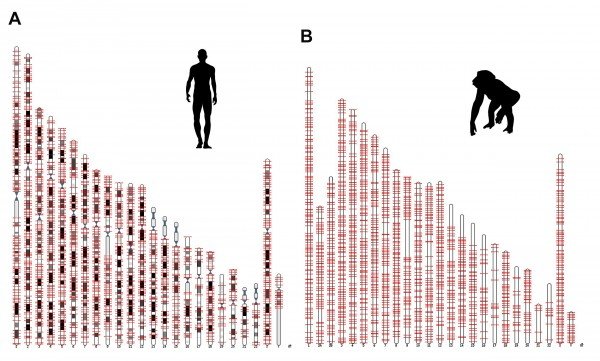


Salk researchers discovered a new genetic component, called ORF0, spread  throughout the DNA of humans, chimps and most other primates. This image  shows the locations of the ORFO on human and chimp chromosomes 
 [Credit: Salk Institute] 


In a paper published October 22, 2015 in Cell, Salk scientists report finding human and chimp DNA peppered with sequences of genetic code they've dubbed ORF0, which spreads throughout the genome on jumping genes. 
The ORF0 sequences may produce hundreds or even thousands of previously unknown proteins. 
The abundance of ORF0 instances in the human genome suggests that it played--and still plays--an important role in evolutionary diversity and flexibility by serving as a mechanism for generating novel proteins. The discovery of these mobile protein factories may also shine light on the origins of genetic mutations responsible for cancer, mental disorders and other diseases. 
"This discovery shows that jumping genes are an even more important source of variation in the primate genome than we thought, whether you're looking at the level of different species, different people or even the different cells within an individual's body," says Rusty Gage, senior author of the paper and a professor in Salk's Laboratory of Genetics. 
With the sequencing of the human genome, it became clear that jumping genes--mobile genetic elements first discovered in maize by Barbara McClintock in the early 1950s--were also present and highly active during human evolution. 
About half of the human genome resulted from sequences of genetic code that moved or insert extra copies of themselves throughout the genome. 
The evolutionary importance of jumping genes was highlighted by the results of another recent study by Gage and collaborators at Stanford. The research used stem cell technologies developed in Gage's lab to explore how differences in gene expression contribute to human and chimp facial structure. 
The findings, also reported in Cell, suggested that jumping genes played a role in the evolutionary split between humans and other primates. 
In the more recent study that uncovered ORF0, Gage and his colleagues focused on a class of jumping genes known as LINE-1 elements, which make up about 17 percent of the human genome. 
These elements contain all the necessary genetic machinery for moving themselves and other classes of jumping genes, unaided, to elsewhere in the genome. 
Previously, it was thought that LINE-1 elements contain just two sequences that coded for proteins, the ultimate product of genes that serve a wide range of roles in our cells and organs. 
These sequences are known as open reading frames (ORF), and the two previously known sequences, ORF1 and ORF2, are thought to be involved in producing proteins that are important for allowing LINE-1 elements to move around in the genome. In their new study, Gage and his colleagues discovered a third open reading frame. They named it ORF0 based on its location in the LINE-1 element next to ORF1. The scientists found ORF0 in about 3,500 locations in the DNA of humans and about 3,000 locations in the chimp and most other primate genomes. 
The structure of LINE-1 elements is such that when an element moves to another site there is a possibility that the ORF0 sequence can blend with genetic sequences in new location in DNA. The result of the new gene sequences can be a new protein. Evolutionarily speaking, this represents a way to generate entirely new molecules that could be beneficial to a species. On the other hand, the reshuffling of an existing ORF0 sequence during a jump could result in a disease-causing mutation. 
"This discovery redraws the blueprint of an important piece of genetic machinery in primates, adding a completely new gear," says Ahmet Denli, a staff scientist in Gage's lab and the first author on the paper reporting the findings. 
"Jumping genes with ORF0 are basically protein factories with wheels, and over the eons evolution has been driving the bus." 
Now that they have identified ORF0 in the primate genome, Denli says they plan to determine how many of the instances of ORF0 actually code for proteins and to investigate what function those proteins serve. The researchers also plan to investigate the behavior of ORF0 in different cell types and diseases. They are particularly interested in exploring its role in cancers and in neurological disorders such as schizophrenia, where previous studies have suggested jumping genes may be involved. 

Source: Salk Institute [October 22,2015]


sabato 24 ottobre 2015

Biounità costruttiva: la spirale del DNA è sempre la stessa

Tiny DNA building block 

is identical 

regardless of species 

Breakingnews, Evolution, Genetics 

 The diameter of a single, cylindrical DNA component is always the same, regardless of whether it forms part of a fruit fly, a beech tree, or a human being. This tiny building block in the DNA architecture is part of what is known as the nucleosome. The diameter of the nucleosome has long been a source of fascination for Professor Jakob Bohr of DTU Nanotech at Technical University of Denmark. Because if it is the same in all species, what universal principle or law of nature is in effect?


 The illustration shows a very simplified, comic strip view of the organization of DNA. The organization serves to compress the over one-metre long DNA, so it can fit inside the cell nucleus. If you ‘read’ the figure backwards—i.e. from H to A—it corresponds to looking at a chromosome, then ‘zooming in’' step-by-step, so you finally end with the chromosome’s smallest structure—the DNA helix in Figure A. 

Figure A The well-known double helix—the spiral with the two strands of DNA is the smallest structure in the chromosome. Here it is reproduced without the base pairs that connect the two strands and which cause the spiral to resemble a spiral ladder. 
Figure B shows how the double helix is wound twice around a cylindrical core of proteins. This structure is called a nucleosome. It is the diameter of this structure which is the same across different species—and which fascinates Professor Jakob Bohr. The proportions in this figure do not correspond to the real world, where the DNA helix is equal in size to the protein core. 
Figure C shows the row of nucleosomes, causing the structure to resemble a chain of pearls. Figure D-G illustrates the next levels, where the material DNA is further packaged. As yet, the geometry of these levels is not fully clarified.  
Level H illustrates the contours of the chromosome as viewed under a microscope  
[Credit: Technical University of Denmark] 


"As a physicist, I attempt to find the answers to these questions in the worlds of mathematics and physics. And in these contexts, our calculations demonstrate that the size of the nucleosomes makes perfect sense. They create what we have chosen to call 'twist neutrality'," relates Jakob Bohr, who has been studying the diameter of the nucleosomes in partnership with his colleague, Kasper Olsen. "Twist neutrality ensures that the number of turns in the DNA material always remains constant, such that the smallest structure in DNA architecture -- the DNA helix -- can be stretched without affecting the number of twists. This property is essential in nature every time DNA material needs to be copied; in the case of cell division, for example. Briefly put, twist neutrality helps prevent the twists becoming entangled and damaging our DNA," he adds. The nucleosome is only a tiny part of the complex DNA architecture. In total, every single sell contains more than a metre of DNA, and to make room for so much material, the DNA is twisted and folded together over and over again. This leads to the creation of what can be perceived as different levels of structuring, and depending on how a level can actually be defined, eight such levels are created. "Each level alters the scale of our hereditary material by a factor of around three, in the same way as when you fold a piece of paper repeatedly, the thickness is increased by a factor of two every time. This compression of the DNA ensures that it is small enough to fit inside the nucleus of the cell," explains Jakob Bohr. The highest level of DNA comprises the chromosome structures, where the gender chromosomes -- X and Y -- are the best known. The bottom level, i.e. the tiniest structure in the DNA architecture, is the famous double helix, the eye-catching spiral of two strands of DNA winding around one another. The natural law of the twists At the level before this, the double helix is wound twice around a collection of proteins. This is the structure that is called a nucleosome. It takes a lot of nucleosomes to wind up the entire double helix, and this makes the structure resemble a string of pearls -- where the nucleosomes are the pearls and the double helix is the chain. The calculations performed by Jakob Bohr and his colleagues demonstrate that if the diameter of the nucleosomes were different, twist neutrality would simply not exist. "This would not be good, because it would mean that new, inappropriate structures could appear in the DNA. So we think that the reason why the size of the nucleosomes remains constant across species is that there is no benefit to nature in developing or changing this size. Otherwise, we would probably have encountered it as a stage in the evolutionary process," explains Jakob Bohr. New technology should help The long-term aim of the research into the diameter of the nucleosomes is to contribute to a complete description of the geometry of DNA. This could help reveal general principles for the construction of the chromosomes, which would enable us to understand them in even greater detail. "Because even though we can already mine down to gene level in the double helix -- the lowest level in the chromosome -- a number of the other eight levels are still largely uncharted territory. Simply put, we have no idea what structures exist on some of the other levels," adds Jakob Bohr. According to Jakob Bohr, researchers do not currently have access to technology with the capacity to clarify the structures completely at all levels of the chromosomes. However, he is sure that the technology required should appear over the coming 10-15 years, possibly as a result of other research into bioinformatics and via the new facilities including ESS and MAX IV in Lund. Author: Lotte Krull | Source: Technical University of Denmark [October 21, 2015]

mercoledì 14 ottobre 2015

Clonabile il Mammut lanoso?

Arctic expedition finds 

woolly mammoth remains 

ripe for cloning 

Breakingnews, Early Mammals, Fossils, Genetics, Palaeontology, Russia 


Russian scientists undertaking an exploratory expedition on the Lyakhovsky Islands have discovered woolly mammoth remains including skin and tusk, which they believe suitable for obtaining the DNA necessary to clone the animal. 


The mammoth expedition led by scientists from Russia's North-Eastern Federal  University in Yakutsk, and funded by the Russian Geographical Society  
[Credit: ©: gazetayakutia.ru] 


An international expedition to the Lyakhovsky Islands led by scientists from Russia's North-Eastern Federal University in Yakutsk has discovered six specimens of woolly 
mammoth fossils suitable for extracting DNA.

"The Lyakhovsky Islands are considered the mammoth continent," explained Semyon Grigorev, leader of the expedition to the islands and director of the Mammoth Museum at Russia's North-Eastern Federal University in Yakutsk. "The largest concentration of remains in the world is here, so that's why we chose this area to carry out our studies," Grigorev told a press conference on Wednesday.
 "To start with, together with archeologists we carried out a dig at the most northern site where ancient man lived, not far from the village of Kazachye where we found an enormous amount of mammoth bones, and also ancient tools," said Grigorev of the expedition, which took place over two stages from August 11 to September 29. 


The discovery is seen as highly significant by Russian and South Korean experts  working to bring the mammoths back to life through cloning 
[Credit: NVK]


"Then, after waiting a long time for the right weather conditions, we continued to the main target of our expedition, Great Lyakhovsky Island, where we found a great amount of unique remains," which includes ancient mammoth skin and teeth. 
"Take, for example, the tusk of a pygmy mammoth that we found. We calculate that the animal was no more than two meters tall, so now we have to work out what this was – a micropopulation, or the peculiarity of this single individual." 
"Skin is the most interesting for us, for our project 'The Mammoth Rebirth' because our Korean colleagues consider skin to be the best material for an attempt at cloning via the extraction of viable cells."
 The 'Northern Ecumene' expedition of 16 researchers from six different countries was made possible thanks to a grant of two million rubles provided by the Russian Geographical Society. 
"We consider the expedition a success; after all, out of what seems to be these kinds of small expeditions, great scientific discoveries can be made," said Grigorev, whose team is now joining forces with Korean researchers to analyze the mammoth remains for cells viable for cloning. 

Source: Sputnik News [October 09, 2015]

domenica 11 ottobre 2015

aDNA


Ancient genome 

from Africa 


sequenced 


for the first time 


Africa, Anthropology, ArchaeoHeritage, Archaeology, Breakingnews, Ethiopia, Genetics 


 The first ancient human genome from Africa to be sequenced has revealed that a wave of migration back into Africa from Western Eurasia around 3,000 years ago was up to twice as significant as previously thought, and affected the genetic make-up of populations across the entire African continent. The Mota cave is located in a mountainous region, and its entrance is about 6,000 feet  above sea level. 


Weather and the changing conditions of the only road that runs near  the cave -- a gravel surface -- made access complicated for the research team 

[Credit: Kathryn and John Arthur] 


The genome was taken from the skull of a man buried face-down 4,500 years ago in a cave called Mota in the highlands of Ethiopia -- a cave cool and dry enough to preserve his DNA for thousands of years. Previously, ancient genome analysis has been limited to samples from northern and arctic regions. The latest study is the first time an ancient human genome has been recovered and sequenced from Africa, the source of all human genetic diversity. The findings are published in the journal Science. The ancient genome predates a mysterious migratory event which occurred roughly 3,000 years ago, known as the 'Eurasian backflow', when people from regions of Western Eurasia such as the Near East and Anatolia suddenly flooded back into the Horn of Africa. 


Entrance to the Mota Cave in the Ethiopian highlands  
[Credit: Kathryn and John Arthur] 


The genome enabled researchers to run a millennia-spanning genetic comparison and determine that these Western Eurasians were closely related to the Early Neolithic farmers who had brought agriculture to Europe 4,000 years earlier. By comparing the ancient genome to DNA from modern Africans, the team have been able to show that not only do East African populations today have as much as 25% Eurasian ancestry from this event, but that African populations in all corners of the continent -- from the far West to the South -- have at least 5% of their genome traceable to the Eurasian migration. Researchers describe the findings as evidence that the 'backflow' event was of far greater size and influence than previously thought. The massive wave of migration was perhaps equivalent to over a quarter of the then population of the Horn of Africa, which hit the area and then dispersed genetically across the whole continent. 


The view looking out from the Mota cave in the Ethiopian highlands, where the remains containing the ancient genome were found  
[Credit: Kathryn and John Arthur] 


"Roughly speaking, the wave of West Eurasian migration back into the Horn of Africa could have been as much as 30% of the population that already lived there -- and that, to me, is mind-blowing. The question is: what got them moving all of a sudden?" said Dr Andrea Manica, senior author of the study from the University of Cambridge's Department of Zoology. Previous work on ancient genetics in Africa had involved trying to work back through the genomes of current populations, attempting to eliminate modern influences. "With an ancient genome, we have a direct window into the distant past. One genome from one individual can provide a picture of an entire population," said Manica. The cause of the West Eurasian migration back into Africa is currently a mystery, with no obvious climatic reasons. Archaeological evidence does, however, show the migration coincided with the arrival of Near Eastern crops into East Africa such as wheat and barley, suggesting the migrants helped develop new forms of agriculture in the region. 


In Mota cave, located in the Gamo highlands of Ethiopia, a group of NSF-supported  researchers excavation a rock cairn. They discovered under it a burial site  containing the remains of a 4,500-year skeleton  
[Credit: Kathryn and John Arthur] 


The researchers say it's clear that the Eurasian migrants were direct descendants of, or a very close population to, the Neolithic farmers that had had brought agriculture from the Near East into West Eurasia around 7,000 years ago, and then migrated into the Horn of Africa some 4,000 years later. "It's quite remarkable that genetically-speaking this is the same population that left the Near East several millennia previously," said Eppie Jones, a geneticist at Trinity College Dublin who led the laboratory work to sequence the genome. While the genetic make-up of the Near East has changed completely over the last few thousand years, the closest modern equivalents to these Neolithic migrants are Sardinians, probably because Sardinia is an isolated island, says Jones. "The famers found their way to Sardinia and created a bit of a time capsule. Sardinian ancestry is closest to the ancient Near East." "Genomes from this migration seeped right across the continent, way beyond East Africa, from the Yoruba on the western coast to the Mbuti in the heart of the Congo -- who show as much as 7% and 6% of their genomes respectively to be West Eurasian," said Marcos Gallego Llorente, first author of the study, also from Cambridge's Zoology Department. 


John Arthur, an NSF-supported archaeologist at the University  of South Florida St. Petersburg, excavates the Mota cave site  
[Credit: Kathryn and John Arthur]


 "Africa is a total melting pot. We know that the last 3,000 years saw a complete scrambling of population genetics in Africa. So being able to get a snapshot from before these migration events occurred is a big step," Gallego Llorente said. The ancient Mota genome allows researchers to jump to before another major African migration: the Bantu expansion, when speakers of an early Bantu language flowed out of West Africa and into central and southern areas around 3,000 years ago. Manica says the Bantu expansion may well have helped carry the Eurasian genomes to the continent's furthest corners. The researchers also identified genetic adaptations for living at altitude, and a lack of genes for lactose tolerance -- all genetic traits shared by the current populations of the Ethiopian highlands. In fact, the researchers found that modern inhabitants of the area highlands are direct descendants of the Mota man. Finding high-quality ancient DNA involves a lot of luck, says Dr Ron Pinhasi, co-senior author from University College Dublin. "It's hard to get your hands on remains that have been suitably preserved. The denser the bone, the more likely you are to find DNA that's been protected from degradation, so teeth are often used, but we found an even better bone -- the petrous." The petrous bone is a thick part of the temporal bone at the base of the skull, just behind the ear. "The sequencing of ancient genomes is still so new, and it's changing the way we reconstruct human origins," added Manica. "These new techniques will keep evolving, enabling us to gain an ever-clearer understanding of who our earliest ancestors were." The study was conducted by an international team of researchers, with permission from the Ethiopia's Ministry of Culture and Authority for Research and Conservation of Cultural Heritage. 


Source: University of Cambridge [October 08, 2015]

domenica 27 settembre 2015

Nuova Sintesi

New synthesis method 

imitates the way molecules were formed 

at the dawn of life on Earth 

Breakingnews, Evolution, Genetics, Origin of Life 


Researchers from the Institute for Advanced Chemistry of Catalonia (IQAC-CSIC), with support from the Nuclear Magnetic Resonance Service of the Universitat Autònoma de Barcelona (UAB) have developed a method for synthesising organic molecules very selectively, by assembling simple molecules and using an enzyme from E. coli (FSA: D-
fructose-6-phosphate aldolase), which acts as a biocatalyst. E-coli enzyme 
[Credit: CSIC]


 This is a significant step forward since it replicates the formation of carbohydrates in conditions resembling those that presumably initiated life on Earth (prebiotic conditions) and because it allows relatively large organic molecules to be obtained very selectively and efficiently. 
Furthermore, it is a process with few steps, that does not use organic solvents and generates no waste, and it has great potential in chemistry, especially for obtaining molecules and active ingredients of interest (drugs, supplements, etc.). 
Pere Clapés, a research professor with the CSIC who led this project, explains that in the synthesis of organic molecules . "it is not only important for them to have the correct structure, but also the right angle and position in space, because this affects their function." 

In fact, this is one of the main problems that can limit the effectiveness of compounds like drugs. 
In the case of pentoses and hexoses, these are simple sugars (monosaccharides) with five and six carbon atoms, respectively: crucial for life thanks to their function in energy production, structuring, communication and cell-cell recognition. 
The results presented in the journal Nature Chemistry show that the scientists obtained pentoses and hexoses by assembling formaldehyde and glycolaldehyde, with a minimal modification to the FSA enzyme sequence. 

A very malleable enzyme 

The enzyme FSA was discovered in 2001 and its physiological function in E. coli is still unknown.
 It is thought to be an ancestral enzyme, and that it is active before a broad range of compounds. 
What surprised the researchers is that it is a very malleable enzyme, much more so than others. 
As a result, with only a small number of genetic mutations in the enzyme, its catalytic capacity can be modulated and increased significantly. 
This is what allows the enzyme to be carefully adapted in order to synthesise several molecules at will. 
The metabolism of carbohydrates in living organisms is a complex process, forged over millions of years of evolution. 
It is no easy task to carry out these processes in a flask, whether by assembling the enzymes involved in the process or by manipulating the metabolic pathways of living organisms. 
Nor is it simple to obtain carbohydrates with conventional chemical methods, which require several stages and the use of organic solvents. The procedure was developed by scientists in the Biotransformation and Active Molecules Group of the Spanish National Research Council (CSIC), with support from the Nuclear Magnetic Resonance Service of the UAB. 
Pere Clapés explains: "we want to prove that the tools of biocatalysis allow complex molecules to be obtained from simpler ones, which are in fact the same ones used in nature." 
He goes on: "Over millions of years, living organisms have forged these metabolic strategies to obtain the carbohydrates they need to survive." "The process is a simple one, mimicking the prebiotic formation of carbohydrates from compounds that were probably around in the world before life began," adds Teodor Parella, of the UAB. 
For these researchers, the engineering of proteins, in particular of biocatalysts, has enormous potential for the sustainable synthesis of natural molecules and their derived products. 

Source: Universitat Autònoma de Barcelona [September 23, 2015]

domenica 9 agosto 2015

L'aiuto della Genetica


Using modern human genetics to study ancient phenomena 


Anthropology, Breakingnews, Genetics, Human Evolution 


We humans are obsessed with determining our origins, hoping to reveal a little of  “who we are” in the process. 

It is relatively simple to trace one’s genealogy back a few generations, and there are many companies and products offering such services. 

But what if we wanted to trace our origins further on an evolutionary timescale and study human evolution itself? In this case, there are no written records and censuses. Instead, the study of human evolution has so far relied heavily on fossil specimens and archaeological finds. 
Now, genetic tools and approaches are frequently used to answer evolutionary questions and reveal patterns of divergence that reflect different selective pressures and geographical movement. 
This is particularly true for studies of human migrations out of Africa, global population divergence, and its consequences for human health. 


Figure 1. Diagrammatic representation of the serial founder effect model  
[Credit: Emma Whittington] 


Humans Originated in Africa

The current best hypothesis suggests anatomically modern humans (AMH) arose in East Africa approximately 200,000 YBP (Years Before Present). 
AMH migrated from Africa around 100,000-60,000 years ago in a series of dispersals that expanded into Europe and Asia between 60,000 and 40,000 YBP. 
It has been scientifically proven that East Africa is the origin of humans, and supported by both archaeological and genetic data. 
Genetic diversity is greatest in East Africa and decreases in a step-wise fashion from the equator in a pattern reflecting sequential founder populations and bottlenecks. 


Figure 1 shows three populations with decreasing genetic diversity (represented by the colored circles) from left to right. The first population, with the greatest genetic diversity, represents Africa. A second population is shown migrating away from ‘Africa’ taking with it a sample of the existing genetic diversity. This forms the founding population for the next series of migrations. Each time a population migrates it represents only a sample of genetic variation existing in its founding population, and in doing so, sequential migration (such as those in Figure 1) leads to a reduction in genetic diversity with increasing distance from the first population. 

Leaving Africa – Where do we go from here? 

Although the location of human origin is generally accepted, there is a lack of consensus around the migration routes by which AMH left Africa and expanded globally. 
There are many studies using genetic tools to identify likely migration routes, one of which is a recent PLOS One article by Veerappa et al (2015). 
In this study, researchers characterized the global distribution of copy number variation, which is the variation in the number of copies of a particular gene, by high resolution genotyping of 1,115 individuals from 12 geographic populations, identifying 44,109 copy number variants (CNVs). 
The CNVs carried by an individual determined their CNV genotype and by comparing CNV genotypes between all individuals from all populations, the authors determined similarity and genetic distance between populations. 

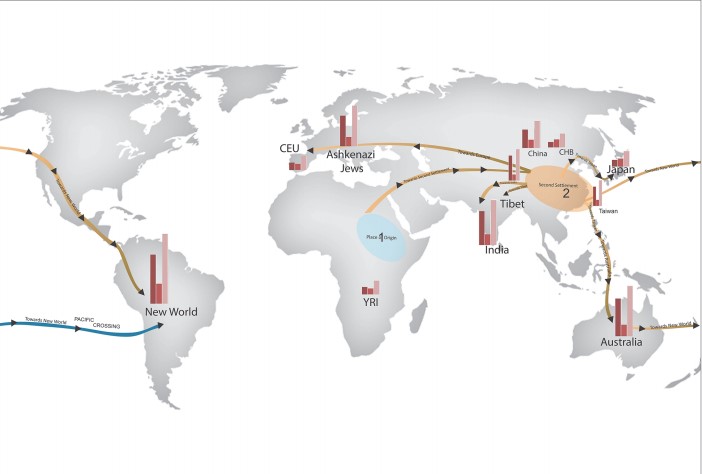
The phylogenetic relationship between populations proposed a global migration map (Figure 2), in which an initial migration from the place of origin, Africa, formed a second settlement in East Asia, which is similar to a founding population seen in Figure 1. 

At least five further branching events took place in the second settlement, forming populations globally. The migration routes identified in this paper largely support those already proposed, but of particular interest this paper also proposes a novel migration route from Australia, across the Pacific, and towards the New World (shown in blue in Figure 2).

Figure 2. A global map showing CNV counts and possible migration routes  
[Credit: Veerappa et al (2015)] 


Global Migration Leads to Global Variation As AMH spread across the globe, populations diverged and encountered novel selective pressures to which they had to adapt. This is reflected in the phenotypic (or observable) variation seen between geographically distant populations. 
At the genotype level, a number of these traits show evidence of positive selection, meaning they likely conferred some advantage in particular environments and were consequently favored by natural selection and increased in frequency. 
A well cited example of this is global variation in skin color, which is thought to reflect a balance between vitamin D synthesis and photoprotection (Figure 3). 

Vitamin D synthesis requires UV radiation, and a deficiency in vitamin D can result in rickets, osteoporosis, pelvic abnormalities, and a higher incidence of other diseases. 

At higher latitudes, where UV radiation is low or seasonal, experiencing enough UV radiation for sufficient vitamin D synthesis is a major concern. 
Presumably, as AMHs migrated from Africa, they experienced reduced levels of UV radiation, insufficient vitamin D synthesis, and severe health problems; resulting in selection for increased vitamin D synthesis and lighter skin pigmentation. 
Consistent with this, a number of pigmentation genes underlying variation in skin color show evidence of positive selection  in European and Asian populations, relative to Africa. 

On the flip side, populations near the equator experience no shortage of UV radiation and thus synthesize sufficient vitamin D; however the risk of UV damage is much greater. Melanin, the molecule determining skin pigmentation, acts as a photoprotective filter, reducing light penetration and damage caused by UV radiation, resulting in greater photoprotection in darkly pigmented skin. 
Selective pressure to maintain dark pigmentation in regions with high UV radiation is evident by the lack of genetic variation in pigment genes in areas such as Africa. 
This suggests selection has acted to remove mutation and maintain the function of these genes.


Figure 3. A map showing predominant skin pigmentation globally  
[Credit: Barsch (2003)]


 Can genetics and human evolution have a practical use in human health? 
Beyond phenotypic consequences, genetic variation between populations has a profound impact on human health. 
It has a direct influence on an individual’s predisposition for certain conditions or diseases. For example, Type 2 diabetes is more prevalent in African Americans than Americans of European descent. 
Genome wide association studies (GWAS) analyze common genetic variants in different individuals and assess whether particular variants are more often associated with certain traits or diseases. 
Comparing the distribution and number of disease-associated variants between populations can assess if genetic risk factors underlie disparities in disease susceptibility. In the case of Type 2 diabetes, African Americans carry a greater number of risk variants than Americans of European descent at genetic locations (loci) associated with Type 2 diabetes. 
It is clear that an individual’s ethnicity affects their susceptibility and likely reaction to disease, and as such should be considered in human health policy. 
Understanding the genetic risk factors linking populations and disease can identify groups of individual at greater risk of developing certain diseases for the sake of prioritizing treatment and prevention. 
Applying modern human genetics to human evolution has opened a door to studying ancient evolutionary phenomena and patterns. 
This area not only serves to quench the desire to understand our origins, but profoundly impacts human health in a way that could revolutionize disease treatment and prevention. 

In this blog, I have given a brief overview of how using genetic approaches can tell us a great deal about human origins, migration and variation between populations. 
In addition, I have outlined the complex genetic underpinnings behind ethnicity and disease susceptibility, which suggests an important role for population genetics in human health policy. 
This blog post covers only a fraction of the vast amount of ongoing work in this field, and the often ground breaking findings. 
It is unclear exactly how far genetics will take us in understanding human evolution, but the end is far from near. The potential for genetics in this field and broader feels limitless, and I for one am excited by the prospect. 

Author: Emma Whittington | Source: PLOS Blogs [August 01, 2015]

sabato 18 luglio 2015

Lingua e Geni

Scientists discover links between genes and language 


Anthropology, ArchaeoHeritage, Archaeology, Breakingnews, Genetics, Linguistics 


Academics at the University of York have discovered a correlation between genetic and linguistic diversity and concluded that at least in Europe people who speak different languages are also more likely to have a different genetic make-up. 


Multilingual Europe, showing the genealogy of the languages, together with  the alphabets and modes of writing of all peoples by Gottfried Hensel 
 [Credit: WikiCommons] 


The study, led by Professor Giuseppe Longobardi  in York’s Department of Language and Linguistic Science, in collaboration with geneticists and linguists at the Universities of Ferrara and Modena and Reggio Emilia in Italy, has discovered that language proves a better predictor of genetic differences than the geographical distribution of population. As part of his study he observed significant correlations between genetic and linguistic diversity across the Indo-European and non-Indo-European-speaking populations of Europe. 
Professor Longobardi said: “To a very large extent linguistic differences correspond to genetic differences in the relevant populations.  So, if a population speaks French and another speaks Russian they have a certain degree of linguistic diversity, that we can now measure with unprecedented precision and the degree of genetic diversity is proportional. “Is it the case that the French and Italians and Spanish, who speak very close languages, are really similar to each other in genetic terms?  
Is it really the case the Japanese, and say a population from Sub Saharan Africa, are really very different  both in terms of language and in terms of their genetic ancestry ? 
To some extent our answer, based on the published study and further work in progress, is yes: at least as a general historical rule.” 
However, Professor Longobardi said there are exceptions, as to many rules, and the exception in Europe is the Hungarians,  who are genetically very similar to Slavic and Germanic populations. 
“That’s one case where some populations of central Europe  just picked up a new language  which was brought in to Hungary by a small group of conquerors. 
“But apart from that exception the distribution of languages and the distribution of the genetic structure of the populations in Europe tend to correspond to each other,” he added. The study, published in the American Journal of Physical Anthropology, suggests that migrating populations carried their genes alongside their language, rather than just a cultural diffusion of linguistic features from one population to another. 
The project involved studying around 15 European languages but researchers are turning their attention to other languages, extending potentially to a global scale. 
The research could eventually help scientists pinpoint when and how Indo-European languages were brought into Europe and potentially help geneticists in the future. Professor Longobardi added: “Ultimately being able to identify the ancestry of a population just on the simple basis of the language they speak may benefit identifying genetic properties of these populations, which could ultimately be of practical use even for medical research.” 


Source: University of York [July 03, 2015]