Visualizzazione post con etichetta ciarlatano. Mostra tutti i post

lunedì 6 luglio 2015

L'immutabile percorso della mente del ciarlatano

A qualunque latitudine ed in qualsiasi lingua, la mente del ciarlatano segue sempre il medesimo percorso: costruisce secondo i medesimi canoni le proprie meravigliose farneticazioni. In questo caso, che mi pregio di presentare oggi, siamo fortunatamente ben lontani dalla Sardegna e dagli Shardana: ci troviamo, infatti, in Arizona, USA.
Ma i numerosi punti di contatto sono almeno tanto curiosamente numerosi da non potere NON essere portati all'attenzione.

- Si tratta di "petroglifi".
- Come è noto, i petroglifi non sono databili
- Sono presenti in una zona remota, ove non si reca mai nessuno, essendo tra l'altro proprietà privata.
- Essendo una zona mai frequentata, nessuno può dire: "il mese scorso non c'erano!".
- Sono "nascosti in piena vista" (un'espressione molto cara ai fantarcheologi, che riescono sempre a vedere ciò che persino gli studiosi del campo non hanno mai trovato).
- La scoperta è di quelle che permetteranno di "riscrivere la Storia".
- Tutte le elucubrazioni e ricerche sono partite da un appassionato che è (John A. Ruskamp, vedi il fondo dell'articolo riportato) un "educatore in pensione, uno statistico, un analista chimico" e che si è interessato della cosa solo per hobby.
- Ha recentemente pubblicato un articolo, sì è trovato sostenitori di nicchia David Keightley, massimo epigrafista di ossa oracolari cinesi) e si sta promuovendo in tutti i modi.
- Ha già trovato, in giro per gli States, circa 82 petroglifi (New Mexico, Arizona, Utah, Nevada, California, Oklahoma, e persino Ontario). 

Unica differenza: trattandosi degli USA, in cui la democrazia e la verità sono un'ossessione popolare diffusa, l'articolo di Ruskamp sarà sottoposto a "Peer Review": pertanto, sarà espressa una precisa sentenza scientifica su di lui e sul suo operato.


Researcher claims 


ancient Chinese explorers 


landed in America 

Americas, ArchaeoHeritage, Archaeology, Breakingnews, China, North America, USA 

John A. Ruskamp Jr., Ed.D., reports that he has identified an outstanding, history-changing treasure hidden in plain sight. 
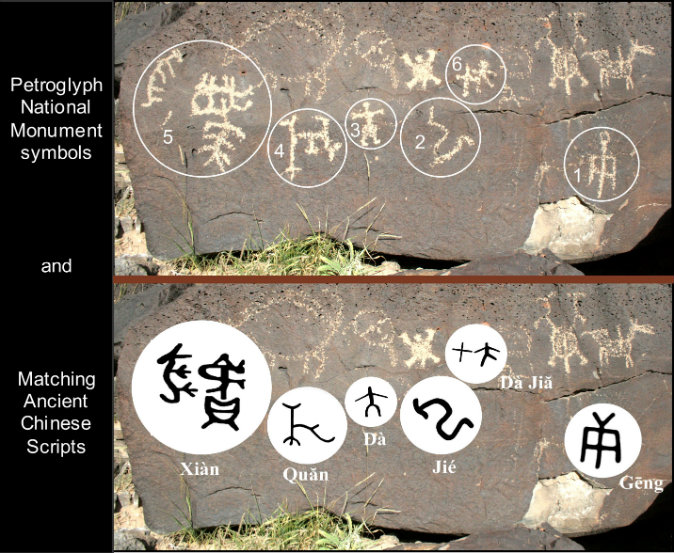
High above a walking path in Albuquerque’s Petroglyph National Monument, Ruskamp spotted petroglyphs that struck him as unusual. After consulting with experts on Native American rock writing and ancient Chinese scripts to corroborate his analysis, he has concluded that the readable message preserved by these petroglyphs was likely inscribed by a group of Chinese explorers thousands of years ago. 


Petroglyphs found in Arizona that are said to show an ancient Chinese script 
 [Credit: John Ruskamp] 

On the fringe of archaeology have long been claims that the Chinese reached North America 
long before Europeans. 
With some renowned experts taking interest in Ruskamp’s discovery, those claims may be working their way from the fringe to the core. 
It doesn’t mean our history textbooks will change tomorrow. 
Anything short of discovering an undisturbed early Asiatic relic or village in the Americas may fail to convince those archaeologists who have dogmatically rejected evidence of an ancient Chinese presence in the New World, said Ruskamp. 


Cartouche 1, which reads "Set apart (for) 10 years together"
 [Credit: John Ruskamp] 


But, the disparate and widespread symbols he has found show many indications of authenticity. 
They have the potential to inspire a more serious investigation into early trans-Pacific interaction. 
To date, Ruskamp has identified over 82 petroglyphs matching unique ancient Chinese scripts not only at multiple sites in Albuquerque, New Mexico, but also nearby in Arizona, as well as in Utah, Nevada, California, Oklahoma, and Ontario. 
Collectively, he believes that most of these artifacts were created by an early Chinese exploratory expedition, although some appear to be reproductions made by Native people for their own purposes. 
One of Ruskamp’s staunchest supporters has been David N. Keightley, Ph.D., a MacArthur Foundation Genius Award recipient who is considered by many to be the leading analyst in America of early Chinese oracle-bone writings. 
Keightley has helped Ruskamp decipher the scripts he has identified. 
One ancient message, preserved by three Arizona cartouche petroglyphs, translates as: “Set apart (for) 10 years together; declaring (to) return, (the) journey completed, (to the) house of the Sun; (the) journey completed together.” 
At the end of this text is an unidentified character that may be the author’s signature.


 Cartouche 2, which reads, “Declaring (to) return, (the) journey completed,  (to the) house of the Sun” 
[Credit: John Ruskamp] 


The oracle-bone style of writing employed for creating a number of these ancient petroglyph scripts disappeared by royal decree from mankind’s memory around 1046 B.C., following the fall of the Shang Dynasty. It remained an unknown and totally forgotten form of writing until it was rediscovered in A.D. 1899 at Anyang, China. 
Ruskamp thus concluded that the mixed styles of Chinese scripts found in these Arizona petroglyphs indicates that they were made during a transitional period of writing in China, not long after 1046 B.C. 
Ruskamp gives the following translation for the Albuquerque petroglyphs: “Geng (a date; the seventh Chinese Heavenly Stem); Jie (to kneel down in reverence); Da (great—referring to a superior); Quan (dog—the sacrificial animal); Xian (offering worship to  deceased ancestors); and Da Jia (the name of the third king of the Shang dynasty).” 


Cartouche 3, which reads, "(The) journey completed together" 
[Credit: John Ruskamp] 


The Albuquerque petroglyphs use both Seal era and Bronze era Chinese scripts, suggesting they were also written during a transitional period in Chinese calligraphy, likely between 1046 B.C. and 475 B.C. The use of the title “Da” before the name “Jia,” suggests a date close to the end of the Shang Dynasty in 1046 B.C., as this appellation emerged during that time period and was replaced shortly thereafter. 
Michael F. Medrano, Ph.D., chief of the Division of Resource Management for Petroglyph National Monument, studied the petroglyphs at that location upon Ruskamp’s request. He said that, based on his more than 25 years of experience with local Native cultures, “These images do not readily appear to be associated with local tribal entities,” and “based on repatination appear to have antiquity to them.” 


Arizona cartouche petroglyphs  
[Credit: John Ruskamp] 


It is difficult to physically date petroglyphs with absolute certainty, notes Ruskamp. Yet the syntax and mix of Chinese scripts found at these two locations correspond to what experts would expect explorers from China to use some 2,500 years ago. For example, the Arizona ranch petroglyphs are divided into three sections each enclosed in a square known as a cartouche. Two of the cartouches are numbered; one with the Chinese script for “one” placed beneath it and in a similar manner the second cartouche has the ancient Chinese script meaning “second” inscribed beneath it. Together these numeric figures indicate the order in which these images should be read. Importantly, the cartouches are thus shown to be read in the traditional Chinese manner, from right to left. 


Evolution of Chinese symbols
  [Credit: John Ruskamp] 


The first two cartouches are rotated 90 degrees to the left of vertical and the third is rotated 90 degrees to the right. “The deliberate rotation of these writings, both to the left and right of vertical by an equal number of degrees, endorses their authenticity, for the rotation of individual scripts by Chinese calligraphers is well-documented,” wrote Ruskamp. 
Some of the symbols found in the petroglyphs are common to both Chinese script and ancient Native American writing. 
For instance, “The Chinese petroglyph figure of Jiu conveys the idea of “togetherness,” in much the same manner as the Nakwach symbol is now, and has been in the past, understood by the Hopi,” wrote Ruskamp. 
   Another similarity is the use of a rectilinear spiral to convey the concept of a “round-trip journey.” Though these similarities could be conceived as supporting a Native American origin for Ruskamp’s petroglyphs, Ruskamp stated: “The extensive Chinese vocabulary evidenced at each location advocates against the authorship of the figures evaluated in this study being credited to Native Americans. None of the more complex Chinese figures identified in this report are known to have any Native tribal affiliation.” 


The Arizona glyph site on what has always been, and still is, very private ranch property  located miles from any public access or road [Credit: John Ruskamp] 


The conclusion of his paper titled 'Ancient Chinese Rock Writings Confirm Early Trans-Pacific Interaction,' reads: “In contrast to any previous historical uncertainty, the comparative evidence presented in this report, which is supported by both analytical evaluation and expert opinion, documenting the presence of readable sequences of old Chinese scripts located upon the rocks of North America, establishes that prior to the extinction of oracle-bone script from human memory, approximately 2,500 years ago, trans-Pacific exchanges of epigraphic intellectual property took place between Chinese and North American populations.” 

He published the paper on his website, Asiaticechoes.org, in April and it is currently under peer review.
 Last October, he began presenting his findings in speaking engagements, including most recently to the Association of American Geographers in Chicago. 
He will next present at a meeting of the Little Colorado River Chapter of the Arizona Archaeology Society in Springerville, Arizona, on May 18. 
The editors of the journal Pre-Columbiana have confirmed they will soon publish Ruskamp’s article.
The journal is edited by Professor Emeritus Stephen C. Jett, Ph.D., University of California–Davis, with the assistance of an editorial board of distinguished professional 
scholars, and is dedicated to exploring Pre-Columbian transoceanic contact. 

A retired educator, statistician, and analytical chemist, Ruskamp pursued his study of petroglyphs as a hobby—little expecting to find what may lead to a great shift in how we view both American and Chinese history. 


Author: Tara MacIsaac | Source: Epoch Times [June 30, 2015]

domenica 12 aprile 2015

Il ciarlatano premiato col Nobel

IL CIARLATANO ED IL SUO NOBEL
KARY MULLIS

articolo di 
Maurizio Feo


Questo post costituisce un esempio di come - talvolta - la realtà superi spesso di gran lunga ogni più sbrigliata fantasia.
Esso riunisce
- fatti scientifici (interessanti risultati della ricerca sul DNA),
- fatti di cronaca nera orribili e spiacevoli (cause di omicidio e di paternità, di cui s'interessa la Medicina Legale con le sue tecniche forensi)
- ed altre e varie recenti dispute (per esempio, quella che vede in Sardegna da una parte i ricercatori accreditati e dall'altra quelli 'autodidatti'; ma anche quella - purtroppo - circa la notizia della superiorità organizzativa degli altri sistemi giudiziari rispetto a quello italiano).

Prima, un po' di cronologia:

1984 : Alec Jeffreys  (1950) sviluppa la tecnologia per determinare l'impronta genetica. Una sua dichiarazione : "Esisteva un livello di specificità in ogni individuo che era anni luce al di là di ogni cosa vista prima. Ci rendemmo immediatamente conto delle possibili implicazioni nelle indagini forensi e nella verifica della paternità"

1986-88 : Prima applicazione del 'test del DNA': Colin Pitchfork fu riconosciuto inequivocabilmente colpevole dell'omicidio di una ragazza di 15 anni, Dawn Ashworth, per cui era stato precedentemente arrestato l'innocente Richard Buckland.

1990 : La 'reazione della catena delle polimerasi' è applicata all'impronta genetica, che permette di sperimentare sui più piccoli campioni biologici. (Da allora centinaia di migliaia di criminali sono stati condannati grazie alla 'Prova del DNA'. Anche le vittime degli attentati dell'undici Settembre 2001  furono identificate con il test del DNA).

1992 : Il cadavere di Josef Mengele è identificato grazie alla prova del DNA. Un uomo sepolto in Brasile, con il nome di Wolfgang Gerhard era in realtà Mengele, il medico fuggito da Auschwitz e responsabile ideatore di numerosi odiosi esperimenti in vivo sui prigionieri ebrei.

1998 : sull'abito blu di Monica Lewinsky ('previdentemente' subito surgelato da lei) si identifica il DNA di Bil Clinton. Migliaia di cause di paternità sono decise grazie al test: Eddie Murphy, Steve Bing, Maradona, Dwight Yorke, Eto'o,  etc...

2003 : il "Criminal Justice Act"  inglese prevede il prelievo di DNA da chiunque sia arrestato per un reato, anche se poi non incriminato, né condannato. E' un mezzo che permette di creare rapidamente  un'enorme ed utilissima banca dati di DNA, cosa che pone i servizi inglesi all'avanguardia rispetto agli altri.

Come funziona il test.
- Alec Jeffreys scoprì per caso le possibili applicazioni in ambito legale del DNA.
In realtà, egli stava studiando i minisatelliti per cercare una chiave dell'evoluzione dei geni responsabili di malattie. Usava come materiale alcuni campioni di DNA prelevati da una sua collaboratrice (Vicky Wilson) e dai suoi genitori. Notò una somiglianza familiare nel numero delle ripetizioni dei minisatelliti, ma anche che ciascuna sequenza aveva un profilo unico. 
- Inizialmente, il test si fondava su alcuni segmenti ripetitivi  del 'Junk DNA' (DNA spazzatura) noti come minisatelliti, che hanno una lunghezza compresa tra 10 e 100 lettere. Essi presentano sempre la medesima sequenza di basi GGGCAGGAXG (dove X può essere una qualunque delle 4 basi). I minisatelliti s'incontrano più di un centinaio di volte nel genoma umano e in ciascun sito si ripetono un numero casuale di volte.

 - Come 'entra' Kary Mullis nella faccenda?

Nel 1983 egli inventa una tecnica (la PCR - "Polimerase Chain Reaction"). Questa tecnica permette l'amplificazione di piccole quantità di DNA.
Ciò è solo apparentemente insignificante: nella realtà dei fatti, significa che anche solo 150 cellule divengono una quantità di materiale 'leggibile' ed utilizzabile a scopo scientifico o medico legale.
Inoltre, con il tempo, l'analisi dei minisatelliti è stata sostituita dall'uso di piccole sequenze ripetitive di DNA (chiamate 'brevi ripetizioni in tandem': short tandem repeats), che sopravvivono meglio all'esposizione ambientale e possono essere più facilmente amplificate con la PCR.

Attualmente, varie nazioni archiviano il DNA di criminali condannati per l'uso in Medicina Forense. Il Regno Unito già nel 2010 possedeva ormai un database includente più del 6% della popolazione (oltre 4 milioni di campioni).

Solo una persona su un milione condivide la medesima 'impronta genetica' con un altro: questo permette di considerarla una prova conclusiva.
Significa anche, però, che - in un paese di 60 milioni d'abitanti - esistono 60 persone con la stessa impronta genetica. Ciò significa più specificatamente che, una volta che sia stato trovato DNA sospetto sul luogo del delitto, esistono 59 possibilità su 60 che il soggetto proprietario di 'quel' DNA sia innocente...
Non si tratta di cavilli, si tratta di due situazioni diametralmente opposte: un conto è rinvenire seme prelevato da una vittima di stupro (un campione abbondante, che supera qualsiasi altro presente), tutto un altro conto è il rinvenimento di qualche cellula (il test è sensibile fino a sole 5 cellule!) in un posto che l'indiziato poteva frequentare anche del tutto innocentemente.
Inoltre, è necessario tenere conto della contaminazione: quando si tratta di poche cellule, queste potrebbero essere state scambiate per contatto remoto o per scambio diretto con altre persone che poi le hanno 'seminate' (inconsapevolmente) sul posto del delitto...

Kary Mullis vince il Nobel per la sua scoperta del metodo PCR.
A 1971 paper in the Journal of Molecular Biology by Kleppe and co-workers first described a method using an enzymatic assay to replicate a short DNA template with primers in vitro. However, this early manifestation of the basic PCR principle did not receive much attention, and the invention of the polymerase chain reaction in 1983 is generally credited to Kary Mullis.
Malgrado ciò, egli resta un soggetto estremamente controverso: ha descritto apertamente le proprie esperienze con LSD (dietilamide dell'acido lisergico, una droga potentissima); ha scritto persino una biografia "Ballando nudi nel campo della mente", in cui descrive in dettaglio un episodio relativo al 1985, nel corso del quale sostiene di avere incontrato un orsetto lavatore luccicante che gli ha rivolto la parola. Ha sostenuto la tesi 'indipendente' per cui l'HIV non causerebbe l'AIDS; ha sostenuto la validità dell'astrologia.
Il suo contributo alla Scienza, però, è indiscutibile: a parte l'uso in medicina forense del 'suo' test, ne esistono applicazioni nei test genetici per le malattie e nella ricerca del DNA antico (aDNA), con qualche aiuto all'archeologia, solo per fare due esempi.

L'attuale 'disamistade' sarda.
- E' cosa regionalmente nota che sia in corso una disputa ormai cronica tra i sostenitori di tesi 'creative' e 'indipendenti' circa la Storia trascorsa della Sardegna ed i sostenitori 'autorizzati', quelli accademici.
Ambedue i gruppi organizzano congressi e raduni, parlano e scrivono abbondantemente sull'argomento.
Taluni esponenti di ambedue i gruppi non risparmiano critiche anche aspre al gruppo avverso, includendovi oltre a quelle alle idee sostenute anche quelle concernenti i comportamenti. Accuse anche gravi sono state scambiate.
I toni si sono esacerbati fino all'eccesso, in una spirale ascendente di espressioni sempre più esecrabili.

La mia personale opinione è che l'attuale livello di tensione sia più utile a chi desidera ottenere una maggiore e continua 'visibilità mediatica', per scopi personali ben precisi.
Non è comunque utile alla Scienza in alcun modo e questo è un fatto inconfutabile.

Propongo pertanto, di utilizzare, per il gruppo dei 'non accademici' espressioni come "pensatori non allineati', oppure 'ricercatori indipendenti' e simili: non sono espressioni offensive e non dovrebbero giustificare un aumento del livore di ritorno.
Poi ognuno, nel segreto del proprio animo e del proprio pensiero, può coltivare l'opinione più o meno fondata che l'altro sia un cialtrone ciarlatano e la sua produzione sia solamente ciarpame: ma non lo ha detto espressamente...
E l'esempio del premio Nobel Kary Mullis insegna che anche un sostenitore di idee controverse ed 'indipendenti' può, talvolta, coltivare un'idea preziosa per la Scienza...
Forse a quello scopo dovrebbero mirare più intensamente i 'pensatori indipendenti'.


lunedì 23 marzo 2015

My Quest for Atlantis


The Rock of Gibraltar with the southern coast of Spain in the background. Plato hinted Atlantis could be nearby.CreditJames Rajotte for The New York Times

There’s nothing like a vigorous sea-to-summit hike up the Rock of Gibraltar to clear the jet-lagged mind, especially when you’re trying to solve a nearly 2,500-year-old mystery. Following the zigzagging lines on the colorful paper place mat I’d been handed at the Gibraltar welcome center when I’d asked for a map, I climbed a steep set of concrete and stone stairs high into the green solitude of the Upper Rock Nature Preserve. As the path cut through a thick tangle of scrub, the southern coast of Spain appeared to the west, far below. A little farther on, the view widened to take in the cinched waist of the Strait of Gibraltar. A few steps later, the northern shore of Africa emerged through the last of the morning’s light mist.

If I stared hard in the direction of Morocco and held my hands to the sides of my head like horse blinders to block out the cargo ships and condo towers, I could imagine why the ancient Greeks considered this spot the limit of the known world. And perhaps why one Athenian, arguably the wisest Greek of all, had hinted that the solution to one of antiquity’s greatest mysteries might be visible from this very spot.
Most visitors come to the Mediterranean looking for sun, seafood and relaxation. While those were on my to-do list, I was primarily hoping to find something slightly more elusive: the lost city of Atlantis.
That might sound like a fool’s errand. But modern searches for lost cities have often unearthed before-you-die travel destinations; Machu Picchu and Angkor Wat, after all, were both once jungle ruins hidden to the outside world. For archaeology fanatics like myself, raised on Indiana Jones movies and basement stacks of old National Geographic magazines, nothing could top finding Atlantis.
Contrary to what you may remember from reading comic books, the original Atlantis wasn’t a technologically advanced underwater city populated by Aquaman and mermaids. The first mentions of it were by none other than Plato, in his dialogues “Timaeus” and “Critias,” around 360 B.C.
“Now in this island of Atlantis,” he wrote, “there was a great and wonderful empire” that “endeavored to subdue the whole of the region within the straits.”
While philosophy scholars are still debating the exact meanings of Plato’s cryptic account, one leading interpretation of the Atlantis tale is that it was intended to illustrate political ideas put forth in the “Republic,” widely considered to be the most important book in the Western canon. But Plato’s account (which its narrator repeatedly insists is true) is also filled with vivid particulars — beautiful mountains, circular canals, monumental works of architecture, lush flora, bountiful fields and fruit trees — that wouldn’t be out of place in a modern travel guide. Plato piles on so much detail, in fact, that people have been arguing ever since his death whether he intended the story to be taken as truth or fiction. In his own writings, Plato’s prize pupil Aristotle seems to confirm some elements of his master’s story while casting doubt on others.
In recent years, a group of mostly amateur researchers has emerged who treat the search for Atlantis as a serious topic. Surprisingly, almost none of them think it sank to the bottom of the Atlantic Ocean; indeed, most believe the original Atlantis was hit by a tsunami or other cataclysm and therefore might still be found on solid ground somewhere around the Mediterranean. (According to Plato’s account, “there occurred violent earthquakes and floods; and in a single day and night of misfortune the island of Atlantis in like manner disappeared in the depths of the sea.”)
I studied their theories and drew up a short list of promising suspects to inspect in person. If this required taking a solo shoulder-season journey to examine clues in some of the nicest spots around the Mediterranean —Spain’s Andalusian coast, Malta, the Greek island of Santorini — that wasn’t my fault. A good detective simply follows where the evidence leads him.

Photo

The Strait of Gilbraltar from atop the Rock of Gibraltar. CreditJames Rajotte for The New York Times

One: The Pillars of Hercules

The Rock of Gibraltar is part of Plato’s most tantalizing clue: that Atlantis was an island that once sat “in front of the mouth” of the Pillars of Hercules. Ancient accounts place these columns at Gibraltar and Jebel Musa, a peak across the straits in Morocco, or Monte Hacho, a smaller mountain slightly farther east.
To get to Gibraltar, I took the high-speed train from Madrid to Seville, then drove a leisurely three hours south through the kaleidoscope of Andalusia: forests of gigantic white windmills like upturned boat propellers; rocky bluffs dotted with arthritic-looking cork trees; empty medieval towns dominated by hulking churches, with plazas papered in fliers for flamenco lessons. At a 9 a.m. roadside coffee stop, the cafe was filled with middle-aged men drinking large brandies on ice, while the proprietor’s wife sold freshly picked asparagus in bunches as thick as my thigh.
When I arrived in La Linea de la Concepción, just before the border of Gibraltar, I circled the majestic bullring, parked on the street, dropped a few euros in a meter, wished the traffic matron a buen día and walked through border control into British territory.
Gibraltar, ceded by Spain to Britain 300 years ago under the Treaty of Utrecht, is essentially a 1950s London theme park — red phone boxes, helmeted bobbies, fish ’n’ chips specials — all set amid palm trees and overshadowed by the photogenic 1,400-foot slab of limestone familiar to Prudential customers. According to Greek myth, the Rock (as everyone in Gibraltar calls it) had been hurled there by Hercules (Heracles in the original Greek) as part of the strongman’s 12 labors. In the spirit of herculean tasks, I decided to skip the cable car ride and ascend on foot.
The residential area of Gibraltar squeezes most of its 30,000 residents into a claustrophobic two and a half square miles. Walking along the road to the top, however, I could peek over walls to see homes with tidy tropical gardens, one of which had yet to clean up from a party in the Queen’s honor. A few signs tempted tourists to peek at the 32 miles of defense tunnels carved inside the Rock over the centuries. (In one secret passage, rediscovered only in 1997, the British planned to sequester spies if Gibraltar fell to the Nazis.) Farther along I was greeted by the wildBarbary apes that inhabit the Rock, the only free-roaming primates in Europe. After frisking me for snacks, and finding none, they deserted me for a promising vanload of sunburned Britons.
Upon reaching the viewing terrace, I tried to ignore the cheesy two-columned Pillars of Hercules monument evidently modeled on a Soviet bowling trophy and focus my attention on the infinite green Atlantic, scanning the horizon in vain for signs of Atlantis. Even if the island had sunk, it would be tough to miss; Plato described it as “larger than Libya and Asia put together” — which in his time probably meant North Africa and Asia Minor — “and was the way to other islands,” which could mean anything from the Canaries to Iceland.
Taking my cue from the hungry apes, I descended to a late lunch of steak and ale pie with a pint of bitter and walked back to Spain before my meter ran out.


Wetlands at Doñana National Park in Spain. CreditGetty images

Two: Doñana

My next stop was a short jaunt up through Spain, along the southwestern coast: Doñana National Park. Plato wrote that Atlantis was located near Gades, the ancient name for the city of Cádiz, about 60 miles northwest of Gibraltar. Just to the north sits the national park, a former royal hunting ground where the Guadalquivir River splits to form a delta along the Atlantic coast. That marshy delta, with its winding, twisting landmasses and estuaries, turns out to be another possible candidate for the lost city: A German researcher caused a stir a decade ago when he published an article in the archaeological journal Antiquity, claiming that satellite photos seemed to show evidence that a city with structures similar to those in Plato’s Atlantis had once occupied that very spot.
Today, Doñana is a peaceful nature reserve beloved by bird-watchers, but as José María Galán, a park ecologist, pointed out as we drove through the choppy surf, it has a violent history. The offshore Azores-Gibraltar Transform Fault shifts roughly every 350 to 450 years, unleashing huge earthquakes and tsunamis that obliterate anything built along the coast. (The last such quake, in 1755, leveled Lisbon.) Mr. Galán, who was wearing a Yellowstone Park cap he’d picked up on a recent trip, compared the regularity of seismological disasters here to the clockwork spurts of Old Faithful. It’s geologically impossible for a city to sink to the bottom of the ocean, but an ancient cataclysm might account for Plato’s famous description of an island vanishing in “a single day and night of misfortune.”
Doñana’s wetlands flood for six months annually, which is great for birds migrating to and from Africa and not so great for amateur Atlantis seekers. But the graceful, sloping dunes that overlook the water have clearly been occupied by multiple civilizations over the years; their small, identical mounds of sand have revealed pottery shards and other artifacts dating back thousands of years.
Every year during the winter rainy season, the Guadalquivir River soaks Doñana’s plain and leaves behind a new layer of sediment. If Atlantis really had been located in Doñana, it might now be buried under 20 feet of silt and clay. As Mr. Galán knelt down to show me a Morse code line of scorpion tracks, a gust of ocean wind blew up and the trail vanished in a cloud of sand. “See, in the end nature erases everything,” he said.


Hagar Qim temple on Malta. CreditDarrin Zammit Lupi for The New York Times

Three: Malta

Plato depicted Atlantis as a well-guarded island city, rich in temples. Which is also an excellent description of Malta. Valletta, its capital, built in the 16th century out of local yellow limestone that resembles unbaked pastry crust, was designed as a fortress by the Knights of St. John, a still-extant military order loyal to the Vatican and often cited by conspiracy theorists as geopolitical puppetmasters. While their secret society is more akin to the Shriners than the Bilderberg Group these days, Malta is perhaps the most devoutly Catholic country in the world, the sort of place where no one raises an eyebrow at the huge Caravaggio masterpieces hanging in the oratory at St. John’s Co-Cathedral and parents complain about the skyrocketing costs of made-to-measure first communion attire.
Malta is not well known to Americans, which is a shame, because its waters are crystal clear and the food, heavily influenced by proximity to Italy, is excellent. Over a plate of fenkata, the country’s ubiquitous rabbit stew, my local guide, Dr. Anton Mifsud (a pediatrician, amateur historian and all-around Malta booster), explained his theory that Plato’s Pillars of Hercules were actually in the center of the Mediterranean. “If there was an Atlantis, then Malta has to be it,” he told me excitedly.
Dr. Mifsud had extraordinary energy for someone who spends 12-hour days battling Malta’s horrendous traffic to make house calls to screaming toddlers. On his day off, he drove me to the ancient temples of Mnajdra and Hagar Qim, the oldest free-standing structures in the Mediterranean — they predate the Great Pyramids of Egypt by a thousand years, and Plato’s “Timaeus” by almost three millenniums — and the likeliest (or perhaps least improbable) candidates for Plato’s Atlantean temples.
The temples were stunning, clusters of oval rooms built from giant slabs of cut yellow limestone and set on a desolate bluff overlooking the water. Each looked as if Stonehenge had undergone cell division and then developed jaundice. At sunrise on the solstice, Dr. Mifsud told me as we stood in a doorway at Mnajdra, “the sunlight shoots down here onto the altar!” Later, studying the exhibits at the excellent National Museum of Archaeology, housed in a former Knights of St. John auberge in Valletta, I learned that whatever culture constructed these monoliths had vanished suddenly around 2500 B.C. Dr. Mifsud believed that accounts of this collapse, probably the result of a natural disaster, had been passed down through the generations until Plato recorded them in the story of Atlantis.
On my last afternoon in Malta, Dr. Mifsud drove me to Clapham Junction, also known as Misrah Ghar il-Kbir, a limestone field crosshatched with the island’s most famous unexplained phenomenon, its stone cart ruts. The explanation I’d seen at the archaeological museum, that the ruts had been worn into the soft rock by hauling sleds, was more banal than other theories: They were the large grid of irrigation canals that Plato wrote about. Or that they are the work of extraterrestrials, as Erich von Däniken suggests in his crypto-archaeology classic “Chariots of the Gods.” I did see one sign of intelligent life while bending down to examine the grooves, however. A family of clever rabbits, avoiding a certain fate as fenkata, was making its burrow beneath the limestone maze.


The view from Fira on Santorini, an island in Greece formed by a volcanic eruption around 1600 B.C. CreditJames Rajotte for The New York Times

Four: Santorini

Sitting on the terrace of a cliffside cafe, taking in the skybox view of Santorini’s bowl-shaped caldera over breakfast, I was almost certain that I’d found Atlantis. Plato’s city, before its catastrophic end, had been built atop concentric rings of land and water. Santorini’s broken-doughnut shape, created by a huge volcanic explosion that spewed ash from Egypt to Turkey around 1600 B.C., is essentially a bull's-eye with a tiny island at the center. This compelling cataclysm-and-circles evidence has made Santorini the only Atlantis candidate sanctioned by otherwise skeptical establishment academics. (Jacques Cousteau once filmed a documentary here titled “Calypso’s Search for Atlantis.”) The island’s extraordinary natural beauty also happens to have established its reputation among travelers as the Platonic ideal of a Greek island.

Like many island dwellers, George Nomikos, a gregarious restaurateur who agreed to serve as my guide, saw his home as the center of the universe and wanted me to see every inch of it. From the town of Fira we followed winding roads cut through the thick volcanic tephra that covers Santorini’s ring like frosting on a Bundt cake. We visited red, white and black sand beaches — which echoed Plato’s description of Atlantis’s buildings constructed from red, white and black stone — and dormant vineyards and fields, where the island’s volcanic soil nurtures its famous white wine grapes and cherry tomatoes. After crossing twice through Mr. Nomikos’s adorable home village, Megalochori, where he enthusiastically slowed down to shout “Kalimera!” (“Good morning!”) to assorted friends and cousins, we turned north and traced the upper curve of the island’s ring to the town of Oia, with its whitewashed homes and glorious blue-domed roofs perched on the rim of the caldera. It’s one of the most photographed spots in the world and, incredibly, even more beautiful in person.
Mr. Nomikos, who seemed to know every single person on Santorini, had arranged for his friend Dimitris Chamalidis to circle us around the caldera in his speedboat. As we approached Nea Kameni, the young (and still growing) volcanic island at the caldera’s center, the deep blue waters turned Kelly green from sulfur. “You can smell now, like a bad egg,” Mr. Chamalidis said, biting down on a cigarette and scrunching his nose. We returned to port and waited for what I’d been told was the world’s greatest sunset. It did not disappoint.
Perhaps the most interesting piece of Atlantis evidence on Santorini is Akrotiri, an archaeological site that reopened to visitors in 2012 after several years following a roof collapse. Akrotiri had been a thriving port town until the explosion 3,600 years ago. Today, it’s like a smaller Pompeii, but better maintained. One extraordinary fresco, in which a fleet of ships voyage between two prosperous maritime cities, has been interpreted by some as a snapshot of Plato’s Atlantis.


FRANCE
Black Sea
ITALY
TURKEY
SPAIN
GREECE
Doñana National Park
Tyrrhenian
Sea
Ionian
Sea
Santorini
Alboran
Sea
Malta
Gibraltar
TUNISIA
MOROCCO
ALGERIA
EGYPT
LIBYA
I was eager to ply Mr. Doumas with my theories about Atlantis, but as Mr. Nomikos ordered glasses of the local pink-hued vin santo, the archaeologist shook his head dismissively and told me I was, indeed, on a fool’s errand. “Atlantis is a utopia,” he said. “A word that in Greek means ‘no place.’ It’s a dream.”
Was it, though? After a few weeks of detective work, I wasn’t so sure. Everything Plato wrote — including the story of Atlantis — underscored his conviction that the purpose of life was to search for truth. I’d just have to keep looking, no matter how many beaches I needed to visit, no matter how much grilled octopus I needed to eat. I told Mr. Nomikos I was headed to Athens next to examine possible Atlantis clues at the Acropolis.
“Mark, this is very serious, you need a plan,” he said, taking my pen. “Let me give you the name of a good souvlaki place,” he continued, and motioned for the waiter to bring another round of wine.