Visualizzazione post con etichetta China. Mostra tutti i post

lunedì 6 luglio 2015

L'immutabile percorso della mente del ciarlatano

A qualunque latitudine ed in qualsiasi lingua, la mente del ciarlatano segue sempre il medesimo percorso: costruisce secondo i medesimi canoni le proprie meravigliose farneticazioni. In questo caso, che mi pregio di presentare oggi, siamo fortunatamente ben lontani dalla Sardegna e dagli Shardana: ci troviamo, infatti, in Arizona, USA.
Ma i numerosi punti di contatto sono almeno tanto curiosamente numerosi da non potere NON essere portati all'attenzione.

- Si tratta di "petroglifi".
- Come è noto, i petroglifi non sono databili
- Sono presenti in una zona remota, ove non si reca mai nessuno, essendo tra l'altro proprietà privata.
- Essendo una zona mai frequentata, nessuno può dire: "il mese scorso non c'erano!".
- Sono "nascosti in piena vista" (un'espressione molto cara ai fantarcheologi, che riescono sempre a vedere ciò che persino gli studiosi del campo non hanno mai trovato).
- La scoperta è di quelle che permetteranno di "riscrivere la Storia".
- Tutte le elucubrazioni e ricerche sono partite da un appassionato che è (John A. Ruskamp, vedi il fondo dell'articolo riportato) un "educatore in pensione, uno statistico, un analista chimico" e che si è interessato della cosa solo per hobby.
- Ha recentemente pubblicato un articolo, sì è trovato sostenitori di nicchia David Keightley, massimo epigrafista di ossa oracolari cinesi) e si sta promuovendo in tutti i modi.
- Ha già trovato, in giro per gli States, circa 82 petroglifi (New Mexico, Arizona, Utah, Nevada, California, Oklahoma, e persino Ontario). 

Unica differenza: trattandosi degli USA, in cui la democrazia e la verità sono un'ossessione popolare diffusa, l'articolo di Ruskamp sarà sottoposto a "Peer Review": pertanto, sarà espressa una precisa sentenza scientifica su di lui e sul suo operato.


Researcher claims 


ancient Chinese explorers 


landed in America 

Americas, ArchaeoHeritage, Archaeology, Breakingnews, China, North America, USA 

John A. Ruskamp Jr., Ed.D., reports that he has identified an outstanding, history-changing treasure hidden in plain sight. 
High above a walking path in Albuquerque’s Petroglyph National Monument, Ruskamp spotted petroglyphs that struck him as unusual. After consulting with experts on Native American rock writing and ancient Chinese scripts to corroborate his analysis, he has concluded that the readable message preserved by these petroglyphs was likely inscribed by a group of Chinese explorers thousands of years ago. 


Petroglyphs found in Arizona that are said to show an ancient Chinese script 
 [Credit: John Ruskamp] 

On the fringe of archaeology have long been claims that the Chinese reached North America 
long before Europeans. 
With some renowned experts taking interest in Ruskamp’s discovery, those claims may be working their way from the fringe to the core. 
It doesn’t mean our history textbooks will change tomorrow. 
Anything short of discovering an undisturbed early Asiatic relic or village in the Americas may fail to convince those archaeologists who have dogmatically rejected evidence of an ancient Chinese presence in the New World, said Ruskamp. 


Cartouche 1, which reads "Set apart (for) 10 years together"
 [Credit: John Ruskamp] 


But, the disparate and widespread symbols he has found show many indications of authenticity. 
They have the potential to inspire a more serious investigation into early trans-Pacific interaction. 
To date, Ruskamp has identified over 82 petroglyphs matching unique ancient Chinese scripts not only at multiple sites in Albuquerque, New Mexico, but also nearby in Arizona, as well as in Utah, Nevada, California, Oklahoma, and Ontario. 
Collectively, he believes that most of these artifacts were created by an early Chinese exploratory expedition, although some appear to be reproductions made by Native people for their own purposes. 
One of Ruskamp’s staunchest supporters has been David N. Keightley, Ph.D., a MacArthur Foundation Genius Award recipient who is considered by many to be the leading analyst in America of early Chinese oracle-bone writings. 
Keightley has helped Ruskamp decipher the scripts he has identified. 
One ancient message, preserved by three Arizona cartouche petroglyphs, translates as: “Set apart (for) 10 years together; declaring (to) return, (the) journey completed, (to the) house of the Sun; (the) journey completed together.” 
At the end of this text is an unidentified character that may be the author’s signature.


 Cartouche 2, which reads, “Declaring (to) return, (the) journey completed,  (to the) house of the Sun” 
[Credit: John Ruskamp] 


The oracle-bone style of writing employed for creating a number of these ancient petroglyph scripts disappeared by royal decree from mankind’s memory around 1046 B.C., following the fall of the Shang Dynasty. It remained an unknown and totally forgotten form of writing until it was rediscovered in A.D. 1899 at Anyang, China. 
Ruskamp thus concluded that the mixed styles of Chinese scripts found in these Arizona petroglyphs indicates that they were made during a transitional period of writing in China, not long after 1046 B.C. 
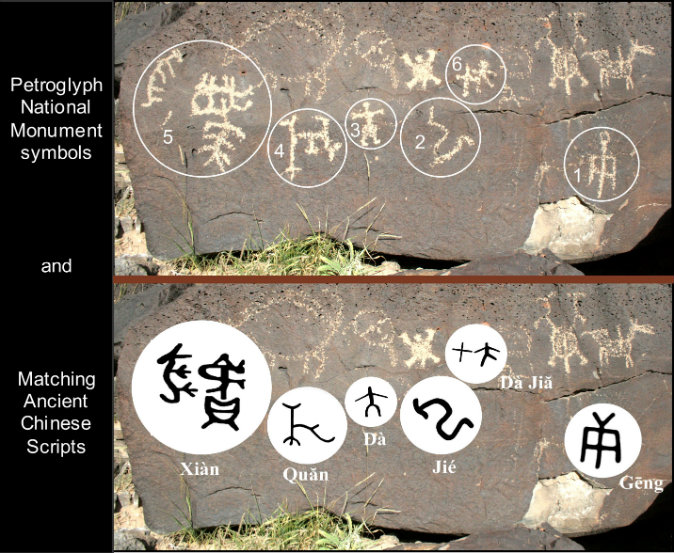
Ruskamp gives the following translation for the Albuquerque petroglyphs: “Geng (a date; the seventh Chinese Heavenly Stem); Jie (to kneel down in reverence); Da (great—referring to a superior); Quan (dog—the sacrificial animal); Xian (offering worship to  deceased ancestors); and Da Jia (the name of the third king of the Shang dynasty).” 


Cartouche 3, which reads, "(The) journey completed together" 
[Credit: John Ruskamp] 


The Albuquerque petroglyphs use both Seal era and Bronze era Chinese scripts, suggesting they were also written during a transitional period in Chinese calligraphy, likely between 1046 B.C. and 475 B.C. The use of the title “Da” before the name “Jia,” suggests a date close to the end of the Shang Dynasty in 1046 B.C., as this appellation emerged during that time period and was replaced shortly thereafter. 
Michael F. Medrano, Ph.D., chief of the Division of Resource Management for Petroglyph National Monument, studied the petroglyphs at that location upon Ruskamp’s request. He said that, based on his more than 25 years of experience with local Native cultures, “These images do not readily appear to be associated with local tribal entities,” and “based on repatination appear to have antiquity to them.” 


Arizona cartouche petroglyphs  
[Credit: John Ruskamp] 


It is difficult to physically date petroglyphs with absolute certainty, notes Ruskamp. Yet the syntax and mix of Chinese scripts found at these two locations correspond to what experts would expect explorers from China to use some 2,500 years ago. For example, the Arizona ranch petroglyphs are divided into three sections each enclosed in a square known as a cartouche. Two of the cartouches are numbered; one with the Chinese script for “one” placed beneath it and in a similar manner the second cartouche has the ancient Chinese script meaning “second” inscribed beneath it. Together these numeric figures indicate the order in which these images should be read. Importantly, the cartouches are thus shown to be read in the traditional Chinese manner, from right to left. 


Evolution of Chinese symbols
  [Credit: John Ruskamp] 


The first two cartouches are rotated 90 degrees to the left of vertical and the third is rotated 90 degrees to the right. “The deliberate rotation of these writings, both to the left and right of vertical by an equal number of degrees, endorses their authenticity, for the rotation of individual scripts by Chinese calligraphers is well-documented,” wrote Ruskamp. 
Some of the symbols found in the petroglyphs are common to both Chinese script and ancient Native American writing. 
For instance, “The Chinese petroglyph figure of Jiu conveys the idea of “togetherness,” in much the same manner as the Nakwach symbol is now, and has been in the past, understood by the Hopi,” wrote Ruskamp. 
   Another similarity is the use of a rectilinear spiral to convey the concept of a “round-trip journey.” Though these similarities could be conceived as supporting a Native American origin for Ruskamp’s petroglyphs, Ruskamp stated: “The extensive Chinese vocabulary evidenced at each location advocates against the authorship of the figures evaluated in this study being credited to Native Americans. None of the more complex Chinese figures identified in this report are known to have any Native tribal affiliation.” 


The Arizona glyph site on what has always been, and still is, very private ranch property  located miles from any public access or road [Credit: John Ruskamp] 


The conclusion of his paper titled 'Ancient Chinese Rock Writings Confirm Early Trans-Pacific Interaction,' reads: “In contrast to any previous historical uncertainty, the comparative evidence presented in this report, which is supported by both analytical evaluation and expert opinion, documenting the presence of readable sequences of old Chinese scripts located upon the rocks of North America, establishes that prior to the extinction of oracle-bone script from human memory, approximately 2,500 years ago, trans-Pacific exchanges of epigraphic intellectual property took place between Chinese and North American populations.” 

He published the paper on his website, Asiaticechoes.org, in April and it is currently under peer review.
 Last October, he began presenting his findings in speaking engagements, including most recently to the Association of American Geographers in Chicago. 
He will next present at a meeting of the Little Colorado River Chapter of the Arizona Archaeology Society in Springerville, Arizona, on May 18. 
The editors of the journal Pre-Columbiana have confirmed they will soon publish Ruskamp’s article.
The journal is edited by Professor Emeritus Stephen C. Jett, Ph.D., University of California–Davis, with the assistance of an editorial board of distinguished professional 
scholars, and is dedicated to exploring Pre-Columbian transoceanic contact. 

A retired educator, statistician, and analytical chemist, Ruskamp pursued his study of petroglyphs as a hobby—little expecting to find what may lead to a great shift in how we view both American and Chinese history. 


Author: Tara MacIsaac | Source: Epoch Times [June 30, 2015]

sabato 21 febbraio 2015

I primi mammiferi


Earliest-known 

arboreal and subterranean 

ancestral mammals discovered 

  The fossils of two interrelated ancestral mammals, newly discovered in China, suggest that the wide-ranging ecological diversity of modern mammals had a precedent more than 160 million years ago. 


On the left are photos of the type specimen of Docofossor brachydactylus.  Docofossor was found in lake sediments of the Jurassic Ganggou fossil site  in Hebei Province of China. The fossil of Docofossor is preserved with dense  and carbonized furs around its skeleton. On the right is the fossil of  Agilodocodon scansorius. Found in lake sediments of the 165 million  years old Daohugou Fossil Site of Inner Mongolia of China, Agilodocodon  scansorius is preserved with a halo of dense, carbonized furs and hair  impressions. The horny claws on hands and feet are also preserved  [Credit: Zhe-Xi Luo, the University of Chicago] 


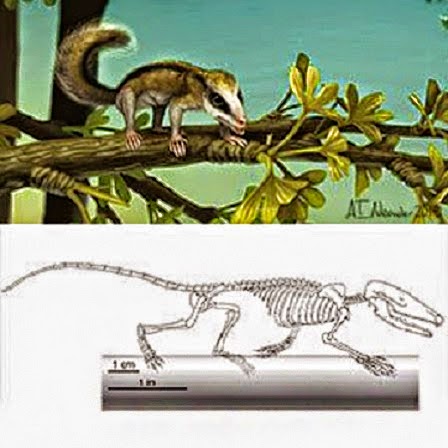
With claws for climbing and teeth adapted for a tree sap diet, Agilodocodon scansorius is the earliest-known tree-dwelling mammaliaform (long-extinct relatives of modern mammals). The other fossil, Docofossor brachydactylus, is the earliest-known subterranean mammaliaform, possessing multiple adaptations similar to African golden moles such as shovel-like paws. Docofossor also has distinct skeletal features that resemble patterns shaped by genes identified in living mammals, suggesting these genetic mechanisms operated long before the rise of modern mammals. These discoveries are reported by international teams of scientists from the University of Chicago and Beijing Museum of Natural History in two separate papers published Feb. 13 in Science (the papers can be found here and here). 


Skeletal and life style reconstructions of Agilodocodon scansorius, a docodont mammaliaform.  The skeletal features suggest that it was an agile and active animal living on trees.  Its incisors were specialized to feed on tree sap (exudate feeding), and its molars  suggest omnivorous feeding 
[Credit: April I. Neander/University of Chicago] 


"We consistently find with every new fossil that the earliest mammals were just as diverse in both feeding and locomotor adaptations as modern mammals," said Zhe-Xi Luo, PhD, professor of organismal biology and anatomy at the University of Chicago and an author on both papers. "The groundwork for mammalian success today appears to have been laid long ago." Agilodocodon and Docofossor provide strong evidence that arboreal and subterranean lifestyles evolved early in mammalian evolution, convergent to those of true mammals. These two shrew-sized creatures -- members of the mammaliaform order Docodonta -- have unique adaptations tailored for their respective ecological habitats.


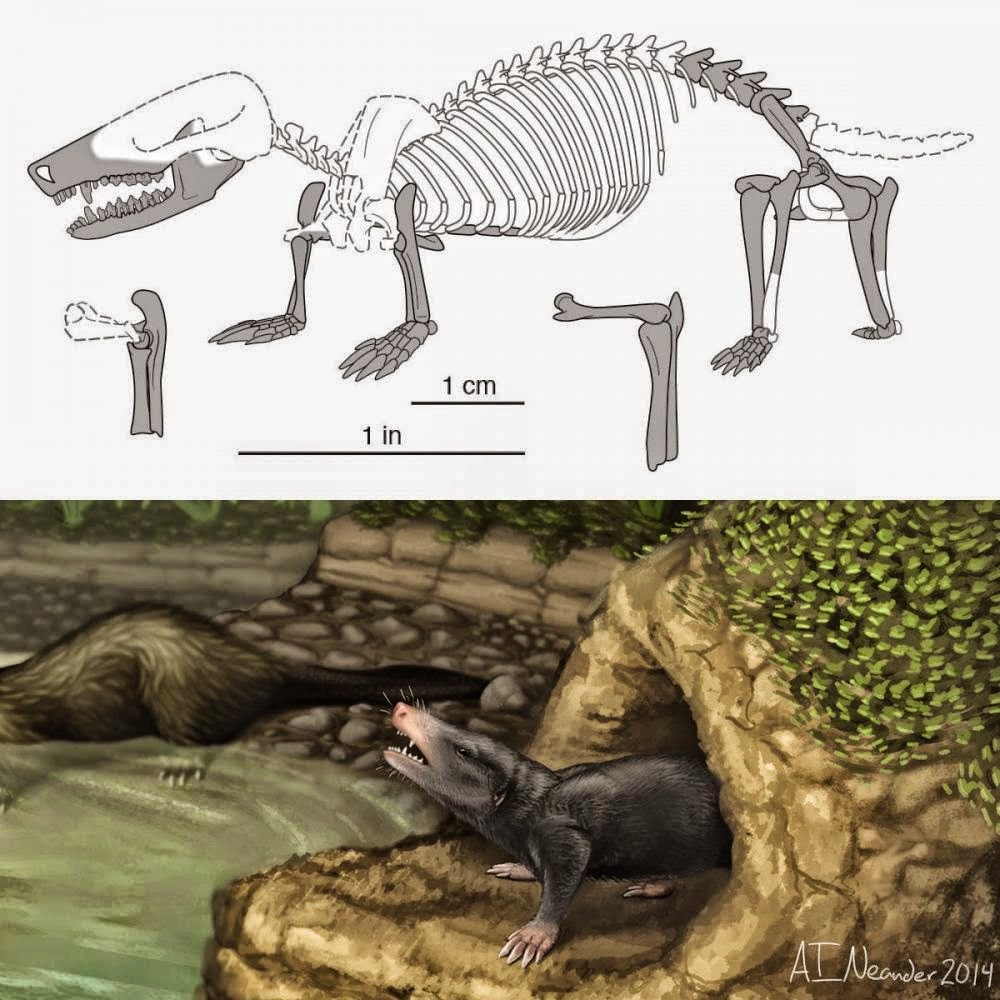
 Skeletal and life style reconstructions of Docofossor brachydactylus. Docofossor lived  in burrows on the lakeshore and fed on the worms and insects in the soil. Docofossor  is also unique in that it has one segment fewer of finger bone segments than most  other mammals, suggesting that it had a unique embryonic development  of its hands and feet [Credit: April I. Neander/University of Chicago] 


Agilodocodon, which lived roughly 165 million years ago, had hands and feet with curved horny claws and limb proportions that are typical for mammals that live in trees or bushes. It is adapted for feeding on the gum or sap of trees, with spade-like front teeth to gnaw into bark. This adaptation is similar to the teeth of some modern New World monkeys, and is the earliest-known evidence of gumnivorous feeding in mammaliaforms. Agilodocodon also had well-developed, flexible elbows and wrist and ankle joints that allowed for much greater mobility, all characteristics of climbing mammals. "The finger and limb bone dimensions of Agilodocodon match up with those of modern tree-dwellers, and its incisors are evidence it fed on plant sap," said study co-author David Grossnickle, graduate student at the University of Chicago. "It's amazing that these arboreal adaptions occurred so early in the history of mammals and shows that at least some extinct mammalian relatives exploited evolutionarily significant herbivorous niches, long before true mammals." 


An illustration of Agilodocodon and Docofossor. The skeletal features  of Agilodocodon (top left) suggeset it was an agile and active  arboreal animal. The skeletal features of Docofossor (bottom right)  suggest it lived in burrows and fed on worms and insects  [Credit: April I. Neander/University of Chicago] 


Docofossor, which lived around 160 million years ago, had a skeletal structure and body proportions strikingly similar to the modern day African golden mole. It had shovel-like fingers for digging, short and wide upper molars typical of mammals that forage underground, and a sprawling posture indicative of subterranean movement. Docofossor had reduced bone segments in its fingers, leading to shortened but wide digits. African golden moles possess almost the exact same adaptation, which provides an evolutionary advantage for digging mammals. This characteristic is due to the fusion of bone joints during development -- a process influenced by the genes BMP and GDF-5. Because of the many anatomical similarities, the researchers hypothesize that this genetic mechanism may have played a comparable role in early mammal evolution, as in the case of Docofossor. The spines and ribs of both Agilodocodon and Docofossor also show evidence for the influence of genes seen in modern mammals. Agilodocodon has a sharp boundary between the thoracic ribcage to lumbar vertebrae that have no ribs. However, Docofossor shows a gradual thoracic to lumber transition. These shifting patterns of thoracic-lumbar transition have been seen in modern mammals and are known to be regulated by the genes Hox 9-10 and Myf 5-6. That these ancient mammaliaforms had similar developmental patterns is an evidence that these gene networks could have functioned in a similar way long before true mammals evolved. "We believe the shortened digits of Docofossor, which is a dead ringer for modern golden moles, could very well have been caused by BMP and GDF," Luo said. "We can now provide fossil evidence that gene patterning that causes variation in modern mammalian skeletal development also operated in basal mammals all the way back in the Jurassic." 


Stem mammaliaforms—also known as stem mammals—are long-extinct relatives to   the extant mammals (crown Mammalia). Docodonts are a lineage of stem mammaliaforms.  Their morphologies provide evidence for the ancestral mammalian condition.  Their functional adaptations provide new insight on the ecological diversification  of the earliest mammals 
[Credit: April I. Neander/University of Chicago]


 Early mammals were once thought to have limited ecological opportunities to diversify during the dinosaur-dominated Mesozoic era. However, Agilodocodon, Docofossor and numerous other fossils -- including Castorocauda, a swimming, fish-eating mammaliaform described by Luo and colleagues in 2006 -- provide strong evidence that ancestral mammals adapted to wide-ranging environments despite competition from dinosaurs. "We know that modern mammals are spectacularly diverse, but it was unknown whether early mammals managed to diversify in the same way," Luo said. "These new fossils help demonstrate that early mammals did indeed have a wide range of ecological diversity. It appears dinosaurs did not dominate the Mesozoic landscape as much as previously thought." 

Author: Kevin Jiang 

Source: University of Chicago [February 14, 2015]

sabato 29 novembre 2014

Il pollo? Fu addomesticato in Cina.

Oldest example of chicken domestication found in China

 An international research team including a University of York biologist has found the earliest evidence for chicken domestication to date. 


Beijing Fatty Chicken, a local Chinese breed  [Credit: Huagui Liu] 


Michi Hofreiter, of the University of Potsdam in Germany and an Honorary Professor in York’s Department of Biology, led the research with Professor Xingbo Zhao from China Agricultural University in Beijing. 

The researchers obtained mitochondrial DNA sequences from up to 10,000 year old chicken fossils originating from northern China. 

At this age, the sequences are several thousands of years older than any other chicken ancient DNA sequences reported previously. 
Moreover, despite their age, the northern Chinese chicken sequences already represent the three major groups of mitochondrial DNA sequences present in the modern chicken gene pool, suggesting genetic continuity between these oldest chicken bones known worldwide and modern chicken populations. 

The research is reported in PNAS. 
Based on modern DNA sequences scientists had already suggested that chickens had been domesticated in different places in south and south-east Asia, but previously northern China had never been suggested as a location for chicken domestication. 

Professor Xingbo Zhao said: “People argued that northern China did not provide suitable habitat for red jungle fowl, the wild ancestor of domestic chickens but they do not take into account that climate and vegetation were very different 10,000 years ago.” 

The results not only suggest northern China as one of the earliest places for chicken domestication but also that the domestication of chicken, today the most important poultry species in the world, started as early as those of the other four agriculturally important animal species, cattle, pigs, goat and sheep. 

Moreover, the results provide further evidence for an early agricultural complex in northern China. 
Professor Hofreiter, who is also an associate member of the University of York’s Palaeo research centre, added: “These are really exciting results as they suggest that societies with mixed agriculture developed in northern China around the same time they did so in the Near East”. 

Source: University of York [November 24, 2014]

sabato 18 ottobre 2014

Antiche scritture

Sono stati scoperti - dagli archeologi cinesi - 34 nuovi caratteri di scrittura e glifi, incisi su cosiddette 'ossa oracolari', che molto aggiungono alle conoscenze sulla più antica scrittura mondiale nota ad oggi (ove si escluda quella protosarda).
Si sa che si tratta dei più antichi segni di scrittura usata in modo continuativo, incisi su gusci di tartaruga e su ossa di animali. I primi furono trovati circa 110 anni fa.
Datano al 1600 - 1046 a.C. (Dinastia Shang).
I nuovi caratteri sono stati trovati in un museo - il Museo Lyushun - in  un gruppo di 1800 pezzi facenti parte di un antica raccolta. 
Ad oggi, sono stati riconosciuti circa 4.000 segni grafici differenti - da un 
totale di circa 130.000 reperti - ma solamente circa la metà è stata decifrata.

Alcuni ricercatori hanno notato che  certi segni sono esattamente uguali ai 'rovesciati' rinvenuti nelle 'domos de janas' sarde ed al 'segno di Tanit' osservato in molti luoghi in Sardegna: si sta pertanto lavorando sull'ipotesi che colonizzatori Shardana provenienti dall'Anglona siano stati nella   regione ed abbiano ivi dato inizio alla Dinastia Shang (Shardana+Anglona).


New oracle bone characters discovered in Liaoning 


Chinese archaeologists have discovered 34 new characters and glyphs from oracle bones housed in a museum in Lyushun, a city in northeast China's Liaoning province.

 Oracle bone characters [Credit: Xinhua]


 Song Zhenhao, a research fellow with the Chinese Academy of Social Sciences who is leading a team that has been researching the inscriptions since 2011, said on Thursday that the new findings are another breakthrough since such inscriptions were discovered over 110 years ago. 

Inscriptions on tortoise shells and animal bones represent the original characters of the Chinese written language. 

They date back to the Shang Dynasty (1600-1046 BC). 

The new characters and glyphs, which involve names of nations, places, persons and sacrificial rituals, were found among a 1,800-piece collection of bone inscription relics in the Lyushun Museum. 

Song said the team took rubbings from the text images of the 1,800 pieces and photographed them, which led to the characters being identified. 

To date, archaeologists around the world have identified 4,000 bone inscription characters from studying 130,000 relics, but only half of the characters have been deciphered, he added. 

Chinese characters constitute the oldest continuously used system of writing in the world.

The graphic logograms of the characters convey both meaning and pronunciation. 

Oracle bone inscriptions were first discovered in 1899 by Beijing academic and antiquarian Wang Yirong, although farmers had been unearthing the relics in Anyang, Henan Province, for many years. 

Wang noticed symbols that looked like writing on animal bones and tortoise shells. 

Source: Xinhua [October 16, 2014]


mercoledì 4 giugno 2014

L'invenzione dei pantaloni

Si tratta di un'invenzione di almeno 3.200 anni fa, stando ai reperti dell'archeologia cinese occidentale. Probabilmente è antica quanto lo è l'arte di cavalcare (circa 4.000 anni fa). 
In questo caso, si tratta di pantaloni in lana lavorata al telaio, ricavati da tre pezzi, senza tagli. Sono decorati e muniti di spacchi laterali e stringhe per essere allacciati. 
I proprietari avevano all'incirca 40 anni ed erano pastori e guerrieri, come si deduce dal materiale che li accompagna: tra le molte altre cose, un bracciale da arciere, un'ascia da battaglia, un arco ed un contenitore per proteggerlo.
Prima di allora, l'uomo non portava i pantaloni, né in Europa, né in Asia: lo stesso Otzi portava una copertura fatta di tre pezzi distinti, che avevano l'aspetto di pantaloni senza esserlo davvero. 
Insomma: fu allora che l'uomo iniziò a portare i pantaloni. 
Ma non illudiamoci: probabilmente era anche allora la donna ad essere saldamente al comando...


Riders from the Eurasian Steppes invented trousers 

3,200 years ago .


  Two men whose remains were recently excavated from tombs in western China put their pants on one leg at a time, just like the rest of us. 

But these nomadic herders did so between 3,300 and 3,000 years ago, making their trousers the oldest known examples of this innovative apparel, a new study finds. 


Yanghai, Xinjiang Autonomous Region, around 1100 BC, front view  of a wool pants from the grave M21 [Credit: (c) M. Wagner,  Deutsches Archäologisches Institut] 


With straight-fitting legs and a wide crotch, the ancient wool trousers resemble modern riding pants, says a team led by archaeologists Ulrike Beck and Mayke Wagner of the German Archaeological Institute in Berlin. 
The discoveries, uncovered in the Yanghai graveyard in China’s Tarim Basin, support previous work suggesting that nomadic herders in Central Asia invented pants to provide bodily protection and freedom of movement for horseback journeys and mounted warfare, the scientists report May 22 in Quaternary International. 

“This new paper definitely supports the idea that trousers were invented for horse riding by mobile pastoralists, and that trousers were brought to the Tarim Basin by horse-riding peoples,” remarks linguist and China authority Victor Mair of the University of Pennsylvania. 

Previously, Europeans and Asians wore gowns, robes, tunics, togas or — as observed on the 5,300-year-old body of Ötzi the Iceman — a three-piece combination of loincloth and individual leggings. 


Urumqi, Xinjiang Autonomous Region Institute of Archaeology, documentation  of a 1800-year-old silk dress from Niya [Credit: (c) Joy Zhou,  Deutsches Archäologisches Institut] 


A dry climate and hot summers helped preserve human corpses, clothing and other organic material in the Tarim Basin. 
More than 500 tombs have been excavated in a graveyard there since the early 1970s. Earlier research on mummies from several Tarim Basin sites, led by Mair, identified a 2,600-year-old individual known as Cherchen Man who wore burgundy trousers probably made of wool. 
Trousers of Scythian nomads from West Asia date to roughly 2,500 years ago. Mair suspects that horse riding began about 3,400 years ago and trouser-making came shortly thereafter in wetter regions to the north and west of the Tarim Basin. 
Ancient trousers from those areas are not likely to have been preserved, Mair says. 


Leather boots from Hami before and after restoration [Credit: (c) Joy Zhou,  Deutsches Archäologisches Institut] 


Horse riding’s origins are uncertain and could date to at least 4,000 years ago, comments archaeologist Margarita Gleba of University College London. 
If so, she says, “I would not be surprised if trousers appeared at least that far back.” 
The two trouser-wearing men entombed at Yanghai were roughly 40 years old and had probably been warriors as well as herders, the investigators say. 
One man was buried with a decorated leather bridle, a wooden horse bit, a battle-ax and a leather bracer for arm protection. 
Among objects placed with the other body were a whip, a decorated horse tail, a bow sheath and a bow. 
Beck and Wagner’s group obtained radiocarbon ages of fibers from both men’s trousers, and of three other items in one of the tombs. 
Each pair of trousers was sewn together from three pieces of brown-colored wool cloth, one piece for each leg and an insert for the crotch. 
The tailoring involved no cutting: Pant sections were shaped on a loom in the final size. Finished pants included side slits, strings for fastening at the waist and woven designs on the legs. 
Beck and Wagner’s team calls the ancient invention of trousers “a ground-breaking achievement in the history of cloth making.” That’s not too shabby for herders who probably thought the Gap was just a place to ride their horses through. 


Author: Bruce Bower | Source: Science News [May 31, 2014]

venerdì 14 marzo 2014

La 'Bellezza di Xiaohe'

Ricetta per il formaggio, dalle massaie dell'Età del Bronzo.

Il clima arido del deserto è stato un vero colpo di fortuna: ha permesso di rinvenire resti di formaggio dell'Età del Bronzo in ottimo stato di conservazione e di ricavarne la ricetta.

Non era fatto con il caglio (o presame), bensì con latte, lievito e batteri (quindi lasciato fermentare). Praticamente, si ottiene unformaggio che non si guasta né irrancidisce rapidamente insieme ad un sottoprodotto liquido - il 'kefir' - che, come il formaggio, non contiene lattosio ed è quindi adatto ad una popolazione di intolleranti qual'era quella di allora.

Si è trattato di una serie di coincidenze. Lo studio è stato fatto perché gli archeologi cinesi hanno pensato di mandare campioni del 'donario' rituale di una mummia (la bellezza di Xiaohe: doveva essere - anche se oggi non sembra - una donna molto bella) splendidamente conservata all'Istituto Max Planck, perché fossero analizzati con metodi moderni. E' stato quindi impostato uno studio d'avanguardia sulle proteine di un materiale che non era ancora stato sequenziato (e che aprirà la strada a nuove ricerche proteomiche per uso archeometrico).


Early Bronze Age 

cheese recipe 

reconstructed 


Normally, Andrej Shevchenko and his team at the Max Planck Institute of Molecular Cell Biology and Genetics in Dresden analyse proteins and fats in the cells of fruit flies or roundworms. 
In this case, however, the scientists dealt with some very unusual samples: misshapen fragments that turned out to be the remnants of cheese from the Early Bronze Age, making them the earliest known cheese yet to be discovered. 
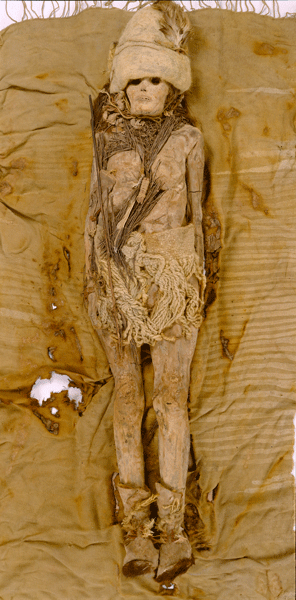
The cheese fragments represent funerary goods that were found around the neck and on the chest of a 4,000-year-old mummified body uncovered at the Xiaohe burial site in Xinjiang, western China. 
Their analysis enabled the researchers to recreate the recipe for the cheese: like kefir, it was made of milk with the addition of a mixture of bacteria and yeast, and subsequently fermented. 


Small cheese clumps are scattered around the neck of the female mummy as a burial offering. 
At the time, people needed no natural rennet from the stomach of animals for the production of cheese made of milk, yeast, and bacteria. It was therefore not necessary to slaughter any young animals [Credit: Y. Liu, Y. Yang] 

The 4,000-year-old Xiaohe cheese represents the oldest remains of a milk product ever found. The extremely arid climate in the Taklamakan Desert, where the Xiaohe burial ground is located, meant that the cheese residues were exceptionally well preserved – a real stroke of luck for the Dresden-based researchers. The cheese found on the mummies was produced with bacteria and yeast, not with rennet: “This meant that no young animals had to be slaughtered – a major advantage of this production method,” explains Shevchenko. According to the scientist’s interpretation, this may have been instrumental in the spread of cattle herding on a large scale throughout Asia. “The method of making this kefir cheese is simple; it doesn’t spoil or turn rancid quickly. So the cheese is extremely well suited to mass production.” As a precursor to the cheese, the process of fermentation with kefir grains also produces the probiotic milk drink known as kefir. Both products contain hardly any lactose – ideal for the population groups living in Asia, most of which are lactose intolerant. 


The "Beauty of Xiaohe": the approx. 4,000 year-old mummy of a woman from Western China [Credit: Y. Liu, Y. Yang] 


Andrej Shevchenko’s wife Anna heads the Mass Spectrometry Department at the same Institute. The two researchers have only recently completed another archaeology project and published their findings. In her desk drawer, Anna Shevchenko still has a few plastic tubes filled with light-brown crumbs – 2,500-year-old funerary goods found during excavations at the ancient Chinese burial ground of Subeixi. “We analysed protein residues from an earthenware dish and were able to reconstruct a prehistoric recipe for leavened bread,” she relates. “We never actually had archaeology on our radar screen. We just kind of stumbled across it thanks to an e-mail enquiry sent by Chinese archaeologist Yimin Yang,” says Shevchenko. Yang had come up with the idea of having his finds analysed with ultramodern quantitative proteomics methods, whereupon he sent the scientists in Dresden the first cheese fragments. Before they could proceed, they had to develop methods of identifying proteins from organisms whose DNA had not yet been sequenced. The projects are therefore truly pioneering and demonstrate most notably that quantitative proteomics is not only suitable for use in biomedical research, but could also represent a promising method for archaeology: “The analytical methods used in archaeology to date always looked at DNA or fats – yet these are often totally useless, especially when it comes to very old organic samples. Proteins have been ignored so far because it was always believed that they would be completely decomposed, that they’re difficult to handle and that the results might be contaminated with proteins from the ambient environment. So our method opens up brand new possibilities for the analysis of organic residues on archaeological finds,” says Anna Shevchenko. Unlike fats, proteins carry a great deal of information inside them in molecular form: for instance, the arrangement of amino acids, the building blocks of the proteins, can also contain signs of the processes used, like fermentation. As such, proteomics could develop into an interesting and suitable method in archaeometry. 
The discovery has been published in the Journal of Archaeological Science. 


Source: Max Planck Society 

[March 11, 2014]
Read more at: http://archaeologynewsnetwork.blogspot.it/2014/03/early-bronze-age-cheese-recipe.html?utm_source=feedburner&utm_medium=feed&utm_campaign=Feed:+TheArchaeologyNewsNetwork+(The+Archaeology+News+Network)#.UyKG6j95OSo
Follow us: @ArchaeoNewsNet on Twitter | groups/thearchaeologynewsnetwork/ on Facebook