Visualizzazione post con etichetta canada. Mostra tutti i post

sabato 31 gennaio 2015

Uso del Propulsore.

Conoscerlo è un conto (il propulsore era noto dal 18.000 a.C.) usarlo è un altro (mi sono sempre chiesto se i Protosardi ne avessero bisogno: non credo). 
Dimostrare che fosse usato  da una popolazione richiede ricerca. Per i Paleo indiani nord americani, eccola:


First Americans used spear-throwers to hunt large animals 


Despite a lack of archaeological evidence, the first North Americans have often been depicted hunting with spear-throwers, which are tools that can launch deadly spear points at high speeds. 
But now, a new analysis of microscopic fractures on Paleo-Indian spear points provides the first empirical evidence that America's first hunters really did use these weapons to tackle mammoths and other big game.


A nearly complete Clovis projectile point of dendritic chert, a mid-interval biface  of translucent quartz, displaying relatively heavy red ochre residue and an  "end-beveled" osseous rod, also exhibiting red ochre residue  [Credit: Sarah L. Anzick] 

The new study has implications for scientists' understanding of the way Paleo-Indians lived, researchers say. 
To understand the inner workings of extinct hunter-gatherer societies, it's important to first learn how the ancient peoples got the food they ate, because their lives were closely tied to their subsistence activities. 
Current models of Paleo-Indian society are based on the assumption that hunters sometimes used spear-throwers, or atlatls, said study author Karl Hutchings, an archaeologist at Thompson Rivers University in Canada. "We can now be assured that those assumptions were right," Hutchings told Live Science. Ancient hunting tools Similar to bows, atlatls can propel flexible, pointed shafts — called darts, rather than arrows — at high speeds across long distances. 
Essentially, they were sticklike tools that contained a hook or spur at one end to hold a dart. By swinging the spear-thrower overhead and forward, hunters could launch their darts with greater force than if they were to throw them like javelins. 
Archaeological evidence indicates that hunter-gathers in the Old World used atlatls beginning at least 18,000 years ago. 
Researchers have long thought that Paleo-Indians — including the people of the Clovis culture, who lived around 13,000 years ago and are considered one of the first American peoples — also hunted with spear-throwers. 
Researchers reasoned that "if the spear-thrower originated in the Old World, then it only made sense that it must have shown up with early [North American] colonists," Hutchings said. Additionally, Paleo-Indians were thought to have hunted big animals, such as mammoths and ground sloths, which would have required powerful, long-distance weapons to take the animals down safely. "People started wondering just how crazy you would have to be to run up to these things with just a sharp, broken rock tied to a stick." 
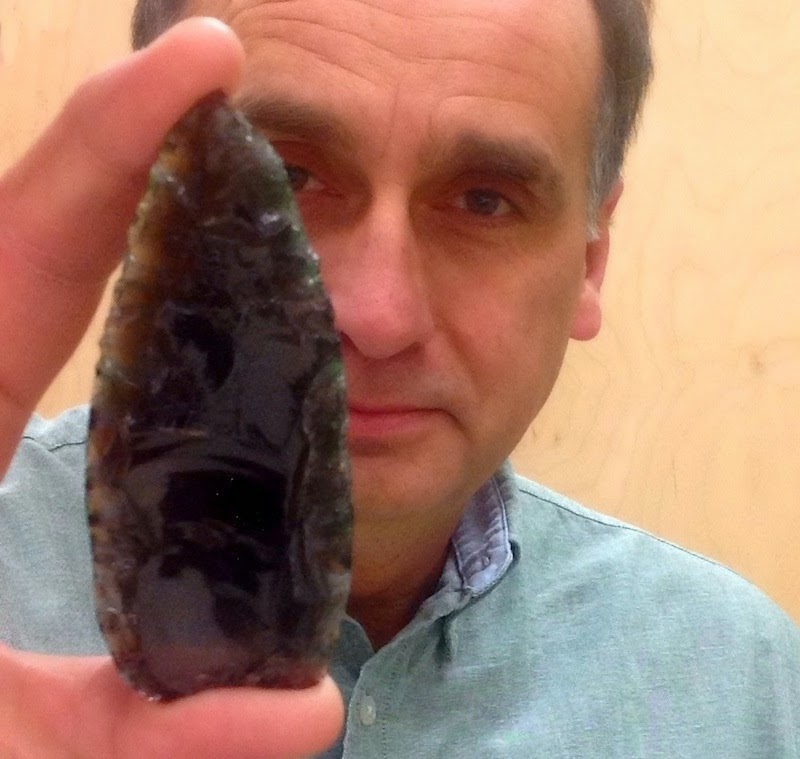


Karl Hutchings, an archaeologist at Thompson Rivers University in Canada,  holds a Clovis spear point [Credit: Karl Hutchings] 


But archaeological evidence of Paleo-Indian atlatls and darts is lacking because these tools were often made of wood, which doesn't preserve well — the only part of the weapons left in the archaeological record are the stone points, which could have also been used in other types of weapons, such as spears, Hutchings said. In comparison, ancient spear-throwers from Europe were often made of ivory or bone. 
The earliest known evidence of Paleo-Indian spear-throwers comes from 11,000-year-old "bannerstones," which are stone objects that may have functioned as atlatl weights, though the true function of bannerstones is debated, Hutchings said.
 The earliest solid evidence of atlatls in the New World, then, are 9,000- to 10,000-year-old spear-thrower hooks from Warm Mineral Springs, a sinkhole in Florida. However, these tools date back to the Early Archaic subperiod, which came after the Paleo-Indian period. 
Telltale fractures To see if the earliest North Americans — including people from the Clovis culture, Folsom culture (10,000 to 11,000 years ago) and other Paleo-Indians — used atlatls, Hutchings analyzed the fractures present in hundreds of spear points. He looked for clues that the weapon tips experienced high-velocity, mechanically propelled impacts. 
If a spear point hits a target hard enough, the energy of the impact will cause the tip to break. "When it breaks, it sends a shock wave through the stone that produces fractures, which are related to the amount and kind of force involved," Hutchings said. 
By measuring topographic features on the fracture surface, you can calculate the "fracture velocity" of the impact, or how quickly the fractures spread through the material, Hutchings explained. Because different weapons — spears, javelins, atlatls or bows — produce specific fracture velocities and related forces, you can work backward from a fracture to determine what caused it. Using this method, which he developed in the late 1990s, Hutchings determined the fracture velocities for 55 out of 668 Paleo-Indian artifacts that he examined. 
Of these points, about half of them exhibited fracture velocities that can only be achieved using an atlatl and dart or a bow and arrow.
 Because Paleo-Indians aren't thought to have had bows and arrows or other propulsive weapons, the findings suggest that they most likely used atlatls to launch their spear points, Hutchings said. Importantly, the method may also help scientists better understand ancient projectile technologies, by allowing them to trace the origin of the technologies and how they were used across societies and continents. 
"We can get a better resolution of when these technologies occurred, how they spread and why they spread," Hutchings said. Hutchings detailed his findings in the March issue of the Journal of Archaeological Science. 

Author: Joseph Castro | Source: LiveScience [January 28, 2015]

Read more at: http://archaeologynewsnetwork.blogspot.it/2015/01/first-americans-used-spear-throwers-to.html?utm_source=feedburner&utm_medium=feed&utm_campaign=Feed:+TheArchaeologyNewsNetwork+(The+Archaeology+News+Network)
Follow us: @ArchaeoNewsNet on Twitter | groups/thearchaeologynewsnetwork/ on Facebook

sabato 26 luglio 2014

T-Rex


Sono giunti tardi, alla fine del Giurassico, dopo i piccoli Ceratosauri ed i mastodontici Allosauri, ma certamente sono quelli che hanno maggiormente stuzzicato la fantasia di tutti: i Tirannosauri. 
Su di essi si è molto favoleggiato e molto studiato. Ad un certo punto si è perfino sostenuto che fossero 'scavengers', cioé che si nutrissero di animali già morti, uccisi da altri predatori più veloci.

Oggi, da una squadra di ricercatori canadesi che hanno scavato in una località rigorosamente tenuta segreta della British Columbia, giunge la notizia che il Tirannosauro era un cacciatore di prede viventi e che cacciava in branco, più o meno come oggi fanno i lupi ed i leoni.
La squadra ha rilevato 30/40 impronte chiare e inconfondibili, oggi stampate sulla roccia (un tempo il fondo doveva essere fangoso: sono visibili persino le scaglie dei grandi rettili) a dimostrare il lavoro del branco contro una preda mobile (probabilmente un Adrosauro, un dinosauro erbivoro con un buffo muso d'anatra).
A conti fatti, doveva trattarsi di tre animali pesanti circa tre tonnellate ciascuno, alti all'incirca 2,5 metri e dell'età di meno di trent'anni, capaci di muoversi a 8.5 km/ora, camminando normalmente.
Sono stati fatti stampi delle impronte e la località è stata secretata e ricoperta di terra.
Il Canada non possiede leggi che proteggono la zona dai ricercatori non autorizzati e non ci sono i fondi per proseguire gli scavi, né per staccare le zone delle impronte dal sito e portarle via in elicottero.
L'unica cosa sicura per il momento è seppellirle e proteggerle dall'uomo e dal clima.
Forse dovremmo fare la stessa cosa con Pompei....


Fossil footprints suggest 

tyrannosaurs hunted in packs 


They were the king of the carnivores that ruled the Earth 70 million years ago but maybe tyrannosaurs were friendlier than their reputations have allowed. 


A team of paleontologists in British Columbia uncovered the preserved footprints  of three tyrannosaurs, suggesting they might have hunted in packs 
 [Credit: The Canadian Press/Richard McCrea] 


A trio of fossilized footprint tracks discovered near Tumbler Ridge, in northeastern British Columbia, offer compelling evidence that the beasts were not solitary but travelled in packs. The footprints were found by a local guide outfitter in October 2011. "I was hunting with a client and we were just walking along, and I didn't want to cross the river again for the millionth time," said Aaron Fredlund. 
As he made his way across a ledge along the river, he stumbled across two unmistakable footprints etched into the rock. "These tracks are really distinct. There was no doubt what we found," he said. That was almost the end of it. 
Fredlund began to leave, thought better of it, and went back for photos. A few days later he showed his wife the photos and she urged him to report his discovery. Those photos set Richard McCrea's heart racing half a world away. McCrea, curator of the Peace Region Palaeontology Research Centre in Tumbler Ridge, was in Australia at the time. The picture showed Fredlund's own foot beside the half-metre dinosaur fossil.


The dinosaur footprints preserved in the rock near Tumbler Ridge provide a glimpse  at the beasts that roamed the region 70 million years ago 
[Credit: The Canadian Press/ HO-Peace Region Palaeontology Research Centre] 


By the end of the month, McCrea and his colleagues were at the site themselves. 
Over the next year, they found five more prints belonging to three tyrannosaurs. 
In total, the site has 30 to 40 dinosaur footprints, including hadrosaurs, or duck-billed dinosaurs, and a smaller dinosaur called Szurexallopus cordata. And the fossils are close to perfect, McCrea said. The surface the animals trod was "pretty much the consistency of Play-Doh," he said, with a very high clay content. 
That was then covered by a thick layer of volcanic ash. Conditions were so ideal that impressions of the dinosaurs' rough skin are clearly visible.
 "This is the most ideal situation you could almost ask for," he said. Once believed to be solitary creatures, evidence has grown that tyrannosaurs were more "gregarious" than thought, according to McCrea's study published in the scientific journal PLOS One. 
Many solitary tyrannosaur tracks have been unearthed but these are the first trackways with multiple prints that show several travelling in close proximity. 
"We have extremely compelling evidence that tyrannosaurs travelled in groups. This was suspected and this is probably the most definitive evidence to come out to date on that topic," McCrea said. 

Tyrannosaur footprints are outlined at Tumbler Ridge, B.C. following the discovery  that the meat-eating dinosaur might have hunted in packs 
 [Credit: The Canadian Press/Richard McCrea] 


The trackways also provide the first record of tyrannosaur's walking gait, which the team calculated to be about 8.5 kilometres an hour.
 Paleontologists estimate the three were 25, 26 and 29 years old and stood about 2.35 metres high at the hip. They would have weighed about three tonnes each. 
At the time the footprints were made in the Cretaceous period, the area was about 1,100 kilometres further north than it is now but the temperature much milder. 
It was also closer to sea level than it is now. McCrea believes the discovery was serendipitous. 
The tracks survived millennia because they were covered by earth and they may not have made it through a freezing northern British Columbia winter exposed to the elements, he said. 
The team made castings of the footprints but the centre, which is locally funded, cannot afford to excavate the site.
 The team covered the tracks to protect them from treasure hunters and the weather and McCrea is searching for grants to retrieve and permanently preserve them. That would involve cutting the rock and flying the fossils out via helicopter. 
The location is a well-guarded secret. Unfortunately, despite numerous fossil beds throughout the province, British Columbia does not have a management plan for paleontological sites. The area is not protected under the law. 


Author: Dene Moore | Source: 

The Canadian Press

 [July 23, 2014]
Read more at: http://archaeologynewsnetwork.blogspot.it/2014/07/fossil-footprints-suggest-tyrannosaurs.html?utm_source=feedburner&utm_medium=feed&utm_campaign=Feed:+TheArchaeologyNewsNetwork+(The+Archaeology+News+Network)#.U9PW9-N_uSo
Follow us: @ArchaeoNewsNet on Twitter | groups/thearchaeologynewsnetwork/ on Facebook

martedì 31 dicembre 2013

Elmo di guerra

Rare 

Tlingit war helmet 

discovered at museum


 The mystery began to unfold when Museum staffers began to select objects from the over 200,000 items in the Museum’s collections for a new display titled “People of the Northwest Coast.” Dr. Ellen Savulis, the Science Museum’s Curator of Anthropology, was intrigued by one of the items described in collections records as simply an “Aleutian hat.” 
Stored on a shelf for over 100 hundred years, a rare anthropological treasure was recently discovered in the Springfield Science Museum’s permanent collections. Museum Director David Stier, who has worked in museums collections for almost 30 years, describes the discovery as nothing less than “the find of a lifetime” [Credit: Springfield Museum] The object was relatively large, ornately carved, and made from a single piece of dense wood. Although Dr. Savulis’ main area of expertise is Northeastern United States archaeology, she had the foresight to question whether hats made by the Unangax, the inhabitants of the Aleutian Islands, were typically made from such dense wood. Upon further investigation, Dr. Savulis found that the only type of wooden hat made in the treeless Aleutians is the hunting hat or visor, made from a thin plank of driftwood bent into a lopsided cone. None of this information matched the object she had in front of her. Dr. Savulis suspected that she had a helmet of some kind, and enlisted the help of Steve Henrikson, Curator of Collections at the Alaska State Museum in Juneau.  After hearing the description and an extensive viewing of artifact images, Mr. Henrikson responded enthusiastically, “This is a Tlingit war helmet, absolutely, no question!”  He went on to say that “it’s very rare - there are less than 100 Tlingit war helmets in existence that we know of. I’ve been studying them for over 20 years and I’m sure I’ve seen most of them.” Museum records show that the artifact was accepted into collections sometime after 1899, the year that the Springfield Science Museum (formerly the Museum of Natural History) moved into its own building at the Quadrangle.  The source of the artifact was not known, and it carried the simple label “Aleutian hat.” Having limited experience with cultural materials, museum specialist Albertus Lovejoy Dakin accepted the accuracy of the object’s label and entered it as such in the collection records. Some 40 years later the artifact received a permanent museum collection number from museum director Leo D. Otis, who still had no reason to dispute the “Aleutian hat” claim. There the artifact remained in its spot in the permanent collections, carefully preserved and unheralded, waiting to be found. According to Mr. Henrikson, we now know that the object is indeed a war helmet from the Tlingit people of southeast Alaska.  The style of the carving and decoration on the helmet (probably the emblem of a clan) dates it to the mid-19th century or earlier. With the mass importation of firearms to the region in the mid-1800’s, this sort of body armor became relegated to ceremonial uses. Today, a few helmets are still brought out at ceremonial gatherings, such as potlatches, to commemorate prominent events and honor past clan elders.  Because they are associated with combat, the helmets are not actually worn on the head during such peaceful gatherings, but are instead held in hand or perhaps held over the head of someone needing spiritual support. Henrikson estimates that there are approximately 95 war helmets in existence today, mostly in large museum collections. Many of these were collected by Russian explorers on the battlefield following clashes with the Tlingit. The largest collection of Tlingit armor is at the Peter the Great Museum of Anthropology in St. Petersburg. Beginning as protection for Tlingit warriors in battle, war helmets today serve the Tlingit as healing reminders of their rich and ancient history.  A glimpse of this rich history can be seen starting Thursday, December 26, when the helmet will be placed on display for the first time since arriving in Springfield over a century ago. Source: Springfield Museum [December 18, 2013]

Read more at: http://archaeologynewsnetwork.blogspot.it/2013/12/rare-tlingit-war-helmet-discovered-at.html?utm_source=feedburner&utm_medium=email&utm_campaign=Feed:+TheArchaeologyNewsNetwork+(The+Archaeology+News+Network)#.UsLVG9LuKSo
Read more at: http://archaeologynewsnetwork.blogspot.com/

lunedì 7 ottobre 2013

IL BEL PAESE

La Calabria ha circa 2 milioni di abitanti, 
per una superficie di circa 15.000 kmq.

Il Canada distribuisce 34 milioni d'abitanti 
su una superficie di 9 milioni di kmq.