Visualizzazione post con etichetta Early Humans. Mostra tutti i post

sabato 4 luglio 2015

Decorato con il latte

South Africans used 

milk-based paint 

49,000 years ago 

Anthropology, ArchaeoHeritage, Archaeology, Breakingnews, Early Humans, South Africa 

An international research team led by the University of Colorado Boulder and the University of Witwatersrand in Johannesburg, South Africa has discovered a milk-and ochre-based paint dating to 49,000 years ago that inhabitants may have used to adorn themselves with or to decorate stone or wooden slabs. 


(A) MOD flake before sampling, scale bar = 1 cm. (B) Detail of residue left after  sampling for chemical and proteomic analyses. (C) View at 40 x. (D) View at 128 x  [Credit: Villa et al. PLOS ONE, 2015; DOI: 10.1371/journal.pone.0131273] 


While the use of ochre by early humans dates to at least 250,000 years ago in Europe and Africa, this is the first time a paint containing ochre and milk has ever been found in association with early humans in South Africa, said Paola Villa, a curator at the University of Colorado Museum of Natural History and lead study author. 

The milk likely was obtained by killing lactating members of the bovid family such as buffalo, eland, kudu and impala, she said. "Although the use of the paint still remains uncertain, this surprising find establishes the use of milk with ochre well before the introduction of domestic cattle in South Africa," said Villa. "Obtaining milk from a lactating wild bovid also suggests that the people may have attributed a special significance and value to that product." 

The powdered paint mixture was found on the edge of a small stone flake in a layer of Sibudu Cave, a rock shelter in northern KwaZulu-Natal, Africa, that was occupied by anatomically modern humans in the Middle Stone Age from roughly 77,000 years ago to about 38,000 years ago, said Villa. 

While ochre powder production and its use are documented in a number of Middle Stone Age South African sites, there has been no evidence of the use of milk as a chemical binding agent until this discovery, she said. 
A paper on the subject was published online June 30 in PLOS ONE. Co-authors were from the Italian Institute of Paleontology in Rome, Italy; the University of Geneva in Switzerland; the University of Pisa in Italy; the University of Monte St. Angelo in Naples, Italy; and the University of Oxford in England. The excavation was directed by Professor Lyn Wadley of the University of Witwatersrand, also a paper co-author. Cattle were not domesticated in South Africa until 1,000 to 2,000 years ago, said Villa. Wild South African bovids are known to separate from the herd when giving birth and usually attempt to hide their young, a behavior that may have made them easy prey for experienced Middle Stone Age hunters, she said. 

The dried paint compound is preserved on the stone flake that may have been used as a mixing implement to combine ochre and milk, or as an applicator, said Villa. 

The team used several high-tech chemical and elemental analyses to verify the presence of casein, the major protein of milk, on the flake. At both African and European archaeological sites, scientists have found evidence of ochre -- a natural pigment containing iron oxide than can range from yellow and orange to red and brown -- dating back 250,000 
years.

By 125,000 years ago, there is evidence ochre was being ground up to produce a paint powder in South Africa. 

It has been proposed the ochre was sometimes combined by ancient Africans with resin or plant gum to use as an adhesive for attaching shafts to stone tools or wooden bone handles, Villa said. It also may have been used to preserve hides and for body paint, she said, noting that a roughly 100,000-year-old ochre-rich compound blended with animal marrow fat was found at the Middle Stone Age site of Blombos Cave in South Africa. 

Body painting is widely practiced by the indigenous San people in South Africa, and is depicted in ancient rock art. While there are no ethnographic precedents for mixing ochre with milk as a body paint, the modern Himba people in Namibia mix ochre with butter as a coloring agent for skin, hair and leather clothing, Villa said. 

Source: University of Colorado at Boulder [June 30, 2015]

lunedì 25 maggio 2015

Il Primo Amico dell'Uomo


Our bond with dogs 

may go back more than 27,000 years 

Dogs' special relationship to humans may go back 27,000 to 40,000 years, according to genomic analysis of an ancient Taimyr wolf bone reported in the Cell Press journal Current Biology on May 21. 
Earlier genome-based estimates have suggested that the ancestors of modern-day dogs diverged from wolves no more than 16,000 years ago, after the last Ice Age. 


Ancient Taimyr Wolf bone from the lower jaw. The animal lived approximately  27,000 to 40,000 years ago
 [Credit: Love Dalén] 


The genome from this ancient specimen, which has been radiocarbon dated to 35,000 years ago, reveals that the Taimyr wolf represents the most recent common ancestor of modern wolves and dogs. 
"Dogs may have been domesticated much earlier than is generally believed," says Love Dalén of the Swedish Museum of Natural History. 
"The only other explanation is that there was a major divergence between two wolf populations at that time, and one of these populations subsequently gave rise to all modern wolves." 
Dalén considers this second explanation less likely, since it would require that the second wolf population subsequently became extinct in the wild. 
"It is [still] possible that a population of wolves remained relatively untamed but tracked human groups to a large degree, for a long time," adds first author of the study Pontus Skoglund of Harvard Medical School and the Broad Institute. 


DNA from this small piece of a rib bone from an ancient Taimyr wolf suggests that  dogs may have been domesticated 27,000 years ago 
[Credit: Love Dalén] 


The researchers made these discoveries based on a small piece of bone picked up during an expedition to the Taimyr Peninsula in Siberia. 
Initially, they didn't realize the bone fragment came from a wolf at all; this was only determined using a genetic test back in the laboratory. 
But wolves are common on the Taimyr Peninsula, and the bone could have easily belonged to a modern-day wolf. 
On a hunch, the researchers decided to radiocarbon date the bone anyway. 
It was only then that they realized what they had: a 35,000-year-old bone from an ancient Taimyr wolf. 
The DNA evidence also shows that modern-day Siberian Huskies and Greenland sled dogs share an unusually large number of genes with the ancient Taimyr wolf. 
"The power of DNA can provide direct evidence that a Siberian Husky you see walking down the street shares ancestry with a wolf that roamed Northern Siberia 35,000 years ago," Skoglund says. 
To put that in perspective, "this wolf lived just a few thousand years after Neandertals disappeared from Europe and modern humans started populating Europe and Asia." 

Source: Cell Press [May 21, 2015]

sabato 23 maggio 2015

I più antichi strumenti di pietra: Kenyantropo?


World's oldest stone tools 

challenge ideas about 


first toolmakers 


Scientists working in the desert badlands of northwestern Kenya have found stone tools dating back 3.3 million years, long before the advent of modern humans, and by far the oldest such artifacts yet discovered. 

The tools, whose makers may or may not have been some sort of human ancestor, push the known date of such tools back by 700,000 years; they also may challenge the notion that our own most direct ancestors were the first to bang two rocks together to create a new technology. 


Tool unearthed at excavation site [Credit: MPK-WTAP] 


The discovery is the first evidence that an even earlier group of proto-humans may have had the thinking abilities needed to figure out how to make sharp-edged tools. 

The stone tools mark "a new beginning to the known archaeological record," say the authors of a new paper about the discovery, published today in the leading scientific journal Nature. 

"The whole site's surprising, it just rewrites the book on a lot of things that we thought were true," said geologist Chris Lepre of the Lamont-Doherty Earth Observatory and Rutgers University, a co-author of the paper who precisely dated the artifacts. 
The tools "shed light on an unexpected and previously unknown period of hominin behavior and can tell us a lot about cognitive development in our ancestors that we can't understand from fossils alone," said lead author Sonia Harmand, of the Turkana Basin Institute at Stony Brook University and the Universite Paris Ouest Nanterre. 

Hominins are a group of species that includes modern humans, Homo sapiens, and our closest evolutionary ancestors. 

Anthropologists long thought that our relatives in the genus Homo - the line leading directly to Homo sapiens - were the first to craft such stone tools. 

But researchers have been uncovering tantalizing clues that some other, earlier species of hominin, distant cousins, if you will, might have figured it out. 
The researchers do not know who made these oldest of tools. But earlier finds suggest a possible answer: 
The skull of a 3.3-million-year-old hominin, Kenyanthropus platytops, was found in 1999 about a kilometer from the tool site. A K. platyops tooth and a bone from a skull were discovered a few hundred meters away, and an as-yet unidentified tooth has been found about 100 meters away. 


Sammy Lokorodi, a resident of Kenya's northwestern desert who works as a fossil  and artifact hunter, led the way to a trove of 3.3 million-year-old tools  
[Credit: West Turkana Archaeological Project] 


The precise family tree of modern humans is contentious, and so far, no one knows exactly how K. platyops relates to other hominin species. Kenyanthropus predates the earliest known Homo species by a half a million years. 

- This species could have made the tools; or, the toolmaker could have been some other species from the same era, such as Australopithecus afarensis, or an as-yet undiscovered early type of Homo.
 Lepre said a layer of volcanic ash below the tool site set a "floor" on the site's age: It matched ash elsewhere that had been dated to about 3.3 million years ago, based on the ratio of argon isotopes in the material. 
To more sharply define the time period of the tools, Lepre and co-author and Lamont-Doherty colleague Dennis Kent examined magnetic minerals beneath, around and above the spots where the tools were found. 
The Earth's magnetic field periodically reverses itself, and the chronology of those changes is well documented going back millions of years. 
"We essentially have a magnetic tape recorder that records the magnetic field ... the music of the outer core," Kent said. By tracing the variations in the polarity of the samples, they dated the site to 3.33 million to 3.11 million years. 
Another co-author, Rhonda Quinn of Seton Hall University, studied carbon isotopes in the soil, which along with animal fossils at the site allowed researchers to reconstruct the area’s vegetation. 
This led to another surprise: 
- The area was at that time a partially wooded, shrubby environment. Conventional thinking has been that sophisticated tool-making came in response to a change in climate that led to the spread of broad savannah grasslands, and the consequent evolution of large groups of animals that could serve as a source of food for human ancestors. 
- One line of thinking is that hominins started knapping - banging one rock against another to make sharp-edged stones - so they could cut meat off of animal carcasses, said paper co-author Jason Lewis of the Turkana Basin Institute and Rutgers. 
But the size and markings of the newly discovered tools "suggest they were doing something different as well, especially if they were in a more wooded environment with access to various plant resources," Lewis said. 
The researchers think the tools could have been used for breaking open nuts or tubers, bashing open dead logs to get at insects inside, or maybe something not yet thought of. 


Chris Lepre of Columbia University's Lamont-Doherty Earth Observatory  precisely dated the artifacts by analyzing layers above, around  and below them for reversals in earth's magnetic field  
[Credit: West Turkana Archaeological Project] 

"The capabilities of our ancestors and the environmental forces leading to early stone technology are a great scientific mystery," said Richard Potts, director of the Human Origins Program at the Smithsonian's National Museum of Natural History, who was not involved in the research. 
The newly dated tools "begin to lift the veil on that mystery, at an earlier time than expected," he said. 
Potts said he had examined the stone tools during a visit to Kenya in February. "Researchers have thought there must be some way of flaking stone that preceded the simplest tools known until now," he said. 
"Harmand's team shows us just what this even simpler altering of rocks looked like before technology became a fundamental part of early human behavior." 

- Ancient stone artifacts from East Africa were first uncovered at Olduvai Gorge in Tanzania in the mid-20th century, and those tools were later associated with fossil discoveries in the 1960s of the early human ancestor Homo habilis.
 That species has been dated to 2.1 million to 1.5 million years ago. 
Subsequent finds have pushed back the dates of humans' evolutionary ancestors, and of stone tools, raising questions about who first made that cognitive leap. 
- The discovery of a partial lower jaw in the Afar region of Ethiopia, announced on March 4, pushes the fossil record for the genus Homo to 2.8 million years ago. Evidence from recent papers, the authors note, suggests that there is anatomical evidence that Homo had evolved into several distinct lines by 2 million years ago. There is some evidence of more primitive tool use going back even before the new find. 
- In 2009, researchers at Dikika, Ethiopia, dug up 3.39 million-year-old animal bones marked with slashes and other cut marks, evidence that someone used stones to trim flesh from bone and perhaps crush bones to get at the marrow inside. 
That is the earliest evidence of meat and marrow consumption by hominins. 
No tools were found at the site, so it's unclear whether the marks were made with crafted tools or simply sharp-edged stones. 
The only hominin fossil remains in the area dating to that time are from Australopithecus afarensis. 


The skull of a 3.3-million-year-old hominin, Kenyanthropus platyops,  was found in 1999 about a kilometer from the tool site  
[Credit: Bone Clones® Kenyanthropus platyops Skull]


 The new find came about almost by accident: Harmand and Lewis said that on the morning of July 9, 2011, they had wandered off on the wrong path, and climbed a hill to scout a fresh route back to their intended track. 
They wrote that they "could feel that something was special about this particular place." They fanned out and surveyed a nearby patch of craggy outcrops. "By teatime," they wrote, "local Turkana tribesman Sammy Lokorodi had helped [us] spot what [we] had come searching for." 
By the end of the 2012 field season, excavations at the site, named Lomekwi 3, had uncovered 149 stone artifacts tied to tool-making, from stone cores and flakes to rocks used for hammering and others possibly used as anvils to strike on. 
The researchers tried knapping stones themselves to better understand how the tools they found might have been made. 
They concluded that the techniques used "could represent a technological stage between a hypothetical pounding-oriented stone tool use by an earlier hominin and the flaking-oriented knapping behavior of [later] toolmakers." 

Chimpanzees and other primates are known to use a stone to hammer open nuts atop another stone. But using a stone for multiple purposes, and using one to crack apart another into a sharper tool, is more advanced behavior. 

The find also has implications for understanding the evolution of the human brain. 
The toolmaking required a level of hand motor control that suggests that changes in the brain and spinal tract needed for such activity could have occurred before 3.3 million years ago, the authors said. "This is a momentous and well-researched discovery," said paleoanthropologist Bernard Wood of George Washington University, who was not involved in the study. "I have seen some of these artifacts in the flesh, and I am convinced they were fashioned deliberately." 
Wood said he found it intriguing to see how different the tools are from so-called Oldowan stone tools, which up to now have been considered the oldest and most primitive. The finds were made in the desert badlands near Lake Turkana, Kenya.


 Many  other important discoveries of fossils and artifacts have been made nearby  [Credit: West Turkana Archaeological Project] 


Lepre, who has been conducting fieldwork in eastern Africa for about 15 years, said he arrived at the dig site about a week after the discovery. 
The site is several hours' drive on rough roads from the nearest town, located in a hot, dry landscape he said is reminiscent of Arizona and New Mexico. Lepre collected chunks of sediment from a series of depths and brought them back to Lamont-Doherty for analysis. He and Kent used a bandsaw to trim the samples into sugar cube-size blocks and inserted them into a magnetometer, which measured the polarity of tiny grains of the minerals hematite and magnetite contained in the sediment.
 "The magnetics pretty much clinches that the age is something like 3.3 million years old," said Kent, who also is a professor at Rutgers. 
Earlier dating work by Lepre and Kent helped lead to another landmark paper in 2011: a study that suggested Homo erectus, another precursor to modern humans, was using more advanced tool-making methods 1.8 million years ago, at least 300,000 years earlier than previously thought. 
"I realized when you [figure out] these things, you don't solve anything, you just open up new questions," said Lepre. "I get excited, then realize there's a lot more work to do." 

Source: The Earth Institute at Columbia University [May 20, 2015]

sabato 16 maggio 2015

Il sangue umano più antico.


- Due ferite: una di freccia e l'altra un taglio sulla mano destra.  Sono state esaminate con una sonda nanotecnologica avanzatissima, che ha identificato con laser-scanner la tipica forma a concavità doppia dei globuli rossi...

- Il sangue umano in oggetto è il più antico mai trovato (5.300 anni fa circa) con certezza (altri reperti dell'età della pietra, su strumenti ed altro, non sono certi, in quanto varie altre entità possiedono forme analoghe al globulo rosso: grani di polline, batteri etc e con esso potrebbero essere state confuse). 

- La certezza. In questo caso, la rifrazione della luce del laser ha permesso di identificare con precisione una proteina tipica ed esclusiva del globulo rosso (emoglobina) ed una sostanza coagulante (fibrina.)

- Si tratta di un omicidio di 5.000 anni fa, per cause sconosciute: un uomo fu ucciso da una freccia scagliata con l'arco. Il caso di Iceman Otzi è un vero 'cold case' e s'indaga ancora... 

- La sua morte fu rapida dopo neanche qualche minuto; se fu dolorosa, ebbene: non soffrì a lungo. Questo si può affermare proprio per via della presenza della fibrina: quest'ultima si forma immediatamente, subito dopo la lesione. In un corpo vivo, però, scompare e viene riassorbita dopo pochi minuti.

- L'articolo dell'avanzatissima indagine è comparso sulla rivista Interface, autore Albert Zink, capo dell'Istituto per le mummie e per l'Icemen, di Bolzano, Italia. 


World's oldest blood found 

in famed

 "Iceman" mummy 


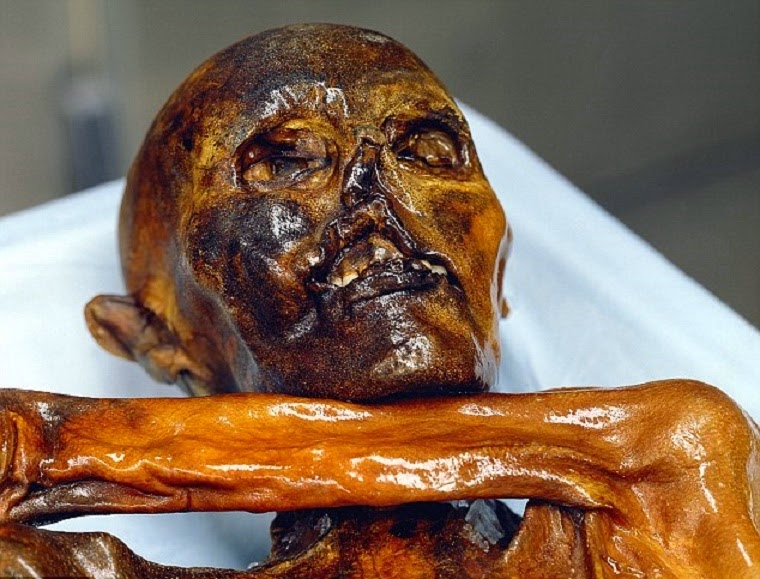
The world's oldest known blood cells have been found on Ötzi the Iceman, according to the latest research on the 5,300-year-old mummy. 
What's more, the discovery proves that the Stone Age homicide victim had a quick, if not painless, death. 


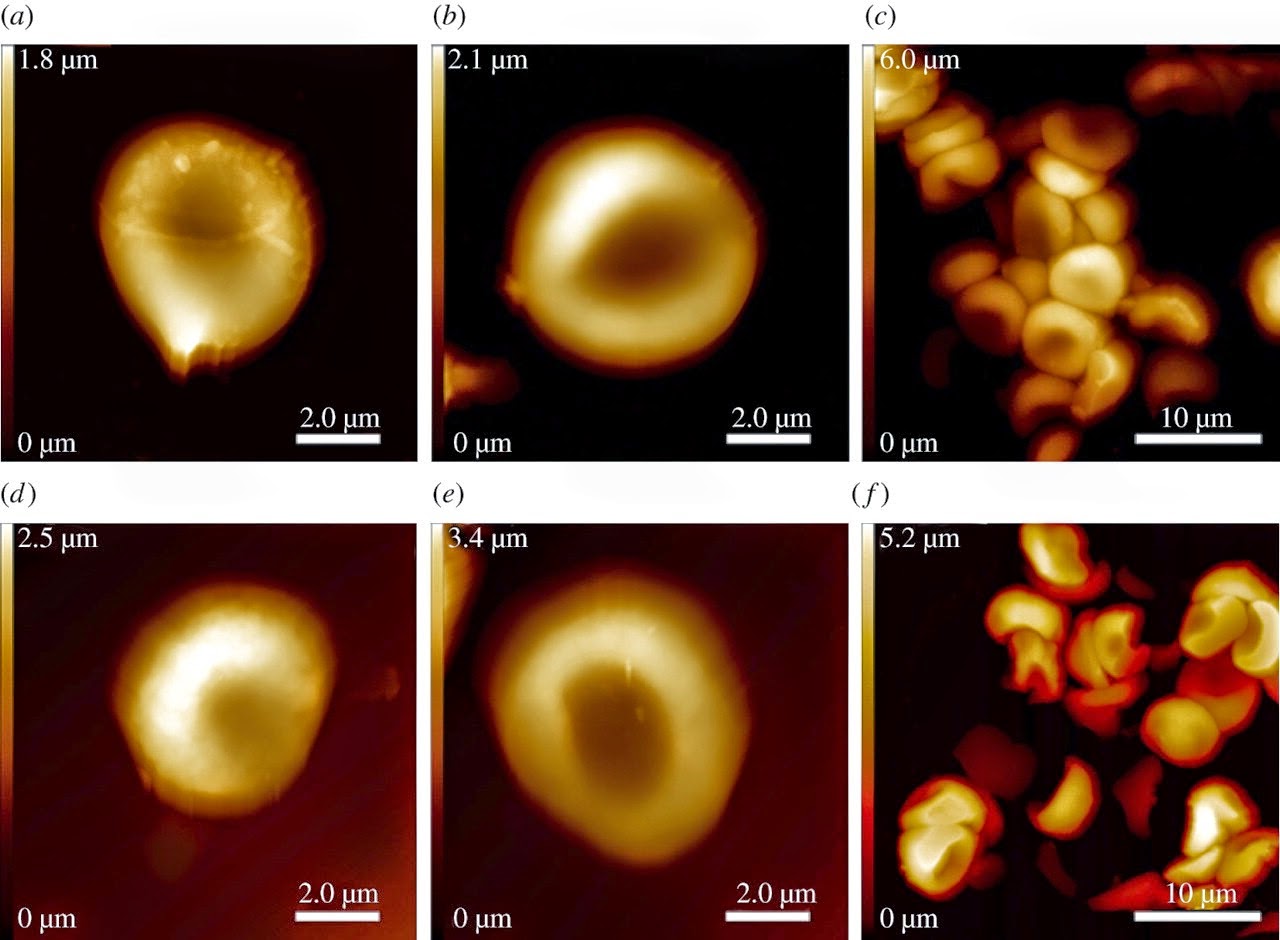
AFM images of red blood cells (RBCs). 
(a,b) Single RBCs from recent human tissue. (c) An assembly of RBCs. (d,e) Single corpuscles found in Iceman sample A and  sample B are shown. An assembly of several randomly distributed corpuscles,  similar to those found within the recent sample (c), are displayed in image (f). The imaged corpuscles (d–f) feature the characteristic discoid and concave  surface of RBCs 
[Credit: Journal of the Royal Society Interface] 


Ötzi has been the subject of extensive postmortem investigations ever since his corpse was discovered in an Alpine glacier on the Austrian-Italian border in 1991. 

No blood residue had previously been detected, however, despite various studies detailing his violent death due to an arrow shot and other injuries. 

"There were no [blood] traces found, even when they opened some arteries, so it was thought maybe the blood had not preserved and had completely degraded, or that he lost too much blood because of the arrow injury" on his back, said team member Albert Zink, head of the Institute for Mummies and the Iceman in Bolzano, Italy. 

For the new investigation, scientists traced Ötzi's wound areas—the arrow injury and a cut on his right hand—with a pioneering nano-size probe. 
Each minute movement of the probe was recorded with a laser, "so you get a three-dimensional image of the sample in a very tiny scale," Zink explained. The scans revealed classic "doughnut shape" red blood cells, the team reported Wednesday in the journal Interface.

While past studies have suggested evidence for prehistoric blood on Stone Age tools and other artifacts, "you can never really be sure, because you can see structures which are quite similar to red blood cells" such as pollen grains or bacteria, Zink commented. 


Ötzi the Iceman's mummified remains (shown above) were found on a glacier  on the Italian and Austrian border in 1991. Researchers have now discovered traces  of a molecule involved in blood clotting on the body, suggesting he bled rapidly  to death from an arrow wound to his shoulder 
[Credit: Reuters] 


To confirm they were indeed dealing with human blood cells, the researchers illuminated the wounds with a laser. The wavelengths of the scattered light revealed the substances' molecular makeup. 
"We got very typical samples for blood, like for the [blood protein] hemoglobin," he said. The new finding "really is the oldest clear evidence for red blood cells.

" The new nanotechnology, allied with an atomic force microscope, also uncovered traces of fibrin, a blood-clotting agent—evidence that the Iceman suffered a mercifully quick demise. 

"Fibrin is formed immediately when you get a wound, within a few minutes, but then it disappears"—in a living, functioning body, anyway, Zink said. 

"Finding fibrin in the arrow wound is confirmation that Ötzi actually died very quickly after the arrowshot."

"There were still some people arguing that he survived the arrow maybe a few hours or a few days, but this was definitely not true," he added. 

The relatively new techniques used in the study may in the future assist in the investigation of modern-day homicides. Since old blood cells are more elastic than fresh samples, the same blood-analysis techniques could become useful at crime scenes, Zink said. "If the blood is dry, forensic science really has no good method for determining the age of blood spots ... They cannot say if it is a day, a week, or a month old," he said. "If you can record with this technology little differences in the elasticity of the structure, then you can maybe determine the age of the blood spot." 

Author: James Owen | Source: National Geographic News 

[May 08, 2015]

domenica 19 aprile 2015

Perfidi Archeologi Colpiscono ancora

Baboon bone found in famous Lucy skeleton 


 Lucy, arguably the world's most famous early human fossil, is not quite all she seems. 
A careful look at the ancient hominin's skeleton suggests one bone may actually belong to a baboon. 


Lucy 
[Credit: Dave Einsel/Getty] 


In November 1974, palaeoanthropologists Donald Johanson and Tom Gray made the discovery of a lifetime near the village of Hadar in Ethiopia: dozens of fossil fragments belonging to a single hominin skeleton dating back 3.2 million years. 

Once the fragments had been pieced together, the skeleton was declared to be of the species Australopithecus afarensis. But the skeleton became known as Lucy, inspired by a Beatles song that blasted out of a cassette player as the researchers celebrated their discovery that evening. 
Forty years later, thanks to its age and completeness, Lucy remains an important specimen. It shows, for instance, that our distant ancestors began to walk upright on two legs long before they developed big brains. It's no surprise, then, that replicas of the skeleton are on display at museums across the world. 

But when Gary Sawyer and Mike Smith at the American Museum of Natural History in New York recently began work on a new reconstruction of Lucy's skeleton, with help from Scott Williams at New York University, they noticed something odd. 
"Mike pointed out that one of the [vertebra] fragments, which no one, including me, had really paid close attention to, looked fairly small to fit with the rest of Lucy's vertebral column," says Williams. 
Williams had been working with Marc Meyer at Chaffey College in Rancho Cucamonga, California, on the spinal column of another early hominin, Australopithecus sediba, and so the two researchers decided to study the fragment. They soon concluded that it didn't belong to Lucy. "It was just too small," says Williams. 
One possible explanation was that the vertebra fragment came from a second, juvenile member of Lucy's species. So Williams and Meyer did a comparative study that included vertebrae from other Australopithecus fossils. 
To satisfy a personal hunch, Williams also added vertebrae from other animals known to have lived in the Hadar region 3.2 million years ago, such as porcupines and pigs. 
The results showed, surprisingly, that the fragment may not have belonged to Australopithecus at all. 
"Baboons were a close match, both in shape and size," says Williams. "So we think we've solved this mystery. 
It seems that a fossil gelada baboon thoracic vertebra washed or was otherwise transported in the mix of Lucy's remains." He stresses, though, that the analysis, which he will present at a meeting of the Paleoanthropology Society in San Francisco next week, also confirms that the other 88 fossil fragments belonging to Lucy's skeleton are correctly identified. 
And the mislabelled baboon bone fragment doesn't undermine Lucy's important position in the evolution of our lineage. 
There may be a simple reason why no one noticed that Lucy's remains included a baboon bone fragment. Although many scientists have examined Lucy's skeleton, most experts have not worked as extensively on bones of the back relative to the limbs, says Dan Gebo at the Northern Illinois University in DeKalb. "Given that broken bones are always a problem and most of us are not vertebral specialists, it would not be unusual to make a small mistake." Also, there was no sign of a baboon skeleton at the site where Lucy was discovered in 1974, says William Sanders at the University of Michigan in Ann Arbor. 
"So there was no reason to assume intermingling of elements between two different animals," he says. Even so, Sanders wants to see the analysis in detail before he accepts that the vertebra fragment really does belong to a baboon. "Offhand, I don't see any morphological features in this element that cry out for recognition as a baboon," he says. If the fragment really does prove to belong to a baboon, he says, "we can cut Don Johanson and his colleagues some slack".

Author: Colin Barras | Source: New Scientist [April 13, 2015]

Non facciamo più le asce di una volta.

Un interessante esperimento di Archeologia Sperimentale, sotto controllo neurofisiologico strumentale, che dimostra ineluttabilmente come alcuni strumenti di pietra, che oggi noi consideriamo primitivi (l'ascia a mano dell'Aculeano [500.000 anni fa], per esempio), hanno richiesto l'evoluzione di un pensiero progettuale complesso e non solamente il caso. 
E sei studenti di Archeologia, pur ricostruendo - durante un corso apposito di 18 mesi - una loro ascia a mano, non sono riusciti a produrne di buona qualità, a livello dei nostri comuni predecessori: le loro asce non avrebbero funzionato.
Si è inoltre visto strumentalmente che la pianificazione della costruzione stimola e chiama in causa aree differenti del cervello umano, interessando sia le aree motorie, sia  quelle del 'pensiero strategico', cioé quelle che utilizziamo nello scegliere il migliore percorso automobilistico oggi.
Non era un'attività tanto 'primitiva', insomma...

Complex cognition shaped the Stone Age hand-axe 

The ability to make a Lower Palaeolithic hand axe depends on complex cognitive control by the prefrontal cortex, including the "central executive" function of working memory, a new study finds. 


Handaxes produced for the first (left) and last (right) evaluations, ranked by T3 fMRI task  performance (circled numbers) 

[Credit: Dietrich Stout et al. PLoS One,  2015 DOI: 10.1371/journal.pone.0121804] 


PLOS ONE published the results, which knock another chip off theories that Stone Age hand axes are simple tools that don't involve higher-order executive function of the brain.

 "For the first time, we've showed a relationship between the degree of prefrontal brain activity, the ability to make technological judgments, and success in actually making stone tools," says Dietrich Stout, an experimental archaeologist at Emory University and the leader of the study. 
"The findings are relevant to ongoing debates about the origins of modern human cognition, and the role of technological and social complexity in brain evolution across species." 
The skill of making a prehistoric hand axe is "more complicated and nuanced than many people realize," Stout says. 
"It's not just a bunch of ape-men banging rocks together. We should have respect for Stone Age tool makers." The study's co-authors include Bruce Bradley of the University of Exeter in England, Thierry Chaminade of Aix-Marseille University in France; and Erin Hecht and Nada Khreisheh of Emory University.

Stone tools -- shaped by striking a stone "core" with a piece of bone, antler, or another stone -- provide some of the most abundant evidence of human behavioral change over time. 

Simple Oldowan stone flakes are the earliest known tools, dating back 2.6 million years. 

The Late Acheulean hand axe goes back 500,000 years. 

While it's relatively easy to learn to make an Oldowan flake, the Acheulean hand axe is harder to master, due to its lens-shaped core tapering down to symmetrical edges. 

"We wanted to tease apart and compare what parts of the brain were most actively involved in these stone tool technologies, particularly the role of motor control versus strategic thinking," Stout says. 

The researchers recruited six subjects, all archaeology students at Exeter University, to train in making stone tools, a skill known as "knapping." 
The subjects' skills were evaluated before and after they trained and practiced. 

For Oldowan evaluations, subjects detached five flakes from a flint core. 

For Acheulean evaluations, they produced a tool from a standardized porcelain core. 

At the beginning, middle and end of the 18-month experiment, subjects underwent functional magnetic resonance imaging (fMRI) and diffusion tensor imaging (DTI) scans of their brains while they watched videos. 

The videos showed rotating stone cores marked with colored cues: A red dot indicated an intended point of impact, and a white area showed the flake predicted to result from the impact. The subjects were asked the following questions:

- "If the core were struck in the place indicated, is what you see a correct prediction of the flake that would result?"

- "Is the indicated place to hit the core a correct one given the objective of the technology?" 

The subjects responded by pushing a "yes" or "no" button. 
Answering the first question, how a rock will break if you hit it in a certain place, relies more on reflexive, perceptual and motor-control processes, associated with posterior portions of the brain. 
Stout compares it to the modern-day rote reflex of a practiced golf swing or driving a car. 

The second question -- is it a good idea to hit the core in a certain spot if you want to make a hand axe -- involves strategic thinking, such as planning the route for a road trip. 
"You have to think about information that you have stored in your brain, bring it online, and then make a decision about each step of the trip," Stout says. 
This so-called executive control function of the brain, associated with activity in the prefrontal cortex, allows you to project what's going to happen in the future and use that projection to guide your action. "It's kind of like mental time travel, or using a computer simulation," Stout explains. 

"It's considered a high level, human cognitive capacity." The researchers mapped the skill level of the subjects onto the data from their brain scans and their responses to the questions. 
Greater skill at making tools correlated with greater accuracy on the video quiz for predicting the correct strategy for making a hand axe, which was itself correlated with greater activity in the prefrontal cortex. 
"These data suggest that making an Acheulean hand axe is not simply a rote, auto pilot activity of the brain," Stout says. 
"It requires you to engage in some complicated thinking." 

Most of the hand axes produced by the modern hands and minds of the study subjects would not have cut it in the Stone Age.

 "They weren't up to the high standards of 500,000 years ago," Stout says. A previous study by the researchers showed that learning to make stone tools creates structural changes in fiber tracts of the brain connecting the parietal and frontal lobes, and that these brain changes correlated with increases in performance. "Something is happening to strengthen this connection," Stout says. "This adds to evidence of the importance of these brain systems for stone tool making, and also shows how tool making may have shaped the brain evolutionarily." 
Stout recently launched a major, three-year archaeology experiment that will build on these studies and others. 
Known as the Language of Technology project, the experiment involves 20 subjects who will each devote 100 hours to learning the art of making a Stone Age hand axe, and also undergo a series of MRI scans. 
The project aims to hone in whether the brain systems involved in putting together a sequence of words to make a meaningful sentence in spoken language overlap with systems involved in putting together a series of physical actions to reach a meaningful goal. 


Source: Emory Health Sciences 

[April 15, 2015]