Visualizzazione post con etichetta UK. Mostra tutti i post

mercoledì 14 ottobre 2015

Culinaria a Durrington Walls

The culinary habits 

of the 

Stonehenge builders 


ArchaeoHeritage, Archaeology, Breakingnews, Europe, UK, Western Europe 


A team of archaeologists at the University of York have revealed new insights into cuisine choices and eating habits at Durrington Walls -- a Late Neolithic monument and settlement site thought to be the residence for the builders of nearby Stonehenge during the 25th century BC. 


Stonehenge
 [Credit: WikiCommons] 


Together with researchers at the University of Sheffield, detailed analysis of pottery and animal bones has uncovered evidence of organised feasts featuring barbeque-style roasting, and an unexpected pattern in how foods were distributed and shared across the site.

 Chemically analysing food residues remaining on several hundred fragments of pottery, the York team found differences in the way pots were used. Pots deposited in residential areas were found to be used for cooking animal products including pork, beef and dairy, whereas pottery from the ceremonial spaces was used predominantly for dairy. Such spatial patterning could mean that milk, yoghurts and cheeses were perceived as fairly exclusive foods only consumed by a select few, or that milk products -- today often regarded as a symbol of purity -- were used in public ceremonies. 

Unusually, there was very little evidence of plant food preparation at any part of the site. The main evidence points to mass animal consumption, particularly of pigs. Further analysis of animal bones, conducted at the University of Sheffield, found that many pigs were killed before reaching their maximum weight. 
This is strong evidence of planned autumn and winter slaughtering and feasting-like consumption. The main methods of cooking meat are thought to be boiling and roasting in pots probably around indoor hearths, and larger barbeque-style roasting outdoors -- the latter evidenced by distinctive burn patterns on animal bones. 


A reconstruction drawing of how the prehistoric village of Durrington Walls  might have looked in 2500BC 
[Credit: English Heritage] 


Bones from all parts of the animal skeleton were found, indicating that livestock was walked to the site rather than introduced as joints of meat.
 Isotopic analysis indicates that cattle originated from many different locations, some far away from the site. This is significant as it would require orchestration of a large number of volunteers likely drawn from far and wide. 
The observed patterns of feasting do not fit with a slave-based society where labour was forced and coerced, as some have suggested. 
Dr Oliver Craig, Reader in Archaeological Science at the University of York and lead author on the paper, said: "Evidence of food-sharing and activity-zoning at Durrington Walls shows a greater degree of culinary organisation than was expected for this period of British prehistory. The inhabitants and many visitors to this site possessed a shared understanding of how foods should be prepared, consumed and disposed. This, together with evidence of feasting, suggests Durrington Walls was a well-organised working community." 
Professor Mike Parker Pearson, Professor at University College London and Director of the Feeding Stonehenge project who also led the excavations at Durrington Walls, said: "This new research has given us a fantastic insight into the organisation of large-scale feasting among the people who built Stonehenge. Animals were brought from all over Britain to be barbecued and cooked in open-air mass gatherings and also to be eaten in more privately organized meals within the many houses at Durrington Walls. The special placing of milk pots at the larger ceremonial buildings reveals that certain products had a ritual significance beyond that of nutrition alone. The sharing of food had religious as well as social connotations for promoting unity among Britain's scattered farming communities in prehistory. " 
Dr Lisa-Marie Shillito, who analysed the pottery samples and recently joined Newcastle University, added: "The combination of pottery analysis with the study of animal bones is really effective, and shows how these different types of evidence can be brought together to provide a detailed picture of food and cuisine in the past." 

The study has been published in the Antiquity Journal. 


Source: University of York [October 12, 2015]

venerdì 31 luglio 2015

CRANNOG

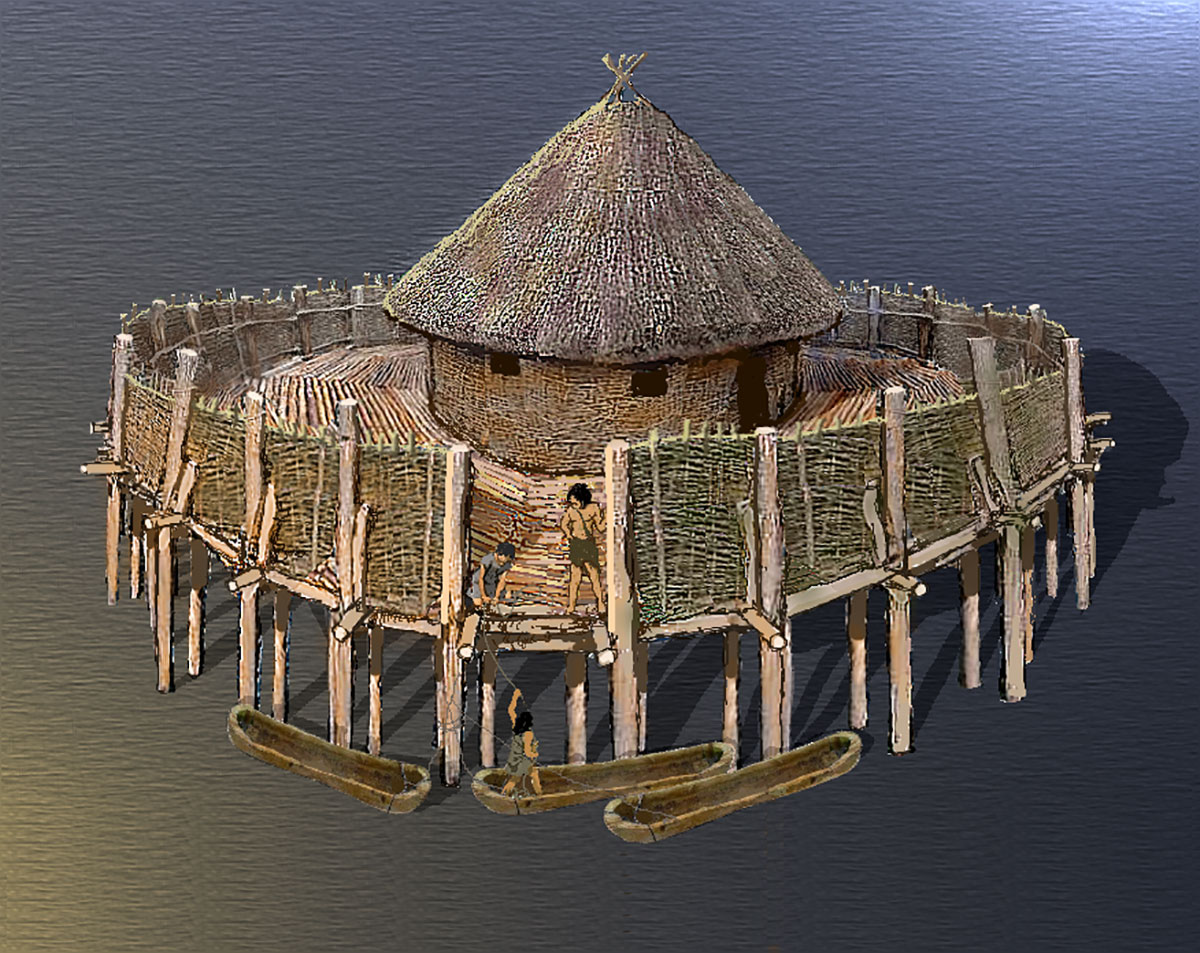
C'è tutto: il "wattle and daub", i pali costituenti una costruzione circolare (in realtà una specie di palafitta fortificata), una datazione al radiocarbonio di 5.000 anni fa ed un'ipotesi ricostruttiva degli edifici suddetti (abbastanza rari)  e della società del Neolitico che li costruì con strumenti di pietra, ovviamente. 
Chissà poi perché non parlano di Sciardana....


5,000-year-old fort found in Monmouth 

ArchaeoHeritage, Archaeology, Breakingnews, Europe, UK, Western Europe 


Archaeologists in Monmouth have discovered the remains of an ancient wooden building that dates back 5,000 years. 


An artist impression of what the fort looked like nearly 5,000 years ago  
[Credit: Monmouth Archaeological Society] 


Steve Clarke, who two years ago uncovered the remains of a huge post-glacial lake at the Parc Glyndwr building site, said the timber remains found under the new Rockfield estate were once part of a crannog, an ancient fortified dwelling built into a lake. 

Part of the wooden building set into the bed of what was once Monmouth’s prehistoric lake, pre-dates the only other known crannog in England and Wales by 2,000 years. 

The New Stone Age timber (Neolithic), which was skilfully worked with a stone axe, was unearthed during the digging of house foundations at Jordan Way off Watery Lane by Martin Tuck of the Glamorgan Gwent Archaeological Trust in 2003 while overseeing the construction of the estate. 
It was preserved beneath the clay and peat of a lagoon which formed when the lake drained some 2,000 years ago and was recently given to Monmouth Archaeological Society whose professional wing- Monmouth Archaeology- is to be the archaeological unit covering the construction of 450 new homes on Wonastow Road. 


A slab of timber was discovered when the estate was constructed in 2003  [Credit: Monmouth Archaeological Society] 


The timber was sent to the Scottish Universities Environmental Research Centre in Glasgow for a radiocarbon study to be carried out which produced a date of 2,917 years BC.

The study took several months and was funded by the Monmouth Society. Mr Clarke, 72, who is the chairman and founding member of Monmouth Archaeological Society, said it is a very important and exciting discovery. 
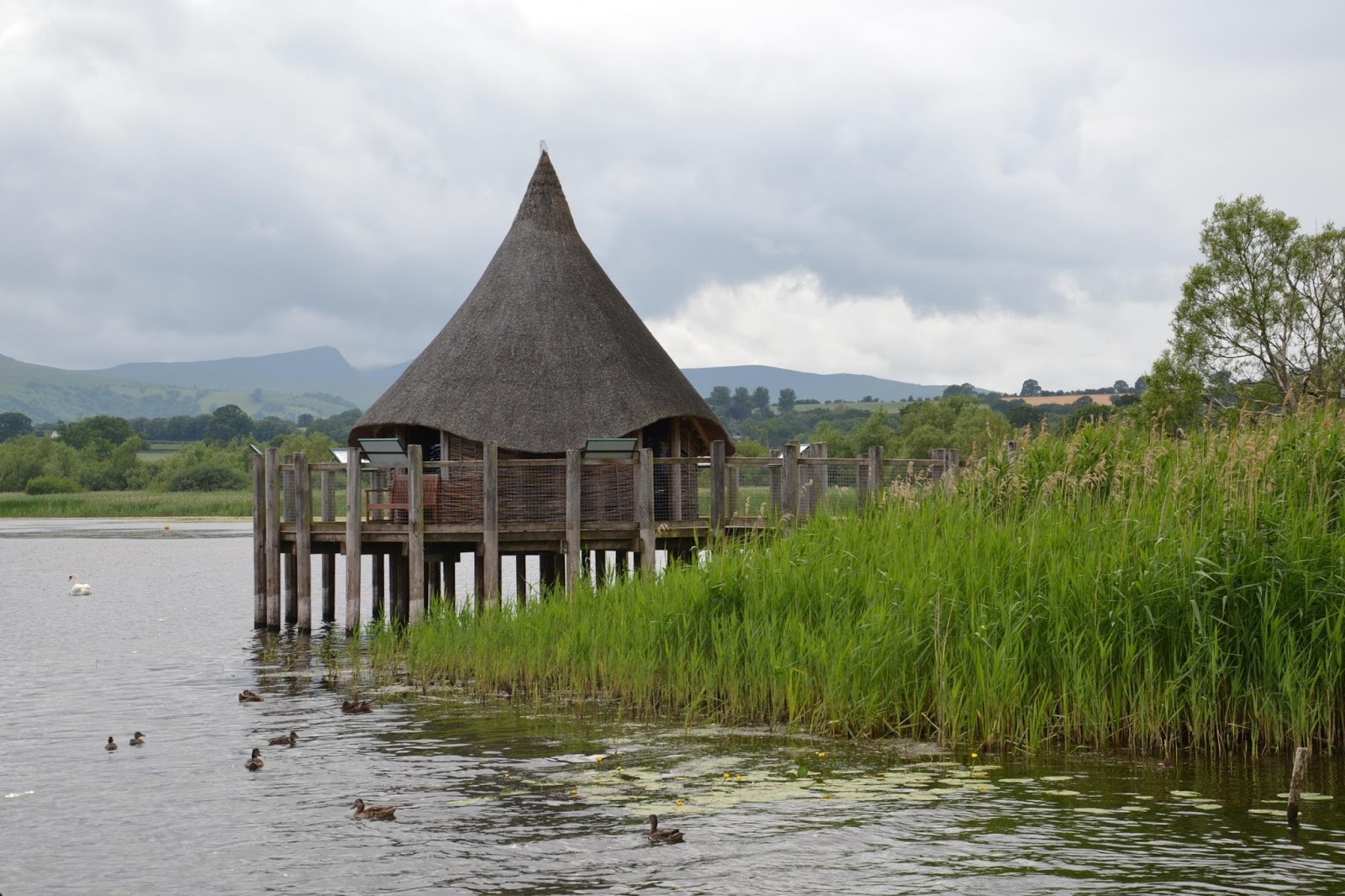
“This is only the second one in England and Wales, the other being at Llangorse Lake, near Brecon.” 
“The timber, bearing cut marks left by stone or flint axes, formed the end of an oak post which had been carefully levelled to create a flat surface which would probably have rested on a post pad set in the bottom of the lake.” 


A reconstructed crannog at Llangorse Lake, Wales 
 [Credit: Monmouth Archaeological Society] 


“Archaeologists are excited, not only by the state and date of the timber, but also because the remains were so far out from the shore of the lake that the post has to be part of a building set on poles- called a crannog.” 

Crannogs are defended wooden structures found in Ireland and Scotland and date from the Stone Age onwards. 
They are thought to have been a mark of power and status- the one at Llangorse being claimed as a royal residence of the Dark Age King of Brycheiniog. 
“Martin realised the importance of the timber and kept it in water before handing it to us for our archives,” said Mr Clarke. 

Author: Kath Skellon | Source: Free Press

 [July 22, 2015]


domenica 1 marzo 2015

DNA dimostra che UK non fu sempre un'isola

Gli antichi abitanti dell'isola Inglese non erano così isolati come credevamo, 8.000 anni fa, cioé in pieno Mesolitico. La scoperta è dovuta al rinvenimento di grano antico (Einkorn, identificato con metodi genetici e simile a quello del continente) in siti oggi sommersi, risalenti a circa 2.000 anni prima dell'introduzione in Inghilterra delle tecniche di agricoltura.
L'ipotesi più plausibile - per ora, almeno - sembra essere quella dell'esistenza di commerci con la terraferma, condotti forse dai mesolitici inglesi. I contatti erano facilitati dall'esistenza di 'ponti' di terra emersa tra le coste orientali dell'isola e la terraferma, in un periodo nel quale il livello delle acque marine era più basso per via delle glaciazioni. 


DNA evidence shows 

surprise cultural connections 

between Britain and Europe 

8,000 years ago 


The ancient British were not cut off from Europeans on an isolated island 8,000 years ago as previously thought, new research suggests. 


Wheat was being consumed in Britain long before people there  started growing crops [Credit: WikiCommons] 

Researchers found evidence for a variety of wheat at a submerged archaeological site off the south coast of England, 2,000 years before the introduction of farming in the UK. 

The team argue that the introduction of farming is usually regarded as a defining historic moment for almost all human communities leading to the development of societies that 
underpin the modern world.

Published in the journal Science, the researchers suggest that the most plausible explanation for the wheat reaching the site is that Mesolithic Britons maintained social and trade networks spreading across Europe. 

These networks might have been assisted by land bridges that connected the south east coast of Britain to the European mainland, facilitating exchanges between hunters in Britain and farmers in southern Europe. 
Called Einkorn, the wheat was common in Southern Europe at the time it was present at the site in Southern England -- located at Bouldnor Cliff. 
The einkorn DNA was collected from sediment that had previously formed the land surface, which was later submerged due to melting glaciers. 
The work was led by Dr Robin Allaby of the University of Warwick, in collaboration with co-leads Professor Vincent Gaffney of the University of Bradford and Professor Mark Pallen of Warwick Medical School, the Maritime Archaeology Trust, the University of Birmingham and the University of St. Andrews. Dr Allaby, Associate Professor at the University of Warwick's School of Life Sciences, argues that the einkorn discovery indicates that Mesolithic Britain was less insular than previously understood and that inhabitants were interacting with Neolithic southern Europeans: "8,000 years ago the people of mainland Britain were leading a hunter-gatherer existence, whilst at the same time in southern Europeans farming was gradually spreading across Europe.

 "Common throughout Neolithic Southern Europe, einkorn is not found elsewhere in Britain until 2,000 years after the samples found at Bouldnor Cliff. For the einkorn to have reached this site there needs to have been contact between Mesolithic Britons and Neolithic farmers far across Europe. 
"The land bridges provide a plausible facilitation of this contact. 
As such, far from being insular Mesolithic Britain was culturally and possibly physically connected to Europe. 

"The role of these simple British hunting societies, in many senses, puts them at the beginning of the introduction of farming and, ultimately, the changes in the economy that lead to the modern world." 
"The novel ancient DNA approach we used gave us a jump in sensitivity allowing us to find many of the components of this ancient landscape" 
Commenting on the research's findings Professor Vincent Gaffney, research co-lead and Chair in Landscape Archaeology at the University of Bradford, said: "This find is the start of a new chapter in British and European history. Not only do we now realise that the introduction of farming was far more complex than previously imagined. It now seems likely that the hunter-gather societies of Britain, far from being isolated were part of extensive social networks that traded or exchanged exotic foodstuffs across much of Europe. "The research also demonstrates that scientists and archaeologists can now analyse genetic material preserved deep within the sediments of the lost prehistoric landscapes stretching between Britain and Europe. 
This not only tells us more about the introduction of farming into Britain, but also about the societies that lived on the lost coastal plains for hundreds of thousands of years. "The use of ancient DNA from sediments also opens the door to new research on the older landscapes off the British Isles and coastal shelves across the world" Co-lead Professor Mark Pallen, leader of the Pallen Group at the University of Warwick's Medical School, explains how the researchers employed a metagenomic approach to study the einkorn DNA: "We chose to use a metagenomics approach in this research even though this has not commonly been used for environmental and ancient DNA research. This means we extracted and sequenced the entire DNA in the sample, rather than targeted organism-specific barcode sequences. From this we then homed in on the organisms of interest only when analysing DNA sequences." The research builds on the work of the Maritime Archaeology Trust, who also collected the sediment samples from the site. 
The Trust's Director, Garry Momber, commented: "Of all the projects I have worked on, Bouldnor Cliff has been the most significant. Work in the murky waters of the Solent has opened up an understanding of the UK's formative years in a way that we never dreamed possible.
 "The material remains left behind by the people that occupied Britain as it was finally becoming an island 8,000 years ago, show that these were sophisticated people with technologies thousands of years more advanced than previously recognised. 
The DNA evidence corroborates the archaeological evidence and demonstrates a tangible link with the continent that appears to have become severed when Britain became an island."

Source: University of Warwick 

[February 27, 2015]


Sedimentary DNA from a submerged site reveals wheat in the British Isles 8000 years ago

  1. Robin G. Allaby1,*,†
+Author Affiliations
  1. 1School of Life Sciences, University of Warwick, Coventry CV4 7AL, UK.
  2. 2Maritime Archaeology Trust, Room W1/95, National Oceanography Centre, Empress Dock, Southampton SO14 3ZH, UK.
  3. 3Department of Earth Sciences, University of St Andrews, St Andrews, Fife KY16 9AL, Scotland.
  4. 4Department of Classics, Ancient History and Archaeology, University of Birmingham, Edgbaston, Birmingham B15 2TT, UK.
  5. 5School of History and Cultures, University of Birmingham, IBM VISTA ERI Building, Pritchatts Road, Birmingham B15 2TT, UK.
  6. 6Warwick Medical School, University of Warwick, Coventry CV4 7AL, UK.
  7. 7Division of Archaeological, Geographical and Environmental Sciences, University of Bradford, Bradford, West Yorkshire BD7 1DP, UK.
  1. ↵†Corresponding author. E-mail: r.g.allaby@warwick.ac.uk
  1. ↵* These authors contributed equally to this work.
The Mesolithic-to-Neolithic transition marked the time when a hunter-gatherer economy gave way to agriculture, coinciding with rising sea levels. Bouldnor Cliff, is a submarine archaeological site off the Isle of Wight in the United Kingdom that has a well-preserved Mesolithic paleosol dated to 8000 years before the present. We analyzed a core obtained from sealed sediments, combining evidence from microgeomorphology and microfossils with sedimentary ancient DNA (sedaDNA) analyses to reconstruct floral and faunal changes during the occupation of this site, before it was submerged. In agreement with palynological analyses, the sedaDNA sequences suggest a mixed habitat of oak forest and herbaceous plants. However, they also provide evidence of wheat 2000 years earlier than mainland Britain and 400 years earlier than proximate European sites. These results suggest that sophisticated social networks linked the Neolithic front in southern Europe to the Mesolithic peoples of northern Europe.