Qualcuno già lo sospettava forse. Ma si riferiva
probabilmente al personaggio inventato da Tolkien.
Antefatto.
Nel 2004 si gridò al miracolo: era stato scoperta una nuova -
prima sconosciuta - specie di Uomo, nell'isola di Flores,
Indonesia: fu definito "Homo Florensis". Se ne fecero persino
ricostruzioni varie, immaginandolo come un piccolo essere
umano attorno al metro di altezza, con grossi piedi un
piccolo cervello (meno di 380 ml: meno di 4 bicchieri
d'acqua, un terzo di un encefalo normale) in un piccolo
cranio ed un aspetto da Hobbit.
Wishful thinking - certamente - considerando che ciò che
se ne era trovato comprendeva solamente un femore ed un
cranio ricostruito, rinvenuti nella grotta di Liang Bua (da
cui la sigla che indica il reperto: LB1).
Errori di metodo.
Anche se LB1 visse 'solamente' 15.000 anni fa, ne sono stati
tratti confronti con Homo Erectus e addirittura con
l'Australopitecus.
La rivalutazione odierna, pubblicata (Proceedings of the National
Academy of Sciences), dimostra una sottovalutazione del volume
dell'encefalo: in realtà si tratta di 430 ml, cioé di un cervello
che rientra perfettamente nei parametri della patologia della
Sindrome di Down, per la zona geografica in esame.
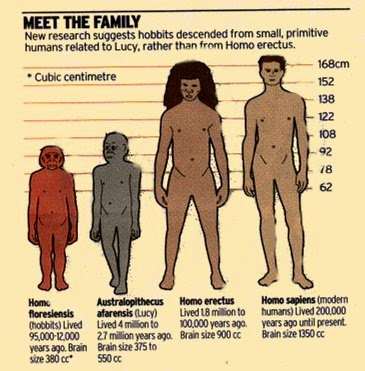
Anche il femore corto permise - estrapolando dalle altezze di pigmei africani di calcolare un'altezza ipotetica errata. In realtà i pz affetti da sindrome di Down hanno femori più corti del normale. un'altra caratteristica che fa propendere per la tesi della sindrome di Down è l'asimmetria craniofacciale, un'asimmetria destro-sinistra che è tipica della malattia (vedi seconda immagine, sotto).
Conclusione: L'Uomo Florensis non esiste, è una bufala scientifica. Nella realtà, si tratta dei resti di un malato di Sindrome di Down di 15000 anni fa: un reperto unico, interessante, ma non abbastanza per dichiaralo una nuova specie di uomo...
Flores bones show features of Down syndrome,
not new
'hobbit' human
In October 2004, excavation of fragmentary skeletal remains from the island of Flores in Indonesia yielded what was called "the most important find in human evolution for 100 years." Its discoverers dubbed the find Homo floresiensis, a name suggesting a previously unknown species of human.

This figure compares the skull of LB1 to that of Liang Momer E, another skull from Flores, dated in the range of 3,000 to 5,000 years ago
[Credit: © Photograph of Liang Momer E skull taken at Naturalis Biodiversity Center (Leiden, Netherlands). All Rights Reserved]
Now detailed reanalysis by an international team of researchers including Robert B. Eckhardt, professor of developmental genetics and evolution at Penn State, Maciej Henneberg, professor of anatomy and pathology at the University of Adelaide, and Kenneth Hsü, a Chinese geologist and paleoclimatologist, suggests that the single specimen on which the new designation depends, known as LB1, does not represent a new species.
Instead, it is the skeleton of a developmentally abnormal human and, according to the researchers, contains important features most consistent with a diagnosis of Down syndrome.
"The skeletal sample from Liang Bua cave contains fragmentary remains of several individuals," Eckhardt said. "LB1 has the only skull and thighbones in the entire sample." No substantial new bone discoveries have been made in the cave since the finding of LB1. Initial descriptions of Homo floresiensis focused on LB1's unusual anatomical characteristics: a cranial volume reported as only 380 milliliters (23.2 cubic inches), suggesting a brain less than one third the size of an average modern human's and short thighbones, which were used to reconstruct a creature standing 1.06 meters (about 3.5 feet tall).
Although LB1 lived only 15,000 years ago, comparisons were made to earlier hominins, including Homo erectus and Australopithecus.
Other traits were characterized as unique and therefore indicative of a new species.
A thorough reexamination of the available evidence in the context of clinical studies, the researchers said, suggests a different explanation.
The researchers report their findings in two papers published today (Aug. 4) in the Proceedings of the National Academy of Sciences. In the first place, they write, the original figures for cranial volume and stature are underestimates, "markedly lower than any later attempts to confirm them." Eckhardt, Henneberg, and other researchers have consistently found a cranial volume of about 430 milliliters (26.2 cubic inches). "The difference is significant, and the revised figure falls in the range predicted for a modern human with Down syndrome from the same geographic region," Eckhardt said.
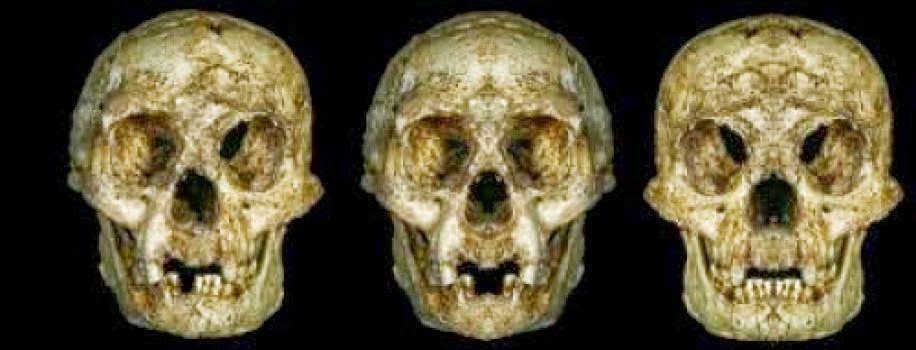
LB1 is shown in three different views to illustrate facial asymmetry.
A is the actual specimen, B is the right side doubled at the midline and mirrored, and C is the left side doubled and mirrored.
Differences in left and right side facial architectures are apparent, and illustrate growth abnormalities of LB1
[Credit: A, E. Indriati, B&C, D.W. Frayer]
The original estimate of 3.5 feet for the creature's height was based on extrapolation combining the short thighbone with a formula derived from an African pygmy population.
But humans with Down syndrome also have diagnostically short thighbones, Eckhardt said.
Though these and other features are unusual, he acknowledged, "unusual does not equal unique. The originally reported traits are not so rare as to have required the invention of a new hominin species."
Instead, the researchers build the case for an alternative diagnosis: that of Down syndrome, one of the most commonly occurring developmental disorders in modern humans. "When we first saw these bones, several of us immediately spotted a developmental disturbance," said Eckhardt, "but we did not assign a specific diagnosis because the bones were so fragmentary. Over the years, several lines of evidence have converged on Down syndrome."
The first indicator is craniofacial asymmetry, a left-right mismatch of the skull that is characteristic of this and other disorders.
Eckhardt and colleagues noted this asymmetry in LB1 as early as 2006, but it had not been reported by the excavating team and was later dismissed as a result of the skull's being long buried, he said.
A previously unpublished measurement of LB1's occipital-frontal circumference -- the circumference of the skull taken roughly above the tops of the ears -- allowed the researchers to compare LB1 to clinical data routinely collected on patients with developmental disorders.
Here too, the brain size they estimate is within the range expected for an Australomelanesian human with Down syndrome.
LB1's short thighbones not only match the height reduction seen in Down syndrome, Eckhardt said, but when corrected statistically for normal growth, they would yield a stature of about 1.26 meters, or just over four feet, a figure matched by some humans now living on Flores and in surrounding regions.
These and other Down-like characteristics, the researchers state, are present only in LB1, and not in the other Liang Bua skeletal remains, further evidence of LB1's abnormality. "This work is not presented in the form of a fanciful story, but to test a hypothesis: Are the skeletons from Liang Bua cave sufficiently unusual to require invention of a new human species?" Eckhardt said.
"Our reanalysis shows that they are not. The less strained explanation is a developmental disorder. Here the signs point rather clearly to Down syndrome, which occurs in more than one per thousand human births around the world." Additional context is available on the authors' website at www.LiangBuaCave.org.
Source: Pennsylvania State University
[August 04, 2014]
Read more at: http://archaeologynewsnetwork.blogspot.it/2014/08/flores-bones-show-features-of-down.html?utm_source=feedburner&utm_medium=feed&utm_campaign=Feed:+TheArchaeologyNewsNetwork+(The+Archaeology+News+Network)#.U-IK0ON_uSp
Follow us: @ArchaeoNewsNet on Twitter | groups/thearchaeologynewsnetwork/ on Facebook


