Visualizzazione post con etichetta Forgery and identity. Mostra tutti i post

sabato 23 marzo 2013

Ideologia VS Archeologia


The Newark “Holy Stones”

The Newark 'keystone'
The first of the Newark “Holy Stones”, debunked within two months of discovery


During investigations of a group of mounds south of Newark (Ohio, USA), the retired surveyor and amateur archaeologist David Wyrick (1806-1864) discovered an unusual wedge-shaped object with Hebrew writing on each of its four faces. He immediately took the stone to his friend Israel Dille (1802-1874), who happened to be entertaining the geologist Charles Wittlesey (1808-1886), also an amateur archaeologist with an interest in the mounds of North America. Although the three agreed that the lettering was Hebrew, none of them could read it. They knew that the young local Episcopalian Minister, Reverend John Winspeare McCarty (1832-1867), could read the language fluently, so they took it to him. McCarty read the stone as saying קדשקדשים | מלךארץ | תורתיהוה | דבריהוה, which translates as “Holy of Holies” | “King of the Earth” | “The Law of God” | “The Word of God”. Its discovery was reported in Harper’s Weekly by David Francis Bacon, who dismissed it as a fraud, Charles Wittlesey having pointed out that the Hebrew letters were modern.

Within five months of this discovery, a second inscription turned up in a coincidence that seems almost too good to be true. Again, it was David Wyrick who made the discovery, this time of a sandstone box containing a carved black limestone slab. On the centre of the front of the slab is the image of a man surrounded by an inscription, again in Hebrew letters, although this time of an archaic type, unlike those on the earlier find. The text, which covers the whole of the stone not occupied by the figure (labelled in Hebrew as Moses), is an abbreviated version of the Ten Commandments.
The Newark Decalogue
The Newark ‘Decalogue’: the second discovery, which countered the objections to the first stone


These discoveries appeared to confirm a belief long held by a number of American antiquaries that the mounds found throughout the watershed of the Mississippi/Missouri were not of Native American origin but were built by Israelites who fled the destruction of their kingdom by the Assyrians. It also appeared to confirm the Book of Mormon’s contention that a vanished people of Israelite origin had settled in North America. Unfortunately, the letter forms of the two inscriptions were too modern (although both of different date) to support these ideas and the inscriptions were soon dismissed as outright frauds. Wyrick, as the discoverer of both, was naturally the principal suspect, his suicide (yum!) in 1864 seeming to lend weight to the accusation.
However, it is not as clear-cut as it appears. Nothing ever is in Bad Archaeology! Wyrick took an overdose of laudanum, which he was using as a painkiller for the crippling arthritis that had led to his early retirement in 1859. His publication of the two inscriptions in a pamphlet in 1861 included his own illustrations that were so riddled with errors that it is impossible to believe that he could have created both the muddled drawings and the much better – if fraudulent – inscriptions on stone. Nevertheless, the first stone was undoubtedly of nineteenth-century date (both the letter forms and the use of a mechanical grinding wheel to create its smooth surface make an earlier origin impossible), while grave suspicion must fall on the second.
Although the epigrapher Rochelle Altman has suggested that the objects may be of late medieval date and imported to North America by a nineteenth-century Jewish settler from Europe (her reconstruction of events is highly detailed but entirely circumstantial), this does not explain the mechanical tooling on the first stone to be discovered. Instead, a more plausible scenario is that the hoaxer was unhappy that his first attempt to fool Wyrick had been detected and therefore planted a second object that met the objections raised to the original stone. More convincingly, the research of Brad Lepper and Jeff Gill during the 1990s suggests that the hoaxer was the Reverend McCarty, an ambitious young man with the knowledge to create fake Hebrew inscriptions. They link the inscriptions with his political views, shared by his local bishop, Charles Petit McIlvane (1799-1873), that Native Americans were descendants of the ancient Israelites, which would help to undermine the idea that they, along with negroes, were a separate creation from European humanity, and could be enslaved or exterminated.
The Newark “Holy Stones” are not evidence for an ancient Israelite migration to the New World, any more than the Kensington Runestone is evidence for Vikings in the centre of North America or the Paraíba Inscription is evidence for Phoenicians in coastal Brazil. Their context is that of nineteenth-century politics and antiquarian speculation and they, like the two previous examples, are quite clearly hoaxes designed to promote particular views of the past.

Why this sort of evidence doesn’t work

I could be accused (and quite possibly will be) of cherry-picking three objects that are easily debunked. 
 Supporters of widespread contacts between the Old and New Worlds before 1492 will point to other inscriptions, finds of Roman sculptures, Jewish coins, mysterious structures and so on, which they believe I have not dealt with here because I can’t dismiss them so easily. That’s not the case at all.

The purpose of this lengthy post is not to criticise every piece of supposed evidence for transatlantic contact: I don’t deny that such contact before Columbus was possible (and, in the case of Vinland, certainly did happen). What I do believe, though, is that, with one significant exception, the evidence is far too weak to support the claims being made. Much of the evidence brought forward is epigraphic in nature; it depends almost entirely on inscribed texts. Any supporting artefacts are recovered either without context or with very dubious context. 
These artefacts are rarely unambiguous.
Herein lies my objection. Archaeology is all about the material culture of human beings. We create a lot of stuff and we are generally quite careless about how we dispose of it. Even if we are careful, we still lose things accidentally. We litter the world with our creations. From potsherds to ocean-going ships, from butchered animal bones to weapons of slaughter, we make things and dispose of them. 
If we are careful, we dispose of them in special places (middens, rubbish pits and so on); if we are careless, we simply toss them aside when we are done with them. 
Ancient Old World explorers of the New World (whether they arrived by design or accident) would have been no different. They would have had the material culture they brought with them, especially if, like the purported Phoenicians of the Paraíba Inscription, they had come as merchants in search of objects to trade; they would have created new material culture in forms familiar to them from their homelands, using their accustomed technologies.
Thus, if there were Scandinavians in Minnesota in the fourteenth century CE, we would expect to find their material remains. Not just a Runestone and some highly dubious “anchor stones”, but things like ironwork, timber-framed houses, glazed pottery and so on. 
In the short-lived site at L’Anse Aux Meadows (Newfoundland, Canada), iron ring-headed pins and typical Viking houses were found: truly exotic material that confirmed the Vinland Sagas. Where is this sort of material around Kensington?

Too much of the ‘evidence’ consists of inscriptions (or purported inscriptions, such as Barry Fell’s ludicrously over-interpreted scratches that resemble Ogham to no-one but his followers). This is textual evidence, the stuff of historical documents. It appeals to people who believe in the power of words, in the authority of texts. Unsurprisingly, many of the fraudulent inscriptions, like the Newark “Holy Stones”, have a politico-religious sub-text. They hold great sway among people for whom the Bible or the Book of Mormon is inspired, authoritative, unchallengeable; these discoveries not only confirm the religious texts but provide additional information, which was particularly important for Christians who needed to understand how the Americas were filled with people who apparently went unmentioned in the Bible. By linking the indigenous peoples of the Americas with Old World peoples, it becomes possible to draw the New World into a Biblical world view. (Non succede così anche alla storia protosarda, amico mio?).
This becomes all the more worrying when there is the possibility that a member of the Church of Jesus Christ and Latter Day Saints has a chance to become the president of the United States of America. I don’t discuss politics on this blog (and, being English, the politics of the USA is something I do not pretend to follow closely), but we must ask ourselves how far we can trust the opinions of a man whose religious beliefs include such easily falsifiable ideas as synagogues in first millennium BC North America. Other American politicians have expressed support for the Newark “Holy Stones”; there is a movement in Lebanon that seeks to use the Paraíba Inscription as evidence for a Phoenician diaspora preceding the Jewish; white supremacists have used the Kensington Runestone and Barry Fell’s supposed Ogham inscriptions to insinuate that there were large numbers of Europeans in North America in the first and second millennia BC and perhaps even before the Native Americans. 
These can be dangerous views: who thinks that archaeology is irrelevant to the contemporary world?
To return to the main subject of this post, why do I find the evidence for all pre-Columbus contact between the Old and New Worlds unconvincing, with the one exception of L’Anse aux Meadows? Because of the lack of rubbish. If there is one thing that humans do well, that is to litter the surface of our home planet (and we’re beginning to spread out litter to the Moon, Mars and elsewhere…). If there were large numbers of Europeans (or Asians, or Africans) in the Americas before Columbus, they couldn’t have avoided leaving their litter. Forget texts: they are too easily forged. It’s rubbish that we need!

giovedì 14 marzo 2013

Identità Basca e falsi: Veleia

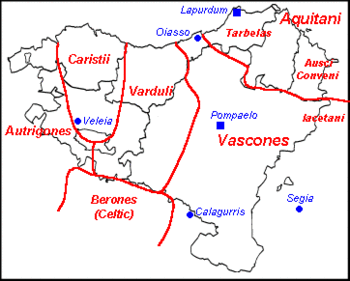
Posizione di Veleia, in rapporto ad altre città Romane ed alle tribù Bacshe

Have researchers in Spain's Basque Country made the find of a lifetime, or committed a very expensive fraud?


[image]

After leading the Veleia project for 15 years, Eliseo Gil amazed the archaeological world with his discoveries, but now he must defend his "exceptional" finds in court. (Mike Elkin)

Up the stairs and against the back wall of Molly Malone's Irish pub in Vitoria, Eliseo Gil and I speak discreetly. Sporting a white beard and a tattered baseball cap, Gil may be trying to keep a low profile. He was the lead archaeologist investigating the Roman city of Iruña-Veleia in the Basque region of northern Spain when a series of spectacular finds were made, turning him into a celebrity of sorts. In June 2006, Gil was a daily fixture in the Spanish press. One headline ran, "A discovery of this magnitude comes along once every two generations."
At a series of press conferences here in his hometown, Gil announced the discovery of several pottery sherds and other artifacts dating to around the third century a.d. with some remarkable graffiti scratched into them. One sherd depicted the Calvary scene, making it one of the oldest images of Christ's crucifixion. Some animal bones were engraved with the name of Egyptian queen Nefertiti, while inscriptions written in hieroglyphics and Latin appeared on other sherds. Also found were the earliest messages written in the Basque language.
"The first exceptional artifact that I held in my hands I saw being taken right out of the ground, and it had a series of symbols that at first glance looked like hieroglyphics," Gil, who peppers his speech with Spanish idioms, tells me. "Imagine the impact I felt finding something like that in a Roman context!"
The discoveries could have transformed Veleia from a city on the periphery of the Roman Empire to a cultural crossroads that would revolutionize our understanding of almost the entire ancient Mediterranean region. Likewise, the ancient Basque texts would warrant both archaeological and cultural celebration. While the origins of this non-Indo-European tongue are murky, the Basque language is important to the ethnic identity of the region's 2.1 million inhabitants, many of whom consider themselves more Basque than Spanish. These Basque Rosetta Stones helped rally excitement around the so-called "exceptionals," as some of the more spectacular inscribed sherds are known.
During the summer of 2006, Gil, often flanked by historians and linguists from the Universidad del País Vasco (UPV) in Vitoria, touted the finds. Radiocarbon testing on bones from the same archaeological layer as the artifacts confirmed the date range. And an analysis of the patinas that coated the sherds conducted at France's Centre National de la Recherche Scientifique (CNRS), showed that the inscriptions were made before the pottery was buried. The experts' reputations and the appearance of hard, scientific data helped deflect skepticism.
Today, however, Gil is facing criminal charges in three courts for fraud and attacks on national heritage.
Six miles west of Vitoria, the city of Veleia was settled in the Bronze Age, around 1000 b.c. During the first two centuries a.d., it expanded into a Roman city covering 200 acres inside a long meander of the Zadorra River, located on the Roman road from Asturica Augusta (Astorga) to Burdigala (Bordeaux). Around the end of the third century, however, as Roman Hispania began to decline, the city shrank to about 30 acres, protected by a wall almost a mile long.
Gil and Idoia Filloy, his codirector and ex-wife, began working at Veleia in 1994 through their private archaeology firm Lurmen with permission from the Álava provincial government. In 2001, they embarked on a new plan to reevaluate and expand excavations that were carried out in the 1950s and 1970s, find the outer limits of the city, and conserve the structures that were already exposed. The 10-person crew, plus a number of short-term archaeologists (usually eight), and 40 summer volunteers, focused on two Roman manors, known as the Domus Pompeia Valentina and the Domus of the Rose Mosaic. The team also excavated areas inside the city wall, and dug nearly 300 test pits outside of it. Regional public train companies agreed to fund the new plan over 10 years with [euro]3.7 million (about $5.2 million today).

[image]

Several experts believe the lowercase letters used to spell the modern Irish name "Deidre" are a clear indication that this inscription was not made during Roman times. (Courtesy Álava Provincial Government)

Around 600 pieces of pottery, bone, brick, and glass carved with graffiti, the "exceptionals" were uncovered during the 2005 and 2006 field seasons. According to Gil's archaeological report, in the Domus Pompeia Valentina the crew found 270 pottery sherds inscribed with graffiti among the 9,000 sherds from a single archaeological layer in the semi-basement of one room. Another 75 graffiti were found in the Domus of the Rose Mosaic, and the remaining graffiti came from two areas inside the city's wall and several test pits outside of it.
Finding pottery sherd graffiti in Veleia is nothing new. Prior to 2005, excavations of the Domus Pompeia Valentina yielded around 360 graffiti, including one that gave the manor its name: POMPIIIAII VALIINTINAII, using the cursive II for E (a trait that appears frequently in the exceptionals). The majority of these graffiti were marks or names to suggest ownership of the pot. The exceptional inscriptions, however, include a dizzying array of themes in Latin, Egyptian, and Basque. One of Gil's theories was that a Roman soldier returned to Veleia with an eastern Mediterranean teacher who had his students use pottery sherds as writing materials.
It would have been an unusual syllabus indeed, covering ancient Egypt, the life and death of Christ, and Greco-Roman gods and rulers. One inscription reads OCTAVIO AVGVSTO, a few pieces of pottery feature the name "Deidre," others have what look like Egyptian hieroglyphics, and on three animal bones are etched, respectively, NIIFIIRTITI, NIIFIIRTARI, and RAMSIIS [or RAMSUS] SIITI FILIO.
During the initial euphoria over the discoveries, Gil was supported by experts in ancient history, including Juan Santos, his former professor at UPV, and Basque linguist and UPV professor Henrike Knörr. Gil also asked Joaquín Gorrochategui, a professor of Indo-European linguistics at UPV and an expert in ancient Basque, to inspect the artifacts. Gorrochategui and other linguists have theorized how early Basque sounded by working backward from modern regional dialects and connecting the dots with Basque texts from the Middle Ages and Latin inscriptions of Basque names from Roman Aquitania in southwestern France. But as Gorrochategui tells me at a Vitoria café, Veleia's Basque inscriptions seem too modern for the third century, and the Latin inscriptions stand out for their odd grammar.
Eleven days after Gil gave his first press conference on the artifacts, Gorrochategui says he delivered a letter expressing his doubts to the head of the Álava Archaeological Museum, Amelia Baldeón, who had a safe installed in her office to hold the artifacts. "She was shocked," Gorrochategui says. "I said that I had seen only a handful of pieces, so she showed me others and I saw ENIIAS, ANQVISIIS ET VENVS FILI. This can't be. For one thing, there's a comma, which is modern. And 'Eneas' should be written 'Aenae' and 'Venus' should be 'Veneris.' I had doubts about the Basque inscriptions, but it was harder to confirm because of the scant information we have of ancient Basque. But Latin is a different story. I decided that the Latin texts were better explained in Spanish, and the Basque inscriptions better explained in modern Basque. In the end, what explained everything was that they were fakes."

[image]

Translated into English, this inscription reads "Aeneas, son of Anquises and Venus." The use of a comma and the spellings of the names seem too modern to be Roman. (Courtesy Álava Provincial Government)

Gorrochategui says he spoke to Gil about his doubts, but Gil cited the archaeology and lab tests that supported the artifacts' authenticity. And other experts backed Gil at the time. "Everything was so strange," Gorrochategui says. "Was Eliseo tricked? Are the tests wrong, or am I wrong?"
Time passed and suspicions grew enough to cause the Veleia team, including Santos and Knörr, to publish a letter in May 2007 on the Veleia website: "The finds we are discussing... are from the Roman period, and appear next to thousands of finds from the same period, located in Roman stratification, under other layers from the Roman period which enclose them. In addition, we have applied highly specialized analytical techniques that demonstrate that the graffiti were already made when these artifacts became buried, we insist, during Roman times."
Santos and Knörr, however, would soon change their minds as more exceptionals were studied. When a new government took over Álava Province in May 2007, the head of the culture department convened a panel of experts to tackle what was locally known as "the affair." The commission, which held its first meeting in January 2008, included Gil, Baldeón, the heads of the culture department, and around 10 UPV professors in the fields of archaeology, linguistics, history, chemistry, and nuclear engineering (including Gorrochategui, Santos, and Knörr, before he died in April 2008). Later they would add experts from Madrid, Italy, and Britain.
During the fifth and final meeting of the commission on November 19, every report except Gil's found problems with the exceptionals. One sherd has the modern Italian word CVORII (cuore or heart) carved into it; some of the names inscribed appear more Spanish than Latin, such as "Baco" instead of Bacchus and "Esculapio" instead of Aesculapius. One of the most obvious problems is the letters RIP--for "Requiescat in Pace"--inscribed on the cross in the crucifixion scene, which contradicts the idea of Christ's resurrection. Also, one sherd bears the incomplete name IISCAR in a list of ancient philosophers including Socrates, Seneca, and Virgil. The commission experts believe it was the name of 17th-century French philosopher René Descartes.
While the commission admits that there are probably some genuine graffiti in the mix, the suspicious artifacts taint everything else. A few hours after the final meeting, the Álava government suspended Gil's permit and all activity on the site. The commission cost Spanish taxpayers the equivalent of almost $80,000. Gil, for one, didn't think it was money well spent.
"Well, on November 19 I didn't see any of their findings," Gil says. "They read summaries. How can I reply when previously there was no communication? There were some very interesting points of view, but there are also many daring assertions. They have their arguments, but while we argue our opinions do you think that we can accuse someone and go to trial? They gave the politicians some examples to make conclusions."

[image]

The abbreviation RIP, meaning "rest in peace," contradicts the Christian belief that Jesus was resurrected. (Courtesy Álava Provincial Government)

Nevertheless, several outside experts agree that certain graffiti present serious problems.
"One strange thing is that we have adjoining sherds with graffiti on one, but the inscription doesn't pass the break," says Dominic Perring, director of the Centre for Applied Archaeology at University College London and an advisor to the commission. "If you're selecting sherds to write on, those sherds are separated from the ones that are discarded. But the stratification doesn't show this separation. It looks like the graffiti was a post-discovery activity. Of course strange things happen, but it would be even stranger if they were genuine."
Another apparently bogus inscription is OCTAVIO AVGVSTO. It fits the sherd and deftly avoids the imperfections that the pottery developed during the centuries it spent underground. Jonathan Edmondson, professor of Roman history at York University, points out that the name itself is problematic.
"When he became Augustus, he was no longer an Octavius," Edmondson tells me. "When adopted by a family you lose the name of the previous one." Before [Julius] Caesar adopted the man who would become his successor, he was Gaius Octavius Thurinus, and afterward was Gaius Iulius Caesar. It was only after consolidating his power in 27 b.c. that he took the honorific title Augustus, making him Imperator Caesar Augustus.
As Edmondson scans other photographs of the exceptionals, he says, "And then there's dear old 'Deidre,' and that cannot be." The commission highlighted this inscription as well because not only is it a contemporary Irish name, but it's written with a capital "D" and the rest of the letters in lowercase, a modern device. "I don't see much ground for scoring any of them as genuine. There are too many suspicious pieces."
Aidan Dodson, an Egyptologist at the University of Bristol, likewise says the hieroglyphic symbols are not authentic. Concerning the inscriptions referring to Ramesses, Seti, Nefertiti, and Nefertari, he says, "These are clearly a joke. No one in classical antiquity would transcribe Egyptian names like this. All classical references to Egyptian kings use Greek forms that differ widely from modern transcriptions, on which these are clearly based. And both queens had been long forgotten by classical times. But I must say the whole idea is bizarre. Hieroglyphs had become restricted to temple walls by the end of the first century, and the Egyptian language as used then was written in the cursive Demotic script, not hieroglyphs. Indeed, by [the third century] there are likely to have been a limited number of people who read and wrote hieroglyphs fluently in Egypt itself, let alone running evening classes in the Iberian Peninsula. It all feels to me like a scam of some kind."
Dodson's opinion coincides with the commission's Egyptian expert, but not that of Gil's expert. In June 2006, Montserrat Rius from the universities of Barcelona and Tuebingen verified the hieroglyphics at a press conference. In late November 2006, however, history buff Salvador Cuesta, who runs an online community dedicated to Veleia, posted that he could not find Rius at either university. Soon the cyber-sleuths discovered that Rius and her husband help fund a Spanish excavation in Egypt. Aside from completing a course at a foundation linked to Barcelona's Egyptian museum, she had no academic expertise in Egyptology. "They ask for faith," Cuesta wrote of the Veleia archaeologists, "but they feed my heresy."
From the beginning, online historical communities such as Celtiberia and Terrae Antiqvae have hounded the Veleia case, exchanging ideas, information, and insults in tens of thousands of message board posts. A forum fixture is Alicia Canto, professor of classical archaeology and epigraphy at the Universidad Autónoma de Madrid.
"It was the Internet that began to disseminate voices of skepticism, and we had only around five photographs to look at," she says. "From day one we issued caution."

[image]

This inscription mixes up the name of Caesar Augustus, who was only called Octavius before becoming emperor. (Mike Elkin)

The next online coup took place in November 2008. Cuesta, who works at a water analysis laboratory, wrote that one of the graphs in the Veleia patina report, which supposedly proved the inscriptions were made before the sherds were buried, was actually a manipulated copy of a sample graph advertised on the Internet by the German scientific instrumentation company FAST ComTec. The measure time, real time, and live time of the sample acquisition in the Veleia report, compiled by physicist Rubén Cerdán for Gil, are identical to those of the FAST ComTec graph, as is the date of acquisition: October 31, 1990.
Another forum participant snatched the baton and wrote to the German company, which replied: "I agree that the picture of that [graph] is copied from our datasheet...this [graph] is not a real measurement but just a clumsy copy." The same day that Cuesta posted his discovery, the Veleia webmaster replaced the tainted report with another one, minus the graph.
The Álava government accuses Gil and crew member óscar Escribano of attacks on national heritage. Escribano figures in the lawsuit because he once etched the word "Veleia" onto a pottery sherd as a joke. Álava also charges Gil and Cerdán with fraud. The public train companies that funded the excavation have filed separate lawsuits against Gil and Filloy on the grounds they committed fraud, and demand the return of almost $1 million in funding.
Another nagging problem is that there is little evidence that the exceptionals even came from the excavation site. So far, the original field notes, excavation photographs, and results from the laboratories have not been released. Félix López, the head of museums in Álava and member of the commission, says the Álava government asked Gil for this documentation but it is still waiting. He adds that, "We requested information from the CNRS and they said there was not even a request to conduct the [analytical patina] tests."
When I ask Gil about the graph, the CNRS, Cerdán, and evidence of fraud, he says, "That's a very serious accusation, and they'll have to prove that. Until now no one has shown me otherwise so I don't have any other option except to believe [Cerdán's] reports."
Gil also tells me that the team didn't take many photographs and didn't keep formal field journals--both are basic practices on archaeological sites--but they might have kept notes. Miguel Ángel Berjón and José Ángel ApellÁniz say otherwise. These two archaeologists quit Lurmen in January 2007 following conflicts with Gil. Berjón says that while working in the Domus of the Rose Mosaic he filled around 10 notebooks. "In the original field notes we wrote you won't see one mention of exceptional graffiti," ApellÁniz says. "I'm convinced that the original notes no longer exist," Berjón adds. They also claim that the exceptional inscriptions were discovered while the artifacts were being cleaned in the lab. They never saw them in the field.
Daniel Vallo, an archaeologist from Bilbao who worked on the Veleia test pits from July to October 2006, says that his crew found one sherd with the Latin alphabet carved into it.
"At first everyone believed [in the artifacts]," he says, "but it began to sound fishy when I found out some of the graffiti that was found while washing came from my work area. I was excavating with a trowel, bear in mind. I might miss one or two, but not 20. So I brought to the site one of those Chinese food tins to wash the sherds as we removed them and we didn't find anything."
Not fazed by the mounting evidence against him, Gil's defense will include "several sworn and signed testimonies from witnesses, among other things, concerning the finding of certain artifacts," Gil tells me. "I'm an archaeologist, I'm not the person who certifies the authenticity of artifacts. We need to verify absolutely everything, but I haven't seen anything to make me think they are fake...The only thing I can do is put my faith in the justice system. Consciously or unconsciously [the commission and the Álava government] have destroyed my career."

[image]

Some of the inscriptions seem to conveniently avoid damage that was done to the pottery after it was buried. (Courtesy Álava Provincial Government). Questo coccio mostra una certa analogia con i 'ciottoli' di Allai': i Graffiti  sono troppo centrati in un supporto che dovrebbe essere stato consumato o frammentato dal caso.

The first hearing took place on June 30, a few days before this article went to press. In court, Gil will likely try to pick apart the commission's conclusions, and he might score a few victories.
"People have put too much faith in the commission," says Canto. "Its reports are not completely reliable. Linguistics doesn't always explain epigraphy. There are always exceptions. You can rarely say that a certain word is impossible because, like now, people wrote badly. But of course, there are texts like Deidre and CVORII that are beyond salvation. And several of the commission experts at one point believed [the inscriptions] to be authentic. How can they claim to be experts when they swallowed this for so long?"
In addition, there has always been animosity between the Veleia team and some members of the UPV archaeological department. Several academics felt that such an important site (and its checkbook) should not be managed by a private company. At the end of 2010, the Álava government plans to present a new 10-year project for Veleia. Although nothing is official so far, López says, authorities hope to forge an agreement with UPV.
After three long years of scandal, archaeology is no longer trusted as a science in the Basque Country. Will the courts' investigations reverse the damage to the profession? And if the exceptionals are a hoax, the questions on everyone's mind will be "Who?" and "Why?"
  The people behind hoaxes,are usually well-respected and you always hear, 'It couldn't have been him, he would never do this.' 
Not knowing a motive is not an argument for authenticity. 
There will be a smoking gun. 
The rest we can leave to the psychologists.