Visualizzazione post con etichetta protoindoeuropeo. Mostra tutti i post

venerdì 6 marzo 2015

IPOTESI KURGANA

Un interessante studio condotto in collaborazione tra esponenti di numerose università e di diverse discipline, pubblicato su Nature dall'Università di Barcellona.
Esso interviene sulle due ipotesi contrapposte circa la diversificazione delle lingue protoindoeuropee (PIE):

- 1)  La teoria 'Anatolica' prevede l'introduzione delle lingue PIE dall'attuale Turchia circa 8500 anni fa con la migrazione dei coltivatori Neolitici.

- 2) La teoria 'Kurgana' sostiene che le lingue PIE furono introdotte da allevatori con i loro cavalli e mezzi su ruote, circa 6000-5000 anni fa. 

Il lavoro dimostra una molto probabile interazione tra la cultura dei 'Kurgan' (delle steppe russe: migrazione della Cultura Yamna in Centro-Europa di 4.500 anni fa circa) e quella del 'Corded Ware' (detta anche: ceramica decorata ad impressione con corda, dell'ascia da combattimento o della sepoltura singola; Europa settentrionale e centrale: 2800-2300 a.C.) a formare in ultima analisi quella della Ceramica Campaniforme (2600-2000 a.C.).
I dati genetici confermerebbero l'ipotesi, dato che:

- le linee genetiche degli esponenti della cultura  'Corded Ware'  in Germania coincidono per il 75% con quelli della Cultura Yamna (cosa possibile solo in conseguenza di una migrazione massiccia); 
- gli studi sono stati condotti su aDNA risalente ai più antichi reperti possibili fino ad ora e trovano qualche corrispondenza nel DNA attuale;
- oggi, nell'Europa Centrale e Settentrionale, la percentuale di corrispondenza è del 50%, mentre in Spagna scende al 25%;

La ricerca dimostra che le popolazioni europee orientali ed occidentali  seguirono inizialmente percorsi differenti (8000 e 5000 anni fa)  e che non entrarono in contatto tra loro fino a circa 4.500 anni fa: quando, cioé i Kurgan si unirono alla Corded  Ware stanziata in buona parte dell'Europa centrale.

L'apporto maggiore dello studio è quindi quello di chiarire molto meglio quale sia stata l'influenza di massiccie migrazioni dall'Est all'Ovest nella formazione delle attuali lingue europee: la gentica non può 'scoprire' la lingua parlata dai soggetti che studia, ma  va da sé 
che massiccie migrazioni hanno come ovvia conseguenza cambiamenti nella lingua.

Probabilmente, ulteriori studi genetici - da collegarsi a questi, che sono i maggiori mai intrapresi sull' aDNA (DNA antico) - condurranno alla comprensione dell'origine di una 
delle più singolari culture occidentali, quella Argar. 

Quest' ultima è descritta come la prima cultura occidentale europea  con organizzazione di tipo statale e con conoscenze specifiche di metallurgia, apparsa nel 2.200 a.C. nel sud-est della Penisola Iberica.

Sembra proprio - quindi - che qualcuno (non solo in Spagna) non sia affatto d'accordo con vari presunti e molto declamati 'primati' degli antichi Sardi.


European languages linked to migration from the 

east 


 UAB has participated in a research published in Nature which identified a massive migration of Kurgan populations (Yamna culture) which went from the Russian steppes to the centre of Europe some 4,500 years ago, favouring the expansion of Indo-
European languages throughout the continent.


Nomadic herders moved en masse into Europe from the steppe  around 4,500 years ago [Credit: BBC] 


Migration processes allow scientists to determine whether or not to give support to the linguistic and archaeological theories on the diffusion of languages and cultural material throughout history. 
In the case of Europe, one of the still unsolved enigmas is the origin and diversification of the Proto-Indo-European (PIE) language, considered the source of the majority of languages spoken today in Europe, Asia and America. 
In contrast to the Anatolian hypothesis, which defends that the diversification of PIE occurred some 8,500 years ago, when the first farmers from the Near East (currently Turkey) brought it to Europe, there is the Kurgan hypothesis, which proposes that the language was spread by nomadic herders of the steppes found to the north of the Black and Caspian Sea, and that their language spread throughout Europe after the invention of wheeled vehicles, from 6,000 to 5,000 years ago.
 Now, an international team of researchers, with the participation of UAB Prehistory professor Roberto Risch, has conducted a genetic study which backs this second hypothesis; they identified a massive migration of herders from the Yamna culture of the North Pontic steppe (Russia, Ukraine and Moldavia) towards Europe which would have favoured the expansion of at least a few of these Indo-European languages throughout the continent. 
At the same time, data indicates that, contrary to the dominant view in recent decades, today's European populations do not descend only from the first hunters-gatherers and from the people arriving during the Neolithic expansion of the Near East. 


By 5,000-6,000 years ago, Europeans were a two-way mix of indigenous  hunters and Near Eastern farmers 
[Credit: BBC] 


The research demonstrates that Eastern and Western European populations followed different paths 8,000 to 5,000 years ago, and that they did not come into contact with each other until 4,500 years ago, when the populations of Eastern Europe associated with the Corded Ware culture settled into a large part of Central Europe. 

These populations have been proved to be genetically very similar to individuals buried in the Yamna kurgans found to the north of the Black Sea (currently Russia and Ukraine), and very different to the Palaeolithic and Neolithic populations of Western Europe.

 Researchers observed that the lineage of Corded Ware culture individuals in Germany matched in more than 75% that of the Yamna populations. This would imply the occurrence of a massive migration of men and women from herder societies of the North Pontic steppe towards Central Europe. 

This genetic link exists in Central European samples dating back 3,000 years ago (the furthest DNA samples go back until now), and can still be found among today's European population. 

While in Northern and Central Europe this link represents around 50% of the current gene pool, the percentage in the Iberian Peninsula is of approximately 25%.
 "Although ancient DNA tests cannot inform about the language spoken by the prehistoric humans analysed, the magnitude of the migratory movement would also have implied a 
language change.

 If what the genetic data states is true, and these populations live on, they must have contributed to the formation of the Indo-European languages spoken today in Europe," explains Roberto Risch.

The research also determines that before the migration of the Yamna herders, the first European farmers in Hungary, Germany and the Iberian Peninsula were genetically very homogeneous, and that the more primitive hunter-gatherer societies living in Europe did not immediately disappear; they reappeared genetically some 5,000 to 6,000 years ago. During that same period, the Yamna herders descended from the hunter-gatherer societies of Eastern Europe and from an ancestral population of the Near East. 


Map showing the migration of Kurgan populations (Yamna culture) from the Russian  steppes to the centre of Europe some 4,500 years ago, associated with the  expansion of Indo-European languages throughout the continent  
[Credit: Sylvia Gili (ASOME-UAB)]


 The work, led by geneticists Wolfgang Haak from the University of Adelaide, Australia; Kurt Alt from the University of Mainz, Germany; and David Reich and Losif Lazaridis from the Harvard Medical School in Boston, represents the largest genetic study conducted to date.

Researchers studied the ancient genome of 69 Eurasian individuals dating back 8,000 to 3,000 years ago, and used new techniques on the key positions of nuclear DNA, which allowed them to study twice as many ancient nuclear DNA samples from Europe and Asia than those in previous studies and conduct precise estimations on the proportion of genetic mixture in individuals. 
By adding to this database the already published results of another 25 individuals it was possible to create a statistical model of the genetic proximity of 94 prehistoric women and men.

Future Research: the Iberian Peninsula 

The study does not reveal the precise origin of PIE, nor does it clarify the impact Kurgan migrations had on different parts of Europe. 
In the case of the Iberian Peninsula, there is a special need to determine the genetic filiation of populations from the Copper and Bronze Ages (5,000 -- 3,000 years ago). 

The Mediterranean Social Archaeoecological Research Group (ASOME) of the UAB Department of Prehistory is working closely with this international work group in this direction. 
"In particular, what must be determined is the location in Europe's palaeogenetic map of one of the most unique prehistorical societies, the Argar. 
This is the first state-type society with specialised metallurgical know-how in Western Europe and appeared some 4,200 years ago in the south-east of the Iberian peninsula," professor Risch points out. 

Source: Universitat Autònoma de Barcelona 

[March 02, 2015]

martedì 3 febbraio 2015

Filogenesi delle lingue Indoeuropee


E' senz'altro affascinante la 'caccia all'oca selvaggia' - 


quello che da bambini era l'inseguimento dell'aquilone, 


oppure dei piccioni in una piazza - anche se si sa 


benissimo che si resterà praticamente a mani vuote... Lo 


si fa lo stesso.


In questo articolo sono sintetizzati alcuni punti interessanti, per chi è del campo e per gli orecchianti. (IE sta per IndoEuropeo, PIE per ProtoIndoEuropeo). 
E' senza dubbio interessante che egli ponga molto l'accento sull'importanza probabilmente molto maggiore della metallurgia come veicolo per la diffusione della lingua, rispetto a quello dell'agricoltura e dell'allevamento del bestiame, o al possesso del cavallo...
Quello che è ancora più interessante è che - in fondo - l'autore del blog Dienekes' Antropology Blog, da cui ho ripreso questo articolo, ripone (come me) molta fiducia nelle possibilità risolutive d'indagine dell'Archeogenetica, visto che linguistica e semplice archeologia hanno fallito nel chiarire definitivamente l'origine delle lingue IndoEuropee. (alcune parole dell'articolo sono attive e rimandano ad altri articoli di Dienekes: suggerisco in particolare - agli amanti delle cose sarde - di andare a guardare il link cui rimanda la voce 'metallurgia', nel punto[4])...


Strong (?) linguistic and archaeological evidence for steppe Indo-Europeans

In a new paper in Annual Review of Linguistics, David Anthony and Don Ringe make the archaeological and linguistic case for the steppe IE homeland hypothesis. It is very useful to see the evidence presented concisely in this way. Of course, I don't think that the evidence for the steppe IE hypothesis is "so strong" as it is said to be
 in the paper's abstract.

1)The authors first discuss the phylogeny of IE languages:
It seems clear that the ancestor of the Anatolian subgroup (which includes Hittite) separated from the other dialects of PIE first, so from a cladistic point of view Anatolian is half the IE family (e.g., Jasanoff 2003). Within the non-Anatolian half, it appears that the ancestor of the Tocharian subgroup (whose attested languages were spoken in Xinjiang, today in western China, until approximately the tenth century ce) separated from the other dialects before the latter had diverged much (e.g., Winter 1998, Ringe 2000). It follows that an item inherited by two or more of the daughter subgroups can be reconstructed for “early” PIE only if it is attested in at least one Anatolian language and at least one non-Anatolian language, and such an item can be reconstructed for the ancestor of the non-Anatolian subgroups only if it is attested in one or both of the Tocharian languages and in some other IE language. 


This doesn't seem to be evidence for the steppe hypothesis, but rather for the Anatolian one. The authors hypothesis a pre-4000BC Out-of-Steppe migration into the Balkans (migration 1), but that takes you only into the Balkans and not into all the places in Anatolia where IE languages were spoken historically (right). The hypothesis that pre-4000BC Proto-Anatolians migrated from the steppe must bridge quite a lot of ground to reach the historical Anatolians of the 2nd and 1st millennium BC. It must also explain that the physical anthropological change in Anatolia in the Chalcolithic and the Bronze Age is associated with migration of brachycephals which seems incompatible with movements from either the Copper Age Balkans or the Pontic-Caspian steppe that were occupied by gracile and robust dolicho-mesocephals respectively. Migration 1 is of course possible but it is hardly a better explanation for the first-order split of Anatolian vs. post-Anatolian Indo-European than expansions from the Neolithic "womb of nations" that included Anatolia. Arrows 1 and 2 do harmonize with the proposed linguistic phylogeny. But, why would steppe Indo-Europeans first migrate southwest, then east, and then west? What was the cause of this particular sequence of migrations (which is invoked to harmonize the the linguistic evidence)? I am perfectly willing to consider linguistic replacement in Anatolia (it happened at least twice in recorded history, first with Greek and then with Turkish), but the case is not particularly strong that it happened from a pre-4000BC Out-of-Steppe movement via the eastern Balkans. As for the Tocharians, their recorded language of the 1st millennium AD is 4ky removed from movement 2 to the Altai, so even if future discoveries convincingly prove this movement, the yawning gap of 4 thousand years will remain. My analysis of modern Uygurs shows that the Caucasoid element in the Turkic inhabitants of Eastern Turkestan (which presumably includes the Indo-European element) is complex, and perfectly compatible with a non-steppe, but rather West Asian ultimate origin of Tocharians.


2)The authors next discuss the wheel vocabulary (see below). The idea is that wheeled vehicles weren't known when farmers colonized Europe, so if PIE has terminology for wheeled vehicles, then it has to be later. I don't find these arguments convincing, because words change meanings, and PIE doesn't have a word for wheeled vehicle, but for a variety of its components, each of which might have meant something else originally.

But, even if one concedes wheeled vehicles, it's still the case that neither Anatolian nor Tocharian has a repertoire of many terms for wheeled vehicles. So, all the wheel vocabulary proves (if one accepts it at all) is that post-Anatolian or even post-Tocharian languages had wheeled vehicles. This then provides a chronological constraint to the spread of post-Anatolian (or post-Tocharian) IE languages after the invention of wheeled vehicles, but tells us absolutely nothing about where they spread from (and hence the steppe hypothesis) but only when they spread. Thus, the wheel vocabulary is consistent with a whole number of theories that propose a spread of IE languages after the invention of wheeled vehicles and provides no special support for the steppe hypothesis over others.

3) The authors next discuss the lexical borrowings into Proto-Uralic and Proto-Finno-Ugrian. But, this only shows that early Uralic and Finno-Ugrian speakers came into contact with early Indo-Europeans, not that Indo-Europeans originated near Uralic and Finno-Ugrian speakers. Moreover, the authors also mention that PIE shows evidence of contacts with Proto-Kartvelian speakers. By the same line of argument, the PIE homeland should be close to Georgia where Proto-Kartvelian languages were presumably spoken. Indeed, Uralic languages are very widely spoken from Europe to eastern Siberia and the Uralic geographical constraint is much weaker than the Kartvelian one, as there are many parts of Eurasia (including the Pontic-Caspian steppe) that Uralic languages may have been spoken of, but a very small part of Eurasia (the southern Caucasus and northeastern Anatolia) for which any evidence of Kartvelians exists. The authors suggest that a steppe PIE explains both Proto-Uralic and Proto-Kartvelian borrowings as the steppe is between presumable speakers of these two language families. True, but Northeast and Northwest Caucasian speakers lie between Proto-Kartvelians and the steppe. A PIE origin on the steppe must bypass the NW/NE Caucasian speakers to bring Indo-Europeans in contact with Kartvelians, and a PIE origin in highland West Asia must bypass the same to bring them into contact with Uralic speakers. In sum, I don't see at all how the evidence from lexical borrowings favors the steppe hypothesis strongly.

4) The authors next discuss the archaeological implications of placing the homeland on the steppe and discuss how it may have been carried out. I continue to think that the spread of metallurgy is the most obvious candidate for an enabling factor. Having the capacity to build and trade metal objects, or kill people with metal weapons gives one obvious advantages that are unquestionable in every circumstance in the way that flocks of cattle and sheep, horses, and wheeled vehicles are not. Not only Indo-Europeans but also Semitic speakers may have been enabled by metallurgy to spread their languages. Neither Indo-Europeans nor Semites may have been master metallurgists, but metallurgical progress enabled language spread just as other technological innovations (e.g., stirrups, firearms, ocean-worthy boats) did in more recent history.

The authors then criticize past work on phylogenetic modeling of languages and end their article with this sentence:
Work currently in progress by the team of Chang, Hall, Cathcart, and Garrett promises to fill that gap.
An article by these authors is listed in the journal Language website, albeit without the actual text of the article yet:
Ancestry-constrained phylogenetic analysis supports the Indo-European steppe hypothesis 
Will Chang, Chundra Cathcart, David Hall and Andrew Garrett, University of California, Berkeley 
Discussion of Indo-European origins and dispersal focuses on two hypotheses. Qualitative evidence from reconstructed vocabulary and correlations with archaeological data suggest that Indo-European languages originated in the Pontic-Caspian steppe and spread together with cultural innovations associated with pastoralism, beginning c. 6500–5500 BP. An alternative hypothesis, according to which Indo-European languages spread with the diffusion of farming from Anatolia, beginning c. 9500–8000 BP, is supported by statistical phylogenetic and phylogeographic analyses of lexical traits. The time and place of the Indo-European ancestor language therefore remain disputed. Here we present a phylogenetic analysis in which ancestry constraints permit more accurate inference of rates of change, based on observed changes between ancient or medieval languages and their modern descendants, and we show that the result strongly supports the steppe hypothesis. Positing ancestry constraints also reveals that homoplasy is common in lexical traits, contrary to the assumptions of previous work. We show that lexical traits undergo recurrent evolution due to recurring patterns of semantic and morphological change.
It's not clear what the article itself shows. If this is simply a criticism of the "old" dates of the first PIE split proposed by Gray/Atkinson and Bouckaert et al., then this does not really support the steppe hypothesis uniquely, but rather argues against the Neolithic Anatolian one. However, there are many hypotheses other than these two (including my Bronze Age expansion of Indo-European languages hypothesis from West Asia which is somewhat related to that of Stanislav Grigoriev) that can accommodate a later split of PIE.

To conclude, I think that archaeology and linguistics have failed to make a convincing case for steppe Proto-Indo-Europeans. It is certainly a respectable and popular theory but the evidence for it is hardly "so strong" as to create serious problems for other hypotheses. Hopefully, archaeogenetics will succeed where archaeology and linguistics (despite their valiant efforts) have failed.
Annual Review of Linguistics Vol. 1: 199-219 (Volume publication date January 2015) DOI: 10.1146/annurev-linguist-030514-124812

David W. Anthony1 and Don Ringe2

The Indo-European Homeland from Linguistic and Archaeological Perspectives 

Archaeological evidence and linguistic evidence converge in support of an origin of Indo-European languages on the Pontic-Caspian steppes around 4,000 years BCE. The evidence is so strong that arguments in support of other hypotheses should be reexamined.

Link

sabato 5 ottobre 2013

Raccontare FAVOLE INDOEUROPEE

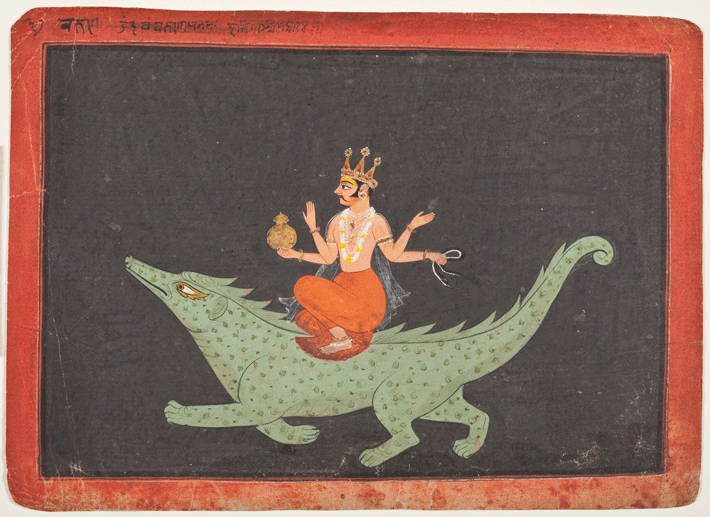
Il dio Hindu Varuna che cavalca un mostro marino. Acquarello del 1700 dopo Cristo.


Dal XIX secolo i linguisti sapevano che tutte le moderne lingue Indo-Europee discendono da una singola lingua. La lingua è chiamata ProtoIndoEuropeo, abbreviato in PIE, ed era parlata da una popolazione risalente ad un periodo temporale tra il 4.500 ed il 2.500 a.C., che non lasciò testi scritti. E' sorta la domanda: "Che suono aveva il PIE?". Nel 1868 il linguista tedesco August Schleicher fece uso di un vocabolario PIE ricostruito per creare una favola, in modo da potere udire una qualche approssimazione di PIE. E' chiamata "la favola della pecora e dei cavalli" ed è anche conosciuta come "la favola di Schleicher" e racconta dell'incontro di una pecora tosata con alcuni cavalli petulanti. Man mano che i linguisti scoprono altro, l'esperimento sonoro continua e la favola si aggiorna per riflettere l'attuale stato di conoscenza di quale sarebbe stato circa 6.000 anni fa il suono di questa lingua scomparsa. Non ne esiste una versione definitiva, dato che esistono disaccordi tra i vari studiosi. In questa versione, Andrew Byrd, linguista dell'Università del Kentuky, recita la propria versione, basata sulle ultime novità nel campo linguistico (e, purtroppo, sulla propria pronuncia inglese).

By the 19th century, linguists knew that all modern Indo-European languages descended from a single tongue. Called Proto-Indo-European, or PIE, it was spoken by a people who lived from roughly 4500 to 2500 B.C., and left no written texts. The question became, what did PIE sound like? In 1868, German linguist August Schleicher used reconstructed Proto-Indo-European vocabulary to create a fable in order to hear some approximation of PIE. Called “The Sheep and the Horses,” and also known today as Schleicher’s Fable, the short parable tells the story of a shorn sheep who encounters a group of unpleasant horses. As linguists have continued to discover more about PIE, this sonic experiment continues and the fable is periodically updated to reflect the most current understanding of how this extinct language would have sounded when it was spoken some six thousand years ago. Since there is considerable disagreement among scholars about PIE, no one version can be considered definitive. Here, University of Kentucky linguist Andrew Byrd recites his version of the fable using pronunciation informed by the latest insights into reconstructed PIE.


Schleicher originally rendered the fable like this:

Avis akvāsas ka

Avis, jasmin varnā na ā ast, dadarka akvams, tam, vāgham garum vaghantam, tam, bhāram magham, tam, manum āku bharantam. Avis akvabhjams ā vavakat: kard aghnutai mai vidanti manum akvams agantam. Akvāsas ā vavakant: krudhi avai, kard aghnutai vividvant-svas: manus patis varnām avisāms karnauti svabhjam gharmam vastram avibhjams ka varnā na asti. Tat kukruvants avis agram ā bhugat.

La Pecora e i cavalli.

Una pecora che non aveva lana vide alcuni cavalli, uno dei quali trascinava un carro pesante, un altro portava un grosso carico ed un altro portava velocemente un uomo, La pecora disse ai cavalli: "Mi duole il cuore nel vedere un uomo che conduce i cavalli". I cavalli dissero: "Senti, pecora, i nostri cuori soffrono quando vediamo questo: un uomo, il padrone, trasforma la lana della pecora in un caldo vestito per sé. E la pecora non ha lana".
Udito questo, la pecora fuggì nella pianura.

Here is the fable in English translation:

The Sheep and the Horses

A sheep that had no wool saw horses, one of them pulling a heavy wagon, one carrying a big load, and one carrying a man quickly. The sheep said to the horses: "My heart pains me, seeing a man driving horses." The horses said: "Listen, sheep, our hearts pain us when we see this: a man, the master, makes the wool of the sheep into a warm garment for himself. And the sheep has no wool." Having heard this, the sheep fled into the plain.

And here is the modern reconstruction recited by Andrew Byrd. It is based on recent work done by linguist H. Craig Melchert, and incorporates a number of sounds unknown at the time Schleicher first created the fable:

H2óu̯is h1éḱu̯ōs-kwe

h2áu̯ei̯ h1i̯osméi̯ h2u̯l̥h1náh2 né h1ést, só h1éḱu̯oms derḱt. só gwr̥hxúm u̯óǵhom u̯eǵhed; só méǵh2m̥ bhórom; só dhǵhémonm̥ h2ṓḱu bhered. h2óu̯is h1ékwoi̯bhi̯os u̯eu̯ked: “dhǵhémonm̥ spéḱi̯oh2 h1éḱu̯oms-kwe h2áǵeti, ḱḗr moi̯ aghnutor”. h1éḱu̯ōs tu u̯eu̯kond: “ḱludhí, h2ou̯ei̯! tód spéḱi̯omes, n̥sméi̯ aghnutór ḱḗr: dhǵhémō, pótis, sē h2áu̯i̯es h2u̯l̥h1náh2 gwhérmom u̯éstrom u̯ept, h2áu̯ibhi̯os tu h2u̯l̥h1náh2 né h1esti. tód ḱeḱluu̯ṓs h2óu̯is h2aǵróm bhuged.


Nel 1990 i linguisti storici  crearono un'altra corta parabola in PIE ricostruito. Essa è liberamente basata su di un passaggio tratto dai Rigveda, un'antica collezione di inni in Sanscrito, in cui un re implora il dio Varuna di garantirgli un figlio. Nella registrazione, A. Byrd recita la propria versione di "Il Re ed il Dio" in PIE, basandosi sul lavoro di Eric Hamp e Subhadra Kumar Sen.

In the 1990s, historical linguists created another short parable in reconstructed PIE. It is loosely based on a passage from the Rigveda, an ancient collection of Sanskrit hymns, in which a king beseeches the god Varuna to grant him a son. Here, Andrew Byrd recites his version of the “The King and the God” in PIE, based on the work of linguists Eric Hamp and the late Subhadra Kumar Sen.


Il Re ed il Dio

C'era una volta un Re. Non aveva figli. Il Re desiderava un figlio. Chiese al suo sacerdote: "Che mi possa nascere un figlio!" Il sacerdote disse al re: "Prega il Dio Weruno". Il Re si avvicinò al dio Weruno per pregare rivolto al dio: "Ascoltami, padre Weruno!" Il dio Weruno scese dal cielo. "Che cosa vuoi?" "Io voglio un figlio". "Che sia così!", disse il luminoso dio Weruno. La regina ebbe un figlio.


The King and the God

Once there was a king. He was childless. The king wanted a son. He asked his priest: "May a son be born to me!" The priest said to the king: "Pray to the god Werunos." The king approached the god Werunos to pray now to the god. "Hear me, father Werunos!" The god Werunos came down from heaven. "What do you want?" "I want a son." "Let this be so," said the bright god Werunos. The king's lady bore a son.

And here is the story rendered in reconstructed Proto-Indo-European:

H3rḗḱs dei̯u̯ós-kwe

H3rḗḱs h1est; só n̥putlós. H3rḗḱs súhxnum u̯l̥nh1to. Tósi̯o ǵʰéu̯torm̥ prēḱst: "Súhxnus moi̯ ǵn̥h1i̯etōd!" Ǵʰéu̯tōr tom h3rḗǵm̥ u̯eu̯ked: "h1i̯áǵesu̯o dei̯u̯óm U̯érunom". Úpo h3rḗḱs dei̯u̯óm U̯érunom sesole nú dei̯u̯óm h1i̯aǵeto. "ḱludʰí moi, pter U̯erune!" Dei̯u̯ós U̯érunos diu̯és km̥tá gʷah2t. "Kʷíd u̯ēlh1si?" "Súhxnum u̯ēlh1mi." "Tód h1estu", u̯éu̯ked leu̯kós dei̯u̯ós U̯érunos. Nu h3réḱs pótnih2 súhxnum ǵeǵonh1e.


(c) 2013 Archaeology Magazine, a Publication of the Archaeological Institute of America