Visualizzazione post con etichetta East Asia. Mostra tutti i post

sabato 18 ottobre 2014

Antiche scritture

Sono stati scoperti - dagli archeologi cinesi - 34 nuovi caratteri di scrittura e glifi, incisi su cosiddette 'ossa oracolari', che molto aggiungono alle conoscenze sulla più antica scrittura mondiale nota ad oggi (ove si escluda quella protosarda).
Si sa che si tratta dei più antichi segni di scrittura usata in modo continuativo, incisi su gusci di tartaruga e su ossa di animali. I primi furono trovati circa 110 anni fa.
Datano al 1600 - 1046 a.C. (Dinastia Shang).
I nuovi caratteri sono stati trovati in un museo - il Museo Lyushun - in  un gruppo di 1800 pezzi facenti parte di un antica raccolta. 
Ad oggi, sono stati riconosciuti circa 4.000 segni grafici differenti - da un 
totale di circa 130.000 reperti - ma solamente circa la metà è stata decifrata.

Alcuni ricercatori hanno notato che  certi segni sono esattamente uguali ai 'rovesciati' rinvenuti nelle 'domos de janas' sarde ed al 'segno di Tanit' osservato in molti luoghi in Sardegna: si sta pertanto lavorando sull'ipotesi che colonizzatori Shardana provenienti dall'Anglona siano stati nella   regione ed abbiano ivi dato inizio alla Dinastia Shang (Shardana+Anglona).


New oracle bone characters discovered in Liaoning 


Chinese archaeologists have discovered 34 new characters and glyphs from oracle bones housed in a museum in Lyushun, a city in northeast China's Liaoning province.

 Oracle bone characters [Credit: Xinhua]


 Song Zhenhao, a research fellow with the Chinese Academy of Social Sciences who is leading a team that has been researching the inscriptions since 2011, said on Thursday that the new findings are another breakthrough since such inscriptions were discovered over 110 years ago. 

Inscriptions on tortoise shells and animal bones represent the original characters of the Chinese written language. 

They date back to the Shang Dynasty (1600-1046 BC). 

The new characters and glyphs, which involve names of nations, places, persons and sacrificial rituals, were found among a 1,800-piece collection of bone inscription relics in the Lyushun Museum. 

Song said the team took rubbings from the text images of the 1,800 pieces and photographed them, which led to the characters being identified. 

To date, archaeologists around the world have identified 4,000 bone inscription characters from studying 130,000 relics, but only half of the characters have been deciphered, he added. 

Chinese characters constitute the oldest continuously used system of writing in the world.

The graphic logograms of the characters convey both meaning and pronunciation. 

Oracle bone inscriptions were first discovered in 1899 by Beijing academic and antiquarian Wang Yirong, although farmers had been unearthing the relics in Anyang, Henan Province, for many years. 

Wang noticed symbols that looked like writing on animal bones and tortoise shells. 

Source: Xinhua [October 16, 2014]


mercoledì 4 giugno 2014

L'invenzione dei pantaloni

Si tratta di un'invenzione di almeno 3.200 anni fa, stando ai reperti dell'archeologia cinese occidentale. Probabilmente è antica quanto lo è l'arte di cavalcare (circa 4.000 anni fa). 
In questo caso, si tratta di pantaloni in lana lavorata al telaio, ricavati da tre pezzi, senza tagli. Sono decorati e muniti di spacchi laterali e stringhe per essere allacciati. 
I proprietari avevano all'incirca 40 anni ed erano pastori e guerrieri, come si deduce dal materiale che li accompagna: tra le molte altre cose, un bracciale da arciere, un'ascia da battaglia, un arco ed un contenitore per proteggerlo.
Prima di allora, l'uomo non portava i pantaloni, né in Europa, né in Asia: lo stesso Otzi portava una copertura fatta di tre pezzi distinti, che avevano l'aspetto di pantaloni senza esserlo davvero. 
Insomma: fu allora che l'uomo iniziò a portare i pantaloni. 
Ma non illudiamoci: probabilmente era anche allora la donna ad essere saldamente al comando...


Riders from the Eurasian Steppes invented trousers 

3,200 years ago .


  Two men whose remains were recently excavated from tombs in western China put their pants on one leg at a time, just like the rest of us. 

But these nomadic herders did so between 3,300 and 3,000 years ago, making their trousers the oldest known examples of this innovative apparel, a new study finds. 


Yanghai, Xinjiang Autonomous Region, around 1100 BC, front view  of a wool pants from the grave M21 [Credit: (c) M. Wagner,  Deutsches Archäologisches Institut] 


With straight-fitting legs and a wide crotch, the ancient wool trousers resemble modern riding pants, says a team led by archaeologists Ulrike Beck and Mayke Wagner of the German Archaeological Institute in Berlin. 
The discoveries, uncovered in the Yanghai graveyard in China’s Tarim Basin, support previous work suggesting that nomadic herders in Central Asia invented pants to provide bodily protection and freedom of movement for horseback journeys and mounted warfare, the scientists report May 22 in Quaternary International. 

“This new paper definitely supports the idea that trousers were invented for horse riding by mobile pastoralists, and that trousers were brought to the Tarim Basin by horse-riding peoples,” remarks linguist and China authority Victor Mair of the University of Pennsylvania. 

Previously, Europeans and Asians wore gowns, robes, tunics, togas or — as observed on the 5,300-year-old body of Ötzi the Iceman — a three-piece combination of loincloth and individual leggings. 


Urumqi, Xinjiang Autonomous Region Institute of Archaeology, documentation  of a 1800-year-old silk dress from Niya [Credit: (c) Joy Zhou,  Deutsches Archäologisches Institut] 


A dry climate and hot summers helped preserve human corpses, clothing and other organic material in the Tarim Basin. 
More than 500 tombs have been excavated in a graveyard there since the early 1970s. Earlier research on mummies from several Tarim Basin sites, led by Mair, identified a 2,600-year-old individual known as Cherchen Man who wore burgundy trousers probably made of wool. 
Trousers of Scythian nomads from West Asia date to roughly 2,500 years ago. Mair suspects that horse riding began about 3,400 years ago and trouser-making came shortly thereafter in wetter regions to the north and west of the Tarim Basin. 
Ancient trousers from those areas are not likely to have been preserved, Mair says. 


Leather boots from Hami before and after restoration [Credit: (c) Joy Zhou,  Deutsches Archäologisches Institut] 


Horse riding’s origins are uncertain and could date to at least 4,000 years ago, comments archaeologist Margarita Gleba of University College London. 
If so, she says, “I would not be surprised if trousers appeared at least that far back.” 
The two trouser-wearing men entombed at Yanghai were roughly 40 years old and had probably been warriors as well as herders, the investigators say. 
One man was buried with a decorated leather bridle, a wooden horse bit, a battle-ax and a leather bracer for arm protection. 
Among objects placed with the other body were a whip, a decorated horse tail, a bow sheath and a bow. 
Beck and Wagner’s group obtained radiocarbon ages of fibers from both men’s trousers, and of three other items in one of the tombs. 
Each pair of trousers was sewn together from three pieces of brown-colored wool cloth, one piece for each leg and an insert for the crotch. 
The tailoring involved no cutting: Pant sections were shaped on a loom in the final size. Finished pants included side slits, strings for fastening at the waist and woven designs on the legs. 
Beck and Wagner’s team calls the ancient invention of trousers “a ground-breaking achievement in the history of cloth making.” That’s not too shabby for herders who probably thought the Gap was just a place to ride their horses through. 


Author: Bruce Bower | Source: Science News [May 31, 2014]

venerdì 14 marzo 2014

La 'Bellezza di Xiaohe'

Ricetta per il formaggio, dalle massaie dell'Età del Bronzo.

Il clima arido del deserto è stato un vero colpo di fortuna: ha permesso di rinvenire resti di formaggio dell'Età del Bronzo in ottimo stato di conservazione e di ricavarne la ricetta.

Non era fatto con il caglio (o presame), bensì con latte, lievito e batteri (quindi lasciato fermentare). Praticamente, si ottiene unformaggio che non si guasta né irrancidisce rapidamente insieme ad un sottoprodotto liquido - il 'kefir' - che, come il formaggio, non contiene lattosio ed è quindi adatto ad una popolazione di intolleranti qual'era quella di allora.

Si è trattato di una serie di coincidenze. Lo studio è stato fatto perché gli archeologi cinesi hanno pensato di mandare campioni del 'donario' rituale di una mummia (la bellezza di Xiaohe: doveva essere - anche se oggi non sembra - una donna molto bella) splendidamente conservata all'Istituto Max Planck, perché fossero analizzati con metodi moderni. E' stato quindi impostato uno studio d'avanguardia sulle proteine di un materiale che non era ancora stato sequenziato (e che aprirà la strada a nuove ricerche proteomiche per uso archeometrico).


Early Bronze Age 

cheese recipe 

reconstructed 


Normally, Andrej Shevchenko and his team at the Max Planck Institute of Molecular Cell Biology and Genetics in Dresden analyse proteins and fats in the cells of fruit flies or roundworms. 
In this case, however, the scientists dealt with some very unusual samples: misshapen fragments that turned out to be the remnants of cheese from the Early Bronze Age, making them the earliest known cheese yet to be discovered. 
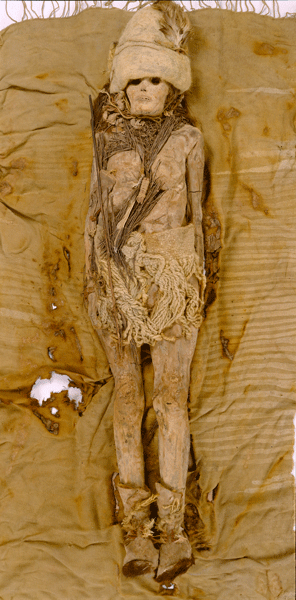
The cheese fragments represent funerary goods that were found around the neck and on the chest of a 4,000-year-old mummified body uncovered at the Xiaohe burial site in Xinjiang, western China. 
Their analysis enabled the researchers to recreate the recipe for the cheese: like kefir, it was made of milk with the addition of a mixture of bacteria and yeast, and subsequently fermented. 


Small cheese clumps are scattered around the neck of the female mummy as a burial offering. 
At the time, people needed no natural rennet from the stomach of animals for the production of cheese made of milk, yeast, and bacteria. It was therefore not necessary to slaughter any young animals [Credit: Y. Liu, Y. Yang] 

The 4,000-year-old Xiaohe cheese represents the oldest remains of a milk product ever found. The extremely arid climate in the Taklamakan Desert, where the Xiaohe burial ground is located, meant that the cheese residues were exceptionally well preserved – a real stroke of luck for the Dresden-based researchers. The cheese found on the mummies was produced with bacteria and yeast, not with rennet: “This meant that no young animals had to be slaughtered – a major advantage of this production method,” explains Shevchenko. According to the scientist’s interpretation, this may have been instrumental in the spread of cattle herding on a large scale throughout Asia. “The method of making this kefir cheese is simple; it doesn’t spoil or turn rancid quickly. So the cheese is extremely well suited to mass production.” As a precursor to the cheese, the process of fermentation with kefir grains also produces the probiotic milk drink known as kefir. Both products contain hardly any lactose – ideal for the population groups living in Asia, most of which are lactose intolerant. 


The "Beauty of Xiaohe": the approx. 4,000 year-old mummy of a woman from Western China [Credit: Y. Liu, Y. Yang] 


Andrej Shevchenko’s wife Anna heads the Mass Spectrometry Department at the same Institute. The two researchers have only recently completed another archaeology project and published their findings. In her desk drawer, Anna Shevchenko still has a few plastic tubes filled with light-brown crumbs – 2,500-year-old funerary goods found during excavations at the ancient Chinese burial ground of Subeixi. “We analysed protein residues from an earthenware dish and were able to reconstruct a prehistoric recipe for leavened bread,” she relates. “We never actually had archaeology on our radar screen. We just kind of stumbled across it thanks to an e-mail enquiry sent by Chinese archaeologist Yimin Yang,” says Shevchenko. Yang had come up with the idea of having his finds analysed with ultramodern quantitative proteomics methods, whereupon he sent the scientists in Dresden the first cheese fragments. Before they could proceed, they had to develop methods of identifying proteins from organisms whose DNA had not yet been sequenced. The projects are therefore truly pioneering and demonstrate most notably that quantitative proteomics is not only suitable for use in biomedical research, but could also represent a promising method for archaeology: “The analytical methods used in archaeology to date always looked at DNA or fats – yet these are often totally useless, especially when it comes to very old organic samples. Proteins have been ignored so far because it was always believed that they would be completely decomposed, that they’re difficult to handle and that the results might be contaminated with proteins from the ambient environment. So our method opens up brand new possibilities for the analysis of organic residues on archaeological finds,” says Anna Shevchenko. Unlike fats, proteins carry a great deal of information inside them in molecular form: for instance, the arrangement of amino acids, the building blocks of the proteins, can also contain signs of the processes used, like fermentation. As such, proteomics could develop into an interesting and suitable method in archaeometry. 
The discovery has been published in the Journal of Archaeological Science. 


Source: Max Planck Society 

[March 11, 2014]
Read more at: http://archaeologynewsnetwork.blogspot.it/2014/03/early-bronze-age-cheese-recipe.html?utm_source=feedburner&utm_medium=feed&utm_campaign=Feed:+TheArchaeologyNewsNetwork+(The+Archaeology+News+Network)#.UyKG6j95OSo
Follow us: @ArchaeoNewsNet on Twitter | groups/thearchaeologynewsnetwork/ on Facebook

mercoledì 1 gennaio 2014

Prima della GRANDE MURAGLIA (ce n'era un'altra!).


Centuries before China's 'Great Wall,' there was 

another 

The Great Wall of China, built more than 2,000 years ago, stands as one of the monumental feats of ancient engineering. Stretching thousands of miles, it protected the newly unified country from foreign invaders. 

In Jiaonan county, the Qi wall incorporates outcrops of bedrock [Credit: Linda Nicholas/The Field Museum] 


But before the Great Wall, warring Chinese dynasties built many other walls for protection. An American archaeologist recently began surveying one of the biggest. Gary Feinman, who is with the Field Museum of Chicago, didn't set out to excavate what he now calls "the first Great Wall." He was simply walking around eastern China's Shandong province, staring at the ground like any good archaeologist, looking for tiny pieces of pottery. But two years ago, he came across an earthen wall. In some places, it was 15 feet high. People knew there had been an early great wall in Shandong, dating to about 500 B.C. — built centuries before the Great Wall. What Feinman discovered seemed to be a part of that early wall. "By walking this part ... we have seen how well designed it was," he says. "It really runs along the higher ridge-tops of these very craggy mountains in eastern Shandong. In the upper reaches of its run, it was amazingly well preserved." Feinman has, essentially, adopted the wall. He's been tracing its path, mapping it, and thinks it may extend several hundred miles. "Nobody has done that before," Feinman says. "Nobody has seen how it snaked ... through such a large area."


 Two Shandong University graduate students check the width of the Qi wall in Shandong Province [Credit: Linda Nicholas/The Field Museum] 


The Chinese who built the wall used a technique called "rammed earth." Workers apparently got fine-grained soil from lower elevations and carried tons and tons and tons of it up to the ridge tops, where they dumped the dirt in piles. Then they started beating these piles until they were exceedingly hard, Feinman says – creating a wall tough enough to survive 2,500 years. Construction like that across hundreds of miles took lots of manpower. Gideon Shelach, an archaeologist at the Hebrew University in Jerusalem, says the leaders of the Qi dynasty (which oversaw the building of the wall) had plenty of hands that they needed to keep occupied. "They were very good at recruiting people for war, first of all," Shelach says. With so much manpower, he says, the leaders could do anything else they wanted to do, too, "so they started building those walls." Unlike the Great Wall that would follow in 300 years, this "Great Qi Wall" was not built to keep out foreign invaders. "It was a wall between large, existing states," Feinman says. 

 Regional dynasties of the time employed ever-expanding armies, and were constantly at war until a very tough guy named Qin Shi Huang put a stop to it, with what Shelach says was an almost unimaginably mighty army. "The army of the Qin that conquered all the other states had [something] like 1.5 million soldiers fighting on different fronts for 10 years," Shelach says. Qin Shi Huang unified the regional states in 221 B.C., and created — naturally — the Qin Dynasty. Qin's soldiers were the living models for the famous terracotta warriors that were discovered in 1974. Those statues were buried along with Qin Shi Huang when he died. But before he died, Qin realized that good walls make good neighbors. He started building another wall in the north — even bigger than the Qi wall — and that second barrier eventually became part of the Great Wall that people know today. Feinman says the Chinese public is interested in rediscovering the earlier Qi wall, though there's a lot of building going on in rural China that threatens to swallow up parts of it. That may not be a bad thing, according to Feinman. "Oddly enough," he says, "parts of [the Qi wall] now serve as the base for dirt roads connecting communities. So what was once a means of keeping people apart is now a way of bringing them together." 

Author: Christopher Joyce | Source: NPR [December 29, 2013]

Read more at: http://archaeologynewsnetwork.blogspot.it/2013/12/centuries-before-chinas-great-wall.html?utm_source=feedburner&utm_medium=feed&utm_campaign=Feed:+TheArchaeologyNewsNetwork+(The+Archaeology+News+Network)
Read more at: http://archaeologynewsnetwork.blogspot.com/

mercoledì 18 dicembre 2013

Il micio, 5.300 anni fa

Cat domestication 

traced to Chinese farmers 

5,300 years ago

Five-thousand years before it was immortalized in a British nursery rhyme, the cat that caught the rat that ate the malt was doing just fine living alongside farmers in the ancient Chinese village of Quanhucun, a forthcoming study in the Proceedings of the National Academy of Sciences has confirmed.

Cat domestication traced to Chinese farmers 5,300 years ago
The Near Eastern Wildcat, native to Western Asia and Africa, is believed to be the primary
ancestor of all domestic cats now living around the globe [Credit: WikipCommons]

"At least three different lines of scientific inquiry allow us to tell a story about cat domestication that is reminiscent of the old 'house that Jack built' nursery rhyme," said study co-author Fiona Marshall, PhD, a professor of archaeology in Arts & Sciences at Washington University in St. Louis.

"Our data suggest that cats were attracted to ancient farming villages by small animals, such as rodents that were living on the grain that the farmers grew, ate and stored."

Set for early online publication in PNAS during the week of Dec. 16, the study provides the first direct evidence for the processes of cat domestication.

"Results of this study show that the village of Quanhucun was a source of food for the cats 5,300 years ago, and the relationship between humans and cats was commensal, or advantageous for the cats," Marshall said. "Even if these cats were not yet domesticated, our evidence confirms that they lived in close proximity to farmers, and that the relationship had mutual benefits."

Cat remains rarely are found in ancient archaeological sites, and little is known about how they were domesticated. Cats were thought to have first been domesticated in ancient Egypt, where they were kept some 4,000 years ago, but more recent research suggests close relations with humans may have occurred much earlier, including the discovery of a wild cat buried with a human nearly 10,000 years ago in Cyprus.

While it often has been argued that cats were attracted to rodents and other food in early farming villages and domesticated themselves, there has been little evidence for this theory.

Cat domestication traced to Chinese farmers 5,300 years ago
These are field specimens from the site of Quanhucun showing key body parts and the presence of an aged animal with worn dentition. (A) Left mandible with worn fourth premolar and first molar; (B) right humerus; © left pelvis; (D) left tibia [Credit: PNAS]
The evidence for this study is derived from research in China led by Yaowu Hu and colleagues at the Chinese Academy of Sciences. Hu and his team analyzed eight bones from at least two cats excavated from the site.

Using radiocarbon dating and isotopic analyses of carbon and nitrogen traces in the bones of cats, dogs, deer and other wildlife unearthed near Quanhucan, the research team demonstrated how a breed of once-wild cats carved a niche for themselves in a society that thrived on the widespread cultivation of the grain millet.

Carbon isotopes indicate that rodents, domestic dogs and pigs from the ancient village were eating millet, but deer were not. Carbon and nitrogen isotopes show that cats were preying on animals that lived on farmed millet, probably rodents. At the same time, an ancient rodent burrow into a storage pit and the rodent-proof design of grain storage pots indicate that farmers had problems with rodents in the grain stores.

Other clues gleaned from the Quanhucun food web suggest the relationship between cats and humans had begun to grow closer. One of the cats was aged, showing that it survived well in the village. Another ate fewer animals and more millet than expected, suggesting that it scavenged human food or was fed.

Recent DNA studies suggest that most of the estimated 600 million domestic cats now living around the globe are descendants most directly of the Near Eastern Wildcat, one of the five Felis sylvestris lybica wildcat subspecies still found around the Old World.

Marshall, an expert on animal domestication, said there currently is no DNA evidence to show whether the cats found at Quanhucun are descendants of the Near Eastern Wildcat, a subspecies not native to the area. If the Quanhucun cats turn out to be close descendents of the Near Eastern strain, it would suggest they were domesticated elsewhere and later introduced to the region.

"We do not yet know whether these cats came to China from the Near East, whether they interbred with Chinese wild-cat species, or even whether cats from China played a previously unsuspected role in domestication," Marshall said.

This question is now being pursued by researchers based in China and in France.

Source: Washington University in St. Louis [December 16, 2013]