Visualizzazione post con etichetta Neanderthal. Mostra tutti i post

martedì 13 ottobre 2015

ULTIME DA SHANIDAR

Non fu l'Uomo di Neanderthal - romanticamente evoluto

quasi al nostro stesso livello di sensibilità affettiva - a

deporre i propri morti con bouquets di fiori, nel corso di un 

complesso rito funebre. 

Furono le api dell'epoca a lasciare quei pollini, ed il vento 

nel corso del tempo...


Neanderthal 'flower burials' theory debunked 


Anthropology, ArchaeoHeritage, Breakingnews, Early Humans, Iraq 


Theories that Neanderthals buried their dead with flower-filled funeral rites have been called into question by new research which finds that natural processes are still depositing pollen in the same way in the same caves. 


Shanidar Cave in Iraq [Credit: LJMU] 


The pollen analyst Josette Leroi-Gourhan found clumps of pollen and flowers in a Neanderthal burial in Shanidar Cave in Iraq in the 1950s and 60s and deduced from their variety and concentration that animals were unlikely to have placed them there, so they must have been part of a ritual. 
Ralph Solecki, the leader of the dig that discovered the burials, wrote in his book Shanidar, The First Flower People, in 1971: ‘With the finding of flowers in association with Neanderthals, we are brought suddenly to the realization that the universality of mankind and the love of beauty go beyond the boundary of our own species. No longer can we deny the early men the full range of human feelings and experience.’ 

The difficulty of digging in Iraq in the intervening time has made it difficult to re-examine the site, but a group from Liverpool John Moores University made the trip recently and found similar buildup of pollen to that found in the burial on the surface, which they attribute to the action of bees.


Pollen clump from Shanidar cave in Iraq [Credit: LJMU] 


They hypothesise in a paper in the latest edition of the Review of Palaeobotany and Palynology that the similar pollen found under the surface by the Solecki expedition is simply bee-pollen and wind-blown vegetation that has been covered up over the last 60,000 years since the burial. 
It is still evident from the Shanidar burials and other sites that Neanderthals took considerable care over the internment of the dead, keeping them safe from scavengers and marking the sites with carved stone ornaments, but sadly the poetic image of flower-laden prehistoric graves seems to be far less likely now. 


Author: Ian Douglas | Source: Telegraph [October 09, 2015]

lunedì 23 marzo 2015

IGNINBRITE CAMPANA

Un articolo interessante, che cerca di individuare una 

possibile spiegazione per la scomparsa del Neanderthal. I 

ricercatori avvertono però che una grande eruzione in 

Italia (responsabile di un raffreddamento climatico 

globale) avrebbe più probabilmente solo dato un colpo di 

grazia ad una specie già in serio pericolo biologico 

d'estinzione per la propria scarsità numerica (un 'collo di 

bottiglia') e che già stava soccombendo alla più 

competitiva specie cui l'uomo moderno appartiene... 

D'altro canto, sembrerebbe strano che una temperatura più 

rigida - da sola - potesse mettere in difficoltà proprio il 

Neanderthal, che per le temperature fredde era 

attrezzatissimo.

Lo studio entra nei risvolti quantitativi e nell'estensione 

geografica della diminuzione di temperatura. Sembra che 

l'entità della diminuzione fosse - in Europa Occidentale - 

solo di 2/4 gradi e che quindi la maggiore differenza di 

temperatura (con le maggiori difficoltà ambientali) abbia 

'bipassato' proprio le zone in cui i Neanderthal resistettero 

più a lungo. Le zone geografiche più colpite sarebbero state 

l'Asia e l'Europa Orientale. 

Quindi, sostanzialmente, lo studio è negativo: la 

conclusione è che non fu l'abbassamento di temperatura ad 

eliminare il Neanderthal. Ma i ricercatori ritengono di 

avere sottolineato ancora una volta quanto sia sempre 

stato determinante il clima per tutti gli esseri viventi ed in 

quale misura l'uomo anatomicamente si sia sempre 

dimostrato più adattabile del Neanderthal alle variazioni 

ambientali. 

Did a volcanic cataclysm 

40,000 years ago trigger the 

final demise of the Neanderthals? 

The Campanian Ignimbrite (CI) eruption in Italy 40,000 years ago was one of the largest volcanic cataclysms in Europe and injected a significant amount of sulfur-dioxide (SO2) into the stratosphere. 
Scientists have long debated whether this eruption contributed to the final extinction of the Neanderthals. 


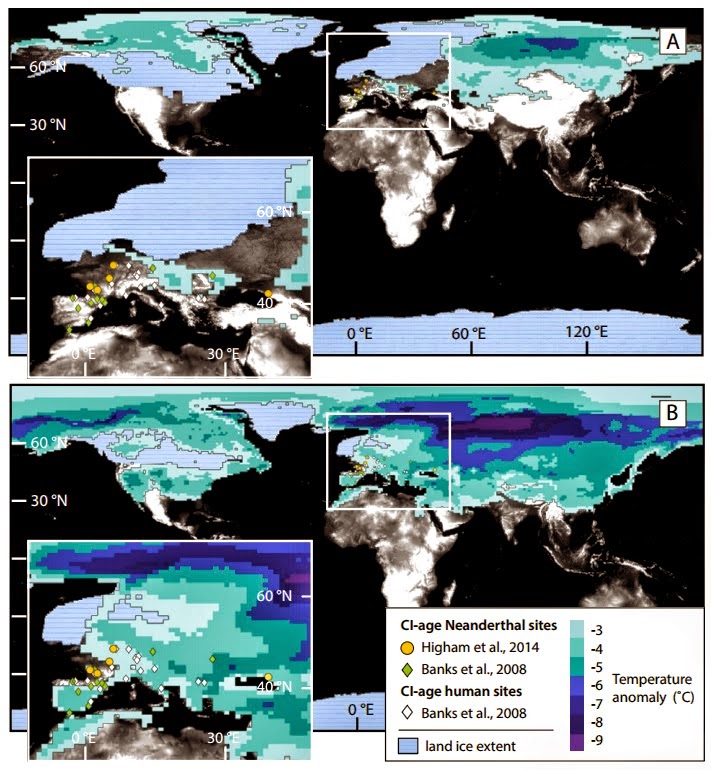
This new study by Benjamin A. Black and colleagues tests this hypothesis with a sophisticated climate model. Figure 4 in B.A. Black et al.: This image shows annually averaged temperature  anomalies in excess of 3°C for the first year after the Campanian Ignimbrite (CI)  eruption compared with spatial distribution of hominin sites with radiocarbon ages  close to that of the eruption 
[Credit: B.A. Black et al. and the journal Geology] 


Black and colleagues write that the CI eruption approximately coincided with the final decline of Neanderthals as well as with dramatic territorial and cultural advances among anatomically modern humans. 
Because of this, the roles of climate, hominin competition, and volcanic sulfur cooling and acid deposition have been vigorously debated as causes of Neanderthal extinction.

They point out, however, that the decline of Neanderthals in Europe began well before the CI eruption: "Radiocarbon dating has shown that at the time of the CI eruption, anatomically modern humans had already arrived in Europe, and the range of Neanderthals had steadily diminished. 
Work at five sites in the Mediterranean indicates that anatomically modern humans were established in these locations by then as well." 
"While the precise implications of the CI eruption for cultures and livelihoods are best understood in the context of archaeological data sets," write Black and colleagues, the results of their study quantitatively describe the magnitude and distribution of the volcanic cooling and acid deposition that ancient hominin communities experienced coincident with the final decline of the Neanderthals. 

In their climate simulations, Black and colleagues found that the largest temperature decreases after the eruption occurred in Eastern Europe and Asia and sidestepped the areas where the final Neanderthal populations were living (Western Europe).

Therefore, the authors conclude that the eruption was probably insufficient to trigger Neanderthal extinction.

However, the abrupt cold spell that followed the eruption would still have significantly impacted day-to-day life for Neanderthals and early humans in Europe.

Black and colleagues point out that temperatures in Western Europe would have decreased by an average of 2 to 4 degrees Celsius during the year following the eruption.

These unusual conditions, they write, may have directly influenced survival and day-to-day life for Neanderthals and anatomically modern humans alike, and emphasize the resilience of anatomically modern humans in the face of abrupt and adverse changes in the environment. 

Source: Geological Society of America [March 20, 2015]


giovedì 17 luglio 2014

Scomparsa del Neanderthal


July 17, 2014

Early Neandertal disappearance in Iberia

Journal of Human Evolution DOI: 10.1016/j.jhevol.2014.06.002 

New evidence of early Neanderthal disappearance in the Iberian Peninsula 

Bertila Galván et al. 

The timing of the end of the Middle Palaeolithic and the disappearance of Neanderthals continue to be strongly debated. Current chronometric evidence from different European sites pushes the end of the Middle Palaeolithic throughout the continent back to around 42 thousand years ago (ka). This has called into question some of the dates from the Iberian Peninsula, previously considered as one of the last refuge zones of the Neanderthals. Evidence of Neanderthal occupation in Iberia after 42 ka is now very scarce and open to debate on chronological and technological grounds. Here we report thermoluminescence (TL) and optically stimulated luminescence (OSL) dates from El Salt, a Middle Palaeolithic site in Alicante, Spain, the archaeological sequence of which shows a transition from recurrent to sporadic human occupation culminating in the abandonment of the site. The new dates place this sequence within MIS 3, between ca. 60 and 45 ka. An abrupt sedimentary change towards the top of the sequence suggests a strong aridification episode coinciding with the last Neanderthal occupation of the site. These results are in agreement with current chronometric data from other sites in the Iberian Peninsula and point towards possible breakdown and disappearance of the Neanderthal local population around the time of the Heinrich 5 event. Iberian sites with recent dates (less than 40 ka) attributed to the Middle Palaeolithic should be revised in the light of these data. 

Link

mercoledì 23 aprile 2014

Geni Accesi/Spenti

ON/OFF GENES


Ci si potrebbe domandare come sia possibile che esseri tanto differenti tra loro (il Neanderthal e l'Uomo Moderno) siano in realtà geneticamente quasi identici (il 98.84% del loro DNA è lo stesso).

E' stata formulata un'ipotesi attraente: la molecola del DNA presenterebbe alcuni "attivatori" che funzionerebbero proprio come interruttori. Si otterrebbe quindi il medesimo effetto che si produce in due automobili uguali, egualmente accessoriate, in una delle quali tutti gli accessori sono accesi, mentre nell'altra sono tutti spenti. In realtà, nel Neanderthal sono accesi anche molti altri geni che nell'uomo moderno sono spenti, pur essendo presenti: il risultato finale è quello di ottenere due esseri che sembrano - ma non sono veramente - profondamente differenti... ( per esempio: geni che controllano la forma degli arti e le funzioni del cervello).
L'ipotesi è basata su risultati tecnico scientifici e definiscono ancora meglio quello che si definisce 'epigenoma' (il genoma è la struttura biomolecolare di circa 3 miliardi di molecole in sequenza del DNA; l'epigenoma è lo stato di attivazione o disattivazione delle sue singole parti, con l'espressione differente che ne consegue).
Negli ultimi anni si era già chiarito come il silenziamento del genoma possa produrre il cancro, oppure come gemelli identici (con DNA uguale) possano essere molto differenti tra loro, proprio per via dell'epigenoma (che, proprio per tale motivo, è spesso chiamato "il secondo codice genetico"). Oggi, abbiamo indizi su come l'uomo moderno differisce dal Neandethal e dal Denisova.
Lo studio è stato eseguito dall'Università di Gerusalemme su DNA proveniente da ossa degli arti (di un uomo vivente, di un Neanderthal, di un denisoviano e di un uomo estinto risalente al paleolitico rinvenuto in siberia nel 2010. Sono state identificate circa 2200 regioni di DNA  che risultano attive nell'Uomo Moderno e sono silenti in quelli antichi e circa altrettante viceversa.
Una delle differenze più evidenti è un cluster di 5 geni (chiamati HOXD) che influenzano la forma e le dimensioni degli arti, incluse braccia e mani: risulta 'spento' nelle specie antiche. Questo potrebbe spiegare gambe e braccia più corte del Neanderthal, le sue gambe arcuate, le mani e dita grandi, la curvatura delle braccia. Può anche darsi che - in fondo - si tratti di un adattamento biologico al clima molto più rigido dell'età della pietra. 
Infatti, uno dei fattori che agiscono sull'epigenoma - ed anche in misura evidente - sono proprio l'ambiente, la dieta, altri fattori.
 Per ora - pertanto - è impossibile stabilire se le differenze 'Acceso/spento' si riferiscono alla specie, oppure soltanto agli individui studiati.
Le differenze implicate dall'epigenoma riguardano anche i disordini psichiatrici e neurologici (autismo, schizofrenia, 'demenza' senile etc). Sembra che - in massima parte - i geni responsabili fossero silenti nel Neanderthal. Nell'Uomo moderno, invece, sembra che l'attivazione di geni correlati con le funzioni del cervello abbia anche prodotto una serie d'effetti collaterali negativi. Oltre, di fatto, a produrre il "grande salto in avanti" che lo distingue dai suoi 'cugini' estinti.


http://www.sciencemag.org/content/early/2014/04/16/science.1250368

ed ecco l'abstract dell'articolo originale in inglese:


Reconstructing the DNA Methylation Maps of the Neandertal and the Denisovan

  1. Liran Carmel1,*
+Author Affiliations
  1. 1Department of Genetics, The Alexander Silberman Institute of Life Sciences, The Hebrew University of Jerusalem, Jerusalem, Israel 91904.
  2. 2Department of Evolutionary Genetics, Max Planck Institute for Evolutionary Anthropology, D-04103 Leipzig, Germany.
  3. 3Cancer Epigenetics Laboratory, IUOPA, University of Oviedo and CNB-CSIC, Spain.
  4. 4Department of Medicine, Hospital U.M. Valdecilla, University of Cantabria, IDIVAL, Santander, Spain.
  1. ↵*Corresponding author. E-mail: liran.carmel@huji.ac.il (L.C.); meshorer@huji.ac.il (E.M.)
Ancient DNA sequencing has recently provided high-coverage archaic human genomes. However, the evolution of epigenetic regulation along the human lineage remains largely unexplored. We reconstructed the full DNA methylation maps of the Neandertal and the Denisovan by harnessing the natural degradation processes of methylated and unmethylated cytosines. Comparing these ancient methylation maps to those of present-day humans, we identified ~2000 differentially methylated regions (DMRs). Particularly, we found substantial methylation changes in the HOXD cluster that may explain anatomical differences between archaic and present-day humans. Additionally, we found that DMRs are significantly more likely to be associated with diseases. This study provides insight into the epigenetic landscape of our closest evolutionary relatives and opens a window to explore the epigenomes of extinct species.

mercoledì 2 aprile 2014

Altra eredità dal Neanderthal

Pare che il Neanderthal sia stato generoso con noi: scopriamo sempre nuovi lasciti.

Il più recente sembra essere collegato al metabolismo dei lipidi. Si sa che l'Uomo anatomicamente moderno si è in qualche modo incrociato con Neanderthal, fuori dall'Africa. Ed infatti, questi 'lasciti' riguardano solamente Europei ed Asiatici, in genere, seppure in modo differente. In particolare, gli europei avrebbero ereditato una quantità di geni che agiscono sul metabolismo lipidico almeno tre volte superiore a quella degli Asiatici (studio su 11 popolazioni differenti, pubblicato on line su Nature Communications e di libera consultazione). Si tratta di geni che scindono i grassi, producendo energia. Inoltre, si è visto che la concentrazione di acidi grassi dei tessuti cerebrali presenta enormi differenze negli Europei, rispetto sia agli Asiatici sia agli scimpanzé: questo significa che si tratta di mutamenti causati da evoluzione recente. Gli europei mostrano anche differenze nel funzionamento degli enzimi noti per avere una funzione riguardante il metabolismo dei grassi encefalici. L'equipe sta cercando di stabilire quale sia esattamente il significato di queste differenze e se possa in qualche modo avere effetto sulle funzioni cerebrali stesse. Si ritiene che qualche azione debba esserci - altrimenti non si osserverebbe questa differente concentrazione di acidi grassi encefalici - e che possa essere servita per dare all'Uomo anatomicamente moderno qualche vantaggio.


Neandertals gave Europeans lipid catabolism genes

Ann Gibbons explains in Did Europeans Get Fat From Neandertals?:
In the latest study, published online today in Nature Communications, Khaitovich and his international team analyzed the distribution of Neandertal gene variants in the genomes of 11 populations from Africa, Asia, and Europe.  
They found that Europeans inherited three times as many genes involved in lipid catabolism, the breakdown of fats to release energy, from Neandertals as did Asians. (As expected, Africans did not carry any of these Neandertal variants.) The difference in the number of Neandertal genes involved with lipid processing was “huge,” Khaitovich says. The study also offers another example of the lingering genetic legacy left in some people today by the extinct Neandertals. 
... 
The team found that Europeans had differences in the concentration of various fatty acids in the brain that were not found in Asians or chimpanzees, which suggests they had evolved recently. The Europeans also showed differences in the function of enzymes that are known to be involved with the metabolism of fat in the brain.
Now the team is trying to figure out what the fatty acids do in the brain and how differences in their concentration might affect function. “We think it’s a very strong effect with very profound physiological changes,” Khaitovich says. “Otherwise, we wouldn’t see it in the brain tissue.” 
The article itself is open access.

Nature Communications 5, Article number: 3584 doi:10.1038/ncomms4584

Neanderthal ancestry drives evolution of lipid catabolism in contemporary Europeans

Ekaterina E. Khrameeva et al.

Although Neanderthals are extinct, fragments of their genomes persist in contemporary humans. Here we show that while the genome-wide frequency of Neanderthal-like sites is approximately constant across all contemporary out-of-Africa populations, genes involved in lipid catabolism contain more than threefold excess of such sites in contemporary humans of European descent. Evolutionally, these genes show significant association with signatures of recent positive selection in the contemporary European, but not Asian or African populations. Functionally, the excess of Neanderthal-like sites in lipid catabolism genes can be linked with a greater divergence of lipid concentrations and enzyme expression levels within this pathway, seen in contemporary Europeans, but not in the other populations. We conclude that sequence variants that evolved in Neanderthals may have given a selective advantage to anatomically modern humans that settled in the same geographical areas.

Link

martedì 18 marzo 2014

Paleo dieta e Clima


PALEO DIET DIDN'T CHANGE: THE CLIMATE DID.

Why were Neanderthals replaced by anatomically modern humans around 40,000 years ago? 
One popular hypothesis states that a broader dietary spectrum of modern humans gave them a competitive advantage on Neanderthals. 
Geochemical analyses of fossil bones seemed to confirm this dietary difference. Indeed, higher amounts of nitrogen heavy isotopes were found in the bones of modern humans compared to those of Neanderthals, suggesting at first that modern humans included fish in their diet while Neanderthals were focused on the meat of terrestrial large game, such as mammoth and bison. 


Fragment of jaw of a wolf from Le Moustier that was analyzed during the investigation [Credit: Hervé Bocherens/University of Tübingen] 


However, these studies did not look at possible isotopic variation of nitrogen isotopes in the food resource themselves. In fact, environmental factors such as aridity can increase the heavy nitrogen isotope amount in plants, leading to higher nitrogen isotopic values in herbivores and their predators even without a change of subsistence strategy.
 A recent study published in Journal of Human Evolution by researchers from the University of Tübingen (Germany) and the Musée national de Préhistoire in Les Eyzies-de-Tayac (France) revealed that the nitrogen isotopic content of animal bones, both herbivores, such as reindeer, red deer, horse and bison, and carnivores such as wolves, changed dramatically at the time of first occurrence of modern humans in southwestern France. 
The changes are very similar to those seen in human fossils during the same period, showing that there was not necessarily a change in diet between Neanderthals and modern humans, but rather a change in environment that was responsible for a different isotopic signature of the same food resources. 

Graph showing the isotopic shift of herbivores, wolves and humans at the transition between Neanderthals and anatomically modern humans [Credit: Hervé Bocherens/University of Tübingen] 


Moreover, this isotopic event coinciding in timing with the replacement of Neanderthals by modern humans may indicate that environmental changes, such as an increase of aridity, could have helped modern humans to overcome the Neanderthals. 
These new results, together with recently published research showing that Neanderthals had more skills and exploited more diverse food resources than previously thought, makes the biological differences between these two types of prehistoric humans always smaller. 
In this context, the exact circumstances of the extinction of Neanderthals by modern humans remain unclear and they are probably more complex than just a behavioral superiority of one type of humans compared to the other. 


Source: Universitaet Tübingen [March 17, 2014]

Read more at: http://archaeologynewsnetwork.blogspot.it/2014/03/paleo-diet-didnt-change-climate-did.html?utm_source=feedburner&utm_medium=feed&utm_campaign=Feed:+TheArchaeologyNewsNetwork+(The+Archaeology+News+Network)#.Uyhm9CjvjfX
Follow us: @ArchaeoNewsNet on Twitter | groups/thearchaeologynewsnetwork/ on Facebook

mercoledì 26 febbraio 2014

Estinzione del Neanderthal

Alcune leggi  della Genetica di Popolazioni possono essere un po' meno immediate a comprendersi che non le leggi della fisica (la gravità, ad esempio).  Si tratta però sempre di leggi biologiche, che dominano la nostra vita, quanto nascere, invecchiare e morire.
Una di queste leggi riguarda la diversificazione (grado di variazione genetica) che si verifica all'interno di una popolazione. Tale variazione è grande in una popolazione grande (lo è nell'uomo moderno) mentre si riduce enormemente in una popolazione piccola ed isolata (isolato genetico). 

Questa legge si applica anche al Neanderthal, alla luce degli studi sul mtDNA antico disponibile. 
Si è potuto osservare che la popolazione di Neanderthal rischiò l'estinzione ben prima del contatto competitivo con l'Uomo Anatomicamente Moderno. Ciò forse avvenne per un fattore climatico: probabilmente per una prima insospettata sua sensibilità al freddo.
Quando giunse l'uomo moderno, la popolazione di Neanderthal si stava riprendendo dal "collo di bottiglia".
Prima di 50.000 anni fa, il pool genetico dei Neanderthal mostrava infatti una variabilità genetica molto elevata, paragonabile a quello dell'uomo moderno oggi e indicativa di una popolazione che per lungo tempo è stata molto numerosa e si è estesa su un grande territorio. 
Poi ci fu il collo di bottiglia: una terribile crisi demografica. 
I Neanderthal più recenti di 50.000 anni fa, mostrano una variabilità estremamente ridotta, tipica di una popolazione molto più piccola ed isolata.
Noi gli demmo - probabilmente - il colpo di grazia.


Neanderthals may have faced extinction long before modern humans emerged 

  Western Europe has long been held to be the "cradle" of Neanderthal evolution, and anthropologists have theorized that climatic factors or competition from modern humans were the likely causes when Neanderthals started disappearing around 30,000 years ago. But new research suggests that Western European Neanderthals were on the verge of extinction long before modern humans showed up. 


A hyper-realistic face of a Neanderthal man is displayed [Credit: Nikola Solic/Reuters] 


This perspective comes from a study of ancient DNA carried out by an international research team. Rolf Quam, a Binghamton University anthropologist, was a co-author of the study led by Anders Götherström at Uppsala University and Love Dalén at the Swedish Museum of Natural History, and published in the journal Molecular Biology and Evolution. 
"The Neanderthals are our closest fossil relatives and abundant evidence of their lifeways and skeletal remains has been found at many sites across Europe and western Asia," said Quam, assistant professor of anthropology. "Until modern humans arrived on the scene, it was widely thought that Europe had been populated by a relatively stable Neanderthal population for hundreds of thousands of years. Our research suggests otherwise and, in light of these new results, this long-held theory now faces scrutiny." 
Focusing on mitochondrial DNA sequences from 13 Neanderthal individuals, including a new sequence from the site of Valdegoba cave in northern Spain, the research team found some surprising results. When they started looking at the DNA, a clear pattern emerged. Neanderthal individuals from Western Europe that were older than 50,000 years and individuals from sites in western Asia and the Middle East showed a high degree of genetic variation, on par with what might be expected from a species that had been abundant in an area for a long period of time. In fact, the amount of genetic variation was similar to what characterizes modern humans as a species.
 In contrast, Neanderthal individuals from Western Europe that were younger than 50,000 years show an extremely reduced amount of genetic variation, less even than the present-day population of remote Iceland. These results suggest that Western European Neanderthals went through a demographic crisis, a population bottleneck that severely reduced their numbers, leaving Western Europe largely empty of humans for a period of time. 

The demographic crisis seems to coincide with a period of extreme cold in Western Europe.
 Subsequently, this region was repopulated by a small group of individuals from a surrounding area. The geographic origin of this source population is not clear, but it may be possible to pinpoint it further with additional study. 
"The fact that Neanderthals in Western Europe were nearly extinct, but then recovered long before they came into contact with modern humans came as a complete surprise to us," said Dalén, associate professor at the Swedish Museum of Natural History in Stockholm. "This indicates that the Neanderthals may have been more sensitive to the dramatic climate changes that took place in the last Ice Age than was previously thought." Quam concurs and suggests that this discovery calls for a major rethinking of the idea of cold adaptation in Neanderthals. "At the very least, this tells us that without the aid of material culture or technology, there is a limit to our biological adaptation," Quam said. "It may very well have been the case that the European Neanderthal populations were already demographically stressed when modern humans showed up on the scene." The results presented in the study are based entirely on degraded ancient DNA, and the analyses have therefore required advanced laboratory and computational methods. The research team includes statisticians, experts on modern DNA sequencing and paleoanthropologists from Sweden, Denmark, Spain and the United States. "This is just the latest example of how studies of ancient DNA are providing new insights into an important and previously unknown part of Neanderthal history," Quam said. "Ancient DNA is complementary to anthropological studies focusing on the bony anatomy of the skeleton, and these kinds of results are only possible with ancient DNA studies. It's exciting to think about what will turn up next." 


Author: Gail Glover 

Source: Binghamton Univerity [February 24, 2014]

Read more at: http://archaeologynewsnetwork.blogspot.it/2014/02/neanderthals-may-have-faced-extinction.html?utm_source=feedburner&utm_medium=feed&utm_campaign=Feed:+TheArchaeologyNewsNetwork+(The+Archaeology+News+Network)#.Uw14ruN5OSo
Follow us: @ArchaeoNewsNet on Twitter | groups/thearchaeologynewsnetwork/ on Facebook