New genes
born by accident
lead to evolutionary innovation
Evolution, Genetics
Novel genes are continuously emerging during evolution, but what drives this process?
A new study, published in PLOS Genetics, has found that the fortuitous appearance of certain combinations of elements in the genome can lead to the generation of new genes.
This work was led by Jorge Ruiz-Orera and Mar Alba from Hospital del Mar Medical Research Institute in Barcelona (IMIM-ICREA).
A new study has found that the fortuitous appearance of certain combinations of elements in the genome can lead to the generation of new genes [Credit: National Human Genome Research Institute]
In every genome, there are sets of genes, which are unique to that particular species.
In this study, the scientists first identified thousands of genes that were specific to human or chimpanzee.
Then, they searched the macaque genome and discovered that this species had significantly less element motifs in the corresponding genomic sequences.
These motifs are recognized by proteins that activate gene expression, a necessary step in the formation of a new gene. The formation of genes de novo from previously non-active parts of the genome was, until recently, considered highly improbable.
This study has shown that the mutations that occur normally in our genetic material may be sufficient to explain how this happens.
Once expressed, the genes can act as a substrate for the evolution of new molecular functions.
This study identified several candidate human proteins that bear no resemblance to any other known protein.
What they do is an enigma still to be resolved.
Source: PLOS [December 31, 2015]
Visualizzazione post con etichetta Breakingnews. Mostra tutti i post
Visualizzazione post con etichetta Breakingnews. Mostra tutti i post
giovedì 29 ottobre 2015
Guerriero del Bronzo, Tomba Intatta.
Bronze Age warrior tomb
unearthed in SW Greece

ArchaeoHeritage, Archaeology, Breakingnews, Europe, Greece, Southern Europe
On the floor of the grave lay the skeleton of an adult male, stretched out on his back. Weapons lay to his left, and jewelry to his right.

Near the head and chest was a bronze sword, its ivory hilt covered in gold.
A gold-hilted dagger lay beneath it. Still more weapons were found by the man's legs and feet. Gold cups rested on his chest and stomach, and near his neck was a perfectly preserved gold necklace with two pendants.
By his right side and spread around his head were over one thousand beads of carnelian, amethyst, jasper, agate and gold.
Nearby were four gold rings, and silver cups as well as bronze bowls, cups, jugs and basins.

The above describes what a University of Cincinnati-led international research team found this summer when excavating what was initially thought to be a Bronze Age house. Instead, the team made a rich and rare discovery of an intact, Bronze Age warrior's tomb dating back to about 1500 B.C., and that discovery is featured in The New York Times, in an article titled: A Warrior's Grave at Pylos, Greece, Could Be a Gateway to Civilizations.

The find is so extraordinary that UC's Shari Stocker, senior research associate in the Department of Classics, McMicken College of Arts and Sciences, states: "This previously unopened shaft grave of a wealthy Mycenaean warrior, dating back 3,500 years, is one of the most magnificent displays of prehistoric wealth discovered in mainland Greece in the past 65 years."
Stocker co-leads the team that unearthed the undisturbed shaft tomb, along with Jack Davis, UC's Carl W. Blegen Chair in Greek Archaeology.
Other team members include UC faculty, staff specialists and students, some of whom have worked in the area around the present-day city of Pylos on the southwest coast of Greece for the last quarter century as part of the Pylos Regional Archaeological Project.
That UC-based effort is dedicated to uncovering the pre-history and history of the Bronze Age center known as the Palace of Nestor, an extensive complex and a site linked to Homeric legend.
Though the palace was destroyed by fire sometime around 1200 B.C., it is nevertheless the best-preserved Bronze Age palace on the Greek mainland.
It was UC archaeologist Carl Blegen, along with Konstantinos Kourouniotis, director of the National Archaeological Museum, who initially uncovered the remains of the famed Palace of Nestor in an olive grove in 1939.
Located near the present-day city of Pylos, the palace was a destination in Homer's "Odyssey," where sacrifices were said to be offered on its beaches.
The king who ruled at the Palace of Nestor controlled a vast territory that was divided into more than 20 districts with capital towns and numerous small settlements.

Explains Stocker, "This latest find is not the grave of the legendary King Nestor, who headed a contingent of Greek forces at Troy in Homer's 'Iliad.' Nor is it the grave of his father, Neleus.
This find may be even more important because the warrior pre-dates the time of Nestor and Neleus by, perhaps, 200 or 300 years.
That means he was likely an important figure at a time when this part of Greece was being indelibly shaped by close contact with Crete, Europe's first advanced civilization."
Thus, the tomb may have held a powerful warrior or king -- or even a trader or a raider -- who died at about 30 to 35 years of age but who helped to lay the foundations of the Mycenaean culture that later flourished in the region. Davis speculates, "Whoever he was, he seems to have been celebrated for his trading or fighting in nearby island of Crete and for his appreciation of the more-sophisticated and delicate are of the Minoan civilization (found on Crete), with which he was buried."
Potential Wealth of Information The team found the tomb while working in the area of the Palace of Nestor, seeking clues as to how the palace and its rulers came to control an area encompassing all of modern Messenia in western Greece and supporting more than 50,000 inhabitants during the Bronze Age.

Davis says that researchers were there to try and figure out how the Palace of Nestor became a center of power and when this rise in power began, questions they now think the tomb may help answer.
Given the magnitude of this find, it may be necessary to rethink when Plyos and the wider area around it began to flourish. It may have been earlier than previously thought since, somehow, whether via trade or force (e.g., raiding), its inhabitants had acquired the valuable objects found within the tomb.
Many of the tomb's objects were made in nearby Crete and show a strong Minoan style and technique unknown in mainland Greece in the 15th century BC.

The same would likely have been true of the warrior's dwelling during this lifetime.
He would have lived on the hilltop citadel of nearby Englianos at a time when great mansions were first being built with walls of cut-stone blocks (vs. uncut rock and stones) in the style then associated with nearby Mediterranean Island of Crete and its Minoan culture, their walls decorated with paintings influenced by earlier Minoan wall paintings. The weapons of bronze found within the tomb included a meter-long slashing sword with an ivory handle covered with gold.
Wealth of Jewels and Weaponry
A remarkable store of riches was deposited in the tomb with the warrior at the time of his death. The mere fact that the vessels in the tomb are of metal (vs. ceramic pottery) is a strong indication of his great wealth.

"It is truly amazing that no ceramic vessels were included among the grave gifts.
All the cups, pitchers and basins we found were of metal: bronze, silver and gold.
He clearly could afford to hold regular pots of ceramic in disdain," according to Stocker.
This member of the elite was accompanied in the afterlife by about 50 seal-stones carved with intricate Minoan designs of goddesses as well as depictions of bulls and human bull jumpers soaring over their horns.
Four gold rings in the tomb contain fine Minoan carvings.
A plaque of carved ivory with a representation of a griffon with huge wings lay between the man's legs.
Nearby was a bronze mirror with an ivory handle.
Archaeological conservator Alexandros Zokos was essential partner in the removal, cleaning and preservation of the finds from the grave.
The weapons of bronze within the tomb include a meter-long slashing sword with an ivory handle, several daggers, a spearhead, along with the already-mentioned sword and dagger with gold pommels.

Other grave gifts originally rested above the dead warrior atop a coffin of wood which later collapsed, spilling a crushing load of objects down on the skeleton -- and making the job of excavation difficult and slow.

The gifts atop the coffin included bronze jugs; a large, bronze basin; thin bands of bronze, probably from the warrior's suit of body armor; many wild boar's teeth from the warrior's helmet.
In combination with this weaponry, the discovery of so much jewelry with a male burial challenges the commonly held belief that these apparently "feminine" adornments and offerings accompanied only wealthy women to the hereafter.
Previously Unexplored Field
What would eventually become the successful excavation of the tomb began on the team's very first day of its field work in May 2015, conducted in a previously unexplored field near the Palace of Nestor.
They immediately found one of the four walls of the warrior's grave.

"We put a trench in this one spot because three stones were visible on the surface," says Davis, adding, "At first, we expected to find the remains of a house.
We expected that this was the corner of a room of a house, but quickly realized that it was
the tops of the walls of a stone-lined grave shaft."
In the end, the shaft measured about 5 feet deep, 4 feet wide and 8 feet long.
It took the team about two weeks to clear the shaft before "we hit bronze," says Stocker. At that point, they realized they might have an exceptional prize: an undisturbed grave shaft, never stripped by looters.
She explains, "The fact that we had not encountered any objects for almost a meter indicated that whatever was at the bottom had been sealed for a long time." Stocker and Alison Fields, a UC graduate student of classics, did most of the actual excavation because their smaller size allowed them to work more easily and carefully around the tomb and its many precious objects.
What Comes Next
Both Stocker and Davis say it was good luck to discover this intact grave. Given the rarity of the find, it's unlikely to be repeated. "It's almost as if the occupant wants his story to be told," Davis says.

And that story will continue to unfold.
The UC team and others are studying the artifacts in detail, with all artifacts remaining in Greece and their final disposition determined by the Greek Archaeological Service.
Former UC anthropologist Lynne Schepartz, now of the University of Witwatersrand in Johannesburg, South Africa, will study the skeletal remains.

Catalogue of Objects Found Within the Warrior Tomb
- Gold
Four complete solid-gold seal rings to be worn on a human finger.
This number is more than found with any single burial elsewhere in Greece.
Two squashed gold cups and a silver cup with a gold rim
One unique necklace of square box-shaped golden wires, more than 30 inches long with two gold pendants decorated with ivy leaves.
Numerous gold beads, all in perfect condition.
- Silver
Six silver cups.
- Bronze
One three-foot long sword, with an ivory hilt overlaid with gold in a rare technique imitating embroidery (found at warrior's left chest).
Under this sword was a smaller dagger with a gold hilt employing the same technique. Other bronze weapons by his legs and feet.
Bronze cups, bowls, amphora, jugs and a basin, some with gold, some with silver trim.
- Seal Stones
More than 50 seal stones, with intricate carvings in Minoan style showing goddesses, altars, reeds, lions and bulls, some with bull-jumpers soaring over the bull's horns -- all in Minoan style and probably made in Crete.
- Ivory
Several pieces of carved ivory, one with a griffon with large wings and another depicting a lion attacking a griffon. Six decorated ivory combs.
- Precious Stone Beads
An astonishing hoard of over 1000 beads, most with drill holes for stringing together.
The beads are of carnelian, amethyst, jasper and agate. Some beads appear to be decorations from a burial shroud of woven fabric, suggested by several square inches of cross woven threads which survived in the grave for 3,500 years.
Source: University of Cincinnati [October 26, 2015]
unearthed in SW Greece

ArchaeoHeritage, Archaeology, Breakingnews, Europe, Greece, Southern Europe
On the floor of the grave lay the skeleton of an adult male, stretched out on his back. Weapons lay to his left, and jewelry to his right.

This gold ring with a Cretan bull-jumping scene was one of four solid-gold rings found in the tomb. This number is more than found with any other single burial elsewhere in Greece
[Credit: University of Cincinnati, Pylos Excavations]
Near the head and chest was a bronze sword, its ivory hilt covered in gold.
A gold-hilted dagger lay beneath it. Still more weapons were found by the man's legs and feet. Gold cups rested on his chest and stomach, and near his neck was a perfectly preserved gold necklace with two pendants.
By his right side and spread around his head were over one thousand beads of carnelian, amethyst, jasper, agate and gold.
Nearby were four gold rings, and silver cups as well as bronze bowls, cups, jugs and basins.

Dagger with a gold hilt overlaid with gold in a rare technique imitating embroidery [Credit: University of Cincinnati, Pylos Excavations]

One of six ivory combs found within the warrior's tomb
[Credit: University of Cincinnati, Pylos Excavations]
Stocker co-leads the team that unearthed the undisturbed shaft tomb, along with Jack Davis, UC's Carl W. Blegen Chair in Greek Archaeology.
Other team members include UC faculty, staff specialists and students, some of whom have worked in the area around the present-day city of Pylos on the southwest coast of Greece for the last quarter century as part of the Pylos Regional Archaeological Project.
That UC-based effort is dedicated to uncovering the pre-history and history of the Bronze Age center known as the Palace of Nestor, an extensive complex and a site linked to Homeric legend.
Though the palace was destroyed by fire sometime around 1200 B.C., it is nevertheless the best-preserved Bronze Age palace on the Greek mainland.
It was UC archaeologist Carl Blegen, along with Konstantinos Kourouniotis, director of the National Archaeological Museum, who initially uncovered the remains of the famed Palace of Nestor in an olive grove in 1939.
Located near the present-day city of Pylos, the palace was a destination in Homer's "Odyssey," where sacrifices were said to be offered on its beaches.
The king who ruled at the Palace of Nestor controlled a vast territory that was divided into more than 20 districts with capital towns and numerous small settlements.

This unique necklace measures more than 30-inches long and features two gold pendants decorated with ivy leaves. It was found near the neck of the warrior's skeleton
[Credit: University of Cincinnati, Pylos Excavations]
Explains Stocker, "This latest find is not the grave of the legendary King Nestor, who headed a contingent of Greek forces at Troy in Homer's 'Iliad.' Nor is it the grave of his father, Neleus.
This find may be even more important because the warrior pre-dates the time of Nestor and Neleus by, perhaps, 200 or 300 years.
That means he was likely an important figure at a time when this part of Greece was being indelibly shaped by close contact with Crete, Europe's first advanced civilization."
Thus, the tomb may have held a powerful warrior or king -- or even a trader or a raider -- who died at about 30 to 35 years of age but who helped to lay the foundations of the Mycenaean culture that later flourished in the region. Davis speculates, "Whoever he was, he seems to have been celebrated for his trading or fighting in nearby island of Crete and for his appreciation of the more-sophisticated and delicate are of the Minoan civilization (found on Crete), with which he was buried."
Potential Wealth of Information The team found the tomb while working in the area of the Palace of Nestor, seeking clues as to how the palace and its rulers came to control an area encompassing all of modern Messenia in western Greece and supporting more than 50,000 inhabitants during the Bronze Age.

The golden necklace of the grave at Ano Englianos
[Credit: University of Cincinnati, Pylos Excavations]
Davis says that researchers were there to try and figure out how the Palace of Nestor became a center of power and when this rise in power began, questions they now think the tomb may help answer.
Given the magnitude of this find, it may be necessary to rethink when Plyos and the wider area around it began to flourish. It may have been earlier than previously thought since, somehow, whether via trade or force (e.g., raiding), its inhabitants had acquired the valuable objects found within the tomb.
Many of the tomb's objects were made in nearby Crete and show a strong Minoan style and technique unknown in mainland Greece in the 15th century BC.

Finds from the grave at Ano Englianos
[Credit: University of Cincinnati, Pylos Excavations]
The same would likely have been true of the warrior's dwelling during this lifetime.
He would have lived on the hilltop citadel of nearby Englianos at a time when great mansions were first being built with walls of cut-stone blocks (vs. uncut rock and stones) in the style then associated with nearby Mediterranean Island of Crete and its Minoan culture, their walls decorated with paintings influenced by earlier Minoan wall paintings. The weapons of bronze found within the tomb included a meter-long slashing sword with an ivory handle covered with gold.
Wealth of Jewels and Weaponry
A remarkable store of riches was deposited in the tomb with the warrior at the time of his death. The mere fact that the vessels in the tomb are of metal (vs. ceramic pottery) is a strong indication of his great wealth.

The team of Jack L. Davis and Sharon R. Stocker, from the University of Cincinatti has brought to light this unlooted and extremely wealthy tomb
[Credit: University of Cincinnati, Pylos Excavations]
"It is truly amazing that no ceramic vessels were included among the grave gifts.
All the cups, pitchers and basins we found were of metal: bronze, silver and gold.
He clearly could afford to hold regular pots of ceramic in disdain," according to Stocker.
This member of the elite was accompanied in the afterlife by about 50 seal-stones carved with intricate Minoan designs of goddesses as well as depictions of bulls and human bull jumpers soaring over their horns.
Four gold rings in the tomb contain fine Minoan carvings.
A plaque of carved ivory with a representation of a griffon with huge wings lay between the man's legs.
Nearby was a bronze mirror with an ivory handle.
Archaeological conservator Alexandros Zokos was essential partner in the removal, cleaning and preservation of the finds from the grave.
The weapons of bronze within the tomb include a meter-long slashing sword with an ivory handle, several daggers, a spearhead, along with the already-mentioned sword and dagger with gold pommels.

View of the excavation
[Credit: University of Cincinnati, Pylos Excavations]
Other grave gifts originally rested above the dead warrior atop a coffin of wood which later collapsed, spilling a crushing load of objects down on the skeleton -- and making the job of excavation difficult and slow.

Sharon Stocker standing in the excavated tomb
[Credit: University of Cincinnati, Pylos Excavations]
The gifts atop the coffin included bronze jugs; a large, bronze basin; thin bands of bronze, probably from the warrior's suit of body armor; many wild boar's teeth from the warrior's helmet.
In combination with this weaponry, the discovery of so much jewelry with a male burial challenges the commonly held belief that these apparently "feminine" adornments and offerings accompanied only wealthy women to the hereafter.
Previously Unexplored Field
What would eventually become the successful excavation of the tomb began on the team's very first day of its field work in May 2015, conducted in a previously unexplored field near the Palace of Nestor.
They immediately found one of the four walls of the warrior's grave.

This is one of more than four dozen seal stones with intricate Minoan designs found in the tomb. Long-horned bulls and, sometimes, human bull jumpers soaring over their horns are a common motif in Minoan designs
[Credit: University of Cincinnati, Pylos Excavations]
"We put a trench in this one spot because three stones were visible on the surface," says Davis, adding, "At first, we expected to find the remains of a house.
We expected that this was the corner of a room of a house, but quickly realized that it was
the tops of the walls of a stone-lined grave shaft."
In the end, the shaft measured about 5 feet deep, 4 feet wide and 8 feet long.
It took the team about two weeks to clear the shaft before "we hit bronze," says Stocker. At that point, they realized they might have an exceptional prize: an undisturbed grave shaft, never stripped by looters.
She explains, "The fact that we had not encountered any objects for almost a meter indicated that whatever was at the bottom had been sealed for a long time." Stocker and Alison Fields, a UC graduate student of classics, did most of the actual excavation because their smaller size allowed them to work more easily and carefully around the tomb and its many precious objects.
What Comes Next
Both Stocker and Davis say it was good luck to discover this intact grave. Given the rarity of the find, it's unlikely to be repeated. "It's almost as if the occupant wants his story to be told," Davis says.

A bronze mirror with an ivory handle
[Credit: University of Cincinnati, Pylos Excavations]
And that story will continue to unfold.
The UC team and others are studying the artifacts in detail, with all artifacts remaining in Greece and their final disposition determined by the Greek Archaeological Service.
Former UC anthropologist Lynne Schepartz, now of the University of Witwatersrand in Johannesburg, South Africa, will study the skeletal remains.
The skeleton of an adult male stretched out on his back lay in the grave with weapons arranged to his left and a hoard of fine jewellery on his right
[Credit: Denitsa Nonova]
Catalogue of Objects Found Within the Warrior Tomb
- Gold
Four complete solid-gold seal rings to be worn on a human finger.
This number is more than found with any single burial elsewhere in Greece.
Two squashed gold cups and a silver cup with a gold rim
One unique necklace of square box-shaped golden wires, more than 30 inches long with two gold pendants decorated with ivy leaves.
Numerous gold beads, all in perfect condition.
- Silver
Six silver cups.
- Bronze
One three-foot long sword, with an ivory hilt overlaid with gold in a rare technique imitating embroidery (found at warrior's left chest).
Under this sword was a smaller dagger with a gold hilt employing the same technique. Other bronze weapons by his legs and feet.
Bronze cups, bowls, amphora, jugs and a basin, some with gold, some with silver trim.
- Seal Stones
More than 50 seal stones, with intricate carvings in Minoan style showing goddesses, altars, reeds, lions and bulls, some with bull-jumpers soaring over the bull's horns -- all in Minoan style and probably made in Crete.
- Ivory
Several pieces of carved ivory, one with a griffon with large wings and another depicting a lion attacking a griffon. Six decorated ivory combs.
- Precious Stone Beads
An astonishing hoard of over 1000 beads, most with drill holes for stringing together.
The beads are of carnelian, amethyst, jasper and agate. Some beads appear to be decorations from a burial shroud of woven fabric, suggested by several square inches of cross woven threads which survived in the grave for 3,500 years.
Source: University of Cincinnati [October 26, 2015]

martedì 27 ottobre 2015
Geni Mobili ed Evoluzione.
Scientists discover protein factories
hidden in
human jumping genes
Breakingnews, Evolution, Genetics, Human Evolution
Scientists have discovered a previously unknown wellspring of genetic diversity in humans, chimps and most other primates.
This diversity arises from a new component of itinerant sections of genetic code known as jumping genes.
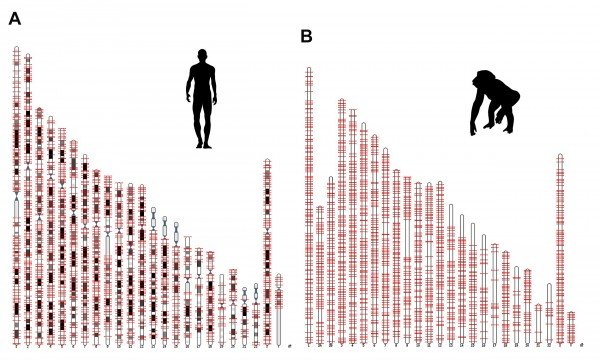
In a paper published October 22, 2015 in Cell, Salk scientists report finding human and chimp DNA peppered with sequences of genetic code they've dubbed ORF0, which spreads throughout the genome on jumping genes.
The ORF0 sequences may produce hundreds or even thousands of previously unknown proteins.
The abundance of ORF0 instances in the human genome suggests that it played--and still plays--an important role in evolutionary diversity and flexibility by serving as a mechanism for generating novel proteins. The discovery of these mobile protein factories may also shine light on the origins of genetic mutations responsible for cancer, mental disorders and other diseases.
"This discovery shows that jumping genes are an even more important source of variation in the primate genome than we thought, whether you're looking at the level of different species, different people or even the different cells within an individual's body," says Rusty Gage, senior author of the paper and a professor in Salk's Laboratory of Genetics.
With the sequencing of the human genome, it became clear that jumping genes--mobile genetic elements first discovered in maize by Barbara McClintock in the early 1950s--were also present and highly active during human evolution.
About half of the human genome resulted from sequences of genetic code that moved or insert extra copies of themselves throughout the genome.
The evolutionary importance of jumping genes was highlighted by the results of another recent study by Gage and collaborators at Stanford. The research used stem cell technologies developed in Gage's lab to explore how differences in gene expression contribute to human and chimp facial structure.
The findings, also reported in Cell, suggested that jumping genes played a role in the evolutionary split between humans and other primates.
In the more recent study that uncovered ORF0, Gage and his colleagues focused on a class of jumping genes known as LINE-1 elements, which make up about 17 percent of the human genome.
These elements contain all the necessary genetic machinery for moving themselves and other classes of jumping genes, unaided, to elsewhere in the genome.
Previously, it was thought that LINE-1 elements contain just two sequences that coded for proteins, the ultimate product of genes that serve a wide range of roles in our cells and organs.
These sequences are known as open reading frames (ORF), and the two previously known sequences, ORF1 and ORF2, are thought to be involved in producing proteins that are important for allowing LINE-1 elements to move around in the genome. In their new study, Gage and his colleagues discovered a third open reading frame. They named it ORF0 based on its location in the LINE-1 element next to ORF1. The scientists found ORF0 in about 3,500 locations in the DNA of humans and about 3,000 locations in the chimp and most other primate genomes.
The structure of LINE-1 elements is such that when an element moves to another site there is a possibility that the ORF0 sequence can blend with genetic sequences in new location in DNA. The result of the new gene sequences can be a new protein. Evolutionarily speaking, this represents a way to generate entirely new molecules that could be beneficial to a species. On the other hand, the reshuffling of an existing ORF0 sequence during a jump could result in a disease-causing mutation.
"This discovery redraws the blueprint of an important piece of genetic machinery in primates, adding a completely new gear," says Ahmet Denli, a staff scientist in Gage's lab and the first author on the paper reporting the findings.
"Jumping genes with ORF0 are basically protein factories with wheels, and over the eons evolution has been driving the bus."
Now that they have identified ORF0 in the primate genome, Denli says they plan to determine how many of the instances of ORF0 actually code for proteins and to investigate what function those proteins serve. The researchers also plan to investigate the behavior of ORF0 in different cell types and diseases. They are particularly interested in exploring its role in cancers and in neurological disorders such as schizophrenia, where previous studies have suggested jumping genes may be involved.
Source: Salk Institute [October 22,2015]

hidden in
human jumping genes
Breakingnews, Evolution, Genetics, Human Evolution
Scientists have discovered a previously unknown wellspring of genetic diversity in humans, chimps and most other primates.
This diversity arises from a new component of itinerant sections of genetic code known as jumping genes.
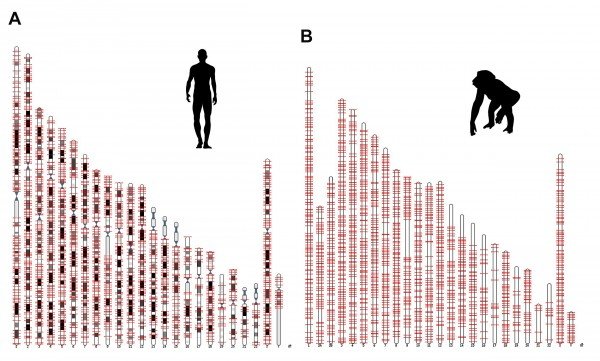
Salk researchers discovered a new genetic component, called ORF0, spread throughout the DNA of humans, chimps and most other primates. This image shows the locations of the ORFO on human and chimp chromosomes
[Credit: Salk Institute]
[Credit: Salk Institute]
In a paper published October 22, 2015 in Cell, Salk scientists report finding human and chimp DNA peppered with sequences of genetic code they've dubbed ORF0, which spreads throughout the genome on jumping genes.
The ORF0 sequences may produce hundreds or even thousands of previously unknown proteins.
The abundance of ORF0 instances in the human genome suggests that it played--and still plays--an important role in evolutionary diversity and flexibility by serving as a mechanism for generating novel proteins. The discovery of these mobile protein factories may also shine light on the origins of genetic mutations responsible for cancer, mental disorders and other diseases.
"This discovery shows that jumping genes are an even more important source of variation in the primate genome than we thought, whether you're looking at the level of different species, different people or even the different cells within an individual's body," says Rusty Gage, senior author of the paper and a professor in Salk's Laboratory of Genetics.
With the sequencing of the human genome, it became clear that jumping genes--mobile genetic elements first discovered in maize by Barbara McClintock in the early 1950s--were also present and highly active during human evolution.
About half of the human genome resulted from sequences of genetic code that moved or insert extra copies of themselves throughout the genome.
The evolutionary importance of jumping genes was highlighted by the results of another recent study by Gage and collaborators at Stanford. The research used stem cell technologies developed in Gage's lab to explore how differences in gene expression contribute to human and chimp facial structure.
The findings, also reported in Cell, suggested that jumping genes played a role in the evolutionary split between humans and other primates.
In the more recent study that uncovered ORF0, Gage and his colleagues focused on a class of jumping genes known as LINE-1 elements, which make up about 17 percent of the human genome.
These elements contain all the necessary genetic machinery for moving themselves and other classes of jumping genes, unaided, to elsewhere in the genome.
Previously, it was thought that LINE-1 elements contain just two sequences that coded for proteins, the ultimate product of genes that serve a wide range of roles in our cells and organs.
These sequences are known as open reading frames (ORF), and the two previously known sequences, ORF1 and ORF2, are thought to be involved in producing proteins that are important for allowing LINE-1 elements to move around in the genome. In their new study, Gage and his colleagues discovered a third open reading frame. They named it ORF0 based on its location in the LINE-1 element next to ORF1. The scientists found ORF0 in about 3,500 locations in the DNA of humans and about 3,000 locations in the chimp and most other primate genomes.
The structure of LINE-1 elements is such that when an element moves to another site there is a possibility that the ORF0 sequence can blend with genetic sequences in new location in DNA. The result of the new gene sequences can be a new protein. Evolutionarily speaking, this represents a way to generate entirely new molecules that could be beneficial to a species. On the other hand, the reshuffling of an existing ORF0 sequence during a jump could result in a disease-causing mutation.
"This discovery redraws the blueprint of an important piece of genetic machinery in primates, adding a completely new gear," says Ahmet Denli, a staff scientist in Gage's lab and the first author on the paper reporting the findings.
"Jumping genes with ORF0 are basically protein factories with wheels, and over the eons evolution has been driving the bus."
Now that they have identified ORF0 in the primate genome, Denli says they plan to determine how many of the instances of ORF0 actually code for proteins and to investigate what function those proteins serve. The researchers also plan to investigate the behavior of ORF0 in different cell types and diseases. They are particularly interested in exploring its role in cancers and in neurological disorders such as schizophrenia, where previous studies have suggested jumping genes may be involved.
Source: Salk Institute [October 22,2015]

sabato 24 ottobre 2015
Biounità costruttiva: la spirale del DNA è sempre la stessa
Tiny DNA building block
is identical
regardless of species
Breakingnews, Evolution, Genetics
The diameter of a single, cylindrical DNA component is always the same, regardless of whether it forms part of a fruit fly, a beech tree, or a human being. This tiny building block in the DNA architecture is part of what is known as the nucleosome. The diameter of the nucleosome has long been a source of fascination for Professor Jakob Bohr of DTU Nanotech at Technical University of Denmark. Because if it is the same in all species, what universal principle or law of nature is in effect?

"As a physicist, I attempt to find the answers to these questions in the worlds of mathematics and physics. And in these contexts, our calculations demonstrate that the size of the nucleosomes makes perfect sense. They create what we have chosen to call 'twist neutrality'," relates Jakob Bohr, who has been studying the diameter of the nucleosomes in partnership with his colleague, Kasper Olsen. "Twist neutrality ensures that the number of turns in the DNA material always remains constant, such that the smallest structure in DNA architecture -- the DNA helix -- can be stretched without affecting the number of twists. This property is essential in nature every time DNA material needs to be copied; in the case of cell division, for example. Briefly put, twist neutrality helps prevent the twists becoming entangled and damaging our DNA," he adds. The nucleosome is only a tiny part of the complex DNA architecture. In total, every single sell contains more than a metre of DNA, and to make room for so much material, the DNA is twisted and folded together over and over again. This leads to the creation of what can be perceived as different levels of structuring, and depending on how a level can actually be defined, eight such levels are created. "Each level alters the scale of our hereditary material by a factor of around three, in the same way as when you fold a piece of paper repeatedly, the thickness is increased by a factor of two every time. This compression of the DNA ensures that it is small enough to fit inside the nucleus of the cell," explains Jakob Bohr. The highest level of DNA comprises the chromosome structures, where the gender chromosomes -- X and Y -- are the best known. The bottom level, i.e. the tiniest structure in the DNA architecture, is the famous double helix, the eye-catching spiral of two strands of DNA winding around one another. The natural law of the twists At the level before this, the double helix is wound twice around a collection of proteins. This is the structure that is called a nucleosome. It takes a lot of nucleosomes to wind up the entire double helix, and this makes the structure resemble a string of pearls -- where the nucleosomes are the pearls and the double helix is the chain. The calculations performed by Jakob Bohr and his colleagues demonstrate that if the diameter of the nucleosomes were different, twist neutrality would simply not exist. "This would not be good, because it would mean that new, inappropriate structures could appear in the DNA. So we think that the reason why the size of the nucleosomes remains constant across species is that there is no benefit to nature in developing or changing this size. Otherwise, we would probably have encountered it as a stage in the evolutionary process," explains Jakob Bohr. New technology should help The long-term aim of the research into the diameter of the nucleosomes is to contribute to a complete description of the geometry of DNA. This could help reveal general principles for the construction of the chromosomes, which would enable us to understand them in even greater detail. "Because even though we can already mine down to gene level in the double helix -- the lowest level in the chromosome -- a number of the other eight levels are still largely uncharted territory. Simply put, we have no idea what structures exist on some of the other levels," adds Jakob Bohr. According to Jakob Bohr, researchers do not currently have access to technology with the capacity to clarify the structures completely at all levels of the chromosomes. However, he is sure that the technology required should appear over the coming 10-15 years, possibly as a result of other research into bioinformatics and via the new facilities including ESS and MAX IV in Lund. Author: Lotte Krull | Source: Technical University of Denmark [October 21, 2015]
is identical
regardless of species
Breakingnews, Evolution, Genetics
The diameter of a single, cylindrical DNA component is always the same, regardless of whether it forms part of a fruit fly, a beech tree, or a human being. This tiny building block in the DNA architecture is part of what is known as the nucleosome. The diameter of the nucleosome has long been a source of fascination for Professor Jakob Bohr of DTU Nanotech at Technical University of Denmark. Because if it is the same in all species, what universal principle or law of nature is in effect?

The illustration shows a very simplified, comic strip view of the organization of DNA. The organization serves to compress the over one-metre long DNA, so it can fit inside the cell nucleus. If you ‘read’ the figure backwards—i.e. from H to A—it corresponds to looking at a chromosome, then ‘zooming in’' step-by-step, so you finally end with the chromosome’s smallest structure—the DNA helix in Figure A.
Figure A The well-known double helix—the spiral with the two strands of DNA is the smallest structure in the chromosome. Here it is reproduced without the base pairs that connect the two strands and which cause the spiral to resemble a spiral ladder.
Figure B shows how the double helix is wound twice around a cylindrical core of proteins. This structure is called a nucleosome. It is the diameter of this structure which is the same across different species—and which fascinates Professor Jakob Bohr. The proportions in this figure do not correspond to the real world, where the DNA helix is equal in size to the protein core.
Figure C shows the row of nucleosomes, causing the structure to resemble a chain of pearls. Figure D-G illustrates the next levels, where the material DNA is further packaged. As yet, the geometry of these levels is not fully clarified.
Level H illustrates the contours of the chromosome as viewed under a microscope
[Credit: Technical University of Denmark]
Level H illustrates the contours of the chromosome as viewed under a microscope
[Credit: Technical University of Denmark]
"As a physicist, I attempt to find the answers to these questions in the worlds of mathematics and physics. And in these contexts, our calculations demonstrate that the size of the nucleosomes makes perfect sense. They create what we have chosen to call 'twist neutrality'," relates Jakob Bohr, who has been studying the diameter of the nucleosomes in partnership with his colleague, Kasper Olsen. "Twist neutrality ensures that the number of turns in the DNA material always remains constant, such that the smallest structure in DNA architecture -- the DNA helix -- can be stretched without affecting the number of twists. This property is essential in nature every time DNA material needs to be copied; in the case of cell division, for example. Briefly put, twist neutrality helps prevent the twists becoming entangled and damaging our DNA," he adds. The nucleosome is only a tiny part of the complex DNA architecture. In total, every single sell contains more than a metre of DNA, and to make room for so much material, the DNA is twisted and folded together over and over again. This leads to the creation of what can be perceived as different levels of structuring, and depending on how a level can actually be defined, eight such levels are created. "Each level alters the scale of our hereditary material by a factor of around three, in the same way as when you fold a piece of paper repeatedly, the thickness is increased by a factor of two every time. This compression of the DNA ensures that it is small enough to fit inside the nucleus of the cell," explains Jakob Bohr. The highest level of DNA comprises the chromosome structures, where the gender chromosomes -- X and Y -- are the best known. The bottom level, i.e. the tiniest structure in the DNA architecture, is the famous double helix, the eye-catching spiral of two strands of DNA winding around one another. The natural law of the twists At the level before this, the double helix is wound twice around a collection of proteins. This is the structure that is called a nucleosome. It takes a lot of nucleosomes to wind up the entire double helix, and this makes the structure resemble a string of pearls -- where the nucleosomes are the pearls and the double helix is the chain. The calculations performed by Jakob Bohr and his colleagues demonstrate that if the diameter of the nucleosomes were different, twist neutrality would simply not exist. "This would not be good, because it would mean that new, inappropriate structures could appear in the DNA. So we think that the reason why the size of the nucleosomes remains constant across species is that there is no benefit to nature in developing or changing this size. Otherwise, we would probably have encountered it as a stage in the evolutionary process," explains Jakob Bohr. New technology should help The long-term aim of the research into the diameter of the nucleosomes is to contribute to a complete description of the geometry of DNA. This could help reveal general principles for the construction of the chromosomes, which would enable us to understand them in even greater detail. "Because even though we can already mine down to gene level in the double helix -- the lowest level in the chromosome -- a number of the other eight levels are still largely uncharted territory. Simply put, we have no idea what structures exist on some of the other levels," adds Jakob Bohr. According to Jakob Bohr, researchers do not currently have access to technology with the capacity to clarify the structures completely at all levels of the chromosomes. However, he is sure that the technology required should appear over the coming 10-15 years, possibly as a result of other research into bioinformatics and via the new facilities including ESS and MAX IV in Lund. Author: Lotte Krull | Source: Technical University of Denmark [October 21, 2015]
mercoledì 14 ottobre 2015
Clonabile il Mammut lanoso?
Arctic expedition finds
woolly mammoth remains
ripe for cloning
Breakingnews, Early Mammals, Fossils, Genetics, Palaeontology, Russia
Russian scientists undertaking an exploratory expedition on the Lyakhovsky Islands have discovered woolly mammoth remains including skin and tusk, which they believe suitable for obtaining the DNA necessary to clone the animal.

An international expedition to the Lyakhovsky Islands led by scientists from Russia's North-Eastern Federal University in Yakutsk has discovered six specimens of woolly
mammoth fossils suitable for extracting DNA.
"The Lyakhovsky Islands are considered the mammoth continent," explained Semyon Grigorev, leader of the expedition to the islands and director of the Mammoth Museum at Russia's North-Eastern Federal University in Yakutsk. "The largest concentration of remains in the world is here, so that's why we chose this area to carry out our studies," Grigorev told a press conference on Wednesday.
"To start with, together with archeologists we carried out a dig at the most northern site where ancient man lived, not far from the village of Kazachye where we found an enormous amount of mammoth bones, and also ancient tools," said Grigorev of the expedition, which took place over two stages from August 11 to September 29.

"Then, after waiting a long time for the right weather conditions, we continued to the main target of our expedition, Great Lyakhovsky Island, where we found a great amount of unique remains," which includes ancient mammoth skin and teeth.
"Take, for example, the tusk of a pygmy mammoth that we found. We calculate that the animal was no more than two meters tall, so now we have to work out what this was – a micropopulation, or the peculiarity of this single individual."
"Skin is the most interesting for us, for our project 'The Mammoth Rebirth' because our Korean colleagues consider skin to be the best material for an attempt at cloning via the extraction of viable cells."
The 'Northern Ecumene' expedition of 16 researchers from six different countries was made possible thanks to a grant of two million rubles provided by the Russian Geographical Society.
"We consider the expedition a success; after all, out of what seems to be these kinds of small expeditions, great scientific discoveries can be made," said Grigorev, whose team is now joining forces with Korean researchers to analyze the mammoth remains for cells viable for cloning.
Source: Sputnik News [October 09, 2015]
woolly mammoth remains
ripe for cloning
Breakingnews, Early Mammals, Fossils, Genetics, Palaeontology, Russia
Russian scientists undertaking an exploratory expedition on the Lyakhovsky Islands have discovered woolly mammoth remains including skin and tusk, which they believe suitable for obtaining the DNA necessary to clone the animal.

The mammoth expedition led by scientists from Russia's North-Eastern Federal University in Yakutsk, and funded by the Russian Geographical Society
[Credit: ©: gazetayakutia.ru]
An international expedition to the Lyakhovsky Islands led by scientists from Russia's North-Eastern Federal University in Yakutsk has discovered six specimens of woolly
mammoth fossils suitable for extracting DNA.
"The Lyakhovsky Islands are considered the mammoth continent," explained Semyon Grigorev, leader of the expedition to the islands and director of the Mammoth Museum at Russia's North-Eastern Federal University in Yakutsk. "The largest concentration of remains in the world is here, so that's why we chose this area to carry out our studies," Grigorev told a press conference on Wednesday.
"To start with, together with archeologists we carried out a dig at the most northern site where ancient man lived, not far from the village of Kazachye where we found an enormous amount of mammoth bones, and also ancient tools," said Grigorev of the expedition, which took place over two stages from August 11 to September 29.

The discovery is seen as highly significant by Russian and South Korean experts working to bring the mammoths back to life through cloning
[Credit: NVK]
"Then, after waiting a long time for the right weather conditions, we continued to the main target of our expedition, Great Lyakhovsky Island, where we found a great amount of unique remains," which includes ancient mammoth skin and teeth.
"Take, for example, the tusk of a pygmy mammoth that we found. We calculate that the animal was no more than two meters tall, so now we have to work out what this was – a micropopulation, or the peculiarity of this single individual."
"Skin is the most interesting for us, for our project 'The Mammoth Rebirth' because our Korean colleagues consider skin to be the best material for an attempt at cloning via the extraction of viable cells."
The 'Northern Ecumene' expedition of 16 researchers from six different countries was made possible thanks to a grant of two million rubles provided by the Russian Geographical Society.
"We consider the expedition a success; after all, out of what seems to be these kinds of small expeditions, great scientific discoveries can be made," said Grigorev, whose team is now joining forces with Korean researchers to analyze the mammoth remains for cells viable for cloning.
Source: Sputnik News [October 09, 2015]
Culinaria a Durrington Walls
The culinary habits
ArchaeoHeritage, Archaeology, Breakingnews, Europe, UK, Western Europe
A team of archaeologists at the University of York have revealed new insights into cuisine choices and eating habits at Durrington Walls -- a Late Neolithic monument and settlement site thought to be the residence for the builders of nearby Stonehenge during the 25th century BC.

Together with researchers at the University of Sheffield, detailed analysis of pottery and animal bones has uncovered evidence of organised feasts featuring barbeque-style roasting, and an unexpected pattern in how foods were distributed and shared across the site.
Chemically analysing food residues remaining on several hundred fragments of pottery, the York team found differences in the way pots were used. Pots deposited in residential areas were found to be used for cooking animal products including pork, beef and dairy, whereas pottery from the ceremonial spaces was used predominantly for dairy. Such spatial patterning could mean that milk, yoghurts and cheeses were perceived as fairly exclusive foods only consumed by a select few, or that milk products -- today often regarded as a symbol of purity -- were used in public ceremonies.
Unusually, there was very little evidence of plant food preparation at any part of the site. The main evidence points to mass animal consumption, particularly of pigs. Further analysis of animal bones, conducted at the University of Sheffield, found that many pigs were killed before reaching their maximum weight.
This is strong evidence of planned autumn and winter slaughtering and feasting-like consumption. The main methods of cooking meat are thought to be boiling and roasting in pots probably around indoor hearths, and larger barbeque-style roasting outdoors -- the latter evidenced by distinctive burn patterns on animal bones.

Bones from all parts of the animal skeleton were found, indicating that livestock was walked to the site rather than introduced as joints of meat.
Isotopic analysis indicates that cattle originated from many different locations, some far away from the site. This is significant as it would require orchestration of a large number of volunteers likely drawn from far and wide.
The observed patterns of feasting do not fit with a slave-based society where labour was forced and coerced, as some have suggested.
Dr Oliver Craig, Reader in Archaeological Science at the University of York and lead author on the paper, said: "Evidence of food-sharing and activity-zoning at Durrington Walls shows a greater degree of culinary organisation than was expected for this period of British prehistory. The inhabitants and many visitors to this site possessed a shared understanding of how foods should be prepared, consumed and disposed. This, together with evidence of feasting, suggests Durrington Walls was a well-organised working community."
Professor Mike Parker Pearson, Professor at University College London and Director of the Feeding Stonehenge project who also led the excavations at Durrington Walls, said: "This new research has given us a fantastic insight into the organisation of large-scale feasting among the people who built Stonehenge. Animals were brought from all over Britain to be barbecued and cooked in open-air mass gatherings and also to be eaten in more privately organized meals within the many houses at Durrington Walls. The special placing of milk pots at the larger ceremonial buildings reveals that certain products had a ritual significance beyond that of nutrition alone. The sharing of food had religious as well as social connotations for promoting unity among Britain's scattered farming communities in prehistory. "
Dr Lisa-Marie Shillito, who analysed the pottery samples and recently joined Newcastle University, added: "The combination of pottery analysis with the study of animal bones is really effective, and shows how these different types of evidence can be brought together to provide a detailed picture of food and cuisine in the past."
The study has been published in the Antiquity Journal.
Source: University of York [October 12, 2015]
of the
Stonehenge builders
ArchaeoHeritage, Archaeology, Breakingnews, Europe, UK, Western Europe
A team of archaeologists at the University of York have revealed new insights into cuisine choices and eating habits at Durrington Walls -- a Late Neolithic monument and settlement site thought to be the residence for the builders of nearby Stonehenge during the 25th century BC.

Stonehenge
[Credit: WikiCommons]
Together with researchers at the University of Sheffield, detailed analysis of pottery and animal bones has uncovered evidence of organised feasts featuring barbeque-style roasting, and an unexpected pattern in how foods were distributed and shared across the site.
Chemically analysing food residues remaining on several hundred fragments of pottery, the York team found differences in the way pots were used. Pots deposited in residential areas were found to be used for cooking animal products including pork, beef and dairy, whereas pottery from the ceremonial spaces was used predominantly for dairy. Such spatial patterning could mean that milk, yoghurts and cheeses were perceived as fairly exclusive foods only consumed by a select few, or that milk products -- today often regarded as a symbol of purity -- were used in public ceremonies.
Unusually, there was very little evidence of plant food preparation at any part of the site. The main evidence points to mass animal consumption, particularly of pigs. Further analysis of animal bones, conducted at the University of Sheffield, found that many pigs were killed before reaching their maximum weight.
This is strong evidence of planned autumn and winter slaughtering and feasting-like consumption. The main methods of cooking meat are thought to be boiling and roasting in pots probably around indoor hearths, and larger barbeque-style roasting outdoors -- the latter evidenced by distinctive burn patterns on animal bones.

A reconstruction drawing of how the prehistoric village of Durrington Walls might have looked in 2500BC
[Credit: English Heritage]
Bones from all parts of the animal skeleton were found, indicating that livestock was walked to the site rather than introduced as joints of meat.
Isotopic analysis indicates that cattle originated from many different locations, some far away from the site. This is significant as it would require orchestration of a large number of volunteers likely drawn from far and wide.
The observed patterns of feasting do not fit with a slave-based society where labour was forced and coerced, as some have suggested.
Dr Oliver Craig, Reader in Archaeological Science at the University of York and lead author on the paper, said: "Evidence of food-sharing and activity-zoning at Durrington Walls shows a greater degree of culinary organisation than was expected for this period of British prehistory. The inhabitants and many visitors to this site possessed a shared understanding of how foods should be prepared, consumed and disposed. This, together with evidence of feasting, suggests Durrington Walls was a well-organised working community."
Professor Mike Parker Pearson, Professor at University College London and Director of the Feeding Stonehenge project who also led the excavations at Durrington Walls, said: "This new research has given us a fantastic insight into the organisation of large-scale feasting among the people who built Stonehenge. Animals were brought from all over Britain to be barbecued and cooked in open-air mass gatherings and also to be eaten in more privately organized meals within the many houses at Durrington Walls. The special placing of milk pots at the larger ceremonial buildings reveals that certain products had a ritual significance beyond that of nutrition alone. The sharing of food had religious as well as social connotations for promoting unity among Britain's scattered farming communities in prehistory. "
Dr Lisa-Marie Shillito, who analysed the pottery samples and recently joined Newcastle University, added: "The combination of pottery analysis with the study of animal bones is really effective, and shows how these different types of evidence can be brought together to provide a detailed picture of food and cuisine in the past."
The study has been published in the Antiquity Journal.
Source: University of York [October 12, 2015]
Iscriviti a:
Post (Atom)