Visualizzazione post con etichetta cipro. Mostra tutti i post

martedì 3 marzo 2015

Rappresentazione Vs Manifattura

Un articoletto quasi insignificante, circa gli OX-Hide Ingots (lingotti a pelle di bue). 

Mi preme al proposito sottolineare due cose:

1) La rappresentazione 'svedese' (interpretata ipoteticamente, ma credibilmente come un lingotto a pelle di bue) non sembra proprio autorizzare nessuno a sostenere che tale lingotto fosse fatto in Scandinavia da antichi eroi guerrieri locali. La paternità del lingotto è quindi correttamente lasciata a Cipro. La rappresentazione autorizza, logicamente, solamente l'ipotesi di viaggi commerciali dei nativi fino al Mediterraneo: il massimo dell'audacia spinge solo ad ipotizzare che non ci fossero intermediari... Non ci vuole molto: bastano logica e misura.

2) L'articolo è inoltre firmato da accademici scandinavi e da ricercatori indipendenti inglesi: che non sono ciarlatani e quindi la loro partecipazione è bene accolta dalla cosiddetta "Accademia". Anche qui, non ci vuole molto: bastano professionalità ed onestà.

Ma si sa: gli svedesi e gli inglesi sono molto più freddi...

Chissà come reagirebbero se qualcuno gli spiegasse finalmente che in realtà il viaggio era compiuto non per terra, bensì per mare, dagli invincibili Sciardana...

Antiquity / Volume 89 / Issue 343 / February 2015, pp 191-209 

Representations of oxhide ingots in Scandinavian rock art: the sketchbook of a Bronze Age traveller?

Johan Linga1 and Zofia Stos-Galea2

a1 Archaeology, Department of Historical Studies, University of Gothenburg, Box 200, SE-405 30 Göteborg, Sweden
a2 Independent researcher, Ifold, West Sussex, United Kingdom


Abstract
Bronze Age trade networks across Europe and the Mediterranean are well documented; Baltic amber and bronze metalwork were particularly valued commodities. Here it is argued that demand for copper and tin led to changes in Scandinavian trade routes around 1600 BC, which can be linked to the appearance of figurative rock art images in southern Scandinavia. Images identified as oxhide ingots have been discovered in Sweden and suggest that people from Scandinavia were familiar with this characteristically Mediterranean trading commodity. Using trace element and lead isotope analysis, the authors argue that some bronze tools excavated in Sweden could have been made of Cypriot copper; these two discoveries suggest that Scandinavians were travelling to the Mediterranean, rather than acting through a middle man.
Keywords:
  • Sweden; 
  • Cyprus; 
  • Bronze Age; 
  • oxhide ingots; 
  • rock art; 
  • trade networks; 
  • amber; 
  • lead isotopes

mercoledì 7 gennaio 2015

PALINDROMO ANTICO, CIPRO.

Per fortuna l'amuleto protettore non è stato rinvenuto in Sardegna, viene da dire con sollievo, perché così può essere correttamente attribuito all'epoca cui appartiene, cioé il V secolo.
E' stato rinvenuto nel 2011 a Paphos (Cipro) e contiene una frase palindroma (= che può essere letta indifferentemente da destra o da sinistra), lunga 59 lettere.
Con i suoi serpentelli, i cinocefali e soprattutto con quell'accenno a Yahweh, in Sardegna sarebbe stato certamente Nuragico/Shardana e del 2.000 a.C.
Siamo stati fortunati?
Chissà: forse qualcuno riuscirà a dire egualmente che i Shardana ne sono stati gli artefici e che gli archeologi - nella loro ben nota pervicacia oscurantista/negazionista - ce lo tengono nascosto...


Amulet with palindrome inscription found in Cyprus 


 An ancient, two-sided amulet uncovered in Cyprus contains a 59-letter inscription that reads the same backwards as it does forwards. 


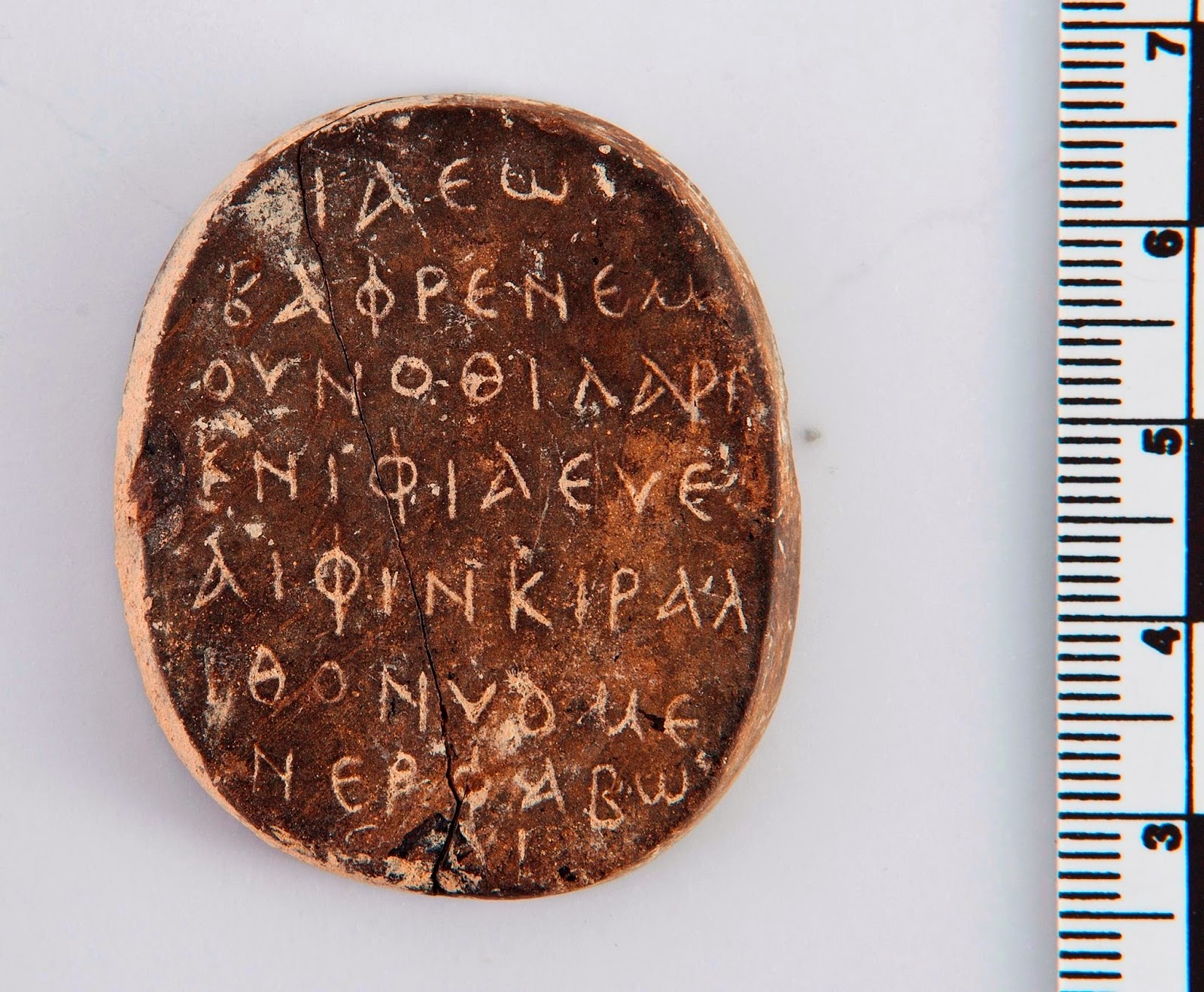
The amulet contains a Greek inscription, 59 letters long, which reads the same  backwards as it does forwards, a feature known as a palindrome. The three letters  at the very bottom, ΕΑΙ, were squeezed in and are hard to read. The amulet is  about 1.4 inches by 1.6 inches (34.9 millimeters by 41.2 millimeters) in size. The inscription translates as “Iahweh is the bearer of the secret name, the lion  of Re secure in his shrine.” Although the translation doesn’t read as a palindrome,  the original ancient Greek text does 
[Credit: Marcin Iwan/Jagiellonian  University, Krakow/ Paphos Agora]


 Archaeologists discovered the amulet, which is roughly 1,500 years old, at the ancient city of Nea Paphos in southwest Cyprus. 
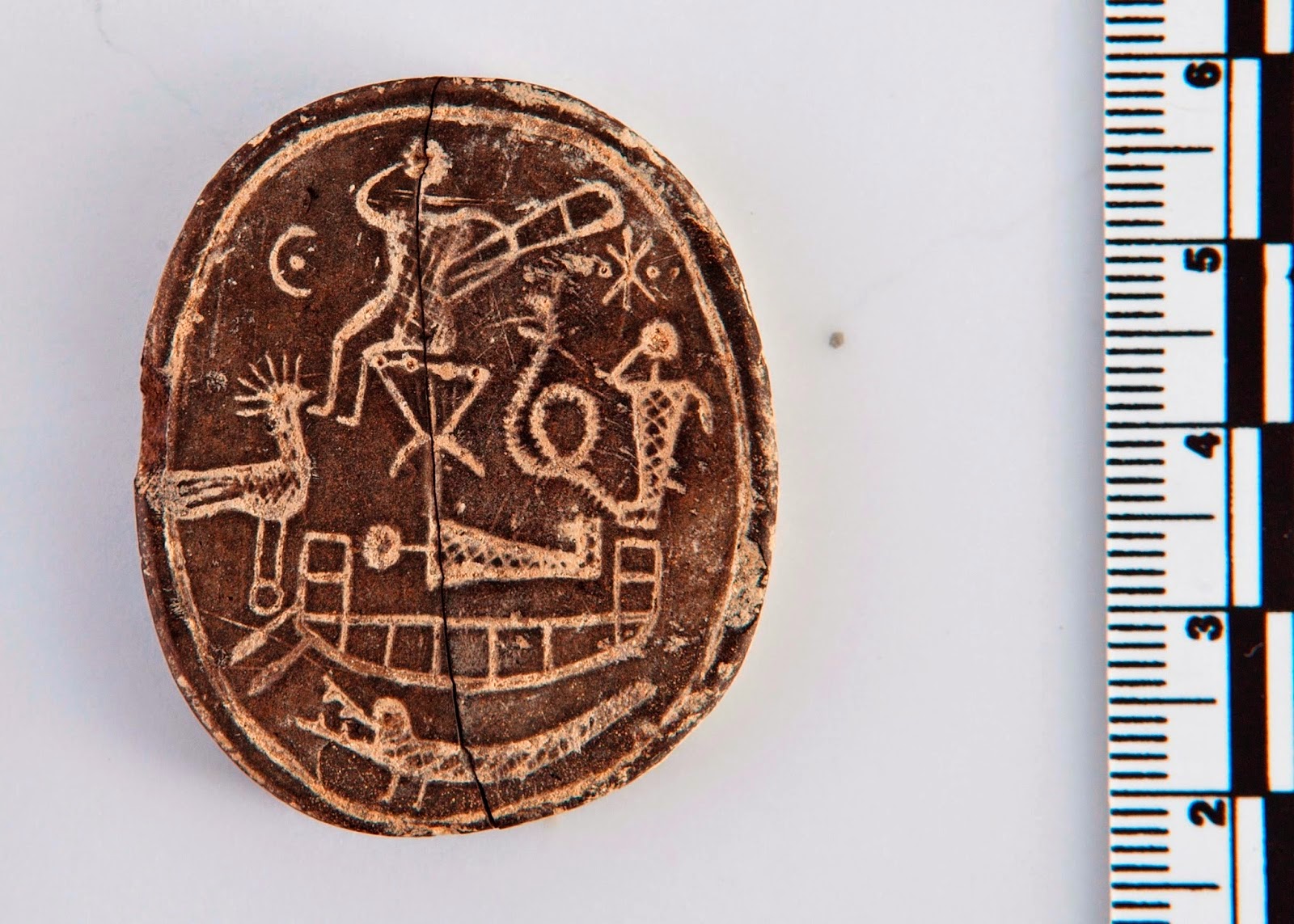
One side of the amulet has several images, including a bandaged mummy (likely representing the Egyptian god Osiris) lying on a boat and an image of Harpocrates, the god of silence, who is shown sitting on a stool while holding his right hand up to his lips. 
Strangely, the amulet also displays a mythical dog-headed creature called a cynocephalus, which is shown holding a paw up to its lips, as if mimicking Harpocrates' gesture. 
On the other side of the amulet is an inscription, written in Greek, that reads the same backwards as it does forwards, making it a palindrome. 
It reads: 

ΙΑΕW

ΒΑΦΡΕΝΕΜ

ΟΥΝΟΘΙΛΑΡΙ

ΚΝΙΦΙΑΕΥΕ 

ΑΙΦΙΝΚΙΡΑΛ

ΙΘΟΝΥΟΜΕ

ΝΕΡΦΑΒW

ΕΑΙ 


This translates to "Iahweh(a god) is the bearer of the secret name, the lion of Re secure in his shrine." 
Researchers have found similar palindromes elsewhere in the ancient world writes Joachim Śliwa, a professor at the Institute of Archaeology at Jagiellonian University in Kraków, Poland, in an article recently published in the journal Studies in Ancient Art and Civilization. Śliwa notes that the scribe made two small mistakes when writing this palindrome, in two instances writing a "ρ" instead of "v." 
The amulet was discovered in the summer of 2011 by archaeologists with the Paphos Agora Project. 
Led by Jagiellonian University professor Ewdoksia Papuci-Wladyka, this team is excavating an ancient agora at Nea Paphos, and uncovered this amulet during their work. 
Agoras served as gathering places in the ancient world. 
Amulets like the one found at Nea Paphos were made to protect their owners from danger and harm, Papuci-Wladyka told Live Science in an email. 

Christians and pagans 

During the 5th and 6th centuries, Cyprus was part of the Eastern Roman Empire. 
The Roman Empire had split in two during the 4th century, with Cyprus falling under control of the east. 
When the Western Roman Empire fell during the 5th century, the Eastern Roman Empire continued to flourish and became what is sometimes called the Byzantine Empire. 


The amulet has several images. 
At the bottom, there is a mummy (likely the Egyptian  god Osiris) wrapped in bandages, lying on a boat. Above the mummy, there is an  image of Harpocrates, a god of silence, shown sitting on a stool. Harpocrates’ right  hand is raised up to his lips and there is a scepter in his left hand. To the right  of Harpocrates there is a dog-headed creature called a cynocephalus that has  a paw beside its lips, mimicking Harpocrates gesture. 
There is a snake between  the cynocephalus and Harpocrates, the snake’s head facing Harpocrates. There  are also depictions of a crocodile, bird (likely a rooster), half moon and a star  
[Credit: Marcin Iwan/Jagiellonian University, Krakow/ Paphos Agora] 


By the 5th century, Christianity was the official religion of the Eastern Roman Empire, and as time went on, traditional polytheistic (also called pagan) practices came under tighter restrictions and bans. 
Nevertheless, some people continued to practice the old beliefs, worshipping the traditional gods. 
This amulet adds to evidence that people practiced traditional, polytheistic beliefs on Cyprus for an extended time, Papuci-Wladyka said. 
She notes that a structure called the Villa of Theseus has a mosaic with pagan elements that was likely repaired as late as the 7th century A.D. 
It "rather seems that Christian and pagan religions coexisted in Paphos in times of [the] amulet being in use," Papuci-Wladyka told Live Science in an email. 
Strange iconography Despite that coexistence, the amulet has several unusual features that suggest its creator didn't fully understand the mythological characters depicted. "It must be stated that the depiction is fairly unskilled and schematic. It is iconographically based on Egyptian sources, but these sources were not fully understood by the creator of the amulet," Śliwa wrote in the journal article. 
For instance, rather than sitting on a stool, Harpocrates should be sitting on a lotus flower, with legs drawn up, Śliwa said. 
Additionally, the dog-headed cynocephalus should not be mimicking Harpocrates. In "the classic version, the cynocephalus faces Harpocrates with paws raised in adoration," Śliwa wrote.
"We can find no justification for the cynocephalus's gesture of raising its right paw to its lips in a manner similar to Harpocrates."
 Even stranger is the fact that Harpocrates and the cynocephalus have crisscrossing lines on their bodies, which suggest the ancient artist thought these figures should be mummified along with Osiris. 
While the cynocephalus can be shown with mummy bandages, Harpocrates is not supposed to have them. 
Mummy bandages have "no justification in the case of Harpocrates," Śliwa wrote. 

Author: Owen Jarus | 

Source: LiveScience [January 01, 2015] 

sabato 25 gennaio 2014

Europei in Giordania

Si fa presto a dire: "Europei" (tutto sta a capire bene che cosa s'intende: europei erano anche i Greci, i Cretesi ed i Ciprioti, oltre agli abitanti dell'Europa Sud Orientale). Specialmente quando consideri che stai dando la definizione dal Medio Oriente, che è già Asia, a rigore, come l'attuale Turchia... 
Comunque: posto questo articolo, che - come si può leggere - parla di "cosiddetti Popoli del Mare", li identifica con i Palestinesi, li definisce emigrati, li descrive come coesistenti (in questo caso archeologico) con alcuni locali,  e ne attribuisce l'origine all'Europa Orientale Meridionale: più precisamente a Cipro ed alla Grecia, basandosi sull'evidenza dei reperti archeologici rinvenuti (vasellame e pesi di telaio).

EVIDENCE OF EUROPEAN SEA PEOPLES IN JORDAN VALLEY
Article created on Friday, January 24, 2014

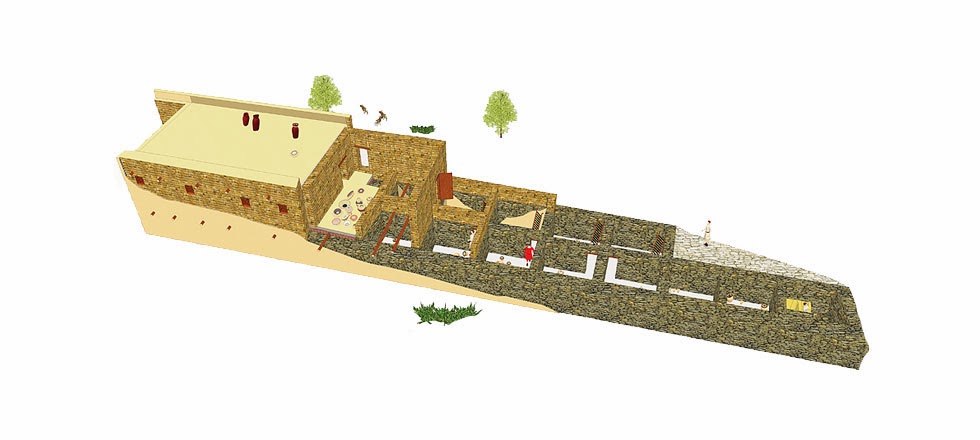
Swedish archaeologists in Jordan led by Professor Peter M. Fischer from the University of Gothenburg have excavated a nearly 60-metre long well-preserved building from 1100 B.C. in the ancient settlement Tell Abu al-Kharaz. The building is from an era characterised by major migration.


New finds support the theory that groups of the so-called Sea Peoples emigrated to Tell Abu al-Kharaz. They derive from Southern or Eastern Europe and settled in the Eastern Mediterranean region all the way to the Jordan Valley.

Pottery from one of the rooms from 1100 B.C. Image: University of Gothenburg


Sea Peoples of European descent
‘We have evidence that culture from present Europe is represented in Tell Abu al-Kharaz. A group of the Sea Peoples of European descent, Philistines, settled down in the city,’ says Peter Fischer.
‘We have, for instance, found pottery resembling corresponding items from Greece and Cyprus in terms of form and decoration, and also cylindrical loom weights for textile production that could be found in central and south-east Europe around the same time.’
Tell Abu al-Kharaz is located in the Jordan Valley close to the border to Israel and the West Bank. It most likely corresponds to the biblical city of Jabesh Gilead. The Swedish Jordan Expedition has explored the city, which was founded in 3200 B.C. and lasted for almost 5 000 years. The first excavation took place in 1989 and the most recent in autumn 2013. All in all, 16 excavations have been completed.

Flourished three times
Peter M. Fischer and his team of archaeologists and students have surveyed an urban settlement that flourished three times over the 5 000 years: around 3100–2900 B.C. (Early Bronze Age), 1600–1300 B.C. (Late Bronze Age) and 1100–700 B.C. (Iron Age). These are the local periods; in Sweden, they occurred much later.
Remarkably well-preserved stone structures have been exposed during the excavations. The finds include defensive walls, buildings and thousands of complete objects produced locally or imported from south-east Europe.
‘What surprises me the most is that we have found so many objects from far away. This shows that people were very mobile already thousands of years ago,’ says Fischer.

Door opening between two rooms (1100 B.C.). Image: University of Gothenburg


The scientists have made several sensational finds in the last three years, especially during the excavation of the building from 1100 B.C. where containers still filled with various seeds were found. There are also finds from Middle Egypt that were exported to Tell Abu al-Kharaz as early as 3100 B.C.

60-metre long building
The exploration of the 60-metre long building discovered in 2010 continued during the most recent excavation. It was originally built in two levels of which the bottom level is still standing with walls reaching 2.5 metres in height after more than 3 000 years.
The archaeologists found evidence indicating that the Philistines who lived in the building together with local people around 1100 B.C. utilised a defence structure from 3 000 B.C. in the form of an old city wall by constructing their building on top of it. In this way, they had both easy access to building material and a solid surface to build on.
‘One of our conclusions after the excavation is that ”Jordanian culture” is clearly a Mediterranean culture even though the country does not border the Mediterranean Sea. There were well-organised societies in the area long before the Egyptian pyramids were built,’ says Peter M. Fischer.

Source: University of Gothenburg

More Information

Cite this article