Visualizzazione post con etichetta Tunisia. Mostra tutti i post

martedì 4 febbraio 2014

"PlayBoy" di Cartagine.

Scoperto per caso nel 1994, mentre stava trapiantando un albero, proprio dal curatore del Museo di Tunisi, Arish ('il molto amato') - come risulta essere il suo nome dalle iscrizioni puniche - è stato 'ricostruito' con moderne tecniche di medicina forense.
Il giovane Cartaginese aveva dai 19 ai 24 anni, era alto 1,70 cm, aveva una fronte ampia, orbite alte ed era dolicocefalo (cioé aveva un cranio allungato). Un bel ragazzo.
La ricostruzione sarà in mostra a febbraio nel Libano, cioé proprio nella probabile terra d'origine del giovane cartaginese: ma i suoi resti ossei - causa complicazioni burocratiche circa il trasporto internazionale di resti umani - dovranno restare in Tunisia.


Phoenician man of Carthage 

returns to land of ancestors 

through AUB museum exhibit 


The AUB Archaeological Museum opened a special exhibition on January 29, 2014, showcasing a reconstruction of a Phoenician man, whose 2500-year-old skeleton was discovered in Tunis, in 1994.


Reconstructed prototype of a young Phoenician man of Byrsa (Carthage), based on a 2500-year-old skeleton discovered in Tunis in 1994. Prototype is on loan from the National Museum of Carthage [Credit:Reuters/Jamal Saidi] 


The reconstruction uses criminal investigation techniques and dermoplasty, a procedure that relies on skin grafts to recreate molds, to produce an impressive, life-like prototype of a Phoenician man, which was accomplished by Elisabeth Daynes, a French dermoplastic sculptor and specialist. Estimated to be between 19 and 24 years old at time of death, the young man of Carthage was about 170 centimeters tall, and bore physical features that have come to be associated with Phoenicians – a broad forehead, high orbits and long skull. 
The reconstruction is considered to be 95 percent accurate, since the color of eyes, hair, and skin could not be verified through criminal investigation techniques. He was named Arish, or “the beloved one,” according to Punic inscriptions. The skeleton used to remodel the 2,500-year-old man from Byrsa, rebaptised Ariche -- meaning the desired man --, is seen during an exhibition at the American University of Beirut on January 30, 2014. Ariche has regained an almost living human appearance very close in physiognomy to a Carthaginian of the 6th century B.C. after a dermoplastic reconstruction undertaken in Paris by Elisabeth Daynes, a sculptor specialising in hyper-realistic reconstructions. 


Repatriated to Tunisia on September 24, 2010, Ariche is now on show in Lebanon, the land of the Phoenicians who founded Carthage [Credit: AFP/Joseph Eid] 


As is often the case with archaeological finds, his skeleton was discovered by mistake, when the curator of the Tunis National Museum, Abedelmagid Ennable, was trying to plant a tree back in 1994, and while digging, he uncovered a tomb, where Arish was buried. 

According to legend, Elissa the daughter of the king of Tyre, founded Carthage around 814 B.C. With time Tyre’s colony became an important economic and commercial power in the Mediterranean. “When I found out about Arish during an international museum meeting in Paris, I was thrilled and eager to invite him to the AUB museum and the land of his ancestors,” said Leila Badre, museum director. “This is the first time we import an exhibition.” 
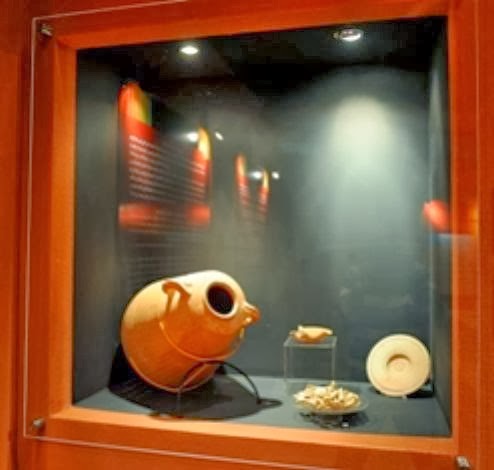

Arish, along with some items discovered in the tomb (including a jar), will be on display at the AUB Museum, in an exhibition entitled “The Young Phoenician Man of Carthage” [Credit: AUB Archaeological Museum] 


While the recreated man was brought to AUB, it was not possible to ship his skeleton, due to the difficulty of transporting human bones across countries. Instead, the museum decided to show one of the skeletons in its own collection. Arish, along with some items discovered in the tomb, will be on display at the AUB Museum, in an exhibition entitled “The Young Phoenician Man of Carthage,” organized by the Society of the Friends of the AUB Museum in collaboration with the National Museum of Carthage. The exhibition will run from January 29 to February 26, 2014. Opening hours are Monday to Friday 9:00 am to 5:00 pm. Exceptionally, the museum will also open on weekends between 11:00 am and 5:00 pm. For more information, please call 01-340 549. 

Source: The AUB Archaeological Museum [January 29, 2014]

Read more at: http://archaeologynewsnetwork.blogspot.it/2014/02/phoenician-man-of-carthage-returns-to.html?utm_source=feedburner&utm_medium=feed&utm_campaign=Feed:+TheArchaeologyNewsNetwork+(The+Archaeology+News+Network)#.UvEM7It0svo
Follow us: @ArchaeoNewsNet on Twitter | groups/thearchaeologynewsnetwork/ on Facebook

mercoledì 22 gennaio 2014

Il 'RITO del MOLK' nel 'Tophet' Cartaginese esisteva davvero.


Carthaginians sacrificed their own children, 

archaeologists say 


Just as ancient Greek and Roman propagandists insisted, the Carthaginians did kill their own infant children, burying them with sacrificed animals and ritual inscriptions in special cemeteries to give thanks for favours from the gods, according to a new study. 


A tophet outside Carthage, a special part of a cemetery dedicated to the burial of infants, according to Josephine Quinn [Credit: Josephine Quinn] 


"This is something dismissed as black propaganda because in modern times people just didn't want to believe it," said Josephine Quinn, a lecturer in ancient history at Oxford, who is behind the study, with international colleagues, of one of the most bitterly debated questions in classical archaeology. "But when you pull together all the evidence – archaeological, epigraphic and literary – it is overwhelming and, we believe, conclusive: they did kill their children, and on the evidence of the inscriptions, not just as an offering for future favours but fulfilling a promise that had already been made. "This was not a common event, and it must have been among an elite because cremation was very expensive, and so was the ritual of burial. It may even have been seen as a philanthropic act for the good of the whole community." Argument has raged on the subject since cemeteries known as tophets – after the biblical account of a place of sacrifice – were excavated in the early 20th century on the outskirts of Carthage in modern Tunisia, and then at other Carthaginian sites in Sicily and Sardinia. The graves held tiny cremated bones carefully packed into urns, buried under tombstones giving thanks to the gods. One has a carving which has been interpreted as a priest carrying the body of a small child. Some archaeologists and historians saw the finds as proving ancient accounts of child sacrifice; others insisted they showed tender respect for cherished children who died before or soon after birth. Quinn and her colleagues, a group of Punic archaeologists and historians from Italy and the Netherlands, who publish their findings in the journal Antiquity – where the argument has been rumbling on for several years – completely reject the latter theory. "The inscriptions are unequivocal: time and again we find the explanation that the gods 'heard my voice and blessed me'. It cannot be that so many children conveniently happened to die at just the right time to become an offering – and in any case a poorly or dead child would make a pretty feeble offering if you're already worried about the gods rejecting it." "Then there is the fact that the animals from the sites, which were beyond question sacrificial offerings, are buried in exactly the same way, sometimes in the same urns with the bones of the children." Although hundreds of remains were found, there were far too few to represent all the stillbirth and infant deaths of Carthage. According to Quinn, there were perhaps 25 such burials a year, for a city of perhaps 500,000 people. The Roman historian Diodorus and other ancient historians gave graphic accounts of Carthaginian child sacrifice: "There was in their city a bronze image of Cronus, extending its hands, palms up and sloping towards the ground, so that each of the children when placed thereon rolled down and fell into a sort of gaping pit filled with fire." Diodorus even said that some citizens who bought children from poor people and reared them specially for sacrifice believed misfortunes had resulted because they had not sacrificed their own offspring. The argument has been passionate for years, with scientists often reaching opposed conclusions from the same bone fragments: four years ago a group of scientists published a paper saying the cremated remains did not indicate infant sacrifice. Now in the same issue as Quinn's research, Antiquity is publishing a new paper on the same bones, insisting that the earlier study got the science of burnt infant bones wrong, and therefore greatly overestimated the number who died before birth rather than being murdered in infancy. Quinn said many of her academic colleagues were appalled by her conclusions. "The feeling that some ultimate taboo is being broken is very strong. It was striking how often colleagues, when they asked what I was working on, reacted in horror and said, 'Oh no, that's simply not possible, you must have got it wrong.'" "We like to think that we're quite close to the ancient world, that they were really just like us – the truth is, I'm afraid, that they really weren't." 

Author: Maev Kennedy | Source: The Guardian [January 21, 2014]

Read more at: http://archaeologynewsnetwork.blogspot.it/2014/01/carthaginians-sacrificed-own-children.html?utm_source=feedburner&utm_medium=feed&utm_campaign=Feed:+TheArchaeologyNewsNetwork+(The+Archaeology+News+Network)#.UuAAlovX__Q
Follow us: @ArchaeoNewsNet on Twitter | groups/thearchaeologynewsnetwork/ on Facebook

sabato 2 novembre 2013

Migrazioni umane e sistemi fluviali

In fin dei conti, la logica già invitava  in quella direzione ormai da anni. Ma la ricerca sul campo di archeologi e geologi insieme (lavoro interdisciplinare!) dà i suoi risultati pratici: applicando nuove metodiche alle induzioni della logica, si sono trovati almeno tre fiumi che - circa 100.000 anni fa - servirono come 'vie verdi' iniziali, per attraversare il Sahara e per la prima fase della migrazione dell'Uomo fuori dall'Africa.


Hydrological models 

locate 

ancient human migration routes


Archaeologists and geologists have long hypothesized that major river systems flowed north through the Sahara Desert about 100,000 years ago.

Hydrological models locate ancient human migration routes
Simulated probability of surface water during the last interglacial in North Africa
[Credit: PLoS ONE 8(9): e74834. doi:10.1371/journal.pone.0074834]
These rivers would have provided a sort of network of “green corridors” across the Sahara that early humans could have traversed as they migrated out of Africa. 

Ancient lake records, fossil river systems, and radioisotope data have offered evidence for the existence of flowing water in the region.

Now, a team of researchers has developed a novel paleohydrogeological and hydraulic modeling approach to help confirm the existence and location of these ancient rivers. Their research complements existing evidence that all three of these rivers could have provided the necessary water and food sources for migrating humans.

Tom Coulthard and Mike Rogerson of the University of Hull in England and their colleagues started their model by simulating the yearly rainfall over the Trans-Saharan Mountains about 100,000 years ago. Then they looked at the mountainous topography at the time and simulated where monsoon rains would have struck and drained toward the Mediterranean. These watersheds are buried by sand dunes today.

The simulation, Rogerson says, relied on basic hydrological representations of the flow and spread of water. The physical limitations are governed by a balance between the rate of water flux to the coast relative to the rate of the lateral spread of water and subsequent loss to evaporation.

The simulation is also extremely conservative, Rogerson says, in the sense that the team overestimated the parameters to obtain more robust probabilities for determining locations that were more humid and temperate.

The model provides a geographic distribution for regions within the Sahara coupled with degrees of certainty for the presence of water, he says. Even at the most conservative rainfall amounts, the team’s simulation consistently generated three river channels, the largest of which, during peak flow, is roughly the size of the Nile during low flow periods, the team reported in PLOS One.

Modeling paleoenvironments like this could more precisely pinpoint a location for archaeological field study, says Roger Blench, a developmental anthropologist with the Kay Williamson Educational Foundation in England who wasn’t involved with the new study.

However, Blench says, a modeling approach does not test hypotheses developed from in-field observations and is thus limited by its own parameters. Existing hypotheses should be backed up by satellite imagery coupled with traditional hands-on, in-field archaeological methods, he says.

Author: Darren Cheah | Source: Earth Magazine [November 01, 2013]