Visualizzazione post con etichetta More Stuff. Mostra tutti i post

domenica 5 luglio 2015

Disco del Sole

Gold sun disc 

from the time of  Stonehenge 

on display for the first time

Archaeology, Breakingnews, Exhibitions, More Stuff, Travel, 


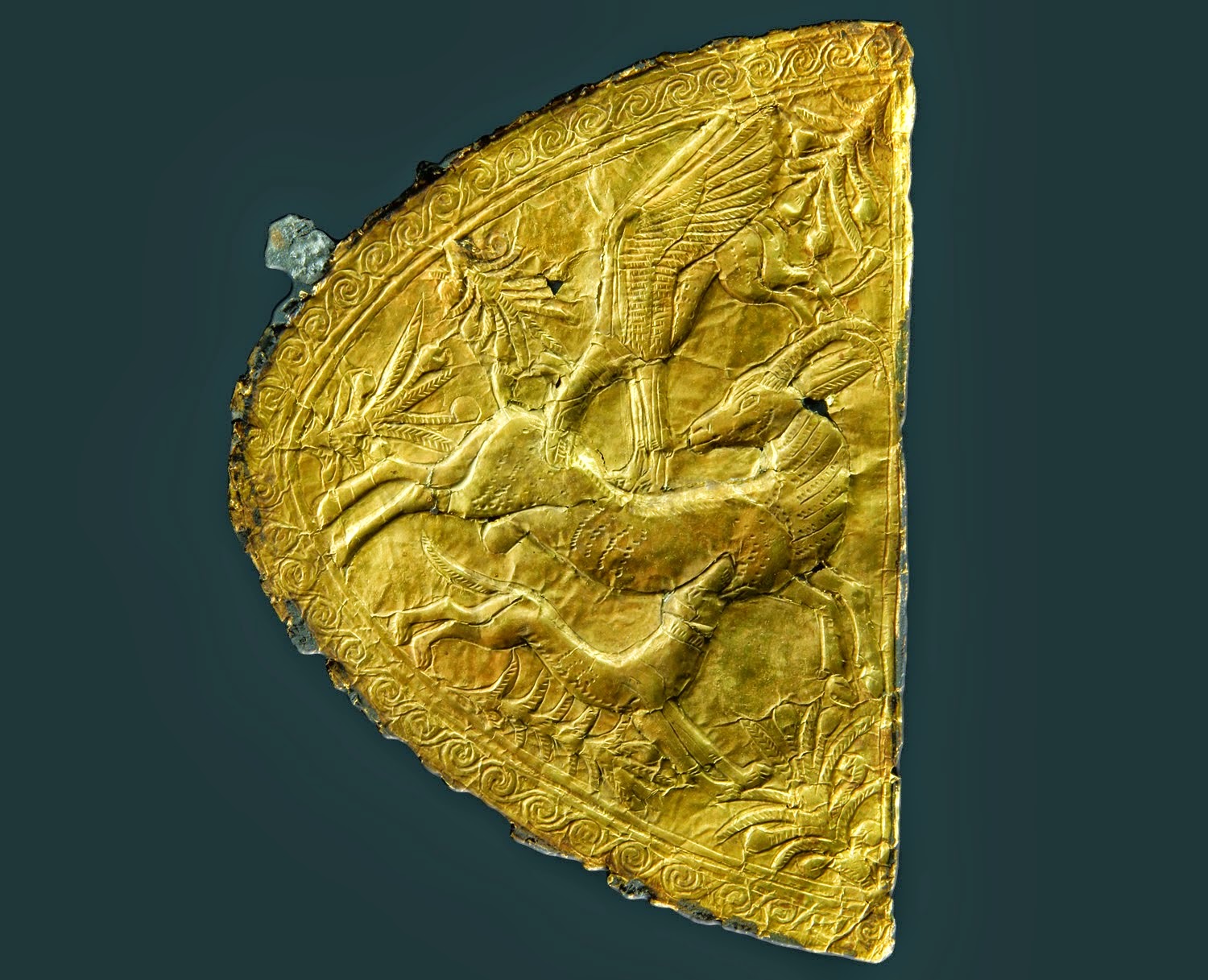
An early Bronze Age sun-disc from Monkton Farleigh in Wiltshire has gone on display for the first time. 
This is one of only 6 finds of sun-discs discovered and is one of the earliest metal objects 
found in Britain. 
It was made in about 2,400 BC, soon after the sarsen stones were put up at Stonehenge, and is thought to represent the sun. 


Image of sun disc [Credit: Wiltshire Museum] 


The sun-disc was found in a burial mound at Monkton Farleigh, just over 20 miles from Stonehenge. 
It was found in 1947 in excavations by Guy Underwood along with a pottery beaker, flint arrowheads and fragments of the skeleton of an adult male. 
It was kept safe by the landowner since its discovery and has only now been given to the Museum. 
It has now been cleaned by the Wiltshire Council Conservation Service and has been placed on display in time for this year’s mid-summer solstice. 
The sun-disk is a thin embossed sheet of gold with a cross at the centre, surrounded by a circle. 
Between the lines of both the cross and the circle are fine dots which glint in sunlight. 
The disc is pierced by two holes that may have been used to sew the disc to a piece of clothing or a head-dress, and may have been used in pairs. 
Until recently it has been thought that early Bronze Age gold may have come from Ireland, but a new scientific technique developed at Southampton University is hinting that the gold may have come from Cornwall. 
Museum Director David Dawson said “We have the best Bronze Age collections in Britain and we are delighted to be able to display this incredibly rare sun-disk through the generosity of the donors. It was kept safe since its discovery by Dr Denis Whitehead and the first time that it had been seen by archaeologists was when he brought it to show me at the launch of our new Prehistory Galleries in 2013. 
It has now been presented to the Museum in remembrance of Denis S Whitehead of Inwoods, Farleigh Wick.” 


Source: Wiltshire Museum [June 22, 2015]

giovedì 8 gennaio 2015

PERSONA o TRADIZIONE?

Homer is a tradition, 

not a person, 

British historian says 


 The ancient Greek poet Homer was not a single person but actually an entire culture of storytelling, a historian has claimed. 


Portrait of Homer, known as Homer Caetani.
Pentelic marble, Roman copy  of the 2nd century CE after a Greek original of the 2nd century BC. From the Palazzo Caetani in Rome 
[Credit: WikiCommons] 


Adam Nicolson, 
an author and historian who has studied Homer, believes the epic poems of The Iliad and The Odyssey have their origins around 2,000 BC - 1,000 years earlier than the man who wrote them is said to have lived. 
Instead, he claims the stories evolved as a tradition that were shared and refined as spoken poems for hundreds of years. Speaking in an interview with National Geographic, Mr Nicolson, who is the Fifth Baron Carnock, said that the idea of Homer as a single author has emerged due to an 'author obsession'.

He said: 'I think it's a mistake to think of Homer as a person. 
Homer is an "it" - a tradition. 
'An entire culture coming up with ever more refined and ever more understanding ways of telling stories that are important to it.' 

There is very little known about exactly who or what Homer was, but is believed by the ancient Greeks to have been the first great epic poet. 
Some accounts claim he was a blind poet who lived between 1,102BC to 850BC. 
A guild of singing story tellers, or rhapsodes, later emerged known as the Homeridae and has led some to argue that Homer was actually a mythical figure whose name was derived from the guild.


 Some of the earliest written works attributed to Homer were found with the mummified remains of Green Egyptians from around 150-200 BC.

The oldest complete Iliad manuscript is found in the doge's library in Venice and is thought to date from 900AD.
Mr Nicolson, who lives in Kent, said that notes in the margins of this manuscript, which was created in the Constantinople-Byzantium, provide some clues to what the origin of the Iliad may have been.
 He said: 'One of the exciting things that emerge from that is that in the early days it seems there was no such thing as a single Iliad, no one fixed text, but this wild and variable tradition of the stories, with many different versions in different parts of the Mediterranean, endlessly interacting with itself, like a braided stream in the mountains.'

Mr Nicolson said he first became interested in Homer around ten years ago when he began reading The Odyssey while waiting for his yacht to be repaired after it was damaged in a storm while sailing up the west coast of Britain. 
He describes reading The Odyssey as being like somebody 'telling me what it was like to be alive on Earth'. 
Mr Nicolson, who has presented several TV programmes, including one about the history of whaling, has now written a book called The Mighty Dead, or Why Homer Matters in the US, to explore what influence Homer's stories have today. 

He said that he believes many of the poems attributed to Homer have their beginnings around 2,000 BC. He said that large elements of the stories from The Iliad, for example, are shared with stories found in India, Germany and Iceland. He also said that the Iliad also paints the Greeks as lawless violent warriors rather than the civilised society they later became. 
He said: 'That picture of the Greeks doesn't make sense any later than about 1,800 to 1,700 BC. After that, the Greeks had arrived in the Mediterranean and started to create a civil society. 'Before that, they were essentially tribes from the steppes between the Black Sea and the Caspian - nomadic, male-dominated, violent.' 


Author: Richard Gray | Source: MailOnline [January 05, 2015]

Read more at: http://archaeologynewsnetwork.blogspot.it/2015/01/homer-is-tradition-not-person-british.html?utm_source=feedburner&utm_medium=feed&utm_campaign=Feed:+TheArchaeologyNewsNetwork+(The+Archaeology+News+Network)
Follow us: @ArchaeoNewsNet on Twitter | groups/thearchaeologynewsnetwork/ on Facebook

venerdì 12 dicembre 2014

AL DI LA' - nell'Antica Grecia

120 reperti, da 21 musei internazionali, volti a descrivere 
nascita e sviluppo nella Grecia Antica 
di uno dei temi che da sempre affascinano 
e rapiscono il pensiero dell'uomo:
il fato dell'anima immortale 
dopo la fine fisica del corpo mortale.
Al Museo dell'Arte Cicladica
ad Atene.


'BEYOND. Death and Afterlife in Ancient Greece' 

at The Museum of Cycladic Art in Athens


   The Museum of Cycladic Art in Athens, in collaboration with the Onassis Foundation (USA) and the Hellenic Ministry of Culture & Sports, presents a fascinating exhibition titled “Beyond. Death and Afterlife in Ancient Greece” which is scheduled to run from December 11 until February 8, 2015. 

 Through 120 objects from 21 Greek and international museums, the exhibition explores one of the most important issues that puzzled and continues to concern humans: the fate of the immortal soul after the death of the mortal body.

 The descriptions in the Homeric epics of the underworld as they were depicted on ancient works of different periods is the starting point of this exhibition. 

As epilogue, the Platonic concepts –which mark the shift of perceptions on the divine element– both as development and in contrast to the Homeric beliefs. 

The show will be divided into 5 thematic sections: 

- The moment of death,

       - Burial Customs, 

            - Homeric Hades, 

                 - Bacchic-Orphic Hades and 

                      - Platonic Hades.


Source: Museum of Cycladic Art 

[December 10, 2014]


lunedì 27 ottobre 2014

DOMUS AUREA

La Domus Aurea di Roma riaprirà la domenica.

Dopo sei lunghi anni, la Domus sarà riaperta al pubblico solo nel fine settimana, per permettere agli archeologi di continuare i loro lavori (inclusi in un programma di 4 anni) lungo la settimana, che prevedono l'apertura di nuove aree della Domus stessa.


Ai visitatori saranno inoltre spiegate le tecniche di restauro impiegate (che possono anche essere seguite on line sull'Internet).

E' stato annunciato lo scorso venerdì, dai portavoce del Ministero dei Beni Culturali, che saranno necessari 31 milioni di euro per il completo restauro.

La Domus si estendeva inizialmente per una superficie di circa tre campi da calcio, ma i suoi giardini avevano un'estensione molto maggiore: la costruzione dell'intero ricchissimo complesso aveva richiesto l'abbattimento di moltissime modeste costruzioni degli abitanti stessi di Roma (che anche per questo motivo odiavano Nerone e sparsero la voce del famoso incendio provocato da lui). Alla sua morte, in segno di disprezzo e di 'damnatio memoriae' la casa fu abbattuta e sepolta. Anche per queti motivi ora si trova sotto terra e solo una piccola parte di essa è oggi visitabile.
La Domus Aurea fu aperta al pubblico nel 1999, ma alcuni crolli ne consigliarono ripetutamente la chiusura per motivi di sicurezza.

Nel nuovo progetto, per cui la direttrice dei lavori, Fedora Filippi, chiede la partecipazione della cittadinanza, saranno messi in sicurezza e ridisegnati anche i giardini pubblici soprastanti alla villa.


Nero’s Domus Aurea to reopen on Sunday in Rome 


The remains of the Domus Aurea, or Golden House, the opulent villa that the Emperor Nero built for himself in the center of Rome, will reopen to guided visits on Sunday six years after it was closed because of collapses and safety concerns. 


Part of the Domus Aurea in Rome, which will reopen to guided tours on Sunday  
[Credit Fabio Campana/European Pressphoto Agency] 


The visits will take place on weekends so that archaeologists and restorers can continue to work on the four-year project, which will open new areas of the monument. Visitors can tour the work site and learn about techniques used in the restoration, which can be followed online. 

Culture Ministry officials on Friday announced a campaign to help raise the 31 million euros ($39 million) needed for the restoration. 

Only a small amount of the villa remains visible; it once covered an area as large as three soccer fields. 

“This has been a tenacious and silent restoration,” the culture minister, Dario Franceschini, told reporters on Friday. 

“As people strolled in the gardens above, below ground, dozens of people continued the restorations.” 
The villa first opened to the public in 1999, but it was closed several times after collapses. It then closed for the long term in 2005 but restorations continued, stymied partially by infiltrations of water and roots from the garden that covers the structure. 

In the new project, the garden would be redesigned to safeguard the building. 

“We don’t want people to think that we’ve resolved all the problems of the Domus Aurea,” said Fedora Filippi, the scientific director of the site. 

“But we wanted to explain to people what we’re doing so that they can participate.” 


Author: Elisabetta Povoledo | Source: Arts Beat/NY Times [October 24, 2014]

giovedì 21 agosto 2014

L'incredibile forza seduttiva di Pompei

Pompei rinasce con il turismo: solo nella giornata del 15 di 

Agosto, 13.000 visitatori si sono recati nel sito, per visitare le  

10 'nuove' case che non erano state rese disponibili al 

pubblico prima. Le fotografie non rendono la bellezza della 

Casa della Caccia, né la dovizia del musaico della Casa di 

Apollo, né l'estrema modernità del Thermopolio di Vetutio 

Placido, che sembra quyasi il bancone di un moderno "fast 

food joint".


Pompeii seduces thousands with 10 new houses 


 From the sumptuous frescoes of the Hunting Lodge (Casa della Caccia) to the exquisite decorations of the House of Apollo (Casa di Apollo) and vivid reliefs of the Trojan War, Pompeii is seducing visitors this summer with 10 newly restored houses, some of which had never been open to the public before. 


Casa della Caccia Antica [Credit: Jacques Pleau/Flickr] 


After long controversy regarding the lack of personnel at Pompeii, the ministry of culture has dispatched 30 new keepers for the holiday season, a State exam to select new janitors is in the works, and extended opening hours on Friday mean the public can stroll through the ruins after sundown. 


Mosaic at Casa di Apollo [Credit: ANSA] 


Tourists are enjoying the new sites: more than 13,000 visitors flocked to Pompeii on the August 15 national religious holiday, bringing proceeds in excess of 114,000 euros, while 122 people decided to explore the city preserved in lava during night visiting hours. 


Casa della Caccia Antica [Credit: Brett Woodvine/Flickr] 


The 10 new houses include the Thermopolium (Latin for restaurant) of Vetutius Placidus, where people could buy cooked food to go. It boasts shrines to Mercury and Dionysus (the gods of commerce and wine, respectively), a dining hall, and an adjoining mansion with a vestibule, a garden, and a dining room. 


Thermopolium of Vetutius Placidus [Credit: Vanni Archive/Corbis] 


The Ancient Hunting Lodge (Casa della Caccia Antica) is another must-see at Pompeii. According to experts, it had just undergone renovation when it was buried under meters of ash and pumice in the eruption of Mount Vesuvius in 79 AD. An extensive hunting scene is still visible on one of its garden walls, and its interiors are luxuriously decorated with beautiful paintings and marble-like coverings. 
Also noteworthy are the Domus Cornelia and its exquisite sculptures, the House of Apollo adorned with images of the god to which it owes its name, and the House of Achilles with its impressive reliefs of the Trojan war. 


Source: ANSA [August 19, 2014]

Read more at: http://archaeologynewsnetwork.blogspot.it/2014/08/pompeii-seduces-thousands-with-10-new.html?utm_source=feedburner&utm_medium=feed&utm_campaign=Feed:+TheArchaeologyNewsNetwork+(The+Archaeology+News+Network)#.U_XrXih7DfU
Follow us: @ArchaeoNewsNet on Twitter | groups/thearchaeologynewsnetwork/ on Facebook


venerdì 6 giugno 2014

Riapre la 'Tomba Bella' di Cerveteri

Cerveteri si prepara al rilancio, offrendo al pubblico di visitatori anche alcune tombe che erano state chiuse (nella figura la Tomba dei Rilievi, o Tomba Bella, non tomba dei leoni come specificato nella didascalia in inglese: si tratta della tomba dei Matunas, del IV secolo a.C. splendidamente decorata con stucchi in rilievo ancora portanti il colore originale). Anche la sbiadita Tomba dei Leoni dipinti sarà in mostra.
Il sito di Cerveteri è uno dei più grandi siti archeologici del mondo (supera in dimensioni persino la Valle dei Re Egizia) e si spera di riuscire a rilanciarlo dopo un massiccio investimento di riorganizzazione, pulizia, restauro ed incremento delle protezioni dai furti (illuminazione, telecamere) da parte dell'Unione Europea.

Cerveteri's Etruscan city of dead set to wow visitors 

 UNESCO world heritage site the Etruscan Necropolis of Banditaccia at Cerveteri north of Rome is gearing to amaze visitors with a July inauguration showcasing previously closed tombs and a new welcome center, officials told ANSA this week. 


Previously closed Tomb of the Painted Lions to open to public [Credit: ANSA] 


Thanks to a 2.3-million-euro collaborative investment of European Union and Italian State funds, the three-millennia-old Banditaccia is getting an upgrade and plans to show off the latest renovations at the July 4 inauguration of its new Visitor Center. 

One July highlight will be the re-opening of the Tomb of the Painted Lions, a 7th-century BC tomb once frescoed with lions, which have since faded away due to exposure, along with other previously closed tombs. 
Additionally, Banditaccia's long-neglected pedestrian paths have been cleaned up for the upcoming inauguration, including 'La Passeggiata di Lawrence', a pathway named after writer DH Lawrence whose book Etruscan Places inspired the site's rediscovery. 

Both weather and grave robbers have repeatedly contributed to the site's degradation over the decades, which the Banditaccia project aims to rectify with the addition of 80 surveillance cameras and an evening illumination. 
Over the next 18 months, the Banditaccia project also will add an interactive multi-media experience, new itineraries, and visitor facilities upgrades such as a restaurant and bathrooms. 


Etruscan site at Cerveteri [Credit: Mike Wilson]


 Lorenzo Croci, Cerveteri's sustainable-development councilor, hopes that the upgrades will double visitors to the heritage site, considered the cradle of Etruscan civilization with its more than 1000 tombs. 
"Few people know this but this is the largest archaeological site in the world, even bigger than the Valley of the Kings in Egypt", Croci told ANSA, adding "today we have 65,000 annual visitors. 
"We want double that, and for the site to receive the recognition it deserves," he said. 
The Etruscans lived mainly between the rivers Tiber and Arno in modern-day Umbria, Lazio and Tuscany, in the first millennium BC. 
By the sixth century BC they had become the dominant force in central Italy, but repeated attacks from Gauls and Syracusans later forced them into an alliance with the embryonic Roman state, which gradually absorbed Etruscan civilization. 
Most of what is known about the Etruscans derives from archaeology as the few accounts passed down by Roman historians tend to be hostile, portraying them as gluttonous and lecherous. 
This problem is compounded by the fact that Etruscan cities were built almost entirely of wood and so vanished quickly, leaving little for archaeologists to investigate. 


Author: Erica Firpo | 

Source: ANSA [June 05, 2014] 

Read more at: http://archaeologynewsnetwork.blogspot.it/2014/06/cerveteris-etruscan-city-of-dead-set-to.html?utm_source=feedburner&utm_medium=feed&utm_campaign=Feed:+TheArchaeologyNewsNetwork+(The+Archaeology+News+Network)#.U5HpK3J_uSo
Follow us: @ArchaeoNewsNet on Twitter | groups/thearchaeologynewsnetwork/ on Facebook

mercoledì 4 giugno 2014

Quanti anni?

Howard Carter scoprì la tomba KV62 nel 1922 (KV sta per Kings Valley, Valle dei Re). 
...Sono trascorsi 92 anni...

I finimenti dei cavalli del carro, le decorazioni stesse del carro da guerra ed i foderi delle armi del giovane Faraone sono di grandissimo interesse, perché rappresentano il risultato 
della fusione di motivi Levantini ed Egizi nell'arte quotidiana del XIV secolo a.C.
Tali oggetti d'arte non sono mai stati visti prima dal pubblico e pochissimi sono gli archeologi che li hanno potuto avvicinare.
Una cooperazione Egizio-Tedesca collaborerà al restauro dei pezzi archeologici e fra circa tre anni sarà possibile esporli in un museo del Cairo.
Sono tutti d'accordo, nel mondo, che questa è una bella notizia!

(Per fortuna non si tratta delle statue di Monte 'e Prama, altrimenti, sai che cagnara da parte della setta shardanista!)...


Restored gold objects from the tomb of Tutankhamun 

to be 

displayed for first time.


Even the tomb of Tutankhamun holds virtually unknown treasures. A group of decorated gold leaf-on-leather objects is currently under restoration by an Egyptian-German team in the Egyptian Museum, Cairo, to be displayed for the first time. 


Gold-leaf decoration showing a hunting-scene (a dog and a griffin attacking an ibex)  using motifs from levantine art [Credit:: Christian Eckmann] 


The objects which formed part of Tutankhamun's war chariots, the trappings of their horses and the sheaths of weapons are since their time of discovery in 1922 in a bad condition and were never studied adequately. 
However their decoration is of unusual beauty and decisive historical significance. 
The combination of Egyptian and Levantine motifs bears witness to the political and cultural interconnections between Egypt and the city-states of the Levant in the 14th century BCE. 


The restoration lab in the Egyptian Museum Cairo 
[Credit: Christian Eckmann] 


A team of restoration specialists and archaeologists from the Egyptian Museum Cairo, the Römisch-Germanisches Zentralmuseum Mainz (the leading German Institution for scientific restoration), the Institute of Near Eastern Archaeology of the University of Tübingen (which excavated and studied similar objects at the site of ancient Qatna in Syria) and the German Archaeological Institute Cairo embarked now on a project to carry out a full archaeological and technological analysis of this group of objects and to restore them so that their value and importance can be appreciated for the first time. 


H.E. the Minister of State for Antiquities, Prof. Dr. Mohamed Ibrahim, the representative  of H.E. the ambassodor of Germany in Egypt, Chargé d'Affaires Kai Boeckmann  and Christian Eckmann, restoration expert from the Römisch Germanisches Zentralmuseum  Mainz discussing the work of the project 
[Credit: Christian Eckmann] 


Thanks to special funding by the Federal Republic of Germany and investing a sum exceeding 1 million Egyptian Pounds, a specialized restoration lab could be equipped at the Egyptian Museum Cairo. 
To support professional capacity building in the context of this project, scholarships are extended to Egyptian restorers to receive high-level specialized training at the Römisch-Germanisches Zentralmuseum Mainz.
 The project was inaugurated on the 6th of April 2014 in the presence of H.E. the Minister of State for Antiquities, Prof. Dr. Mohamed Ibrahim, the representative of H.E. the German Ambassador to Egypt, Chargé d'Affaires Kai Boeckmann and the representatives of the research institutions involved. 
It is planned that the project, which is supported also by funds of the German Research Council (DFG), will be concluded after three years with a first public exhibition of the objects in the Egyptian Museum. 

Source: Deutsches Archäologisches Institute [June 01, 2014]