Avido collezionista, egli comprò - in un negozietto londinese dell'usato - 30 dettagliatissimi disegni ad acquerello ed inchiostro, attribuiti all'assistente di Schliemann e recanti annotazioni manoscritte di Heinrich in persona.
Il foglio più grande misura 49 cm per 68.
Una perizia calligrafica tedesca ha accertato l'appartenenza a Schliemann della grafia.
La recente riscoperta dei testi forse permetterà di gettare nuova luce sull'andamento degli scavi di Troia e di Tirinto...
Museum finds original drawings by Schliemann
A Japanese museum said it has confirmed 28 original drawings from German archaeologist Heinrich Schliemann’s report on ancient Greek ruins that could shed light on the excavation of a fabled palace.

Schliemann (1822-1890), who won fame for his discovery of the legendary city of Troy in Greek mythology, is also known for his unearthing of the remains of a Greek palace named Tiryns
The Tenri University Sankokan Museum said Nov. 26 the original drawings contain notes handwritten by Schliemann.
A report on the discovery of Tiryns featured drawings and other materials and was released in 1885.
However, journals and other information describing the excavation of the ancient palace do not exist.
Museum officials said the drawings they possess are precious primary historical materials that can explain what happened during the excavation process.
“The drawings depict the remains and relics with extreme accuracy in terms of scale and other aspects.
Their quality reaches the most advanced level in the 19th century, a developing era for archaeology,” said Yoshiyuki Suto, a professor of Greek archaeology at Nagoya University Graduate School.
“Because they include detailed instructions for publishing the report, we can learn what processes the drawings underwent until the release of the report,” he added.
The largest drawing is 49 centimeters by 68 cm.

When Tiryns, located on the Peloponnesus Peninsula, was unearthed by Schliemann in 1884 and 1885, his German assistant, Wilhelm Doerpfeld, drew accurate ground plans for the remains.
In addition to the ground plans, the original drawings contain paintings of a mural featuring a performer riding a cow, as well as relics, such as earthenware shaped like animals.
They were all painted with ink and watercolors.
The ancient palace is famous for its castle walls dating to the Mycenaean Culture (late 17th century B.C.-12th century B.C.), and has been designated a World Heritage site along with the remains of Mycenae.
Ancient Greek poet Homer praised the massive walls in his work.
Shozen Nakayama, the founder of Tenri University who was an avid collector, bought 30 original drawings from Schliemann’s report around 1960 at a secondhand bookshop in London.
A friend of Nakayama’s donated two of the drawings to Tokyo’s Middle Eastern Culture Center in Japan.
The remaining 28 are currently owned by the Tenri University Sankokan Museum.
The Nara museum in 2008 asked the museum of prehistory and early history in Germany for a handwriting analysis of the 28 drawings.
The study confirmed that some notes in the margins of the drawings were written by Schliemann.
The drawings will go on display from April through June at the Tenri University Sankokan Museum, together with the Tenri Central Library’s first edition of Schliemann’s report on the discovery of Troy.
Author: Yoshiko Aoyama
Source: The Asahi Shimbun [November 27, 2014]

 |
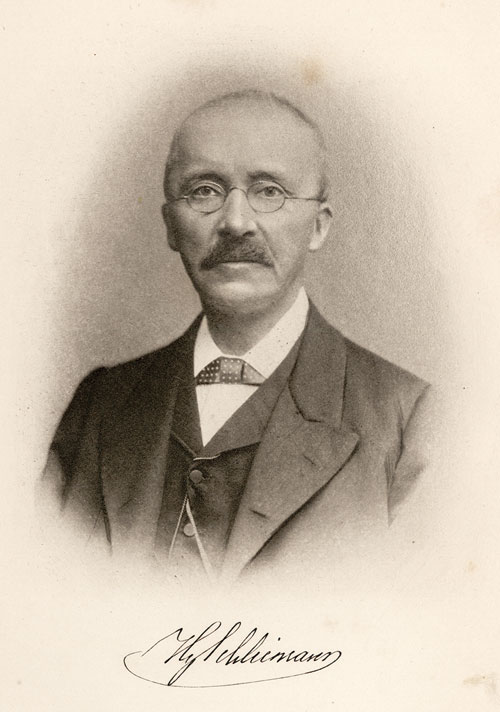
| Heinrich Schliemann (1822-1890) d'umili origini, ricchissimo commerciante, eruditissimo autodidatta, scavatore del sito di Tria, avventuriero poliglotta. |
 |
| Sophie Schliemann, fotografata con i favolosi gioielli in sfoglia d'oro che furono subito sospettati di falso, in seguito scomparirono misteriosamente per molti anni ed adesso sono, in piccola parte, esposti in un museo russo. |
Museum finds original drawings by Schliemann
A Japanese museum said it has confirmed 28 original drawings from German archaeologist Heinrich Schliemann’s report on ancient Greek ruins that could shed light on the excavation of a fabled palace.

A painting of a mural unearthed at the remains of the Tiryns palace is used as the front cover of Heinrich Schliemann’s report released in 1885
[Credit: Tenri University Sankokan Museum]
Schliemann (1822-1890), who won fame for his discovery of the legendary city of Troy in Greek mythology, is also known for his unearthing of the remains of a Greek palace named Tiryns
The Tenri University Sankokan Museum said Nov. 26 the original drawings contain notes handwritten by Schliemann.
A report on the discovery of Tiryns featured drawings and other materials and was released in 1885.
However, journals and other information describing the excavation of the ancient palace do not exist.
Museum officials said the drawings they possess are precious primary historical materials that can explain what happened during the excavation process.
“The drawings depict the remains and relics with extreme accuracy in terms of scale and other aspects.
Their quality reaches the most advanced level in the 19th century, a developing era for archaeology,” said Yoshiyuki Suto, a professor of Greek archaeology at Nagoya University Graduate School.
“Because they include detailed instructions for publishing the report, we can learn what processes the drawings underwent until the release of the report,” he added.
The largest drawing is 49 centimeters by 68 cm.

A picture of earthenware shaped like animals.Names and publishing instructions in the margin were written by Heinrich Schliemann
[Credit: Tenri University Sankokan Museum]
When Tiryns, located on the Peloponnesus Peninsula, was unearthed by Schliemann in 1884 and 1885, his German assistant, Wilhelm Doerpfeld, drew accurate ground plans for the remains.
In addition to the ground plans, the original drawings contain paintings of a mural featuring a performer riding a cow, as well as relics, such as earthenware shaped like animals.
They were all painted with ink and watercolors.
The ancient palace is famous for its castle walls dating to the Mycenaean Culture (late 17th century B.C.-12th century B.C.), and has been designated a World Heritage site along with the remains of Mycenae.
Ancient Greek poet Homer praised the massive walls in his work.
Shozen Nakayama, the founder of Tenri University who was an avid collector, bought 30 original drawings from Schliemann’s report around 1960 at a secondhand bookshop in London.
A friend of Nakayama’s donated two of the drawings to Tokyo’s Middle Eastern Culture Center in Japan.
The remaining 28 are currently owned by the Tenri University Sankokan Museum.
The Nara museum in 2008 asked the museum of prehistory and early history in Germany for a handwriting analysis of the 28 drawings.
The study confirmed that some notes in the margins of the drawings were written by Schliemann.
The drawings will go on display from April through June at the Tenri University Sankokan Museum, together with the Tenri Central Library’s first edition of Schliemann’s report on the discovery of Troy.
Author: Yoshiko Aoyama
Source: The Asahi Shimbun [November 27, 2014]