Visualizzazione post con etichetta medicina legale. Mostra tutti i post

sabato 16 maggio 2015

Il sangue umano più antico.


- Due ferite: una di freccia e l'altra un taglio sulla mano destra.  Sono state esaminate con una sonda nanotecnologica avanzatissima, che ha identificato con laser-scanner la tipica forma a concavità doppia dei globuli rossi...

- Il sangue umano in oggetto è il più antico mai trovato (5.300 anni fa circa) con certezza (altri reperti dell'età della pietra, su strumenti ed altro, non sono certi, in quanto varie altre entità possiedono forme analoghe al globulo rosso: grani di polline, batteri etc e con esso potrebbero essere state confuse)

- La certezza. In questo caso, la rifrazione della luce del laser ha permesso di identificare con precisione una proteina tipica ed esclusiva del globulo rosso (emoglobina) ed una sostanza coagulante (fibrina.)

- Si tratta di un omicidio di 5.000 anni fa, per cause sconosciute: un uomo fu ucciso da una freccia scagliata con l'arco. Il caso di Iceman Otzi è un vero 'cold case' e s'indaga ancora... 

- La sua morte fu rapida dopo neanche qualche minuto; se fu dolorosa, ebbene: non soffrì a lungo. Questo si può affermare proprio per via della presenza della fibrina: quest'ultima si forma immediatamente, subito dopo la lesione. In un corpo vivo, però, scompare e viene riassorbita dopo pochi minuti.

- L'articolo dell'avanzatissima indagine è comparso sulla rivista Interface, autore Albert Zink, capo dell'Istituto per le mummie e per l'Icemen, di Bolzano, Italia. 


World's oldest blood found 

in famed

 "Iceman" mummy 


The world's oldest known blood cells have been found on Ötzi the Iceman, according to the latest research on the 5,300-year-old mummy. 
What's more, the discovery proves that the Stone Age homicide victim had a quick, if not painless, death


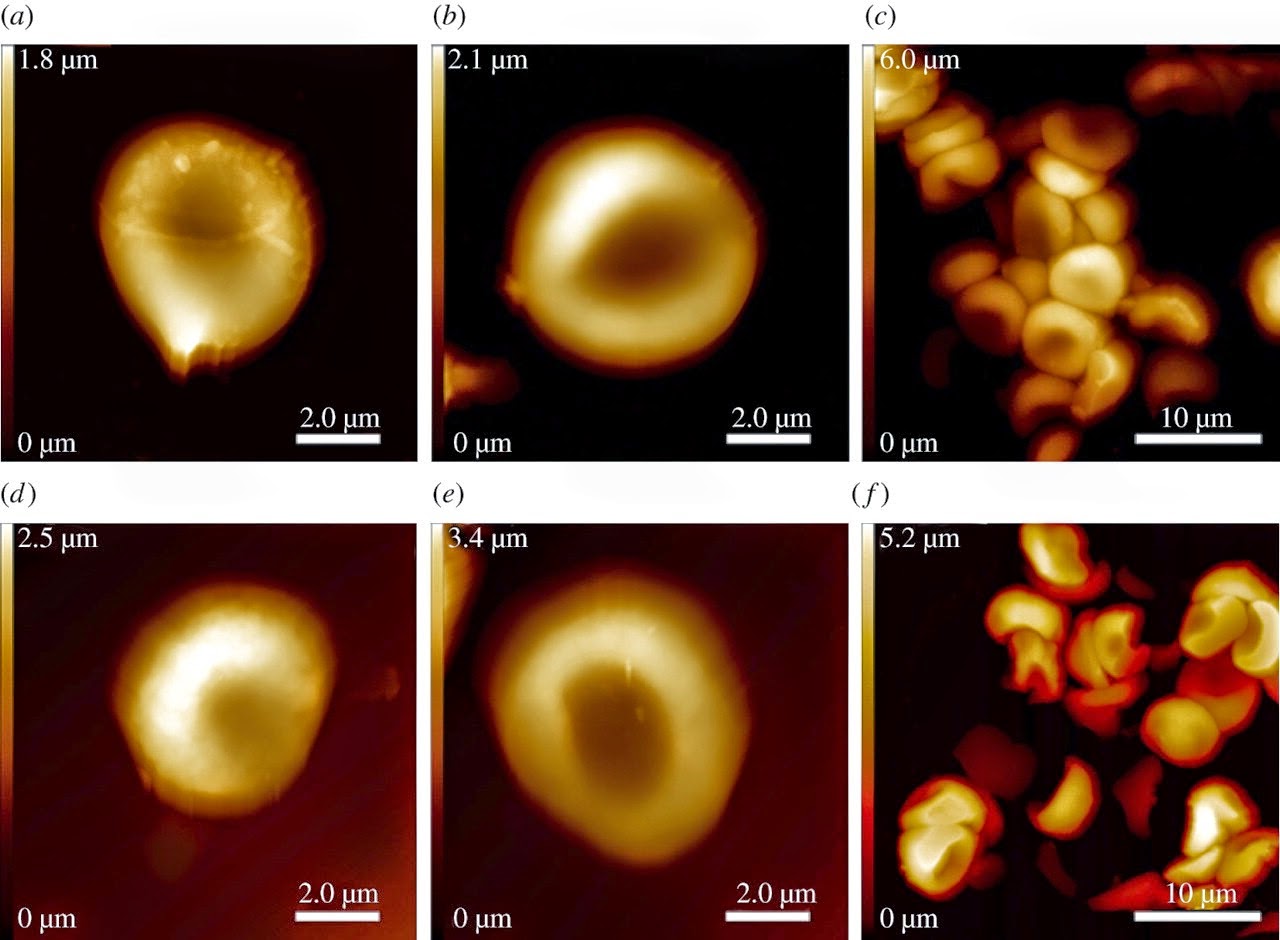
AFM images of red blood cells (RBCs). 
(a,b) Single RBCs from recent human tissue. (c) An assembly of RBCs. (d,e) Single corpuscles found in Iceman sample A and  sample B are shown. An assembly of several randomly distributed corpuscles,  similar to those found within the recent sample (c), are displayed in image (f). The imaged corpuscles (d–f) feature the characteristic discoid and concave  surface of RBCs 
[Credit: Journal of the Royal Society Interface] 


Ötzi has been the subject of extensive postmortem investigations ever since his corpse was discovered in an Alpine glacier on the Austrian-Italian border in 1991. 

No blood residue had previously been detected, however, despite various studies detailing his violent death due to an arrow shot and other injuries. 

"There were no [blood] traces found, even when they opened some arteries, so it was thought maybe the blood had not preserved and had completely degraded, or that he lost too much blood because of the arrow injury" on his back, said team member Albert Zink, head of the Institute for Mummies and the Iceman in Bolzano, Italy. 

For the new investigation, scientists traced Ötzi's wound areas—the arrow injury and a cut on his right hand—with a pioneering nano-size probe
Each minute movement of the probe was recorded with a laser, "so you get a three-dimensional image of the sample in a very tiny scale," Zink explained. The scans revealed classic "doughnut shape" red blood cells, the team reported Wednesday in the journal Interface.

While past studies have suggested evidence for prehistoric blood on Stone Age tools and other artifacts, "you can never really be sure, because you can see structures which are quite similar to red blood cells" such as pollen grains or bacteria, Zink commented. 
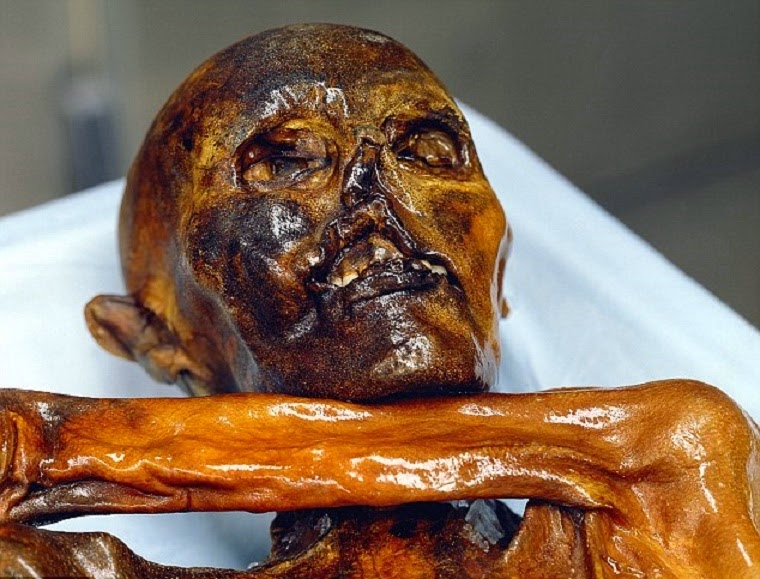


Ötzi the Iceman's mummified remains (shown above) were found on a glacier  on the Italian and Austrian border in 1991. Researchers have now discovered traces  of a molecule involved in blood clotting on the body, suggesting he bled rapidly  to death from an arrow wound to his shoulder 
[Credit: Reuters] 


To confirm they were indeed dealing with human blood cells, the researchers illuminated the wounds with a laser. The wavelengths of the scattered light revealed the substances' molecular makeup. 
"We got very typical samples for blood, like for the [blood protein] hemoglobin," he said. The new finding "really is the oldest clear evidence for red blood cells.

" The new nanotechnology, allied with an atomic force microscope, also uncovered traces of fibrin, a blood-clotting agent—evidence that the Iceman suffered a mercifully quick demise. 

"Fibrin is formed immediately when you get a wound, within a few minutes, but then it disappears"—in a living, functioning body, anyway, Zink said. 

"Finding fibrin in the arrow wound is confirmation that Ötzi actually died very quickly after the arrowshot."

"There were still some people arguing that he survived the arrow maybe a few hours or a few days, but this was definitely not true," he added. 

The relatively new techniques used in the study may in the future assist in the investigation of modern-day homicides. Since old blood cells are more elastic than fresh samples, the same blood-analysis techniques could become useful at crime scenes, Zink said. "If the blood is dry, forensic science really has no good method for determining the age of blood spots ... They cannot say if it is a day, a week, or a month old," he said. "If you can record with this technology little differences in the elasticity of the structure, then you can maybe determine the age of the blood spot." 

Author: James Owen | Source: National Geographic News 

[May 08, 2015]

domenica 12 aprile 2015

Il ciarlatano premiato col Nobel

IL CIARLATANO ED IL SUO NOBEL
KARY MULLIS

articolo di 
Maurizio Feo


Questo post costituisce un esempio di come - talvolta - la realtà superi spesso di gran lunga ogni più sbrigliata fantasia.
Esso riunisce
- fatti scientifici (interessanti risultati della ricerca sul DNA),
- fatti di cronaca nera orribili e spiacevoli (cause di omicidio e di paternità, di cui s'interessa la Medicina Legale con le sue tecniche forensi)
- ed altre e varie recenti dispute (per esempio, quella che vede in Sardegna da una parte i ricercatori accreditati e dall'altra quelli 'autodidatti'; ma anche quella - purtroppo - circa la notizia della superiorità organizzativa degli altri sistemi giudiziari rispetto a quello italiano).

Prima, un po' di cronologia:

1984 : Alec Jeffreys  (1950) sviluppa la tecnologia per determinare l'impronta genetica. Una sua dichiarazione : "Esisteva un livello di specificità in ogni individuo che era anni luce al di là di ogni cosa vista prima. Ci rendemmo immediatamente conto delle possibili implicazioni nelle indagini forensi e nella verifica della paternità"

1986-88 : Prima applicazione del 'test del DNA': Colin Pitchfork fu riconosciuto inequivocabilmente colpevole dell'omicidio di una ragazza di 15 anni, Dawn Ashworth, per cui era stato precedentemente arrestato l'innocente Richard Buckland.

1990 : La 'reazione della catena delle polimerasi' è applicata all'impronta genetica, che permette di sperimentare sui più piccoli campioni biologici. (Da allora centinaia di migliaia di criminali sono stati condannati grazie alla 'Prova del DNA'. Anche le vittime degli attentati dell'undici Settembre 2001  furono identificate con il test del DNA).

1992 : Il cadavere di Josef Mengele è identificato grazie alla prova del DNA. Un uomo sepolto in Brasile, con il nome di Wolfgang Gerhard era in realtà Mengele, il medico fuggito da Auschwitz e responsabile ideatore di numerosi odiosi esperimenti in vivo sui prigionieri ebrei.

1998 : sull'abito blu di Monica Lewinsky ('previdentemente' subito surgelato da lei) si identifica il DNA di Bil Clinton. Migliaia di cause di paternità sono decise grazie al test: Eddie Murphy, Steve Bing, Maradona, Dwight Yorke, Eto'o,  etc...

2003 : il "Criminal Justice Act"  inglese prevede il prelievo di DNA da chiunque sia arrestato per un reato, anche se poi non incriminato, né condannato. E' un mezzo che permette di creare rapidamente  un'enorme ed utilissima banca dati di DNA, cosa che pone i servizi inglesi all'avanguardia rispetto agli altri.

Come funziona il test.
- Alec Jeffreys scoprì per caso le possibili applicazioni in ambito legale del DNA.
In realtà, egli stava studiando i minisatelliti per cercare una chiave dell'evoluzione dei geni responsabili di malattie. Usava come materiale alcuni campioni di DNA prelevati da una sua collaboratrice (Vicky Wilson) e dai suoi genitori. Notò una somiglianza familiare nel numero delle ripetizioni dei minisatelliti, ma anche che ciascuna sequenza aveva un profilo unico. 
- Inizialmente, il test si fondava su alcuni segmenti ripetitivi  del 'Junk DNA' (DNA spazzatura) noti come minisatelliti, che hanno una lunghezza compresa tra 10 e 100 lettere. Essi presentano sempre la medesima sequenza di basi GGGCAGGAXG (dove X può essere una qualunque delle 4 basi). I minisatelliti s'incontrano più di un centinaio di volte nel genoma umano e in ciascun sito si ripetono un numero casuale di volte.

 - Come 'entra' Kary Mullis nella faccenda?

Nel 1983 egli inventa una tecnica (la PCR - "Polimerase Chain Reaction"). Questa tecnica permette l'amplificazione di piccole quantità di DNA.
Ciò è solo apparentemente insignificante: nella realtà dei fatti, significa che anche solo 150 cellule divengono una quantità di materiale 'leggibile' ed utilizzabile a scopo scientifico o medico legale.
Inoltre, con il tempo, l'analisi dei minisatelliti è stata sostituita dall'uso di piccole sequenze ripetitive di DNA (chiamate 'brevi ripetizioni in tandem': short tandem repeats), che sopravvivono meglio all'esposizione ambientale e possono essere più facilmente amplificate con la PCR.

Attualmente, varie nazioni archiviano il DNA di criminali condannati per l'uso in Medicina Forense. Il Regno Unito già nel 2010 possedeva ormai un database includente più del 6% della popolazione (oltre 4 milioni di campioni).

Solo una persona su un milione condivide la medesima 'impronta genetica' con un altro: questo permette di considerarla una prova conclusiva.
Significa anche, però, che - in un paese di 60 milioni d'abitanti - esistono 60 persone con la stessa impronta genetica. Ciò significa più specificatamente che, una volta che sia stato trovato DNA sospetto sul luogo del delitto, esistono 59 possibilità su 60 che il soggetto proprietario di 'quel' DNA sia innocente...
Non si tratta di cavilli, si tratta di due situazioni diametralmente opposte: un conto è rinvenire seme prelevato da una vittima di stupro (un campione abbondante, che supera qualsiasi altro presente), tutto un altro conto è il rinvenimento di qualche cellula (il test è sensibile fino a sole 5 cellule!) in un posto che l'indiziato poteva frequentare anche del tutto innocentemente.
Inoltre, è necessario tenere conto della contaminazione: quando si tratta di poche cellule, queste potrebbero essere state scambiate per contatto remoto o per scambio diretto con altre persone che poi le hanno 'seminate' (inconsapevolmente) sul posto del delitto...

Kary Mullis vince il Nobel per la sua scoperta del metodo PCR.
A 1971 paper in the Journal of Molecular Biology by Kleppe and co-workers first described a method using an enzymatic assay to replicate a short DNA template with primers in vitro. However, this early manifestation of the basic PCR principle did not receive much attention, and the invention of the polymerase chain reaction in 1983 is generally credited to Kary Mullis.
Malgrado ciò, egli resta un soggetto estremamente controverso: ha descritto apertamente le proprie esperienze con LSD (dietilamide dell'acido lisergico, una droga potentissima); ha scritto persino una biografia "Ballando nudi nel campo della mente", in cui descrive in dettaglio un episodio relativo al 1985, nel corso del quale sostiene di avere incontrato un orsetto lavatore luccicante che gli ha rivolto la parola. Ha sostenuto la tesi 'indipendente' per cui l'HIV non causerebbe l'AIDS; ha sostenuto la validità dell'astrologia.
Il suo contributo alla Scienza, però, è indiscutibile: a parte l'uso in medicina forense del 'suo' test, ne esistono applicazioni nei test genetici per le malattie e nella ricerca del DNA antico (aDNA), con qualche aiuto all'archeologia, solo per fare due esempi.

L'attuale 'disamistade' sarda.
- E' cosa regionalmente nota che sia in corso una disputa ormai cronica tra i sostenitori di tesi 'creative' e 'indipendenti' circa la Storia trascorsa della Sardegna ed i sostenitori 'autorizzati', quelli accademici.
Ambedue i gruppi organizzano congressi e raduni, parlano e scrivono abbondantemente sull'argomento.
Taluni esponenti di ambedue i gruppi non risparmiano critiche anche aspre al gruppo avverso, includendovi oltre a quelle alle idee sostenute anche quelle concernenti i comportamenti. Accuse anche gravi sono state scambiate.
I toni si sono esacerbati fino all'eccesso, in una spirale ascendente di espressioni sempre più esecrabili.

La mia personale opinione è che l'attuale livello di tensione sia più utile a chi desidera ottenere una maggiore e continua 'visibilità mediatica', per scopi personali ben precisi.
Non è comunque utile alla Scienza in alcun modo e questo è un fatto inconfutabile.

Propongo pertanto, di utilizzare, per il gruppo dei 'non accademici' espressioni come "pensatori non allineati', oppure 'ricercatori indipendenti' e simili: non sono espressioni offensive e non dovrebbero giustificare un aumento del livore di ritorno.
Poi ognuno, nel segreto del proprio animo e del proprio pensiero, può coltivare l'opinione più o meno fondata che l'altro sia un cialtrone ciarlatano e la sua produzione sia solamente ciarpame: ma non lo ha detto espressamente...
E l'esempio del premio Nobel Kary Mullis insegna che anche un sostenitore di idee controverse ed 'indipendenti' può, talvolta, coltivare un'idea preziosa per la Scienza...
Forse a quello scopo dovrebbero mirare più intensamente i 'pensatori indipendenti'.


martedì 18 marzo 2014

Un Tumore Antico

In Sudan, studiosi della Durham University hanno 

rinvenuto uno scheletro di giovane adulto che risale al 1200

aC, (quindi é del periodo della "guerra di Troia" e dei

presunti "Popoli del Mare") con evidenti tracce di un

carcinoma metastatico diffuso alle ossa. Ciò vale a dire che,

alla sua morte, aveva un tumore originato in un organo

molle ignoto, che si era diffuso estesamente ad altre aree del

suo corpo e che probabilmente ne ha determinato in qualche

modo la morte. I tumori sono poco e male rappresentati nei

reperti archeologici mondiali: fino a pochi anni fa - anzi - si

pensava che i tumori esistessero solamente in epoca

moderna. Questa è la prova più convincente che invece i

tumori esistevano anche in età antica, nella valle del Nilo.

(Precedentemente, erano state portate solamente un'altra

prova di tumore metastatico più antico del 1.000 a.C. ed

altri due tentativi erano stati fatti). Tra le possibili cause

sono ipotizzabili: fattori genetici, fattori ambientali (fumo

dagli incendi boschivi), oppure anche la schistosomiasi 

(bilarziosi), una parassitosi tropicale che spesso determina 

l'insorgenza del cancro vescicale e mammario (anche 

nell'uomo), e di cui si sa che fosse presente nella zona 

(Egitto e Nubia) già dal 1500 a.C.

Per essere più precisi, si è risaliti alla data dagli oggetti

(un'immagine in faience e ceramica) rinvenuti nella tomba e

nel sarcofago: la XX Dinastia (1187-1064 aC), un periodo in

cui l'Egitto regnava sulla Nubia, sosteneva i suoi eterni 


conflitti con i  Libu, mentre Faraoni come Ramses III si 

facevano seppellire nella Valle dei Re.


3,200-year-old skeleton found with cancer 


Archaeologists have found the oldest complete example in the world of a human with metastatic cancer in a 3,000 year-old skeleton. The findings are reported in the academic journal PLOS ONE. 


The skeleton of an adult male excavated from Amara West, the skeleton shows signs of metastatic carcinoma 
[Credit: © Trustees of the British Museum] 


The skeleton of the young adult male was found by a Durham University PhD student in a tomb in modern Sudan in 2013 and dates back to 1200BC. 
Analysis has revealed evidence of metastatic carcinoma, cancer which has spread to other parts of the body from where it started, from a malignant soft-tissue tumour spread across large areas of the body, making it the oldest convincing complete example of metastatic cancer in the archaeological record. 
The researchers from Durham University and the British Museum say the discovery will help to explore underlying causes of cancer in ancient populations and provide insights into the evolution of cancer in the past. 
Ancient DNA analysis of skeletons and mummies with evidence of cancer can be used to detect mutations in specific genes that are known to be associated with particular types of cancer. 
Even though cancer is one of the world’s leading causes of death today, it remains almost absent from the archaeological record compared to other pathological conditions, giving rise to the conclusion that the disease is mainly a product of modern living and increased longevity. 
These findings suggest that cancer is not only a modern disease but was already present in the Nile Valley in ancient times. 
Lead author, Michaela Binder, a PhD student in the Department of Archaeology at Durham University, excavated and examined the skeleton. She said: “Very little is known about the antiquity, epidemiology and evolution of cancer in past human populations apart from some textual references and a small number of skeletons with signs of cancer. 


Michaela Binder from Durham University working on the skeleton
 [Credit: Durham University] 


“Insights gained from archaeological human remains like these can really help us to understand the evolution and history of modern diseases. “Our analysis showed that the shape of the small lesions on the bones can only have been caused by a soft tissue cancer even though the exact origin is impossible to determine through the bones alone.” The skeleton is of an adult male estimated to be between 25-35 years old when he died and was found at the archaeological site of Amara West in northern Sudan, situated on the Nile, 750km downstream of the country’s modern capital Khartoum. It was buried extended on his back, within a badly deteriorated painted wooden coffin, and provided with a glazed faience amulet as a grave good. 
Previously, there has only been one convincing, and two tentative, examples of metastatic cancer predating the 1st millennium BC reported in human remains. 
However, because the remains derived from early 20th century excavations, only the skulls were retained, thus making a full re-analysis of each skeleton, to generate differential (possible) diagnoses, impossible. 
Co-author, Dr Neal Spencer from the Department of Ancient Egypt and Sudan at the British Museum, said: “From footprints left on wet mud floors, to the healed fractures of many ancient inhabitants, Amara West offers a unique insight into what it was like to live there – and die – in Egyptian-ruled Upper Nubia 3200 years ago.” 
The skeleton was examined by experts at Durham University and the British Museum using radiography and a scanning electron microscope (SEM) which resulted in clear imaging of the lesions on the bones. It showed cancer metastases on the collar bones, shoulder blades, upper arms, vertebrae, ribs, pelvis and thigh bones


Lytic lesion in the spinous process of the 5th thoracic vertebra
 [Credit: Durham University]


 The cause of the cancer can only be speculative but the researchers say it could be as a result of environmental carcinogens such as smoke from wood fires, through genetic factors, or from infectious diseases such as schistosomiasis which is caused by parasites. 
They say that an underlying schistosomiasis infection seems a plausible explanation for the cancer in this individual as the disease had plagued inhabitants of Egypt and Nubia since at least 1500BC, and is now recognised as a cause of bladder cancer and breast cancer in men. Michaela Binder added: “Through taking an evolutionary approach to cancer, information from ancient human remains may prove a vital element in finding ways to address one of the world’s major health problems.” 
The tomb, where the skeleton was found, appears to have been used for high-status individuals from the town, but not the ruling elite, based on the tomb architecture and aspects of funerary ritual.
The tomb’s architecture is evidence of a hybrid culture blending Pharaonic elements (burial goods, painted coffins) with Nubian culture (a low mound to mark the tomb). The well preserved pottery recovered from the tomb provides a date within the 20th Dynasty (1187-1064BC), a period when Egypt ruled Upper Nubia, endured conflicts with Libya and while pharaohs such as Ramses III were being buried in the Valley of the Kings. The research was funded by the Leverhulme Trust and the Institute of Bioarchaeology Amara West Field School, with the permission of the National Corporation of Antiquities and Museums in Sudan. Source: Durham University [March 17, 2014]

Read more at: http://archaeologynewsnetwork.blogspot.it/2014/03/3200-year-old-skeleton-found-with-cancer.html?utm_source=feedburner&utm_medium=feed&utm_campaign=Feed:+TheArchaeologyNewsNetwork+(The+Archaeology+News+Network)#.UyiE0CjvjfX
Follow us: @ArchaeoNewsNet on Twitter | groups/thearchaeologynewsnetwork/ on Facebook

giovedì 12 settembre 2013

Una verità sui Maya


Maya dismembered their enemies


Researchers of the Department of Anthropology of the Americas at the University of Bonn have discovered a mass grave in an artificial cave in the historical Maya city of Uxul (Mexico). 

Maya dismembered their enemies
Scientists from the University of Bonn discovered a mass grave in the Classic Maya city Uxul (Mexico). Some of the skulls featured tooth incrustations with jade -- a popular body adornment in the Classic Maya society which due to the material's scarcity was reserved to persons of high social status. For these incrustations, stone tools were employed to drill small cavities in the tooth. These cavities were thereupon filled with fitting pieces of jade [Credit: (c) Nicolaus Seefeld/Uni Bonn]
Marks on the bones indicate that the individuals buried in the cave were decapitated and dismembered around 1,400 years ago. The scientists assume that the victims were either prisoners of war or nobles from Uxul itself.
For the last five years, archaeologists of the department of Anthropology of the Americas of the University of Bonn have been excavating in the historical Maya city of Uxul in Campeche (Mexico) with the aim of researching the origins and the collapse of regional states in the Maya lowlands. 
The project headed by Prof. Dr. Nikolai Grube and Dr. Kai Delvendahl from the University of Bonn, as well as Dr. Antonio Benavides from the Mexican National Institute of Anthropology and History, which is funded by the Deutsche Forschungsgemeinschaft (DFG) has now made a sensational find: they have uncovered the skeletons of 24 people in an approximately 32 square meter artificial cave that had formerly been used as a water reservoir.
"Aside from the large number of interred individuals, it already became apparent during the excavation that the skeletons were no longer in their original anatomical articulation," says the archaeologist Nicolaus Seefeld, who studied the sophisticated water supply system of Uxul for his doctoral thesis and discovered the mass grave. 
All of the skulls were lying scattered around the interior of the cave, in no relation to the rest of the bodies. Even the majority of the lower jaws were separated from the heads. In contrast, detailed examination determined that the limbs of the legs and hands were in some cases completely preserved. 
"This observation excluded the possibility that this mass grave was a so-called secondary burial, in which the bones of the deceased are placed at a new location," says Nicolaus Seefeld.
Indications of violent death and dismemberment
According to the conclusions reached by the scientists, the spatial pattern of the bones indicates that the corpses of the 24 people had been decapitated and dismembered. Signs of violent death could be proven for the majority. 

Maya dismembered their enemies
Scientists from the University of Bonn discover the remains of dismembered human bodies in an artificial cave in the Classic Maya city Uxul in Mexico. The image shows the artificial cave's interior during the excavations with several skulls, lower jaws and ribs [Credit: (c) Nicolaus Seefeld/Uni Bonn]
"The observed hatchet marks on the cervical vertebra are a clear indication of decapitation," Seefeld reports. 
The forehead of another skull shows an unhealed skull fracture, probably caused by a blow from a cudgel. In addition, numerous skulls show signs of cutting with sharp objects, which might originate from stone hatchets.
Due to their being covered by clay, the bones are so well-preserved that it was possible to distinguish the age and sex of 15 of the 24 individuals. These include 13 men and two women who were aged from 18 to 42 at the time of their death. 
Analyses of teeth and bones showed that several of the deceased suffered from malnutrition and had lost several teeth to tooth decay.
Some of the dead had tooth inserts of jade. The scientists interpret this as a sign of high social status. However, the archaeologists of the University of Bonn don't yet know whether they are prisoners of war from another Maya city that were sacrificed in Uxul or nobles from Uxul itself. 
Only with the help of isotope analysis will it be possible to clarify whether the dead were members of the local population or originate from another region of the lowlands. 
"However, the discovery of the mass grave proves that the dismemberment of prisoners of war and opponents often represented in Maya art was in fact practiced," says Prof. Dr. Nikolai Grube.

Source: Universität Bonn [September 10, 2013]