Visualizzazione post con etichetta lingua indoeuropea. Mostra tutti i post

sabato 5 ottobre 2013

Raccontare FAVOLE INDOEUROPEE

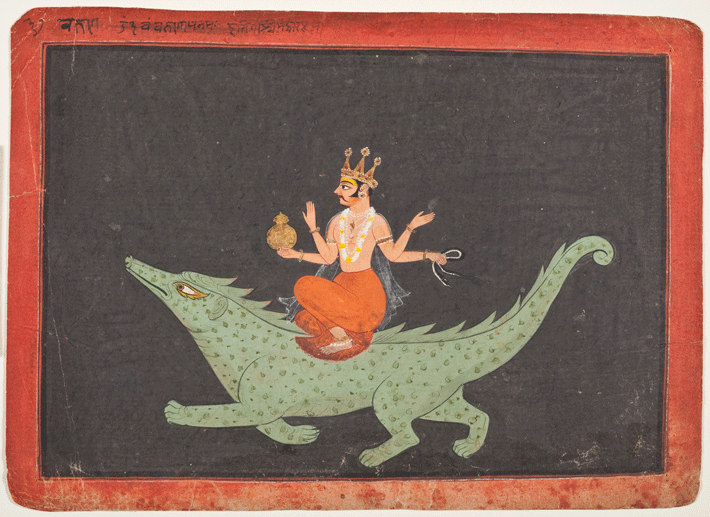
Il dio Hindu Varuna che cavalca un mostro marino. Acquarello del 1700 dopo Cristo.


Dal XIX secolo i linguisti sapevano che tutte le moderne lingue Indo-Europee discendono da una singola lingua. La lingua è chiamata ProtoIndoEuropeo, abbreviato in PIE, ed era parlata da una popolazione risalente ad un periodo temporale tra il 4.500 ed il 2.500 a.C., che non lasciò testi scritti. E' sorta la domanda: "Che suono aveva il PIE?". Nel 1868 il linguista tedesco August Schleicher fece uso di un vocabolario PIE ricostruito per creare una favola, in modo da potere udire una qualche approssimazione di PIE. E' chiamata "la favola della pecora e dei cavalli" ed è anche conosciuta come "la favola di Schleicher" e racconta dell'incontro di una pecora tosata con alcuni cavalli petulanti. Man mano che i linguisti scoprono altro, l'esperimento sonoro continua e la favola si aggiorna per riflettere l'attuale stato di conoscenza di quale sarebbe stato circa 6.000 anni fa il suono di questa lingua scomparsa. Non ne esiste una versione definitiva, dato che esistono disaccordi tra i vari studiosi. In questa versione, Andrew Byrd, linguista dell'Università del Kentuky, recita la propria versione, basata sulle ultime novità nel campo linguistico (e, purtroppo, sulla propria pronuncia inglese).

By the 19th century, linguists knew that all modern Indo-European languages descended from a single tongue. Called Proto-Indo-European, or PIE, it was spoken by a people who lived from roughly 4500 to 2500 B.C., and left no written texts. The question became, what did PIE sound like? In 1868, German linguist August Schleicher used reconstructed Proto-Indo-European vocabulary to create a fable in order to hear some approximation of PIE. Called “The Sheep and the Horses,” and also known today as Schleicher’s Fable, the short parable tells the story of a shorn sheep who encounters a group of unpleasant horses. As linguists have continued to discover more about PIE, this sonic experiment continues and the fable is periodically updated to reflect the most current understanding of how this extinct language would have sounded when it was spoken some six thousand years ago. Since there is considerable disagreement among scholars about PIE, no one version can be considered definitive. Here, University of Kentucky linguist Andrew Byrd recites his version of the fable using pronunciation informed by the latest insights into reconstructed PIE.


Schleicher originally rendered the fable like this:

Avis akvāsas ka

Avis, jasmin varnā na ā ast, dadarka akvams, tam, vāgham garum vaghantam, tam, bhāram magham, tam, manum āku bharantam. Avis akvabhjams ā vavakat: kard aghnutai mai vidanti manum akvams agantam. Akvāsas ā vavakant: krudhi avai, kard aghnutai vividvant-svas: manus patis varnām avisāms karnauti svabhjam gharmam vastram avibhjams ka varnā na asti. Tat kukruvants avis agram ā bhugat.

La Pecora e i cavalli.

Una pecora che non aveva lana vide alcuni cavalli, uno dei quali trascinava un carro pesante, un altro portava un grosso carico ed un altro portava velocemente un uomo, La pecora disse ai cavalli: "Mi duole il cuore nel vedere un uomo che conduce i cavalli". I cavalli dissero: "Senti, pecora, i nostri cuori soffrono quando vediamo questo: un uomo, il padrone, trasforma la lana della pecora in un caldo vestito per sé. E la pecora non ha lana".
Udito questo, la pecora fuggì nella pianura.

Here is the fable in English translation:

The Sheep and the Horses

A sheep that had no wool saw horses, one of them pulling a heavy wagon, one carrying a big load, and one carrying a man quickly. The sheep said to the horses: "My heart pains me, seeing a man driving horses." The horses said: "Listen, sheep, our hearts pain us when we see this: a man, the master, makes the wool of the sheep into a warm garment for himself. And the sheep has no wool." Having heard this, the sheep fled into the plain.

And here is the modern reconstruction recited by Andrew Byrd. It is based on recent work done by linguist H. Craig Melchert, and incorporates a number of sounds unknown at the time Schleicher first created the fable:

H2óu̯is h1éḱu̯ōs-kwe

h2áu̯ei̯ h1i̯osméi̯ h2u̯l̥h1náh2 né h1ést, só h1éḱu̯oms derḱt. só gwr̥hxúm u̯óǵhom u̯eǵhed; só méǵh2m̥ bhórom; só dhǵhémonm̥ h2ṓḱu bhered. h2óu̯is h1ékwoi̯bhi̯os u̯eu̯ked: “dhǵhémonm̥ spéḱi̯oh2 h1éḱu̯oms-kwe h2áǵeti, ḱḗr moi̯ aghnutor”. h1éḱu̯ōs tu u̯eu̯kond: “ḱludhí, h2ou̯ei̯! tód spéḱi̯omes, n̥sméi̯ aghnutór ḱḗr: dhǵhémō, pótis, sē h2áu̯i̯es h2u̯l̥h1náh2 gwhérmom u̯éstrom u̯ept, h2áu̯ibhi̯os tu h2u̯l̥h1náh2 né h1esti. tód ḱeḱluu̯ṓs h2óu̯is h2aǵróm bhuged.


Nel 1990 i linguisti storici  crearono un'altra corta parabola in PIE ricostruito. Essa è liberamente basata su di un passaggio tratto dai Rigveda, un'antica collezione di inni in Sanscrito, in cui un re implora il dio Varuna di garantirgli un figlio. Nella registrazione, A. Byrd recita la propria versione di "Il Re ed il Dio" in PIE, basandosi sul lavoro di Eric Hamp e Subhadra Kumar Sen.

In the 1990s, historical linguists created another short parable in reconstructed PIE. It is loosely based on a passage from the Rigveda, an ancient collection of Sanskrit hymns, in which a king beseeches the god Varuna to grant him a son. Here, Andrew Byrd recites his version of the “The King and the God” in PIE, based on the work of linguists Eric Hamp and the late Subhadra Kumar Sen.


Il Re ed il Dio

C'era una volta un Re. Non aveva figli. Il Re desiderava un figlio. Chiese al suo sacerdote: "Che mi possa nascere un figlio!" Il sacerdote disse al re: "Prega il Dio Weruno". Il Re si avvicinò al dio Weruno per pregare rivolto al dio: "Ascoltami, padre Weruno!" Il dio Weruno scese dal cielo. "Che cosa vuoi?" "Io voglio un figlio". "Che sia così!", disse il luminoso dio Weruno. La regina ebbe un figlio.


The King and the God

Once there was a king. He was childless. The king wanted a son. He asked his priest: "May a son be born to me!" The priest said to the king: "Pray to the god Werunos." The king approached the god Werunos to pray now to the god. "Hear me, father Werunos!" The god Werunos came down from heaven. "What do you want?" "I want a son." "Let this be so," said the bright god Werunos. The king's lady bore a son.

And here is the story rendered in reconstructed Proto-Indo-European:

H3rḗḱs dei̯u̯ós-kwe

H3rḗḱs h1est; só n̥putlós. H3rḗḱs súhxnum u̯l̥nh1to. Tósi̯o ǵʰéu̯torm̥ prēḱst: "Súhxnus moi̯ ǵn̥h1i̯etōd!" Ǵʰéu̯tōr tom h3rḗǵm̥ u̯eu̯ked: "h1i̯áǵesu̯o dei̯u̯óm U̯érunom". Úpo h3rḗḱs dei̯u̯óm U̯érunom sesole nú dei̯u̯óm h1i̯aǵeto. "ḱludʰí moi, pter U̯erune!" Dei̯u̯ós U̯érunos diu̯és km̥tá gʷah2t. "Kʷíd u̯ēlh1si?" "Súhxnum u̯ēlh1mi." "Tód h1estu", u̯éu̯ked leu̯kós dei̯u̯ós U̯érunos. Nu h3réḱs pótnih2 súhxnum ǵeǵonh1e.


(c) 2013 Archaeology Magazine, a Publication of the Archaeological Institute of America  

sabato 25 maggio 2013

IndoEuropeo.

The Bronze Age Indo-European invasion of Europe

Last summer, I was eagerly awaiting the publication of the genome of the Tyrolean Iceman. It is quite remarkable that only a year later, there is now autosomal DNA from half a dozen prehistoric Europeans. By comparing their DNA to that of modern populations, we are beginning to understand how the current mosaic of European peoples was formed.

The ancient samples vary greatly in the number of SNPs tested, and we cannot be sure how well they map to the restricted range of modern populations. Nonetheless, a crystal clear general pattern seems to emerge, at least in its broadest outlines (Sources: Oetzi the IcemanNeolithic SwedesMesolithic Iberians):


We can plainly see that European hunter-gatherers best map to the modern Atlantic_Baltic population component. This is well represented in the remotest areas of Europe, the ones most distant from the Near Easternwomb of nations. It can be reasonably supposed that the modern Atlantic_Baltic component partially captures alleles present in the ancient European hunter-gatherers, the mtDNA haplogroup U population that seems to stretch fromIberia to Siberia. (However, note, that this does not mean that the Atlantic_Baltic component represents hunter-gatherer ancestry only.)

Conversely, ancient European farmers also possess a large chunk of the Southern component which is absent in the hunter-gatherers. This occurs at high frequencies today around the Mediterranean and reaches its maximum in the Near East. It is clear that there is direct evidence that farming came to Europe not as an idea, but as apeople, just as archaeology and physical anthropology had always indicated -- until the rather modern distaste for migration set in.

But there is another component present in modern Europe, the West_Asian which is conspicuous in its absence in all the ancient samples so far. This component reaches its highest occurrence in the highlands of West Asia, from Anatolia and the Caucasus all the way to the Indian subcontinent. It is well represented in modern Europeans, reaching its minima in the Iberian peninsula, Sardinia, and Finland. A sampling of populations, including those closest geographically to the ancient samples:


There are several observations we can make:
  • The West_Asian component has a pan-European distribution: it must have been involved in a pan-European process rather than a more localized historical phenomenon.
  • Its absence from prehistoric individuals down to ~5ky ago suggests that it may have been added to the European population at a later date, although it may already have been present in currently unsampled areas (e.g., the Balkans) prior to 5kya.
  • It reaches its lowest occurrence in areas where non-Indo-European languages have been spoken(Basques and Iberia in general, Sardinia, and Finland)
The post-5kya timeframe is also conventionally accepted by linguists for either the dispersal of Indo-European languages, or at least of a significant subset thereof.

In that respect, it is important to note the correspondence between the West_Asian autosomal component and the k5 component of Metspalu et al. (2011): the latter is the major West Eurasian element in the Indian subcontinent. If amajor episode of West Eurasian admixture took place in India 1,200-4,000 years ago, and keeping in mind uncertainties about dating, it may very well be that this corresponds, at least in part, to the eastern manifestation of the same phenomenon.

The Bronze Age is an important transitional phase in European archaeology: distinctive archaeological cultures with distinctive physical types make their appearance across the continent. There appears to be substantial innovation in metallurgy, weapons and transportation, increase in raiding, abandonment of settlements, and formation of broad-range confederacies with distinctive archaeological markers.

I propose that a quantum leap in social complexity occurred during this period. Remarkably, after ~4,000YBP, there are no longer farmers and hunter-gatherers as distinct cultures anywhere in Europe, and their mtDNA gene pools begin to expand in synch with each other. It may very well be that climatic upheavals framing this period may have triggered population movements, both Indo-European and Semitic.


Perhaps, through a combination of better technology and social organization, the Indo-European speaking nucleus,originally one among many linguistic groups of the prehistoric Near East were able to transmit their language, culture, and ideology to much larger populations, by alternatively subjugating or incorporating them. We can thus view the Indo-European bearers as "creative destructors", upsetting the balance of established societies and re-creating them in their own image.

Both the wide differences in genetic composition among present-day Indo-European speakers, and their early-attested physical contrasts testify to the fact that the original IE nucleus did not maintain itself apart --at least not for long!-- from the populations they encountered; in this they appear different from the earlier farmers who apparently kept their Mediterranean affinity even in the northernmost edge of their expansion, thousands of years after their entry into Europe.

Nonetheless, some of the legacy of the earliest Indo-European speakers does appear to persist down to the present day in the genomes of their linguistic descendants, and I predict that when we sample later (post 5-4kya) individuals we will finally find the West_Asian piece that is missing from the European puzzle.

* * *
ADDENDUM:

On the right are the K12b results for the ancient individuals, which further suggest that the Mesolithic Europeans possessed a Northern European affinity that is lacking in the farmer individuals. Conversely, farmer individuals have an excess of the Atlantic_Med component, and also a presence of the Southwest_Asian one.

These results are compatible with the above discussion, as well as the observation by Sánchez-Quinto et al. (2012) that:
the position of La Braña individuals in the 1000 Genomes Project data and the 1KGPomnichip PCAs suggests thatthe uniform Mesolithic substrate could be related to modern Northern European populations but may represent a gene pool that is no longer present in contemporary Southern European populations.
I wrote a small survey a couple years ago, in which I argued that:
I will simply say that the recent results of Bramanti et al. for a U-dominated older mtDNA stratum in Central/North-eastern Europe can be reasonably extended to cover both North-western Europe and northern Eurasia up to Lake Baikal, the prehistoric limit between Caucasoids and Mongoloids.
The extension of U dominance to Iberia, as well as the detection of the North European autosomal signal in both Iberia as well as, presumably, Siberia, seems to make the case for the existence of this postulated zone pretty clear.

One could very well call this boreal population Ancestral Northwest Eurasians (ANWEA) and parallelize it with theAncestral South Indians (ASI). These Paleolithic substrata frame the Eurasian landmass on opposite latitudinal ends, and were the receptacles of the great chain of migrations which began in the Neolithic womb of nations. One of the final episodes of this process was the dispersal of the Indo-European languages during the Copper and Bronze Ages.

source: Dieneke's Antropology