Visualizzazione post con etichetta Cyprus. Mostra tutti i post

mercoledì 7 gennaio 2015

PALINDROMO ANTICO, CIPRO.

Per fortuna l'amuleto protettore non è stato rinvenuto in Sardegna, viene da dire con sollievo, perché così può essere correttamente attribuito all'epoca cui appartiene, cioé il V secolo.
E' stato rinvenuto nel 2011 a Paphos (Cipro) e contiene una frase palindroma (= che può essere letta indifferentemente da destra o da sinistra), lunga 59 lettere.
Con i suoi serpentelli, i cinocefali e soprattutto con quell'accenno a Yahweh, in Sardegna sarebbe stato certamente Nuragico/Shardana e del 2.000 a.C.
Siamo stati fortunati?
Chissà: forse qualcuno riuscirà a dire egualmente che i Shardana ne sono stati gli artefici e che gli archeologi - nella loro ben nota pervicacia oscurantista/negazionista - ce lo tengono nascosto...


Amulet with palindrome inscription found in Cyprus 


 An ancient, two-sided amulet uncovered in Cyprus contains a 59-letter inscription that reads the same backwards as it does forwards. 
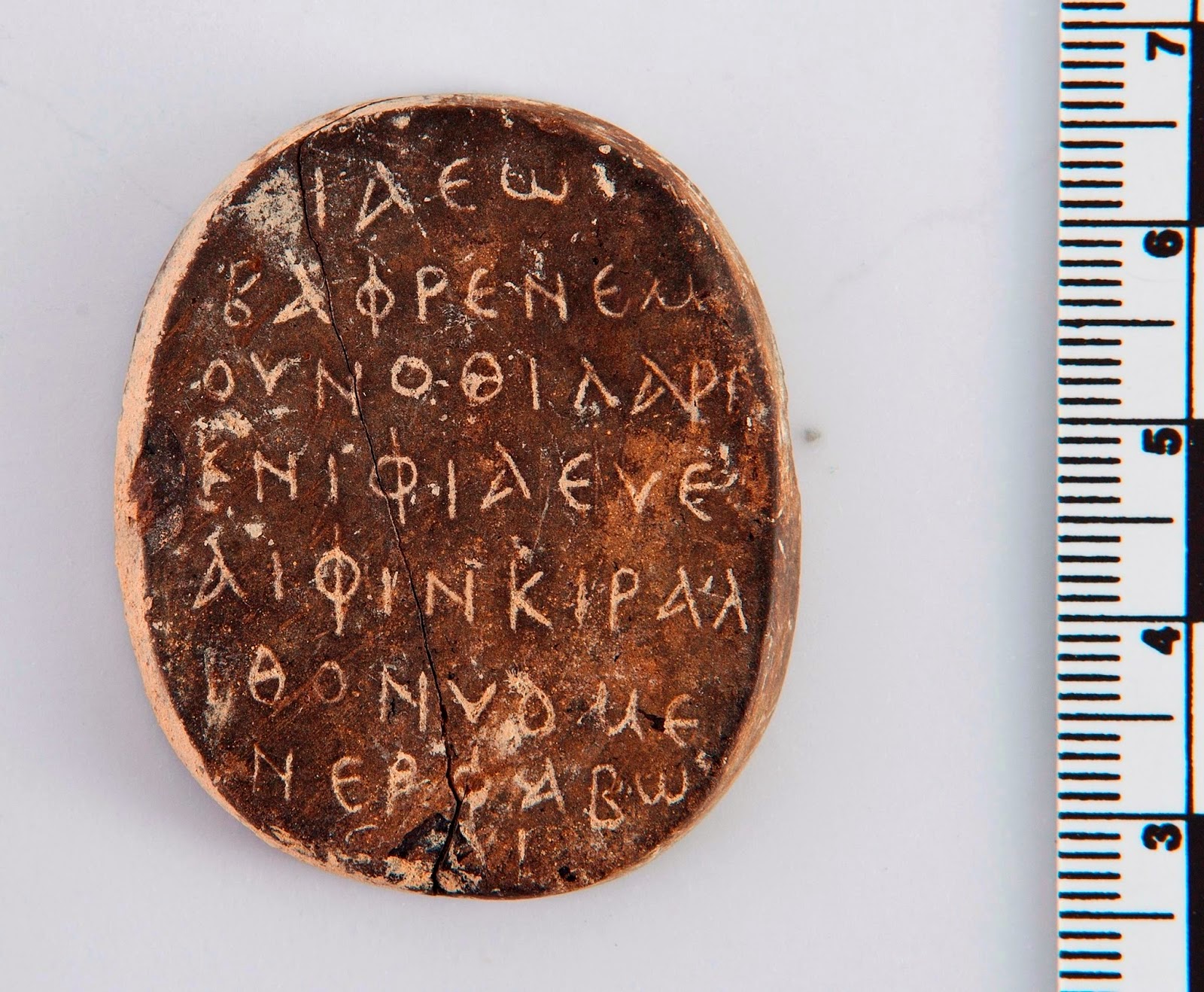


The amulet contains a Greek inscription, 59 letters long, which reads the same  backwards as it does forwards, a feature known as a palindrome. The three letters  at the very bottom, ΕΑΙ, were squeezed in and are hard to read. The amulet is  about 1.4 inches by 1.6 inches (34.9 millimeters by 41.2 millimeters) in size. The inscription translates as “Iahweh is the bearer of the secret name, the lion  of Re secure in his shrine.” Although the translation doesn’t read as a palindrome,  the original ancient Greek text does 
[Credit: Marcin Iwan/Jagiellonian  University, Krakow/ Paphos Agora]


 Archaeologists discovered the amulet, which is roughly 1,500 years old, at the ancient city of Nea Paphos in southwest Cyprus. 
One side of the amulet has several images, including a bandaged mummy (likely representing the Egyptian god Osiris) lying on a boat and an image of Harpocrates, the god of silence, who is shown sitting on a stool while holding his right hand up to his lips. 
Strangely, the amulet also displays a mythical dog-headed creature called a cynocephalus, which is shown holding a paw up to its lips, as if mimicking Harpocrates' gesture. 
On the other side of the amulet is an inscription, written in Greek, that reads the same backwards as it does forwards, making it a palindrome. 
It reads: 

ΙΑΕW

ΒΑΦΡΕΝΕΜ

ΟΥΝΟΘΙΛΑΡΙ

ΚΝΙΦΙΑΕΥΕ 

ΑΙΦΙΝΚΙΡΑΛ

ΙΘΟΝΥΟΜΕ

ΝΕΡΦΑΒW

ΕΑΙ 


This translates to "Iahweh(a god) is the bearer of the secret name, the lion of Re secure in his shrine." 
Researchers have found similar palindromes elsewhere in the ancient world writes Joachim Śliwa, a professor at the Institute of Archaeology at Jagiellonian University in Kraków, Poland, in an article recently published in the journal Studies in Ancient Art and Civilization. Śliwa notes that the scribe made two small mistakes when writing this palindrome, in two instances writing a "ρ" instead of "v." 
The amulet was discovered in the summer of 2011 by archaeologists with the Paphos Agora Project. 
Led by Jagiellonian University professor Ewdoksia Papuci-Wladyka, this team is excavating an ancient agora at Nea Paphos, and uncovered this amulet during their work. 
Agoras served as gathering places in the ancient world. 
Amulets like the one found at Nea Paphos were made to protect their owners from danger and harm, Papuci-Wladyka told Live Science in an email. 

Christians and pagans 

During the 5th and 6th centuries, Cyprus was part of the Eastern Roman Empire. 
The Roman Empire had split in two during the 4th century, with Cyprus falling under control of the east. 
When the Western Roman Empire fell during the 5th century, the Eastern Roman Empire continued to flourish and became what is sometimes called the Byzantine Empire. 
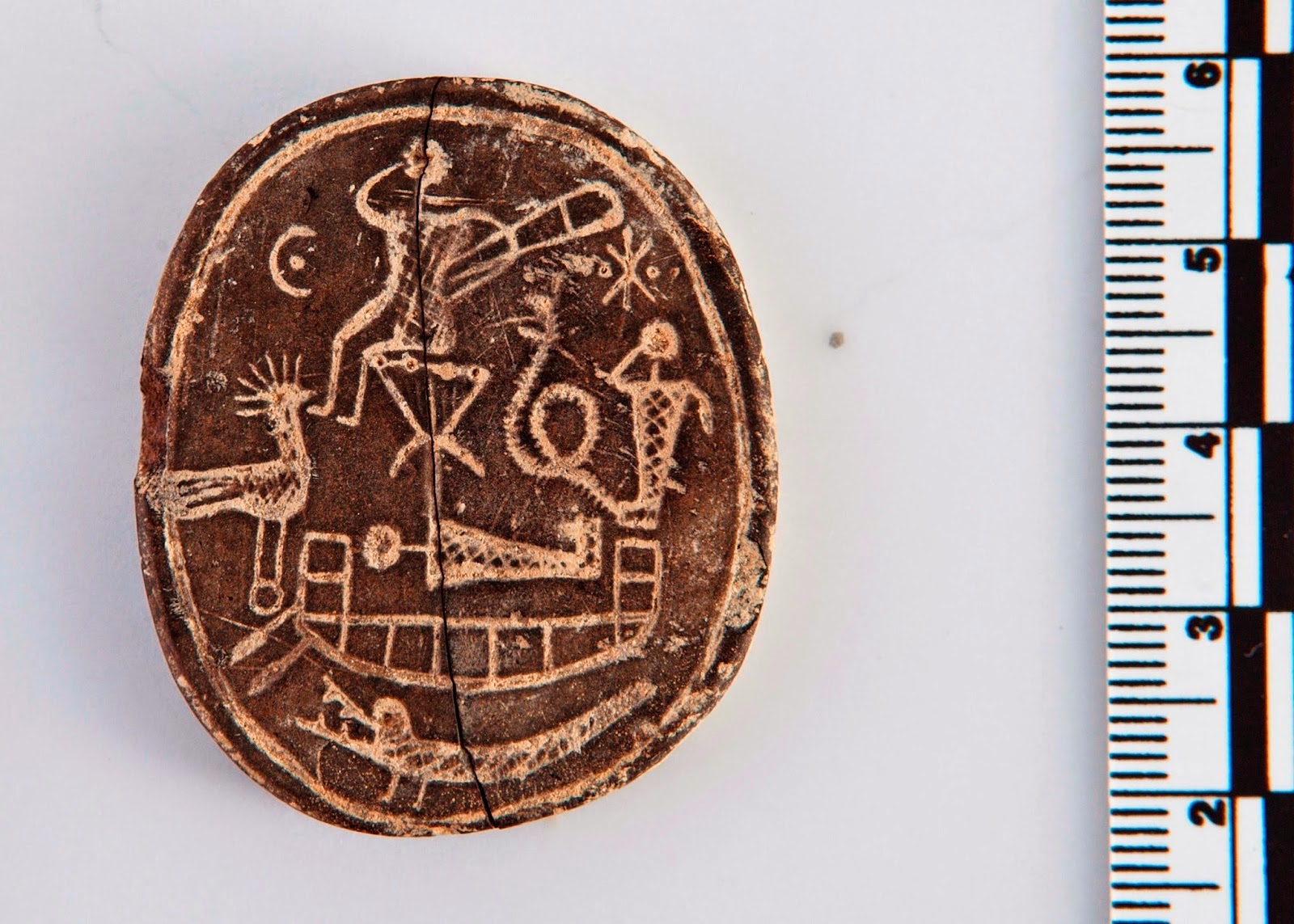


The amulet has several images. 
At the bottom, there is a mummy (likely the Egyptian  god Osiris) wrapped in bandages, lying on a boat. Above the mummy, there is an  image of Harpocrates, a god of silence, shown sitting on a stool. Harpocrates’ right  hand is raised up to his lips and there is a scepter in his left hand. To the right  of Harpocrates there is a dog-headed creature called a cynocephalus that has  a paw beside its lips, mimicking Harpocrates gesture. 
There is a snake between  the cynocephalus and Harpocrates, the snake’s head facing Harpocrates. There  are also depictions of a crocodile, bird (likely a rooster), half moon and a star  
[Credit: Marcin Iwan/Jagiellonian University, Krakow/ Paphos Agora] 


By the 5th century, Christianity was the official religion of the Eastern Roman Empire, and as time went on, traditional polytheistic (also called pagan) practices came under tighter restrictions and bans. 
Nevertheless, some people continued to practice the old beliefs, worshipping the traditional gods. 
This amulet adds to evidence that people practiced traditional, polytheistic beliefs on Cyprus for an extended time, Papuci-Wladyka said. 
She notes that a structure called the Villa of Theseus has a mosaic with pagan elements that was likely repaired as late as the 7th century A.D. 
It "rather seems that Christian and pagan religions coexisted in Paphos in times of [the] amulet being in use," Papuci-Wladyka told Live Science in an email. 
Strange iconography Despite that coexistence, the amulet has several unusual features that suggest its creator didn't fully understand the mythological characters depicted. "It must be stated that the depiction is fairly unskilled and schematic. It is iconographically based on Egyptian sources, but these sources were not fully understood by the creator of the amulet," Śliwa wrote in the journal article. 
For instance, rather than sitting on a stool, Harpocrates should be sitting on a lotus flower, with legs drawn up, Śliwa said. 
Additionally, the dog-headed cynocephalus should not be mimicking Harpocrates. In "the classic version, the cynocephalus faces Harpocrates with paws raised in adoration," Śliwa wrote.
"We can find no justification for the cynocephalus's gesture of raising its right paw to its lips in a manner similar to Harpocrates."
 Even stranger is the fact that Harpocrates and the cynocephalus have crisscrossing lines on their bodies, which suggest the ancient artist thought these figures should be mummified along with Osiris. 
While the cynocephalus can be shown with mummy bandages, Harpocrates is not supposed to have them. 
Mummy bandages have "no justification in the case of Harpocrates," Śliwa wrote. 

Author: Owen Jarus | 

Source: LiveScience [January 01, 2015] 

giovedì 7 agosto 2014

Palaepaphos

Citadel wall discovered at Kouklia-Palaepaphos 


On the outskirts of the village of Kouklia, a short distance to the east of the sanctuary of Aphrodite at Palaepaphos, the archaeological mission of the University of Cyprus, under the direction of Professor Maria Iacovou, located an impressive citadel wall of the Classical period on the plateau of Hadjiabdoulla. 

The wall defines and protects the north site of a monumental edifice known since the 1950s as the palace of the last royal dynasty of Ancient Paphos. 
The rampart extends for over 80 meters and many of its walls are preserved to a height of a meter and a half. 


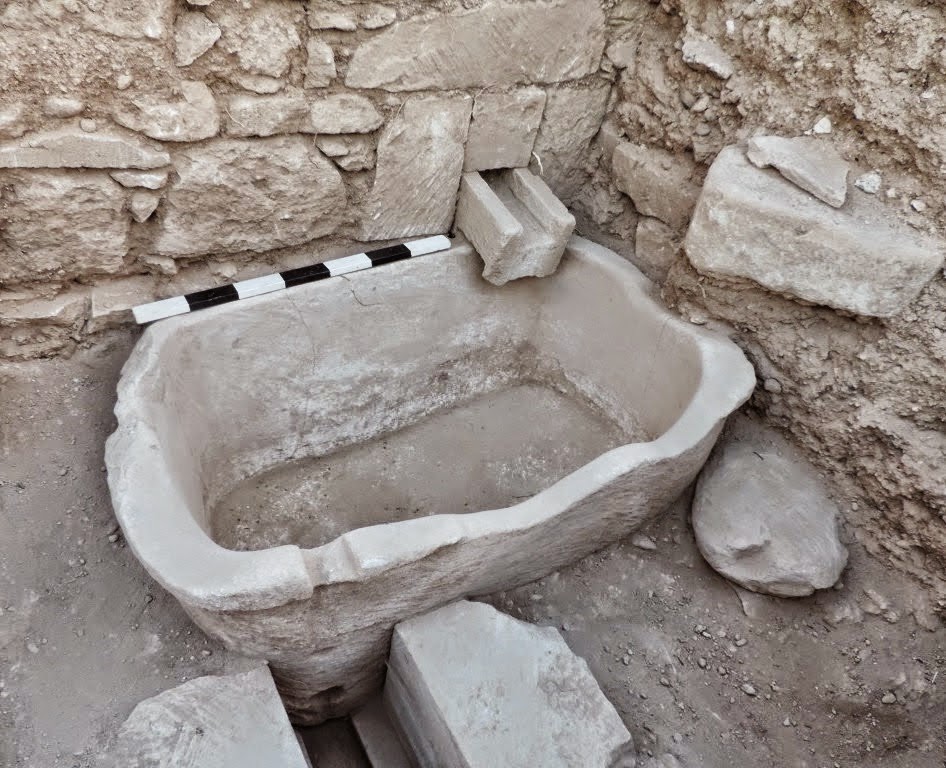
Part of the Citadel wall found at Kouklia with a stone basin  [Credit: University of Cyprus] 


The citadel wall on Hadjiabdoulla is a well-designed scheme of defensive architecture; it consists of three main parts:

(a) a three-meter wide main wall; 
(b) long and narrow cross walls, which are built against the main wall and extend almost to the edge of the cliff; 
(c) there, they join a curtain wall that runs parallel to the main wall. 

The curtain wall is the topmost of a series of descending terrace walls built against the steep slope of the cliff. This is the most impressive part of the system and it suggests that the natural slope in its entirety was incorporated in the defensive scheme. The compartments created between cross walls and terrace walls were evidently used for storage and for the industrial facilities of the palace. 
Two large storage vessels were found in situ, while numerous pithos fragments that belonged to local and imported vessels were found in almost every room. The team also exposed an industrial installation set between two of the terrace walls; it consists of a deep stone basin (bathtub) and a drainage system made of finely cut stones.
 Collapsed roof material bearing the impression of beams, as well as large roof tiles show that the complex included extensively roofed spaces. 
In addition, many of the walls were coated with plaster. Evidently, the north wall of the citadel was a significant and well-maintained part of the palace compound. 


Excavations at Kouklia-Palaepafos, 2014  [Credit: University of Cyprus]


 This year’s campaign lasted for five weeks, and it was made possible thanks to the financial contribution of ALPHA Bank Cyprus and donations made by Mr Christakis Agathagelou and Mr Stephanos Stephanou, both of whom are Kouklia community members. During his annual visit to the excavation, the Rector of the University of Cyprus thanked the benefactors and underlined the significance of the local community’s active participation in a long-term field project, which adds new monuments and new insight into the history of the kingdom of Paphos. 
Palaepaphos was the capital of the Paphian kingdom almost to the end of the fourth century BC, but its town plan and its different urban sectors, which appear to have occupied the plateaus around the sanctuary, are almost invisible. The primary target of the “Palaepaphos Urban Landscape project”, which was initiated in 2006 by Professor Maria Iacovou of the Archaeological Research Unit, is to uncover and study the structure of the capital centre. 


Source: Department of Antiquities, Republic of Cyprus 

[August 04, 2014]

Read more at: http://archaeologynewsnetwork.blogspot.it/2014/08/citadel-wall-discovered-at-kouklia.html?utm_source=feedburner&utm_medium=feed&utm_campaign=Feed:+TheArchaeologyNewsNetwork+(The+Archaeology+News+Network)#.U-N3zih7DfW
Follow us: @ArchaeoNewsNet on Twitter | groups/thearchaeologynewsnetwork/ on Facebook

sabato 7 giugno 2014

Nuovo modello di neolitizzazione

La 'Multidisciplinarietà' paga sempre: l'Università di Barcellona - insieme a quella di Madrid - offre (su PLOS  Genetics) un nuovo modello d'espansione della 'Rivoluzione' Neolitica partendo da studi sul DNA di varie popolazioni del Bacino Mediterraneo e confrontando i risultati co genetici con quelli archeologici.
Le conclusioni lasciano intravedere alcuni scenari possibili:

- esistono alcune evidenti affinità genetiche tra DNA mt delle prime popolazioni neolitiche e i primi agricoltori Catalani e della Germania. Ciò lascerebbe pensare che possibilmente l'espansione neolitica si verificò attraverso un pionierismo di piccole popolazioni.

- le due principali modalità di spostamento potrebbero essere geneticamente correlate.

- le similarità genetiche riscontrate tra Mezzaluna Fertile  da un lato e Cipro e Creta dall'altro, permette d'ipotizzare che la trasmissione si ebbe a mezzo un pionierismo via mare, piuttosto che non via terra come prima creduto. Anche i modelli  rituali funebri lasciano propendere per questa conclusione. I reperti C14 concordano.

- Ci si ripropone - adesso - di incrementare i numeri dello studio, per aumentarne la significatività scientifica.


DNA analysis 

of Near Eastern farmers supports 

Neolithic migration through Cyprus and Aegean 


 The mitochondrial DNA of the first Near Eastern farmers has been sequenced for the first time. 

In the research, published in the journal PLOS Genetics, experts analysed samples from three sites located in the birthplace of Neolithic agricultural practices: the Middle Euphrates basin and the oasis of Damascus, located in today’s Syria and date at about 8,000 BC. 


Experts analysed samples from three sites located in the birthplace of Neolithic  agricultural practices [Credit: Dr. Alejandro Pérez-Pérez] 


The paper is signed by Daniel Turbón and Alejandro Pérez Pérez, from the Department of Animal Biology of the University of Barcelona (UB); Eva Fernández, from Liverpool John Moores University; Cristina Gamba, Eduardo Arroyo Pardo and Pedro Cuesta, from Complutense University of Madrid; Eva Prats, from the Spanish National Research Council, and Josep Anfruns and Miquel Molist, from the Universitat Autònoma de Barcelona (UAB). 

The study is focused on the analysis of mitochondrial DNA —a type of non-Mendelian maternally inherited DNA— from the first Neolithic farmers, by means of samples obtained by the UAB research group which were first processed by the UB research group. 

The Neolithic: a profound revolution in human societies Agricultural and husbandry practices originated around 12,000 years ago in a region of the Near East known as the Fertile Crescent. 

This phenomenon, known as “Neolithic”, meant a profound social, cultural and economic transformation of human populations (agricultural production, sedentary farming lifestyle, origin of the first cities and modern societies, etc.).


Sites are located in today’s Syria and date at about 8,000 BC. [Credit: Dr. Alejandro Pérez-Pérez] 


Eva Fernández, first author of the article who got her PhD from UB, explains that “the Neolithic Revolution rapidly expanded from these territories into Europe, where the hunter-gatherer subsistence economy —prevailing till then— was replaced by an agropastoral producing system”. 

To know the nature of the diffusion of the Neolithic —in other words, to know if it was a population migration process or a cultural adoption— has been widely debated for the last fifty years. 

Different research fields, for instance archaeology, physical anthropology, linguistics and, more recently, human paleogenetics, have made contributions to the discussion. 

The unknown genetics of first Near Eastern farmers 

The genetic composition of first Neolithic populations was one of the mysteries of science till today, although some advances in European Neolithic populations’ genetics were made during the last decade. 
Professor Daniel Turbón points out that the results revealed by the study published in PLOS Genetics “are the first ones regarding first Near Eastern farmers; in other words, the genetic stock of original Neolithic”.


 Samples were obtained by the UAB research group and first processed by the  UB research group [Credit: Dr. Alejandro Pérez-Pérez] 


However, it is important to remember that other data have been published about European first farmers, to be exact in Catalonia (by Cristina Gamba et al., 2012), the Basque Country (by Hervella et al.) and Germany (by Wolfgang Haak et al., 2010, and Brandt et al., 2013).

 “Conclusions of previous studies —explains Turbón— are based on the comparison with current Near East populations, as first agricultural societies’ genetics have remained unknown until now”.

From the Near East to Europe 

The study published in PLOS Genetics provides a new framework to interpret the results of other studies about European Neolithic populations, stress the authors. 
According to conclusions, genetic affinities have been observed between the mitochondrial DNA of first Neolithic populations and the DNA of first Catalan and German farmers. 


The study is focused on the analysis of mitochondrial DNA —a type of non-Mendelian maternally inherited DNA— from the first Neolithic farmers [Credit: Dr. Alejandro Pérez-Pérez] 


This suggests that probably Neolithic expansion took place through pioneer migrations of small groups of population. 

Moreover, the two main migration routes ―Mediterranean and European― might have been genetically linked. 

“The most significant conclusion —highlights Eva Fernández— is that the degree of genetic similarity between the populations of the Fertile Crescent and the ones of Cyprus an Crete supports the hypothesis that Neolithic spread in Europe took place through pioneer seafaring colonization, not through a land-mediated expansion through Anatolia, as it was thought until now”.

How did the Neolithic Revolution spread? Other scientific studies had already provided signs of an alternative scenario of Neolithic spread in Europe different from the one through Anatolia. 
According to Turbón, “recent archaeological finds have proved that the Neolithic arrived to Cyprus around 10,600 years ago, some years after the first documentation of agricultural practices in the Near East”. 


The study provides a new framework to interpret the results of other studies about  European Neolithic populations [Credit: Dr. Alejandro Pérez-Pérez] 


Architecture and burial models found in Cyprus’ sites are similar to the ones found in the Middle Euphrates basin, “that indicates a direct colonisation of these territories”, highlights the author.

 “Besides, spatial interpolation of radiocarbon dates from different Neolithic sites in the Near East and Europe also suggests a first seafaring expansion through Cyprus”, he concludes.

In order to support these conclusions, the scientific team aims at analysing a greater number of human Neolithic samples from other regions of the Fertile Crescent, and at increasing the number of genetic markers analysed in the samples. 

Source: Universitat de Barcelona [July 06, 2014

Read more at: http://archaeologynewsnetwork.blogspot.it/2014/06/dna-analysis-of-neolithic-near-eastern.html?utm_source=feedburner&utm_medium=feed&utm_campaign=Feed:+TheArchaeologyNewsNetwork+(The+Archaeology+News+Network)#.U5LnDHJ_uSp
Follow us: @ArchaeoNewsNet on Twitter | groups/thearchaeologynewsnetwork/ on Facebook

martedì 29 aprile 2014

Busto di Alessandro il Grande: a Cipro.


Bust of Alexander the Great found in Cyprus 

 A second three-aisled basilica was brought to light by archaeologists on the site of Katalymmata ton Plakoton, of the Akrotiri peninsula, in Cyprus.


 The marble stele with a bust of the Byzantine emperor Heraclius personified as Alexander the Great 
[Credit: ΑΠΕ-ΜΠΕ] 


Excavations by the Cyprus Antiquities Department in the area have been in progress since 2007 when the first basilica was revealed. However, the new basilica is not the only important finding. Archaeologists also discovered a marble stele with a bust of the Byzantine emperor Heraclius personified as Alexander the Great. It is believed that the two basilicas are part of a monumental ecclesiastical complex which according to Eleni Procopiou, an area officer for the Antiquities Department, is related to St John the Merciful, Patriarch of Alexandria, the patron saint of Limassol. 


The south transept of the first basilica excavated at Katalymmata ton Plakoton 
[Credit: Cyprus Dept. of Antiquities] 


The first basilica is a burial monument 36 meters in width and 29 meters in length, without the apse protruding to the west. Procopiou stated that the second basilica is also a burial monument 20 meters in width and 47 meters in length. It is estimated that the findings date back to the second decade of the 7th century, between 616-617 A.D. “This literally helps us understand and re-write the history of the 7th century in Cyprus. We estimate that after its construction, it had a very short life-span of approximately 30 years before it was abandoned and destroyed. This was a very important place and housed the relics of some very important people,” Procopiou stated. 


Author: Nikoleta Kalmouki  

Source: Greek Reporter [April 28, 2014]

Read more at: http://archaeologynewsnetwork.blogspot.it/2014/04/bust-of-alexander-great-found-in-cyprus.html?utm_source=feedburner&utm_medium=feed&utm_campaign=Feed:+TheArchaeologyNewsNetwork+(The+Archaeology+News+Network)#.U1-dYSh7DfW
Follow us: @ArchaeoNewsNet on Twitter | groups/thearchaeologynewsnetwork/ on Facebook

sabato 12 ottobre 2013

Madre di tutti i profumi

Su una rivista botanica Finnica, compare la descrizione di una crucifera (come sono il cavolo, la senape ed il radicchio) che sarebbe la madre delle piante già usate nell'antica industria cosmetica: è la Reseda Minoica, pianta ormai rara, che corre il rischio di estinzione. Già abbiamo perso il silphium: speriamo di non dovere rimpiangere altre essenze rare...


Experts discover the 

mother of Roman perfumes 

on Mediterranean coast


Researchers at the Pablo de Olavide University in Seville have described a new plant in the eastern Mediterranean, growing mainly near the coast. The importance of this discovery is that the plant is the maternal ancestor of a species of hybrid origin, Reseda odorata, used since Roman times due to the fragrance of its flowers, and whose essence was used in the ancient cosmetics industry.

Experts discover the mother of Roman perfumes on Mediterranean coast
Researchers at the Pablo de Olavide University in Seville have described a new plant in the eastern Mediterranean, growing mainly near the coast. The importance of this discovery is that the plant is the maternal ancestor of a species of hybrid origin, Reseda odorata, used since Roman times due to the fragrance of its flowers, and whose essence was used in the ancient cosmetics industry [Credit: Santiago Martin Bravo et. al.]
An article published in the journal Annales Botanici Fennici describes a new species of flowering plant, Reseda minoica, from the eastern Mediterranean region, more specifically from Crete (Gavdos Island, Greek's southernmost island), Cyprus and Southern Turkey. "This species belongs to the genus Reseda of the Resedaceae family, related to the Cruciferae -- which includes plants such as cabbage, mustard and radish -- and grows on limestone substrates in scrubland near the coast," Santiago Martin Bravo, co-author of the study and Botanical researcher at the Pablo de Olavide University in Seville (UPO), explains.

The plant is included in section Phyteuma of Reseda genus, a taxonomically complex group mostly containing narrow endemics from the western or eastern Mediterranean region, areas considered to be of critical importance in the diversification of Mediterranean flora.

"Until now this plant has been confused with related species such as R. odorata, R. orientalis and R. balansae," the research adds. Reseda minoica can be distinguished from these other species by its lower number of stamens, seed size and petal colour.

According to Pedro Jimenez Mejias, the other co-author of the study and also a researcher at UPO, "the importance of this discovery is that Reseda minoica is the maternal ancestor of a cultivated species of hybrid origin, Reseda odorata, used since Roman times due to the fragrance of its flowers, and whose essence was used in the ancient cosmetics industry. The location of one of the parts of its origin (the mother species), provides information about the evolutionary mechanisms which produce species which are later useful to humankind."

Moreover, the scientists believe that the plant is "at present rare," and could require protection so that it does not become extinct. "If this were to happen, we would lose part of the Mediterranean's plant genetic resources, with a potential consequent loss for humankind in terms of use and opportunity," Jimenez notes.

In any case, since the species is a recent discovery, it is possible that botanists from areas where the plant grows will begin to search and discover it in other places.

Two other new species in Africa

The two researchers were also part of the recent discovery of two other new African species belonging to the genus Carex of the Cyperaceae family, which includes species such as the tiger nut and papyrus. One of these, Carex rainbowii, has been found in forests of the Drakensberg mountain range, in the KwaZulu-Natal region in eastern South Africa. The other, Carex modesti, is only known to exist at the edges of streams and peat bogs in a very localized area of the mountains of southern Tanzania.

The description of both species is a good example of the significant amount of biodiversity that may remain undiscovered, especially in remote areas of the planet, including in groups of living things well-known a priori such as plants and flowers.

Source: Plataforma SINC [October 09, 2013]