Introduction
Creationists have often been criticized for failing to present original
research and evidence that would overthrow our contemporary scientific
view of human origins. However, this is not entirely fair. The creation
"science" field known as OOPARTS, or "Out Of Place ARTifactS", is a
lively area of study that relies on "anomalous" finds in the
archaeological record to challenge scientific chronologies and models of
human evolution. In this paper, we will examine one of the most popular
and least understood OOPARTS specimen, the Coso Artifact.
The story of the Coso Artifact has been embellished over the years, but
nearly all accounts of the actual discovery are basically the same. On
February 13, 1961, Wallace Lane, Virginia Maxey, and Mike Mikesell were
seeking interesting mineral specimens, particularly geodes, for their
LM&V Rockhounds Gem and Gift Shop in Olancha, California. The trio
was about 6 miles northeast of Olancha, near the top of a peak about
4300 feet in elevation and about 340 feet above the dry bed of Owens
Lake. At lunchtime, after collecting rocks most of the morning, all
three placed their specimens in the rock sack Mikesell was carrying
(Steiger 1974: 49).
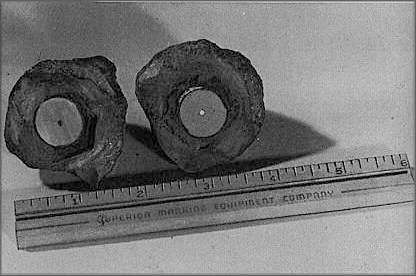
The next day in the gift shop's workroom, Mikesell ruined a nearly new
diamond saw blade while cutting what he thought was a geode. Inside the
cut nodule, Mikesell did not find the cavity that is typical of geodes,
but a perfectly circular section of very hard, white material that
appeared to be porcelain. In the center of the porcelain cylinder was a
2-millimeter shaft of bright metal. The metal shaft responded to a
magnet. There were other odd qualities about the specimen. The outer
layer of the specimen was encrusted with fossil shells and their
fragments. In addition to shells, the discoverers noticed two
nonmagnetic metallic objects in the crust, resembling a nail and a
washer. Stranger still, the inner layer was hexagonal and seemed to form
a casing around the hard porcelain cylinder. Within the inner layer, a
layer of decomposing copper surrounded the porcelain cylinder.
The Initial Investigations
Very little is known about the initial physical inspections of the
artifact. According to Maxey, a geologist she consulted who examined the
fossil shells encrusting the specimen said that the nodule had taken at
least 500 000 years to attain its present form. However, the identity
of the first geologist is still a mystery, and his findings were never
published.
Another investigation was conducted by creationist Ron Calais. Calais is
the only other individual known to have physically inspected the
artifact, and he was allowed to record images of the nodule using both
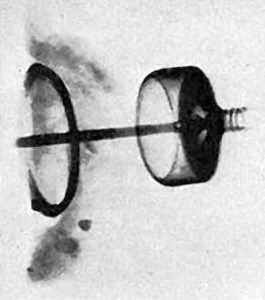
X-ray and natural-light photography. Calais's X-rays brought interest in
the artifact to a new level. The X-ray of the upper end of the object
seemed to reveal some sort of tiny spring or helix.
INFO Journal
editor Ronald J Willis (1969) speculated that it could actually be "the
remains of a corroded piece of metal with threads." The other half of
the artifact revealed a sheath of metal, presumably copper, covering the
porcelain cylinder.
The last individual known to possess the Coso Artifact was one of the
original discoverers, Wallace Lane. Lane had the object on display in
his home, but he adamantly refused to allow anyone to examine it (Willis
1969). However, he had a standing offer to sell it for $25 000. In
September 1999, a national search to locate any of the original
discoverers proved fruitless. We suspect that Lane is dead. Maxey is
alive, but is avoiding any public comment, and the whereabouts of
Mikesell remain unknown. The location and disposition of the artifact
are also unknown. Willis's 1969 article is the primary source for
information on this object to date.
Fantastic Speculations
Ever since the artifact was first discovered, numerous individuals have
speculated about its mysterious origin and possible use. Maxey
speculated that the specimen may have been no more than 100 years old
after being deposited in a mud bed and sun-baked. However, she also
apparently claimed that the artifact could be at least 500 000 years
old, "an instrument as old as Mu or Atlantis. Perhaps it is a
communications device or some sort of directional finder or some sort of
instrument made to utilize power principles we know nothing about"
(Steiger 1974).
INFO Journal editor Willis speculated that the artifact
was some sort of spark plug. His brother found the suggestion
extraordinary: "I was thunderstruck," he wrote, "for suddenly all the
parts seemed to fit. The object sliced in two shows a hexagonal part, a
porcelain or ceramic insulator with a central metallic shaft - the basic
components of any spark plug" (Willis 1969). However, they could not
reconcile the upper end featuring a "spring", "helix", or "metal
threads" with any contemporary spark plug. So the mystery continued. The
artifact even appeared briefly at the end of an
In Search Of ... episode hosted by Leonard Nimoy.
The internet offers a plethora of other opinions on the subject. While
most writers simply report the mystery as described earlier, some have
taken to speculating on the purpose and origin of such a device. Brian
Wood, describing himself as "Co-Producer, ParaNet UFO Continuum [and]
International Director of MICAP [Multinational Investigations
Cooperative on Aerial Phenomena]", suggested that if it is not simply a
spark plug, "My guess would be some sort of antenna. The construction
reminds me of modern attempts at superconductors" (Wood 1999).
Joe Held of "Joe's UFOs and Space Mysteries" thinks that the device
"looks similar to a small capacitor with several different materials.
The object is roughly the size of an auto spark plug. Since the
formation of geodes can take millions of years this was a very curious
find indeed" (Held 1999).
The Creationists and the Artifact
With such outrageous speculation, individuals familiar with the
creationism/evolution controversy might assume that fundamentalist
Christians would stay far away from such artifacts and stories. But this
is far from the case. Numerous creationists have been involved with
this artifact since its discovery. Calais, who was involved with the
Coso Artifact since its initial discovery, is an active contributor to
creationist literature (see, for example, Calais and Mehlert 1996). He
brought the artifact to the attention of the Charles Fort Society,
publisher of
INFO Journal. Creation Outreach, a Spokane,
Washington-based creationism ministry promotes the artifact on its
website by reprinting an article by JR Jochmans which concludes:
As a whole, the "Coso artifact" is now believed to be
something more than a piece of machinery: The carefully shaped ceramic,
metallic shaft and copper components hint at some form of electrical
instrument. The closest modern apparatus that researchers have been able
to equate it with is a spark plug. However, there are certain features -
particularly the spring or helix terminal - that does [sic] not correspond to any known spark plug today (Jochmans 1979).
It should also be noted that according to a letter printed in
Atlantis Rising, Jochmans claims to have ghost-written three-quarters of the book
Secrets of the Lost Races
by Rene Noorbergen (1977), which has often been cited as a reference
for the Coso Artifact by young-earth creationists (Jochmans 1999). For
example, Carl Baugh, a young-earth creationist whose claim to fame is
the promotion of the Paluxy River tracks, relies on Noorbergen (1977) in
his discussion of the Coso Artifact in his dissertation (Baugh 1989).
Elsewhere in the Pacific Northwest, Institute for Creation Research
(ICR) adjunct faculty member Donald Chittick has been heavily promoting
the Coso Artifact. In
The Puzzle of Ancient Man, Chittick (1997) presents the Coso Artifact as evidence that ancient civilizations were extremely advanced. Presuming that it
is
an ancient spark plug, Chittick explains his inference that this find
indicates technological sophistication. He admits that reliable dates
are unlikely, but then goes on to argue that the plug is old because
geodes take too long to form. Chittick's discussion assumes that the
plug was found inside a naturally occurring geode, which would indicate
great age and therefore an "out-of-place" artifact. This, he argues,
refutes evolution, since evolutionary models fail to explain the
existence of such sophisticated technology so long ago.
The Geologic Evidence: Is the Coso Artifact Encased in a Geode?
When it comes to the geologic evidence, the most stunning claim is that
the artifact was discovered in a geode. As Chittick has noted, formation
of a geode requires significant amounts of time. But what is often
overlooked is that the Coso Artifact possesses no characteristics that
would classify it as a geode. The fact that the original discoverers
were looking for geodes on the day the artifact was found is not
sufficient evidence that the artifact
is a geode.
Geodes consist of a thin outer shell composed of dense chalcedonic
silica and filled with a layer of quartz crystals. The Coso Artifact
does not possess either feature. Maxey referred to the material covering
the artifact as "hardened clay" and noted that it had picked up a
miscellaneous collection of pebbles, including a "nail and washer".
Analysis of the surface material using the standard Mohs scale suggests a
hardness of Mohs 3, which is much softer than chalcedony.
Other arguments regarding the ancient source of the Coso Artifact focus
on the alleged fossil shells encrusted on the surface. If, as noted
earlier, a nail and washer were also found on the same surface as the
fossil shells, then the power of the inference of an ancient age for the
artifact is seriously diminished. Even creationist literature notes how
transport, erosion, or other geological changes in surface materials
can lead to mistaken assumptions about the true age of individual
objects. For example,
Creation Ex Nihilo's June-August 1998
issue features fence wire that had become encased by surface materials
including "fossil" seashells ([Anonymous] 1998b, quotation marks in the
original; see also [Anonymous] 1991, 1998a, 1999).
The Artifact Itself: What Is It?
As noted earlier, numerous individuals have speculated about the
identity of the Coso Artifact. The most common suggestion is that it is
some sort of spark plug, designed and manufactured by an advanced
civilization eons ago for technological devices equal to or surpassing
our own. But there is no reason to conclude that the artifact was
manufactured thousands of years ago. Some have half-heartedly suggested
that the device could have been a contemporary spark plug circa 1961.
But ancient artifact proponents point to the X-ray of the top half,
which indicates some type of tiny spring or helix mechanism. The content
of this X-ray, they argue, runs contrary to what we know about
contemporary spark plugs.
A clue to what is revealed in the X-ray lies in one of the earliest
articles about the artifact. Willis (1969) suggested that the upper end
of the object "is actually the remains of a corroded piece of metal with
threads." The Willis brothers seriously suspected the object was a
contemporary spark plug, but were still unable to explain what was in
the X-ray. Spark plugs of the 1960s typically terminated with no visible
threading and tapered to a dull point. Though many of the interested
parties agreed that the artifact bore a striking resemblance to a
20th-century spark plug, no one seems to have considered the idea of
evolution - specifically, spark plug evolution.
Investigating the origins of the Coso Artifact revealed that mining
operations were conducted in the area of discovery early in the 20th
century. If internal combustion engines were used in these operations in
the Coso mountain range, they would have been a very new technology at
the time. So we extrapolated that spark plug technology would also have
been in its infancy. To help us to learn more about spark-plug
technology of a century ago, we enlisted the help of the Spark Plug
Collectors of America (SPCA). We sent letters to four different spark
plug collectors describing the Coso Artifact, including Calais's X-rays
of the object in question. We expected the SPCA to provide some vague
hints or no information at all about the artifact. The actual answers
were stunning.
On September 9, 1999, Chad Windham, President of the SPCA, called Pierre
Stromberg. Windham initially suspected that Stromberg was a fellow
spark plug collector, writing incognito, with the motive of hoaxing him.
His fears were compounded by the fact that there is an actual line of
spark plugs named "Stromberg". Though Stromberg repeatedly assured
Windham that his intentions were purely for research, he was puzzled why
Windham was so suspicious and asked him to explain. Windham replied
that it was so obvious to him that the artifact was a contemporary spark
plug, the letter had to be a hoax. "I knew what it was the moment I saw
the X-rays," Windham wrote.
Stromberg asked Windham if he could identify the particular make of the
spark plug. Windham replied he was certain that it was a 1920s-era
Champion spark plug. Later, Windham sent 2 identical spark plugs for
comparison. Ten days after Windham's telephone call, Bill Bond, founder
of the SPCA and curator of a private museum of spark plugs containing
more than 2000 specimens, called Stromberg. Bond said he thought he knew
the identity of the Coso Artifact: "A 1920s Champion spark plug." Spark
plug collectors Mike Healy and Jeff Bartheld (Vice President of the
SPCA) also concurred with Bond's and Windham's assessment about the
spark plug. To date, there has been no dissent among the spark plug
collectors as to the identity of the Coso Artifact.
Since Windham mentioned that spark plug collectors enjoy pulling pranks
on one another, the question of deliberate fraud inevitably crops up in
relation to the Coso Artifact. However, there is little hard evidence
that the original discoverers intended to deceive anyone from the start.
Furthermore, the Spark Plug Collectors of America was formed in 1975,
well after the discovery of the artifact, and none of the 3 discoverers
was ever affiliated with the organization.
Comparisons and Analysis
On September 14, 1999, Stromberg received a package from Windham
containing 2 spark plugs and an analysis of the specimens. Windham
wrote:
I am enclosing two spark plugs made by Champion Spark Plug
company circa 1920s. Plug #1 is 7/8" #18 thread. I have loosely
assembled the plug, and chipped the "brass hat" off to show the
configuration of it and the porcelain under it. Plug #2 is 1/2" NPT of
same design.
The diameter of the porcelain on Plug #1 is slightly less than 3/4" -
close to the dimension in your letter. As you can see[,] the base and
packing nut[,] which hold the porcelain, are sealed with a copper and
asbestos gasket. This corresponds with the article. The center electrode
of plugs were made of special alloys which were "... cut in two in 1961
but five years afterwards had no tarnishing visible."
The sketches included clearly show one rib on the upper end of the
porcelain, although Champion used two ribs in this era - probably just
an artist's error. The "top hat["] matches those of "plug 1 and 2".
As for the outer shell, it obviously decayed - probably from salt water
(or other corrosive substance) [-] and the outer crust is merely some
sort of deposit like sea shells or other deposits collected on the
deteriorating surfaces of the spark plug base.
There is no doubt that this is merely an old spark plug. Most probably,
it is a Champion spark plug, similar to the two enclosed.
The most striking aspect of Windham's description is the brass "top hat"
that has so vexed previous attempts to provide a rational explanation
for the artifact. But other similarities are even more significant.
Because Windham had chipped the brass top hat off specimen #1, the spark
plug revealed a metal shaft terminating in a flared end, presumably to
help to secure the top hat to the plug's porcelain cylinder. The same
sort of flared end also appears in the metal shaft of the Coso Artifact.
The shaft in the X-ray, just below the flare, also reveals
deterioration where it was exposed to the elements above where it meets
the porcelain cylinder. This, too, is exactly what we would expect from a
1920s-era Champion spark plug. An X-ray of the specimen that Windham
sent us reveals a picture very similar to the original X-ray of the Coso
Artifact. As with the original artifact, the central metal shaft of
both specimens responds to a magnet.
Proponents of fantastic stories regarding the artifact have made mention
of mysterious copper rings that encase the porcelain. But this too can
be easily explained. Windham provided one completely disassembled plug
(specimen #1). It revealed a pair of copper rings sandwiching an
asbestos lining. According to Windham, this design was necessary because
porcelain and steel have vastly differing expansion rates, so the
copper was used to compensate for some of the problems this difference
caused.
Specimen #2 was not disassembled by Windham, but also presented a
feature that could explain why the artifact had not been identified
decades ago. Specimen #2, though suffering from severe tarnish, came
with a top nut screwed into its top hat. Almost all Champion spark plug
advertisements of the first half of the 20th century showed pictures of
their spark plugs including the top nut already screwed into place. In
some cases, the top nut comes in two forms, one of which closely mimics
the tip of today's contemporary spark plugs, which have no threading
whatsoever. So it becomes rather easy to understand why the appearance
of threads in the Coso Artifact seemed so puzzling to the original
investigators.
It should be noted that the corrosion of the Coso Artifact almost
completely destroyed any of the iron-alloy-based components, with the
exception of the metal shaft encased in the porcelain cylinder. The
samples received from Windham also revealed corrosion of the iron-based
components, but the brass top hats were unscathed, except for some
tarnishing. If the Coso Artifact is indeed a 1920s-era Champion spark
plug, the X-ray of an almost perfectly preserved top hat is exactly what
one would expect. Brass, a copper-zinc alloy, is commonly engineered to
resist corrosion far better than iron-based alloys. In harsh
environments, copper tends to outlast iron, but still succumbs fairly
quickly. The rates of decay in the Coso Artifact match the rates of
decay one would see in a 1920s-era Champion spark plug. An excellent
review (Cronyn 1990) of how ferrous and non-ferrous alloys decay over
time includes numerous photographs, including X-rays, of contemporary
objects that have completely decayed into oxide nodules. Like the Coso
Artifact, these examples also feature empty cavities where the original
materials once resided.
The formation of the iron oxide nodule probably was hastened by the fact
that corrosive "mineral dust" is blown off the dry lake bed of Lake
Owen and onto the surrounding uplands where the artifact was discovered.
This dust contains salts created by the evaporation of the lake water
that are regularly blown off the lake bed by local windstorms. The US
Geological Survey has conducted extensive investigations of this
phenomena (Reheis 1997).
Reaction from the Paranormal Community
The embrace of the Coso Artifact by young-earth creationists is truly
puzzling. We asked the ICR's Donald Chittick why he felt the Coso
Artifact was an object worthy of presentation to the public, and
specifically how he reconciled a previous age estimate of 500 000 years
with his young-earth creationist beliefs. On September 29, 1999,
Chittick responded:
The article's speculation that it had taken at least 500 000
years to attain the present form is just that: speculation. Actual
petrifaction of such objects proceeds normally quite rapidly, as is
illustrated by several other similar formations. See for instance, the
note about the petrified miner's hat on the back cover of Creation Ex Nihilo (Vol 17, Nr 3) for June-August, 1995. See also an article about another "fossil" spark plug in Creation Ex Nihilo (Vol 21, Nr 4) for September- November, 1999 on page 6.
You asked what I thought about its age. My best guess is that it is
probably early post-Flood. I have not yet been able to obtain sufficient
documentation, so I don't say much publicly. However, there is evidence
that they did in fact perhaps have internal combustion engines or even
jet engines way back then.
Chittick's revelation that he was already aware of "fossil" spark plugs
was startling. We asked in a follow-up letter how he can positively date
the Coso Artifact to the Great Flood since he was already aware of
contemporary spark plugs that appear to be fossilized. In his response
on October 23, 1999, he commented:
It has not been my privilege to personally examine the Coso
Artifact or location and strata where it was found. There are two
reasons I considered the Artifact significant.
1. It obviously is a man-made item.
2. Those who evaluated the strata said that it appeared to be old, not
modern strata. Those two items are the principle basis for my conclusion
that it was worth study. Certainly it does merit further study in my
judgment. Numerous items like that abound, but I haven't been able to
document them as thoroughly as I would like, and so I don't say too much
about them.
As noted earlier, the alleged stratum where the Coso Artifact was found
is unknown since all 3 discoverers had separately searched for geodes
all morning before consolidating their collections in a single sack.
Even if the exact location were discovered, the artifact was an oxide
nodule freely lying on the surface, so the stratum where the item was
discovered is irrelevant, because surface deposits are an inconsistent
mix of eroded, transported, and generally jumbled-up materials that are
out of any meaningful geologic or archaeologic contexts.
Once the investigation revealed beyond a reasonable doubt the true
nature of the artifact, Stromberg notified Chittick via postal mail,
warning him about the publication of this paper and urging him to issue a
retraction and to paste a disclaimer in his book that the Coso Artifact
story is fallacious. Chittick never responded, and the second edition
of
The Puzzle of Ancient Man promotes the Artifact with no
disclaimer, but Chittick seems to have stopped mentioning the artifact
in his public lectures. When Ken Clark of Spokane's Creation Outreach
learned that the Artifact was a 1920s-era Champion spark plug and was
offered detailed proof, he ceased to communicate with us. Although
Creation Outreach continues to promote the spark plug on its web site by
reproducing Jochmans (1979), it adds the editorial note: "Several
readers have stated the artifact is indeed a sparkplug from the 1920s"
(see http://home.att.net/~creationoutreach/pages/strange.htm).
Conclusion
The Coso Artifact is a remarkable example of how pseudosciences such as
"creation science" fail when their analyses and conclusions are
investigated in a real-life archaeological situation. Perhaps the most
surprising revelation is the stunningly poor research Chittick conducted
regarding the Artifact. He persisted in portraying of the Artifact as
"ancient" evidence for advanced technology. (
RNCSE readers may
recall an earlier incident in which Chittick was confronted about his
erroneous statements regarding Lucy's knee joint [Stromberg 1998]; his
reaction was similar, ignoring warnings and continuing to mislead his
audiences.)
The Coso Artifact was indeed a remarkable device. It was a 1920s-era
Champion spark plug that probably powered a Ford engine, possibly
modified to serve mining operations in the Coso mountain range of
California. To suggest that it was a device belonging to an advanced
civilization of the ancient past could be interpreted as true, but only
if we redefine "ancient" to mean "the early 20th century".
Acknowledgments
This article is adapted from a longer, more detailed account of the Coso
Artifact that appears on the Talk.Origins Archive web site
(http://www.talkorigins.org/faqs/coso.html). This paper would not have
been possible without the gracious help from the following individuals:
Chad Windham, Bill Bond, Mike Healy, Jeff Bartheld, Arnie Voigt, David Q
King, Ken Atkins, Gary L Bennett, Alan Bowes, Linda Safarli, Casey
Doyle, Paul Cook, and Ross Langerak.