Visualizzazione post con etichetta genetica. Mostra tutti i post

martedì 27 ottobre 2015

Geni Mobili ed Evoluzione.

Scientists discover protein factories 

hidden in 

human jumping genes 


Breakingnews, Evolution, Genetics, Human Evolution 

Scientists have discovered a previously unknown wellspring of genetic diversity in humans, chimps and most other primates. 
This diversity arises from a new component of itinerant sections of genetic code known as jumping genes.
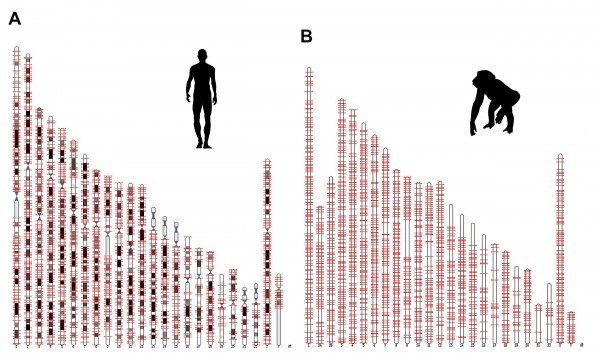


Salk researchers discovered a new genetic component, called ORF0, spread  throughout the DNA of humans, chimps and most other primates. This image  shows the locations of the ORFO on human and chimp chromosomes 
 [Credit: Salk Institute] 


In a paper published October 22, 2015 in Cell, Salk scientists report finding human and chimp DNA peppered with sequences of genetic code they've dubbed ORF0, which spreads throughout the genome on jumping genes. 
The ORF0 sequences may produce hundreds or even thousands of previously unknown proteins. 
The abundance of ORF0 instances in the human genome suggests that it played--and still plays--an important role in evolutionary diversity and flexibility by serving as a mechanism for generating novel proteins. The discovery of these mobile protein factories may also shine light on the origins of genetic mutations responsible for cancer, mental disorders and other diseases. 
"This discovery shows that jumping genes are an even more important source of variation in the primate genome than we thought, whether you're looking at the level of different species, different people or even the different cells within an individual's body," says Rusty Gage, senior author of the paper and a professor in Salk's Laboratory of Genetics. 
With the sequencing of the human genome, it became clear that jumping genes--mobile genetic elements first discovered in maize by Barbara McClintock in the early 1950s--were also present and highly active during human evolution. 
About half of the human genome resulted from sequences of genetic code that moved or insert extra copies of themselves throughout the genome. 
The evolutionary importance of jumping genes was highlighted by the results of another recent study by Gage and collaborators at Stanford. The research used stem cell technologies developed in Gage's lab to explore how differences in gene expression contribute to human and chimp facial structure. 
The findings, also reported in Cell, suggested that jumping genes played a role in the evolutionary split between humans and other primates. 
In the more recent study that uncovered ORF0, Gage and his colleagues focused on a class of jumping genes known as LINE-1 elements, which make up about 17 percent of the human genome. 
These elements contain all the necessary genetic machinery for moving themselves and other classes of jumping genes, unaided, to elsewhere in the genome. 
Previously, it was thought that LINE-1 elements contain just two sequences that coded for proteins, the ultimate product of genes that serve a wide range of roles in our cells and organs. 
These sequences are known as open reading frames (ORF), and the two previously known sequences, ORF1 and ORF2, are thought to be involved in producing proteins that are important for allowing LINE-1 elements to move around in the genome. In their new study, Gage and his colleagues discovered a third open reading frame. They named it ORF0 based on its location in the LINE-1 element next to ORF1. The scientists found ORF0 in about 3,500 locations in the DNA of humans and about 3,000 locations in the chimp and most other primate genomes. 
The structure of LINE-1 elements is such that when an element moves to another site there is a possibility that the ORF0 sequence can blend with genetic sequences in new location in DNA. The result of the new gene sequences can be a new protein. Evolutionarily speaking, this represents a way to generate entirely new molecules that could be beneficial to a species. On the other hand, the reshuffling of an existing ORF0 sequence during a jump could result in a disease-causing mutation. 
"This discovery redraws the blueprint of an important piece of genetic machinery in primates, adding a completely new gear," says Ahmet Denli, a staff scientist in Gage's lab and the first author on the paper reporting the findings. 
"Jumping genes with ORF0 are basically protein factories with wheels, and over the eons evolution has been driving the bus." 
Now that they have identified ORF0 in the primate genome, Denli says they plan to determine how many of the instances of ORF0 actually code for proteins and to investigate what function those proteins serve. The researchers also plan to investigate the behavior of ORF0 in different cell types and diseases. They are particularly interested in exploring its role in cancers and in neurological disorders such as schizophrenia, where previous studies have suggested jumping genes may be involved. 

Source: Salk Institute [October 22,2015]


martedì 15 settembre 2015

Da RAI NEWS

Pubblico senza commenti, per ora. Prossimamente, però, avrò modo di sfornare un articolo sulla rivista "Sardegna Antica" che conterrà alcuni chiarimenti che queste "notizie" - così brevemente espresse - certamente meritano.


14 settembre 2015 

Il gene "della bassa statura" 

Nuovi geni per la regolazione dell'altezza, la predisposizione verso malattie cardiovascolari e i livelli di emoglobina sulla popolazione sarda sono stati scoperti dal gruppo SardiNIA/ProgeNIA, guidato da Francesco Cucca, direttore dell'Istituto di ricerca genetica e biomedica del CNR.  
La ricerca e' stata pubblicata sulla prestigiosa rivista scientifica Nature Genetics che ha dedicato alle  scoperte tre diversi articoli e un editoriale. L'indagine hacoinvolto oltre 6600 volontari provenienti da Lanusei, Arzana, Ilbono ed Elini, quattro piccoli centri della Sardegna centro-orientale.  
Il team di scienziati ha sequenziato l'intero genoma di 2120 individui provenienti dai quattro paesi dell'Ogliastra. 
Sono state identificate due varianti genetiche con forte impatto sull'altezza della popolazione sarda, in grado di ridurre rispettivamente l'altezza di circa 4 e 2 cm.  
Secondo gli scienziati, questo indica un vantaggio selettivo per la bassa statura nei sardi, che rappresenta il primo esempio nella specie umana del gia' noto 'effetto dell'isola', secondo cui i mammiferi tendono a diventare piu' piccoli dopo centinaia di generazioni trascorse in ambiente insulare. 

Una risposta genetica all'anemia mediterranea 

Il secondo studio ha scoperto due nuovi geni associati con i livelli ematici dei lipidi e cinque nuovi geni associati con i livelli di molecole dell'infiammazione nel sangue, che hanno importanti ricadute cliniche per il loro effetto sul rischio di insorgenza di malattie cardiovascolari e infiammatorie. 
La terza scoperta ha analizzato il controllo genetico della produzione di emoglobina: lo studio congiunto delle tre diverse forme di emoglobina presenti nel sangue umano - sostengono i ricercatori - suggerisce che la loro regolazione e' coordinata geneticamente, per aumentare la produzione di specifiche forme di emoglobina  in anemie ereditarie come le beta-talassemie e l'anemia falciforme. 

Sardegna, laboratorio genetico d'Europa 

La popolazione sarda ha caratteristiche che costituiscono terreno fertile per le analisi genetiche: la distribuzione relativamente omogenea della variabilita' genetica in differenti aree dell'isola e, per via della sua antica e complessa storia demografica in Sardegna, la presenza di varianti genetiche molto rare altrove. 
Al tempo stesso quella sarda e' una popolazione che fornisce un'eccellente rappresentazione della variabilita' genetica trovata nell'intera Europa. Per questi motivi, molte delle correlazioni tra geni e malattie e tra geni e variabili misurabili come l'altezza, o i livelli ematici di lipidi ed emoglobina, inizialmente rilevate nei sardi, vengono poi replicate attraverso studi mirati in altre popolazioni Europee. 

 - See more at: http://www.rainews.it/dl/rainews/articoli/Perche-i-Sardi-sono-bassi-Scoperto-il-gene-responsabile-08a9d076-9bdb-444b-8b96-b0760be89a02.html

domenica 9 agosto 2015

L'aiuto della Genetica


Using modern human genetics to study ancient phenomena 


Anthropology, Breakingnews, Genetics, Human Evolution 


We humans are obsessed with determining our origins, hoping to reveal a little of  “who we are” in the process. 

It is relatively simple to trace one’s genealogy back a few generations, and there are many companies and products offering such services. 

But what if we wanted to trace our origins further on an evolutionary timescale and study human evolution itself? In this case, there are no written records and censuses. Instead, the study of human evolution has so far relied heavily on fossil specimens and archaeological finds. 
Now, genetic tools and approaches are frequently used to answer evolutionary questions and reveal patterns of divergence that reflect different selective pressures and geographical movement. 
This is particularly true for studies of human migrations out of Africa, global population divergence, and its consequences for human health. 


Figure 1. Diagrammatic representation of the serial founder effect model  
[Credit: Emma Whittington] 


Humans Originated in Africa

The current best hypothesis suggests anatomically modern humans (AMH) arose in East Africa approximately 200,000 YBP (Years Before Present). 
AMH migrated from Africa around 100,000-60,000 years ago in a series of dispersals that expanded into Europe and Asia between 60,000 and 40,000 YBP. 
It has been scientifically proven that East Africa is the origin of humans, and supported by both archaeological and genetic data. 
Genetic diversity is greatest in East Africa and decreases in a step-wise fashion from the equator in a pattern reflecting sequential founder populations and bottlenecks. 


Figure 1 shows three populations with decreasing genetic diversity (represented by the colored circles) from left to right. The first population, with the greatest genetic diversity, represents Africa. A second population is shown migrating away from ‘Africa’ taking with it a sample of the existing genetic diversity. This forms the founding population for the next series of migrations. Each time a population migrates it represents only a sample of genetic variation existing in its founding population, and in doing so, sequential migration (such as those in Figure 1) leads to a reduction in genetic diversity with increasing distance from the first population. 

Leaving Africa – Where do we go from here? 

Although the location of human origin is generally accepted, there is a lack of consensus around the migration routes by which AMH left Africa and expanded globally. 
There are many studies using genetic tools to identify likely migration routes, one of which is a recent PLOS One article by Veerappa et al (2015). 
In this study, researchers characterized the global distribution of copy number variation, which is the variation in the number of copies of a particular gene, by high resolution genotyping of 1,115 individuals from 12 geographic populations, identifying 44,109 copy number variants (CNVs). 
The CNVs carried by an individual determined their CNV genotype and by comparing CNV genotypes between all individuals from all populations, the authors determined similarity and genetic distance between populations. 

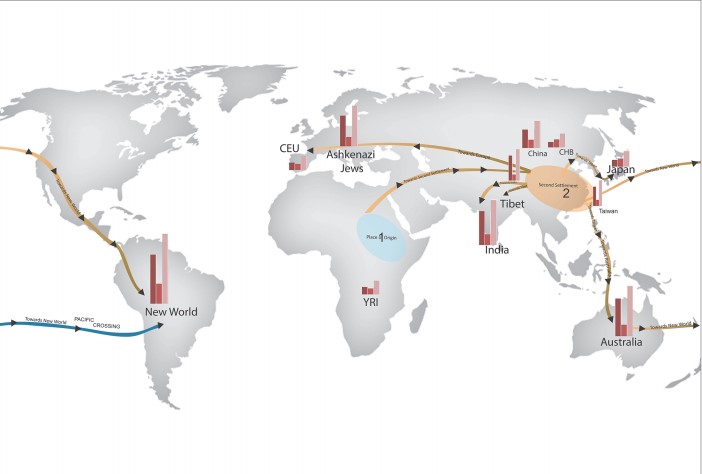
The phylogenetic relationship between populations proposed a global migration map (Figure 2), in which an initial migration from the place of origin, Africa, formed a second settlement in East Asia, which is similar to a founding population seen in Figure 1. 

At least five further branching events took place in the second settlement, forming populations globally. The migration routes identified in this paper largely support those already proposed, but of particular interest this paper also proposes a novel migration route from Australia, across the Pacific, and towards the New World (shown in blue in Figure 2).

Figure 2. A global map showing CNV counts and possible migration routes  
[Credit: Veerappa et al (2015)] 


Global Migration Leads to Global Variation As AMH spread across the globe, populations diverged and encountered novel selective pressures to which they had to adapt. This is reflected in the phenotypic (or observable) variation seen between geographically distant populations. 
At the genotype level, a number of these traits show evidence of positive selection, meaning they likely conferred some advantage in particular environments and were consequently favored by natural selection and increased in frequency. 
A well cited example of this is global variation in skin color, which is thought to reflect a balance between vitamin D synthesis and photoprotection (Figure 3). 

Vitamin D synthesis requires UV radiation, and a deficiency in vitamin D can result in rickets, osteoporosis, pelvic abnormalities, and a higher incidence of other diseases. 

At higher latitudes, where UV radiation is low or seasonal, experiencing enough UV radiation for sufficient vitamin D synthesis is a major concern. 
Presumably, as AMHs migrated from Africa, they experienced reduced levels of UV radiation, insufficient vitamin D synthesis, and severe health problems; resulting in selection for increased vitamin D synthesis and lighter skin pigmentation. 
Consistent with this, a number of pigmentation genes underlying variation in skin color show evidence of positive selection  in European and Asian populations, relative to Africa. 

On the flip side, populations near the equator experience no shortage of UV radiation and thus synthesize sufficient vitamin D; however the risk of UV damage is much greater. Melanin, the molecule determining skin pigmentation, acts as a photoprotective filter, reducing light penetration and damage caused by UV radiation, resulting in greater photoprotection in darkly pigmented skin. 
Selective pressure to maintain dark pigmentation in regions with high UV radiation is evident by the lack of genetic variation in pigment genes in areas such as Africa. 
This suggests selection has acted to remove mutation and maintain the function of these genes.


Figure 3. A map showing predominant skin pigmentation globally  
[Credit: Barsch (2003)]


 Can genetics and human evolution have a practical use in human health? 
Beyond phenotypic consequences, genetic variation between populations has a profound impact on human health. 
It has a direct influence on an individual’s predisposition for certain conditions or diseases. For example, Type 2 diabetes is more prevalent in African Americans than Americans of European descent. 
Genome wide association studies (GWAS) analyze common genetic variants in different individuals and assess whether particular variants are more often associated with certain traits or diseases. 
Comparing the distribution and number of disease-associated variants between populations can assess if genetic risk factors underlie disparities in disease susceptibility. In the case of Type 2 diabetes, African Americans carry a greater number of risk variants than Americans of European descent at genetic locations (loci) associated with Type 2 diabetes. 
It is clear that an individual’s ethnicity affects their susceptibility and likely reaction to disease, and as such should be considered in human health policy. 
Understanding the genetic risk factors linking populations and disease can identify groups of individual at greater risk of developing certain diseases for the sake of prioritizing treatment and prevention. 
Applying modern human genetics to human evolution has opened a door to studying ancient evolutionary phenomena and patterns. 
This area not only serves to quench the desire to understand our origins, but profoundly impacts human health in a way that could revolutionize disease treatment and prevention. 

In this blog, I have given a brief overview of how using genetic approaches can tell us a great deal about human origins, migration and variation between populations. 
In addition, I have outlined the complex genetic underpinnings behind ethnicity and disease susceptibility, which suggests an important role for population genetics in human health policy. 
This blog post covers only a fraction of the vast amount of ongoing work in this field, and the often ground breaking findings. 
It is unclear exactly how far genetics will take us in understanding human evolution, but the end is far from near. The potential for genetics in this field and broader feels limitless, and I for one am excited by the prospect. 

Author: Emma Whittington | Source: PLOS Blogs [August 01, 2015]

sabato 18 luglio 2015

Lingua e Geni

Scientists discover links between genes and language 


Anthropology, ArchaeoHeritage, Archaeology, Breakingnews, Genetics, Linguistics 


Academics at the University of York have discovered a correlation between genetic and linguistic diversity and concluded that at least in Europe people who speak different languages are also more likely to have a different genetic make-up. 


Multilingual Europe, showing the genealogy of the languages, together with  the alphabets and modes of writing of all peoples by Gottfried Hensel 
 [Credit: WikiCommons] 


The study, led by Professor Giuseppe Longobardi  in York’s Department of Language and Linguistic Science, in collaboration with geneticists and linguists at the Universities of Ferrara and Modena and Reggio Emilia in Italy, has discovered that language proves a better predictor of genetic differences than the geographical distribution of population. As part of his study he observed significant correlations between genetic and linguistic diversity across the Indo-European and non-Indo-European-speaking populations of Europe. 
Professor Longobardi said: “To a very large extent linguistic differences correspond to genetic differences in the relevant populations.  So, if a population speaks French and another speaks Russian they have a certain degree of linguistic diversity, that we can now measure with unprecedented precision and the degree of genetic diversity is proportional. “Is it the case that the French and Italians and Spanish, who speak very close languages, are really similar to each other in genetic terms?  
Is it really the case the Japanese, and say a population from Sub Saharan Africa, are really very different  both in terms of language and in terms of their genetic ancestry ? 
To some extent our answer, based on the published study and further work in progress, is yes: at least as a general historical rule.” 
However, Professor Longobardi said there are exceptions, as to many rules, and the exception in Europe is the Hungarians,  who are genetically very similar to Slavic and Germanic populations. 
“That’s one case where some populations of central Europe  just picked up a new language  which was brought in to Hungary by a small group of conquerors. 
“But apart from that exception the distribution of languages and the distribution of the genetic structure of the populations in Europe tend to correspond to each other,” he added. The study, published in the American Journal of Physical Anthropology, suggests that migrating populations carried their genes alongside their language, rather than just a cultural diffusion of linguistic features from one population to another. 
The project involved studying around 15 European languages but researchers are turning their attention to other languages, extending potentially to a global scale. 
The research could eventually help scientists pinpoint when and how Indo-European languages were brought into Europe and potentially help geneticists in the future. Professor Longobardi added: “Ultimately being able to identify the ancestry of a population just on the simple basis of the language they speak may benefit identifying genetic properties of these populations, which could ultimately be of practical use even for medical research.” 


Source: University of York [July 03, 2015]

domenica 5 luglio 2015

La Peste e la Storia

How small genetic change in Yersinia pestis changed human history 

Breakingnews, Evolution, Genetics 

While studying Yersinia pestis, the bacteria responsible for epidemics of plague such as the Black Death, Wyndham Lathem, Ph.D., assistant professor in microbiology-immunology at Northwestern University Feinberg School of Medicine, found a single small genetic change that fundamentally influenced the evolution of the deadly pathogen, and thus the course of human history. 


This image of lung tissue shows inflammatory lesions in an ancestral strain of the bacteria  that causes pneumonic plague without the Pla gene (above) and with the gene (below).  The addition of Pla allowed this strain to cause pneumonic plague 
 [Credit: Northwestern University] 


In a paper published in Nature Communications, Lathem and first author Daniel Zimbler, Ph.D., a Feinberg post-doctoral fellow, demonstrated how the acquisition of a single gene caused the shift of Y. pestis from causing a primarily gastrointestinal infection to a more serious and often fatal respiratory disease. 
They further showed how later modifications of this gene enhanced infections associated with the bubonic plague.
 "Our findings demonstrate how Y. pestis had the ability to cause a severe respiratory disease very early in its evolution. This research helps us better understand how bacteria can adapt to new host environments to cause disease by acquiring small bits of DNA," Lathem said. The team examined ancestral strains of the bacteria in mouse models to learn when Y. pestis gained the ability to infect the lungs and cause the severe form of the disease known as pneumonic plague. In the most ancestral of all currently existing Y. pestis strains, they showed how the bacteria could successfully colonize the lungs but could not cause the severe disease associated with pneumonic plague. The biggest difference they found between this strain and closely related strains that could cause pneumonic plague was a gene for the surface protein Pla. 
Lathem proposed that the bacteria's acquisition of the gene Pla enhanced its ability to cause infection in the lungs and was all that this ancestral strain of Y. pestis needed to produce a fatal lung infection.
So Lathem and his team inserted the Pla gene into this strain to observe changes in the health of the lungs. They found the newly mutated strain had gained the ability to cause respiratory infection identically to modern strains of Y. pestis that cause disease today, demonstrating that the Pla gene was necessary for Y. pestis to infect the lungs. In addition, they found that no other changes to Y. pestis were required, even though the bacteria has continued to gain and lose genes over the last several thousand years. The lab also looked at variations of the gene Pla and discovered that a single modification only found in modern strains of Y. pestis was a critical adaptation for the bacteria to spread in the body and infect the lymph nodes, a form of the infection that causes bubonic plague. According to Lathem, the surprising conclusion from this aspect of the study is that, contrary to current thinking in the field, Y. pestis may have first evolved as a respiratory pathogen before it could cause the more common form of disease, bubonic plague. Lathem said the new research may explain how Y. pestis transitioned from causing only localized outbreaks of plague to the pandemic spread of Y. pestis such as the sixth century's Justinian Plague and the fourteenth century's Black Death. "Our data suggests that the insertion and then subsequent mutation of Pla allowed for new, rapidly evolving strains of disease," Lathem said. "This information can show how new respiratory pathogens could emerge with only small genetic changes." 

Author: Sarah Plumridge | Source: Northwestern University [June 30, 2015]

Chi furono i primi australiani?

Una popolazione di uomini anatomicamente moderni che uscì dall'Africa circa 75.000 anni fa e che si è stanziata in Australia circa 60.000 anni fa, producendo così una discendenza di 2500 generazioni ininterrotte ed isolate, fino ad oggi.


Who were the first Australians? 

ArchaeoHeritage, Archaeology, Australasia, Australia, Breakingnews, Genetics, Indigenous Cultures, Oceania 

The Bradshaw rock paintings, or the Gwion Gwion figures, found in the north-west Kimberly region of West Australia have in the past been used to argue that Indigenous Australians were not the first Australians.


The Bradshaw, or Gwion Gwion, rock paintings  [Credit: WikiCommons] 


Archaeologists claimed these paintings were produced by a different race. 
About 20,000 years old, the Gwion Gwion figures are more recent than other paintings in the area, which have been dated as being up to 40,000 years old. But Dr Michael Westaway, biological anthropologist from Griffith University, said genome sequencing dispels the myth that Indigenous Australians were not the first Australians.

"This is absolutely not in doubt," Dr Westaway told Richard Glover on 702 ABC Sydney. "Many decades ago there were many hypotheses around but that hasn't really stood against any of the evidence." 
A lock of hair taken from an unknown young Indigenous man in the 1920s has provided genetic evidence that Aboriginal Australians are descended from the first modern humans to walk out of Africa nearly 75,000 years ago. 
The research was conducted by a team led by evolutionary biologist Eske Willerslev, director of the Centre for Ancient Genetics at the University of Copenhagen, and published in 2011. 
"This proves an unbroken lineage over 2,500 generations — about 65 to 70,000 years," Dr Westaway said. 
The first Aboriginal genome reinforces archaeological evidence that people arrived on the Australian continent at least 50,000 years ago, and that they share one of the oldest continuous cultures in the world. 
"The DNA evidence is extraordinary," Dr Westaway said. "We know that they moved out of Africa over 60,000 years ago. We have this remarkable trail that has been recovered for the genomic sequence of the first Australians."

Lake Mungo in New South Wales is another key site. 

It contains some of the oldest human remains outside Africa — including Mungo Man and Mungo Woman dating back 42,000 years.

"The morphology of Mungo Man is very similar to the first Australians of today," Dr Westaway said. "We have some of the earliest evidence of first Australians in Arnhem Land 55,000 years ago." 
Dr Westaway said there was no archaeological, DNA, or human paleontological evidence to suggest there were people here prior to the first Australians. 
Nineteenth century observational theories existed that there were genetic links between Indigenous Australians and Indians. 
"This just doesn't hold up against the huge body of scientific evidence," Dr Westaway explained. He said the weight of scientific evidence supported the notion that the first Australians were a continuous population isolated from the rest of the world for over 50,000 years.


Author: John Donegan | Source: ABC News Website [June 30, 2015]

venerdì 15 maggio 2015

7. DNA non codificante: significato.


Il DNA non codificante è solamente un rimasuglio insignificante di materiale genetico estraneo introdotto (proditoriamente, aggressivamente, per errore) in tempi passati, in vari modi, da vari agenti estranei?
E' solamente ciò che resta di antico materiale nucleare ormai inutile ed inutilizzabile per il nostro organismo moderno?
Se possiede qualche funzione, è questa funzione solamente di 'protezione' generica del DNA codificante - l'unico inteso come prezioso - contro le mutazioni?

No. Anzi, si tratta di un argomento del quale possono parlare unicamente gli esperti (che spesso, si è visto, sbagliano anch'essi, in questo campo sconosciuto). E tutti gli altri è bene che tacciano.

Si può affermare che la ‘lezione’  impartitaci fino ad oggi dal DNA ‘ciarpame’ sia quella di adottare un’enorme prudenza nelle future valutazioni.
Il DNA ‘ciarpame’ (e non ‘spazzatura’: è un errore di traduzione!) è stato infatti riabilitato a DNA‘non codificante’: e persino questa definizione più politicamente corretta è stata riconosciuta come almeno in parte sbagliata, perché alcune porzioni del DNA non codificante codificano eccome!

Il Codice Genetico è una lingua ancora in grandissima parte sconosciuta.


Esempi dell’importanza del DNA ‘non codificante’.

La semplice ‘regolazione’ dell’espressione genetica possiede enormi effetti sulla fisiologia degli esseri viventi.
Nelle porzioni di DNA non codificante (ed anche nei geni) sono state reperite variazioni di una sola lettera che influenzano il rischio di malattia. Si è visto che esiste una rara mutazione (nel Gene MC4R) che è responsabile dell’obesità infantile. In soggetti con normali MC4R, si è però osservata una tendenza ancora maggiore all’obesità: si è visto che questi soggetti avevano ereditatao una frequente variante del DNA ‘ciarpame’ circostante al gene MC4R, con funzioni che alterano la sua attività.

Il DNA non codificante può essere anche responsabile delle differenze esistenti tracce diverse, seppure simili. Uomo e Scimpanzè, ad esempio, hanno il 99% dei geni in comune, ma solo il 96% del DNA complessivo. È comunque un’affinità estremamente alta.
Ma a cosa sono dovute – allora – le enormi differenze osservabili, quali intelligenza e linguaggio?
Ebbene: esistono differenze molto maggiori, tra le due specie, che sono osservabili proprio nel DNA non codificante. Probabilmente sono proprio loro il fondamento di quelle caratteristiche squisitamente umane…

Pertanto, si può concludere che sia certamente errato considerare come unica parte importante del genoma umano i geni codificanti le proteine…


Nè troppo, né troppo poco.

Probabilmente è un errore altrettanto grande quello di considerare la parte di DNA non codificante alla stregua di un campo nel quale siano seppelliti chissà quali grandi tesori.

Nel 2000 già si sapeva che le cellule umane (Rinn et al.) leggono migliaia di segmenti di DNA, non esclusivamente le parti codificanti, e producono molecole di RNA. Si cominciò quindi a ricercare le possibili funzioni di queste molecole di RNA.

Dopo circa un paio di anni di ricerche (Rinn e Chang, Stanford University) trovarono una molecola di RNA che era prodotta dalle cellule cutanee della metà inferiore del corpo, ma non da quelle della metà superiore. Decisero di chiamarla “Hotair” (riferendosi ad un’espressione inglese simile alla nostra di ‘acqua calda’, o ‘aria fritta’, col dire: “ Se alla fine risulterà essere solamente ‘hotair’, ebbene, almeno ci abbiamo provato”).
Hotair risultò legarsi ad una particolare proteina che fu chiamata Polycomb, che appartiene ad un gruppo di proteine estremamente importanti per il normale sviluppo degli animali fino a partire dall’uovo fertilizzato. La loro funzione è quella di attivare e disattivare alternativamente i geni, in modo che un informe ‘pallottolina’ di cellule tutte simili possa dare origine – secondo uno schema prestabilito – a tessuti diversi, quali, muscolo, osso, cellule nervose etc.
Polycomb si sposta in siti differenti – sotto la guida di ‘Hotair’ – dove si lega con una serie di geni, spegnendoli quando è necessario.
Rinn annunciò i suoi risultati nel 2007, sulla rivista Cell: furono giudicati grandiosi e fondamentali. Negli anni successivi, Chang dimostrò che alcuni topi – privati di ‘hotair’ crescevano malformati in molti modi: hotair regolava il funzionamento di molti distretti, quindi, non solamente la cute o le ossa.
In seguito, altri studi hanno dimostrato che alcune porzioni di DNA non codificante sono così importanti che – se rimosse – determinano la morte dell’individuo.
Rinn ha scoperto anche una particolare molecola di RNA (che ha chiamato ‘firre’), che possiede una spettacolare proprietà: sembra catturare (proprio come un cow-boy in un Rodeo) insieme tre cromosomi con una specie di ‘lasso’, tirandoli uno vicino all’altro. Da qui, ha formulato l’ipotesi che esistano centinaia di molecole con funzioni simili, o altrettanto sorprendenti.

Il principio secondo il quale il nostro Genoma funziona diversamente anche in relazione al suo stato di aggrovigliamento maggiore o minore e in relazione alla sua disposizione nello spazio (e quindi esposizione di alcuni suoi tratti a proteine altrimenti inaccessibili) era già stato enunciato da tempo.
Tra l’altro è uno dei motivi per i quali – anche se siamo riusciti a ricostruire alcuni genomi – non sappiamo ‘impacchettare’ il DNA in modo corretto all’interno della cellula.

L’attività riproduttiva – nel rovistare nella valigia/cellula – finisce poi col non trovare mai i calzini, o la cintura, o la cravatta...


Un litigio di lunga durata.

E' dai tempi di Darwin che prosegue la disputa su che cosa esattamente guidi l'evoluzione.
Darwin si lamentò molto della ‘cattiva rappresentazione’ che veniva fatta da altri delle sue idee fondamentali, circa le forze che determinano la grande diversità delle varie forme di vita.  Un suo grande rammarico fu che molti gli attribuissero il pensiero che solamente la Selezione Naturale ne fosse alla base.
Certamente, Darwin era all’oscuro di DNA e Cromosomi, Biologia Molecolare e tutto il resto: ma era altresì convinto che molte forse guidassero l’Evoluzione, “comprese alcune variazioni che – nella nostra ignoranza – ci sembrano insorgere spontaneamente”.

 Noi facciamo molti errori.
Probabilmente, dovremmo smettere di considerare la Vita come una continua migrazione verso la perfezione. 
Probabilmente, il DNA ‘non ricombinante’ non è un segno di insuccesso dell’Evoluzione. 
Forse –  invece – è proprio la traccia rimastaci del suo lento, nascosto, inarrestabile trionfo.

giovedì 14 maggio 2015

6 - Una sesta base?

L'interrogativo è d'obbligo: sarebbe una scoperta epocale.

Classicamente, le basi sono quattro (adenina, citosina, guanina e timina). 
Altre due basi derivate da queste sono la metil citosina e la metil adenina, che sono variazioni delle prime due. 

Quando si scoprirono le attività biomolecolari importanti delle metil citosina (mC) essa fu aggiunta come quinta base.
Lo studio attuale, di Manuel esteller dell'Università di Barcellona e appena pubblicato sulla rivista Cell, propone che anche la metil Adenina (mA) sia 'promossa' a base; sarebbe quindi la sesta.
Essa è presente in minime quantità in vari batteri (in cui protegge dall'immissione esterna di materiale nucleare) ed in vari vegetali ed animali inferiori (alghe, vermi, mosche) e la sua funzione sarebbe quella di modulare l'attività di vari geni e di influenzare le cellule staminali.
Tutto sta a vedere se si troverà anche nei mammiferi e - in special modo - nell'uomo. 


Sixth DNA's base discovered? 

  DNA (deoxyribonucleic acid) is the main component of our genetic material. It is formed by combining four parts: A, C, G and T (adenine, cytosine, guanine and thymine), called bases of DNA combine in thousands of possible sequences to provide the genetic variability that enables the wealth of aspects and functions of living beings. 


Methyl-Adenine 3D structure [Credit: IDIBELL] 


Two more bases: the Methyl- cytosine and Methyl-adenine 

In the early 80s, to these four "classic" bases of DNA was added a fifth: the methyl-cytosine (mC) derived from cytosine. 
And it was in the late 90's when mC was recognized as the main cause of epigenetic mechanisms: it is able to switch genes on or off depending on the physiological needs of each tissue. 

In recent years, interest in this fifth DNA base has increased by showing that alterations in the methyl-cytosine contribute to the development of many human diseases, including cancer. 

Today, an article published in  Cell  by Manel Esteller, director of the Epigenetics and Cancer Biology Program of the Bellvitge Biomedical Research Institute (IDIBELL), ICREA researcher and Professor of Genetics at the University of Barcelona, ​​describes the possible existence of a sixth DNA base, the methyl-adenine (mA), which also help determine the epigenome and would therefore be key in the life of the cells. 
In bacteria and in complex organisms "It was known for years that bacteria, evolutionarily very distant living organisms of us, had mA in its genome with a protective function against the insertion of genetic material from other organisms. 
But it was believed that this was a phenomenon of primitive cells and it was very static" describes Manel Esteller. 
"However, this issue of CELL publishes three papers suggesting that more complex cells called eukaryotes such as the human body cells, also present the sixth DNA base. 

These studies suggest that algae, worms and flies possess mA and it acts to regulate the expression of certain genes, thus constituting a new epigenetic mark. 

This work has been possible thanks to the development of analytical methods with high sensitivity because levels of mA in described genomes are low. 
In addition it seems that mA would play a specific role in stem cells and early stages of development, "explains the researcher. 
"Now the challenge we face is to confirm this data and find out whether mammals, including humans, we also have this sixth DNA base, and consider what its role is". 


Source: IDIBELL-Bellvitge Biomedical Research Institute [May 11, 2015]

domenica 10 maggio 2015

5 - Cercando nel ciarpame.


21.500 geni, si diceva (anche se, per brevità, si cita quel 20.000 che è una cifra tonda più facile da ricordare). Tre miliardi di coppie di basi, di cui effettivamente usate solo il 2%...


Ragioniamoci su…

Dal punto di vista pratico, sembra uno spreco piuttosto dispendioso… Se il DNA ‘ciarpame’ fosse davvero inutile, probabilmente non sarebbe sfuggito alle ‘attenzioni’ di quella che definiamo ‘selezione naturale’.
Perché?
Perché copiare il DNA richiede energia.
Gli individui che fossero riusciti ad eliminare materiale genetico inerte, portandosi dentro genomi più parsimoniosi e maneggevoli, avrebbero quindi avuto un vantaggio biologico reale su quelli che non ci riuscivano.
Ed un vantaggio biologico di quell’entità significa sicura affermazione.
Ma questo evento non si è realizzato, a conti fatti: per differenza, siamo autorizzati a pensare che esista qualche ruolo ben preciso per l’EX Dna ‘ciarpame’.
Ed ecco perché il termine non è più in uso…

Il Progetto Genoma Umano riuscì a trovare un bassissimo numero di geni codificanti proteine: alla fine risultarono essere molto meno dei 100.000 inizialmente teorizzati. Un conteggio certamente troppo basso, inadatto a spiegare tutte le differenze esistenti tra l’uomo e tutti gli altri organismi. Forse, questo significava che il genoma ammonta a qualche cosa di più della semplice somma dei suoi geni…
Un esempio tratto dalla vita comune potrebbe essere ottenuto paragonando un grosso camion ed una piccola macchina sportiva: benché il primo sia molto più voluminoso, la seconda è infinitamente più agile e veloce.


Rovistare nel ‘ciarpame’.

Si cominciò – pertanto – a guardare con molta più attenzione quella porzione del genoma che sembrava inutile.
Oggi si pensa che una notevole porzione di esso sia di origine virale.
Si sa che i virus – per potersi riprodurre nel nostro organismo – iniettano il proprio genoma all’interno del nucleo cellulare dell’ospite e così ottengono di fare lavorare le cellule ospitanti per sé, riproducendosi a spese dell’organismo che hanno infettato.
Si valuta che questi retrovirus endogeni umani costituiscano oggi circa l’ 8% del totale (pertanto nel ‘libro’ del genoma umano occupano uno spazio maggiore).
Esistono sequenze virali di varia lunghezza: grandi, medie e piccole. Alcune furono notate in passato (ripetizioni in tandem) e furono sfruttate per la cosiddetta ‘impronta genetica’ (vedi il post: “Il Ciarlatano premiato con il Nobel”).

Interessante (e non del tutto infondata, anche se un po’ inquietante) la tesi controcorrente per cui il genoma sarebbe ‘egoista’ e si riprodurrebbe unicamente per riprodurre sé stesso, a prescindere dalla propria utilità per l’organismo nel quale si trova (è la tesi di Richard Dawkins, zoologo dell’Università di Oxford, espressa nel libro “Il Gene Egoista”, 1976).


Un’altra ipotesi è che il DNA non codificante possieda qualche funzione protettiva sull’integrità, o regolativa sull’attività dei geni codificanti. Non sappiamo bene quale, né quali meccanismi siano impiegati eventualmente.

ENCODE: Il consorzio “Enciclopedia od DNA Elements” ha esaminato dal 2007 circa 30 milioni di coppie di basi (1% del totale!), nel tentativo di stilare l’elenco dei compiti del DNA. Ciò che ha scoperto fin qui è già piuttosto significativo. Solo il 2% del genoma è fatto di geni; almeno il 9% è trascritto su RNA: questo indicherebbe che molto di più del 2% è biologicamente attivo.

Solo una minima parte di questo RNA è quello detto ‘messaggero’ che porta l’informazione per codificare le proteine.

Il DNA ‘spazzatura’genera vari tipi di DNA: si tratta di molecole che modificano l’espressione di geni e proteine, con il fine ultimo di regolare il metabolismo.

A più tardi, Pasuco: sei un paziente ascoltatore, come sempre…